
GENERIC COMPETITIVE
STRATEGIES
PRESENTED BY,
NAVYA JAYAKUMAR P
REG NO: MBA105/18
INTRODUCTION
 Professor Michael Porter suggested three
general positioning strategies to achieve competitive
advantage :
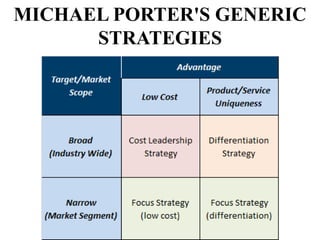
1. Low Cost Leadership Strategy
2. Differentiation Strategy
3. Focus Strategy
 The Generic Competitive Strategy (GCS) is a methodology
designed to provide companies with a strategic plan to
compete .The GCS is useful when a company is looking to
gain an advantage over a competitor
MICHAEL PORTER'S GENERIC
STRATEGIES
LOW COST LEADERSHIP
STRATEGY
• The firm employs economies of scale and
efficiencies in production line
• Here the firm tries to beat the competitors by
keeping the prices low
• It is characterised by reduction of over heads
and fixed costs of production
• This helps to avoid risk and able to sustain in
inflation
ACHIEVED THROUGH
• Appropriate Demand forecasting techniques
• Efficient resource utilisation
• Achieving economies of scale
• Outsourcing
• Complete capacity utilisation
• Use of improved technologies
EXAMPLE
• Wal-Mart is one of the most well-known
companies that use Cost Leadership as their
business strategy.
• With efficient distribution methods, huge
volume discounts from suppliers, and their
control of manufacturing and inventory
• By specializing in low costs, they got higher
number of customers who spend an average
amount of money in their stores
DIFFERENTIATION STRATEGY
• This strategy is adopted by the firm which
wants to differentiate its product from its
competitors
• Here the firm wants to highlight some feature
or benefit in its product offering as superior to
that of its competitors
• By heavy advertising it is able to insert this
value in the minds of its customers thereby
creating brand loyalty for its product
ACHIEVED THROUGH
• Through different pricing strategies
• Incorporating features and benefits in their
product or service
• Packaging
• By offering new products, services or offer
attractive promotions (innovation)
• Channel and distribution strategies
EXAMPLE
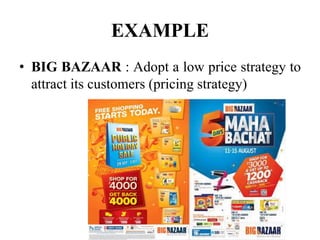
• BIG BAZAAR : Adopt a low price strategy to
attract its customers (pricing strategy)
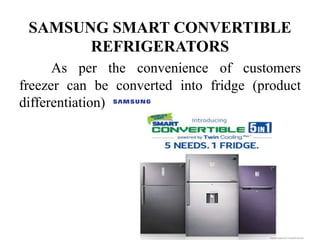
SAMSUNG SMART CONVERTIBLE
REFRIGERATORS
As per the convenience of customers
freezer can be converted into fridge (product
differentiation)
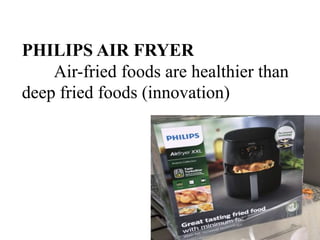
PHILIPS AIR FRYER
Air-fried foods are healthier than
deep fried foods (innovation)
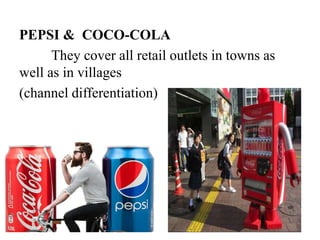
PEPSI & COCO-COLA
They cover all retail outlets in towns as
well as in villages
(channel differentiation)
FOCUS STRATEGY
• In this firm focuses on a particular segment or
market within an industry
• This segment maybe defined in terms of
products, geography or customers
• Focus are of two types
– Cost focus
Cost focus strategy implies a cost advantage in the
segment
– Differentiation focus
Differentiation focus focuses on a differentiated
offering in the market
ACHIEVED THROUGH
• Offering unique features that fulfill the
demands of a narrow market
• Develop Customer Intimacy
• Promotional and advertising activities based
on needs of target market
• Increasing production efficiency by making
investments in technology
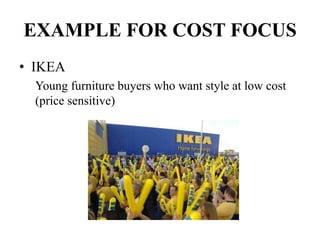
EXAMPLE FOR COST FOCUS
• IKEA
Young furniture buyers who want style at low cost
(price sensitive)
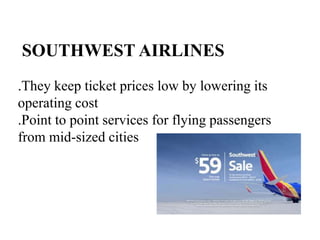
.They keep ticket prices low by lowering its
operating cost
.Point to point services for flying passengers
from mid-sized cities
SOUTHWEST AIRLINES
EXAMPLE FOR
DIFFERENTIATION FOCUS
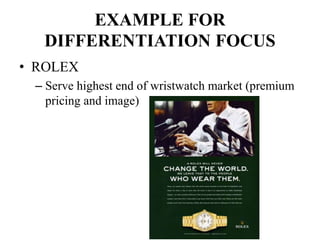
• ROLEX
– Serve highest end of wristwatch market (premium
pricing and image)
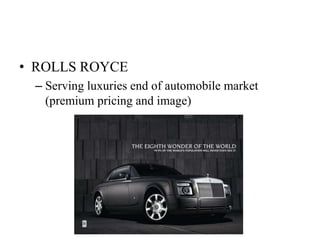
• ROLLS ROYCE
– Serving luxuries end of automobile market
(premium pricing and image)
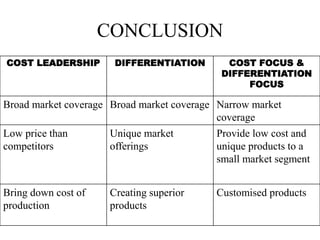
CONCLUSION
COST LEADERSHIP DIFFERENTIATION COST FOCUS &
DIFFERENTIATION
FOCUS
Broad market coverage Broad market coverage Narrow market
coverage
Low price than
competitors
Unique market
offerings
Provide low cost and
unique products to a
small market segment
Bring down cost of
production
Creating superior
products
Customised products
REFERENCE
• “Strategic Management Concepts” by Robert E Hoskisson and
Michael A Hitt
• “Strategic Marketing Management: planning, implementation
and control” by Colin Gilligan and Richard M S Wilson
• “Strategic Project Management (Strategic Success)” by Paul
Roberts
GENERIC COMPETITIVE  STRATEGIES

GENERIC COMPETITIVE STRATEGIES

  • 1.
  • 2.
    INTRODUCTION  Professor MichaelPorter suggested three general positioning strategies to achieve competitive advantage : 1. Low Cost Leadership Strategy 2. Differentiation Strategy 3. Focus Strategy  The Generic Competitive Strategy (GCS) is a methodology designed to provide companies with a strategic plan to compete .The GCS is useful when a company is looking to gain an advantage over a competitor
  • 3.
  • 4.
    LOW COST LEADERSHIP STRATEGY •The firm employs economies of scale and efficiencies in production line • Here the firm tries to beat the competitors by keeping the prices low • It is characterised by reduction of over heads and fixed costs of production • This helps to avoid risk and able to sustain in inflation
  • 5.
    ACHIEVED THROUGH • AppropriateDemand forecasting techniques • Efficient resource utilisation • Achieving economies of scale • Outsourcing • Complete capacity utilisation • Use of improved technologies
  • 6.
    EXAMPLE • Wal-Mart isone of the most well-known companies that use Cost Leadership as their business strategy. • With efficient distribution methods, huge volume discounts from suppliers, and their control of manufacturing and inventory • By specializing in low costs, they got higher number of customers who spend an average amount of money in their stores
  • 7.
    DIFFERENTIATION STRATEGY • Thisstrategy is adopted by the firm which wants to differentiate its product from its competitors • Here the firm wants to highlight some feature or benefit in its product offering as superior to that of its competitors • By heavy advertising it is able to insert this value in the minds of its customers thereby creating brand loyalty for its product
  • 8.
    ACHIEVED THROUGH • Throughdifferent pricing strategies • Incorporating features and benefits in their product or service • Packaging • By offering new products, services or offer attractive promotions (innovation) • Channel and distribution strategies
  • 9.
    EXAMPLE • BIG BAZAAR: Adopt a low price strategy to attract its customers (pricing strategy)
  • 10.
    SAMSUNG SMART CONVERTIBLE REFRIGERATORS Asper the convenience of customers freezer can be converted into fridge (product differentiation)
  • 11.
    PHILIPS AIR FRYER Air-friedfoods are healthier than deep fried foods (innovation)
  • 12.
    PEPSI & COCO-COLA Theycover all retail outlets in towns as well as in villages (channel differentiation)
  • 13.
    FOCUS STRATEGY • Inthis firm focuses on a particular segment or market within an industry • This segment maybe defined in terms of products, geography or customers • Focus are of two types – Cost focus Cost focus strategy implies a cost advantage in the segment – Differentiation focus Differentiation focus focuses on a differentiated offering in the market
  • 14.
    ACHIEVED THROUGH • Offeringunique features that fulfill the demands of a narrow market • Develop Customer Intimacy • Promotional and advertising activities based on needs of target market • Increasing production efficiency by making investments in technology
  • 15.
    EXAMPLE FOR COSTFOCUS • IKEA Young furniture buyers who want style at low cost (price sensitive)
  • 16.
    .They keep ticketprices low by lowering its operating cost .Point to point services for flying passengers from mid-sized cities SOUTHWEST AIRLINES
  • 17.
    EXAMPLE FOR DIFFERENTIATION FOCUS •ROLEX – Serve highest end of wristwatch market (premium pricing and image)
  • 18.
    • ROLLS ROYCE –Serving luxuries end of automobile market (premium pricing and image)
  • 19.
    CONCLUSION COST LEADERSHIP DIFFERENTIATIONCOST FOCUS & DIFFERENTIATION FOCUS Broad market coverage Broad market coverage Narrow market coverage Low price than competitors Unique market offerings Provide low cost and unique products to a small market segment Bring down cost of production Creating superior products Customised products
  • 20.
    REFERENCE • “Strategic ManagementConcepts” by Robert E Hoskisson and Michael A Hitt • “Strategic Marketing Management: planning, implementation and control” by Colin Gilligan and Richard M S Wilson • “Strategic Project Management (Strategic Success)” by Paul Roberts