Subject: Strategic Management
Submitted to: Submitted By:
Dr.Pinki Madhu Yadav
Roll no :180010501047
Class:M.com 2yrs 4th sem.
Functional Implementation
Functional implementation is carried out through
functional plan and policies in five different areas.
 Marketing
 Financial
 Operation
 Personnel
 Information management
Functional Strategies
Functional strategies deals with relatively restricted
plan designed to achieve objectives in a specific
functional area, allocation of resources among
different operations within that functional area and
coordination among different functional areas for
optimal contribution to the achievement of the
business and corporate level objectives.
Functional Strategies
 Vertical Fit
Congruence and
coordination among
strategies at different
level.
 Horizontal Fit
Congruence and
coordination among
different strategies at
same level.
Functional Level Strategies
1) Marketing plan & policies.
2) Financial plan & policies.
3) Operational plan & policies
4) HRM plan& policies.
5) Information management plan & policies.
Functional Plans and Policies
 Functional strategies defined in terms of functional
plans and policies –plans or tactics to implement
business strategies –are made within the guidelines set
at the higher levels.
Plans
Plan are made to select a course of action.
• Policies
Policies are required to act as guidelines to action.
Need for functional plans and
policies
To implement strategic decisions by all parts of an
organization.
To control activities in different functional areas of
business.
To reduce time spent by functional managers in
decision making.
To handle similar situations occurring in different
functional areas in a consistent manner.
Coordination across the different functions takes
place.
Marketing Plans and Policies
 Product:
quality ,features,choice of models , brand names,packaging etc.
 Pricing:
Discount , mode of payment , allowances , payment period , credit
terms etc.
 Place:
Channels to be used,transportation,logistics and inventory storage
management and coverage of markets etc.
 Promotion:
Advertising,personal selling, sales promotion and publicity.
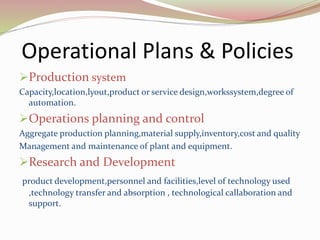
Operational Plans & Policies
Production system
Capacity,location,lyout,product or service design,workssystem,degree of
automation.
Operations planning and control
Aggregate production planning,material supply,inventory,cost and quality
Management and maintenance of plant and equipment.
Research and Development
product development,personnel and facilities,level of technology used
,technology transfer and absorption , technological callaboration and
support.
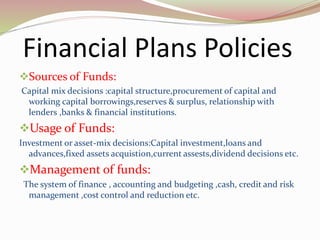
Financial Plans Policies
Sources of Funds:
Capital mix decisions :capital structure,procurement of capital and
working capital borrowings,reserves & surplus, relationship with
lenders ,banks & financial institutions.
Usage of Funds:
Investment or asset-mix decisions:Capital investment,loans and
advances,fixed assets acquistion,current assests,dividend decisions etc.
Management of funds:
The system of finance , accounting and budgeting ,cash, credit and risk
management ,cost control and reduction etc.
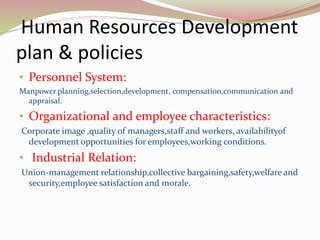
Human Resources Development
plan & policies
• Personnel System:
Manpower planning,selection,development, compensation,communication and
appraisal.
• Organizational and employee characteristics:
Corporate image ,quality of managers,staff and workers, availabilityof
development opportunities for employees,working conditions.
• Industrial Relation:
Union-management relationship,collective bargaining,safety,welfare and
security,employee satisfaction and morale.
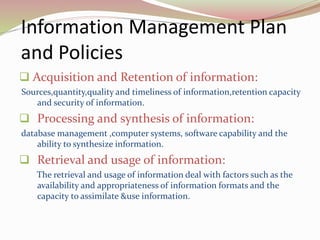
Information Management Plan
and Policies
 Acquisition and Retention of information:
Sources,quantity,quality and timeliness of information,retention capacity
and security of information.
 Processing and synthesis of information:
database management ,computer systems, software capability and the
ability to synthesize information.
 Retrieval and usage of information:
The retrieval and usage of information deal with factors such as the
availability and appropriateness of information formats and the
capacity to assimilate &use information.
Information management
plans and policies
Transmission and dissemination of information:
The plans & policies with regard to the transmission and dissemination of
information deal with the factors such as speed, scope ,width &depth
of coverage of information and with the willingness to accept
information.
Integrative ,Systemic and supportive factors:
Availability of IT infrastructure, its relevance and compatibility to
organizational needs, up gradation of facilities ,willingness to invest in
state –of-the-art systems ,availability of computer professionals and top
management support.

Functional implementation

  • 1.
    Subject: Strategic Management Submittedto: Submitted By: Dr.Pinki Madhu Yadav Roll no :180010501047 Class:M.com 2yrs 4th sem.
  • 2.
    Functional Implementation Functional implementationis carried out through functional plan and policies in five different areas.  Marketing  Financial  Operation  Personnel  Information management
  • 3.
    Functional Strategies Functional strategiesdeals with relatively restricted plan designed to achieve objectives in a specific functional area, allocation of resources among different operations within that functional area and coordination among different functional areas for optimal contribution to the achievement of the business and corporate level objectives.
  • 4.
    Functional Strategies  VerticalFit Congruence and coordination among strategies at different level.  Horizontal Fit Congruence and coordination among different strategies at same level.
  • 5.
    Functional Level Strategies 1)Marketing plan & policies. 2) Financial plan & policies. 3) Operational plan & policies 4) HRM plan& policies. 5) Information management plan & policies.
  • 6.
    Functional Plans andPolicies  Functional strategies defined in terms of functional plans and policies –plans or tactics to implement business strategies –are made within the guidelines set at the higher levels. Plans Plan are made to select a course of action. • Policies Policies are required to act as guidelines to action.
  • 7.
    Need for functionalplans and policies To implement strategic decisions by all parts of an organization. To control activities in different functional areas of business. To reduce time spent by functional managers in decision making. To handle similar situations occurring in different functional areas in a consistent manner. Coordination across the different functions takes place.
  • 8.
    Marketing Plans andPolicies  Product: quality ,features,choice of models , brand names,packaging etc.  Pricing: Discount , mode of payment , allowances , payment period , credit terms etc.  Place: Channels to be used,transportation,logistics and inventory storage management and coverage of markets etc.  Promotion: Advertising,personal selling, sales promotion and publicity.
  • 9.
    Operational Plans &Policies Production system Capacity,location,lyout,product or service design,workssystem,degree of automation. Operations planning and control Aggregate production planning,material supply,inventory,cost and quality Management and maintenance of plant and equipment. Research and Development product development,personnel and facilities,level of technology used ,technology transfer and absorption , technological callaboration and support.
  • 10.
    Financial Plans Policies Sourcesof Funds: Capital mix decisions :capital structure,procurement of capital and working capital borrowings,reserves & surplus, relationship with lenders ,banks & financial institutions. Usage of Funds: Investment or asset-mix decisions:Capital investment,loans and advances,fixed assets acquistion,current assests,dividend decisions etc. Management of funds: The system of finance , accounting and budgeting ,cash, credit and risk management ,cost control and reduction etc.
  • 11.
    Human Resources Development plan& policies • Personnel System: Manpower planning,selection,development, compensation,communication and appraisal. • Organizational and employee characteristics: Corporate image ,quality of managers,staff and workers, availabilityof development opportunities for employees,working conditions. • Industrial Relation: Union-management relationship,collective bargaining,safety,welfare and security,employee satisfaction and morale.
  • 12.
    Information Management Plan andPolicies  Acquisition and Retention of information: Sources,quantity,quality and timeliness of information,retention capacity and security of information.  Processing and synthesis of information: database management ,computer systems, software capability and the ability to synthesize information.  Retrieval and usage of information: The retrieval and usage of information deal with factors such as the availability and appropriateness of information formats and the capacity to assimilate &use information.
  • 13.
    Information management plans andpolicies Transmission and dissemination of information: The plans & policies with regard to the transmission and dissemination of information deal with the factors such as speed, scope ,width &depth of coverage of information and with the willingness to accept information. Integrative ,Systemic and supportive factors: Availability of IT infrastructure, its relevance and compatibility to organizational needs, up gradation of facilities ,willingness to invest in state –of-the-art systems ,availability of computer professionals and top management support.