Strategic Evaluation
& Control
Manish Kumar
CUHP17MBA33
Central University Of Himachal Pradesh
Strategic Evaluation and Control
• Meaning :
Strategy evaluation and control is defined as the process of
determining the effectiveness of a given strategy in achieving the
organizational objective and taking corrective action wherever
required.
Strategic Management Process
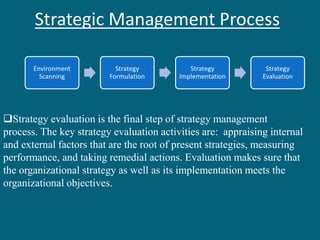
Strategy evaluation is the final step of strategy management
process. The key strategy evaluation activities are: appraising internal
and external factors that are the root of present strategies, measuring
performance, and taking remedial actions. Evaluation makes sure that
the organizational strategy as well as its implementation meets the
organizational objectives.
Environment
Scanning
Strategy
Formulation
Strategy
Implementation
Strategy
Evaluation
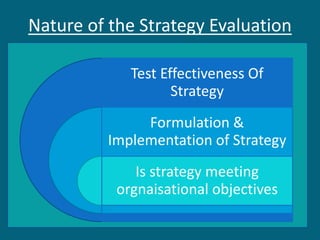
Nature of the Strategy Evaluation
Test Effectiveness Of
Strategy
Formulation &
Implementation of Strategy
Is strategy meeting
orgnaisational objectives
Importance of Strategy Evaluation
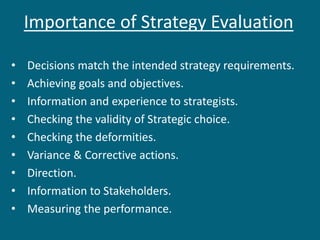
• Decisions match the intended strategy requirements.
• Achieving goals and objectives.
• Information and experience to strategists.
• Checking the validity of Strategic choice.
• Checking the deformities.
• Variance & Corrective actions.
• Direction.
• Information to Stakeholders.
• Measuring the performance.
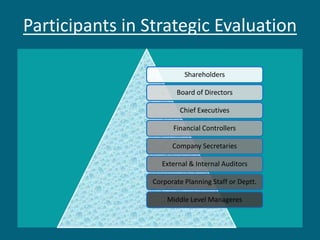
Participants in Strategic Evaluation
Shareholders
Board of Directors
Chief Executives
Financial Controllers
Company Secretaries
External & Internal Auditors
Corporate Planning Staff or Deptt.
Middle Level Manageres
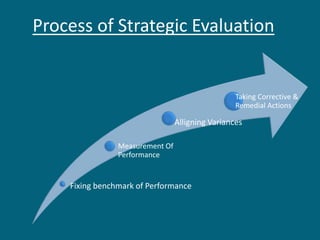
Process of Strategic Evaluation
Fixing benchmark of Performance
Measurement Of
Performance
Alligning Variances
Taking Corrective &
Remedial Actions
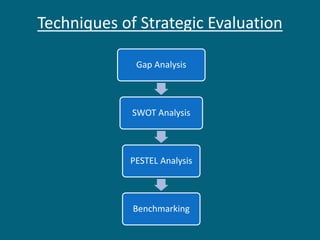
Techniques of Strategic Evaluation
Gap Analysis
SWOT Analysis
PESTEL Analysis
Benchmarking
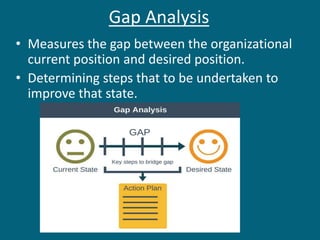
Gap Analysis
• Measures the gap between the organizational
current position and desired position.
• Determining steps that to be undertaken to
improve that state.
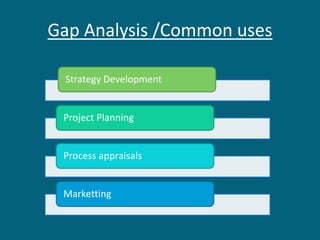
Gap Analysis /Common uses
Strategy Development
Project Planning
Process appraisals
Marketting
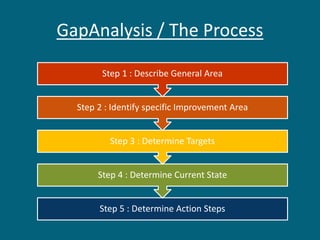
GapAnalysis / The Process
Step 5 : Determine Action Steps
Step 4 : Determine Current State
Step 3 : Determine Targets
Step 2 : Identify specific Improvement Area
Step 1 : Describe General Area
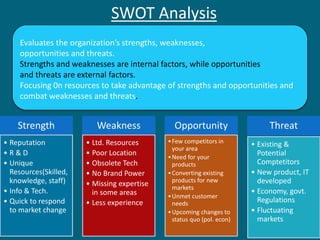
SWOT Analysis
Evaluates the organization’s strengths, weaknesses,
opportunities and threats.
Strengths and weaknesses are internal factors, while opportunities
and threats are external factors.
Focusing 0n resources to take advantage of strengths and opportunities and
combat weaknesses and threats.
Strength
• Reputation
• R & D
• Unique
Resources(Skilled,
knowledge, staff)
• Info & Tech.
• Quick to respond
to market change
Weakness
• Ltd. Resources
• Poor Location
• Obsolete Tech
• No Brand Power
• Missing expertise
in some areas
• Less experience
Opportunity
•Few competitors in
your area
•Need for your
products
•Converting existing
products for new
markets
•Unmet customer
needs
•Upcoming changes to
status quo (pol. econ)
Threat
• Existing &
Potential
Comptetitors
• New product, IT
developed
• Economy, govt.
Regulations
• Fluctuating
markets
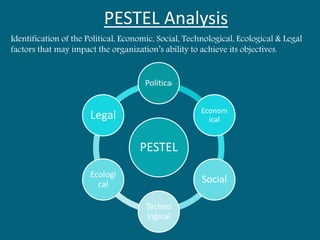
PESTEL Analysis
Identification of the Political, Economic, Social, Technological, Ecological & Legal
factors that may impact the organization’s ability to achieve its objectives.
PESTEL
Political
Econom
ical
Social
Techno
logical
Ecologi
cal
Legal
Strategic Control
Strategic controls take into account the changing assumptions that
determine a strategy, continually evaluate the strategy as it is
being implemented, and take the necessary steps to adjust the
strategy to the new requirements.
According to Schendel and Hofer:
“strategic control focuses on the dual questions of whether: (1)
the strategy is being implemented as planned; and (2) the results
produced by the strategy are those intended.”
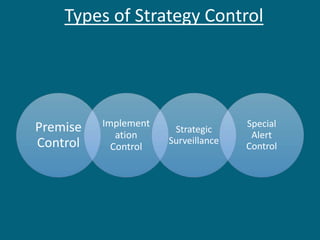
Types of Strategy Control
Premise
Control
Implement
ation
Control
Strategic
Surveillance
Special
Alert
Control
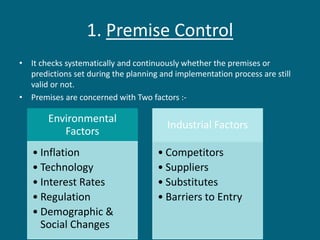
1. Premise Control
• It checks systematically and continuously whether the premises or
predictions set during the planning and implementation process are still
valid or not.
• Premises are concerned with Two factors :-
Environmental
Factors
• Inflation
• Technology
• Interest Rates
• Regulation
• Demographic &
Social Changes
Industrial Factors
• Competitors
• Suppliers
• Substitutes
• Barriers to Entry
2. Implementation Control
• Implementation control is designed to assess
whether the overall strategy should be
changed in the light of unfolding events or
only its some parts to be change.
3. Strategic Surveillance
• Stratgic surveillance is similar to “environment
scanning”.
• It is designed to safeguard the established
strategy on a continuous basis.
• It helps in monitoring a broad range of events
inside and outside the company that are likely to
threaten the course of the firm’s strategy.
4. Special Alert Control
• It refers to the being prepared for the unexpected
events.
• It is the need to thoroughly, and often rapidly,
reconsider the firms basis strategy based on a sudden,
unexpected event.
•Examples :- Natural Disasters, product defects, hostile
takeovers etc.
References
Images :- Google & Shutterstock
 https://yourbusiness.azcentral.com/four-
types-strategic-control-24352.html
 https://smallbusiness.chron.com/four-types-
strategic-control-14720.html
 https://www.strategic-
control.24xls.com/en141
Thank You!
Open Discussion

Strategic evaluation and control

  • 1.
    Strategic Evaluation & Control ManishKumar CUHP17MBA33 Central University Of Himachal Pradesh
  • 2.
    Strategic Evaluation andControl • Meaning : Strategy evaluation and control is defined as the process of determining the effectiveness of a given strategy in achieving the organizational objective and taking corrective action wherever required.
  • 3.
    Strategic Management Process Strategyevaluation is the final step of strategy management process. The key strategy evaluation activities are: appraising internal and external factors that are the root of present strategies, measuring performance, and taking remedial actions. Evaluation makes sure that the organizational strategy as well as its implementation meets the organizational objectives. Environment Scanning Strategy Formulation Strategy Implementation Strategy Evaluation
  • 4.
    Nature of theStrategy Evaluation Test Effectiveness Of Strategy Formulation & Implementation of Strategy Is strategy meeting orgnaisational objectives
  • 5.
    Importance of StrategyEvaluation • Decisions match the intended strategy requirements. • Achieving goals and objectives. • Information and experience to strategists. • Checking the validity of Strategic choice. • Checking the deformities. • Variance & Corrective actions. • Direction. • Information to Stakeholders. • Measuring the performance.
  • 6.
    Participants in StrategicEvaluation Shareholders Board of Directors Chief Executives Financial Controllers Company Secretaries External & Internal Auditors Corporate Planning Staff or Deptt. Middle Level Manageres
  • 7.
    Process of StrategicEvaluation Fixing benchmark of Performance Measurement Of Performance Alligning Variances Taking Corrective & Remedial Actions
  • 8.
    Techniques of StrategicEvaluation Gap Analysis SWOT Analysis PESTEL Analysis Benchmarking
  • 9.
    Gap Analysis • Measuresthe gap between the organizational current position and desired position. • Determining steps that to be undertaken to improve that state.
  • 10.
    Gap Analysis /Commonuses Strategy Development Project Planning Process appraisals Marketting
  • 11.
    GapAnalysis / TheProcess Step 5 : Determine Action Steps Step 4 : Determine Current State Step 3 : Determine Targets Step 2 : Identify specific Improvement Area Step 1 : Describe General Area
  • 12.
    SWOT Analysis Evaluates theorganization’s strengths, weaknesses, opportunities and threats. Strengths and weaknesses are internal factors, while opportunities and threats are external factors. Focusing 0n resources to take advantage of strengths and opportunities and combat weaknesses and threats. Strength • Reputation • R & D • Unique Resources(Skilled, knowledge, staff) • Info & Tech. • Quick to respond to market change Weakness • Ltd. Resources • Poor Location • Obsolete Tech • No Brand Power • Missing expertise in some areas • Less experience Opportunity •Few competitors in your area •Need for your products •Converting existing products for new markets •Unmet customer needs •Upcoming changes to status quo (pol. econ) Threat • Existing & Potential Comptetitors • New product, IT developed • Economy, govt. Regulations • Fluctuating markets
  • 13.
    PESTEL Analysis Identification ofthe Political, Economic, Social, Technological, Ecological & Legal factors that may impact the organization’s ability to achieve its objectives. PESTEL Political Econom ical Social Techno logical Ecologi cal Legal
  • 14.
    Strategic Control Strategic controlstake into account the changing assumptions that determine a strategy, continually evaluate the strategy as it is being implemented, and take the necessary steps to adjust the strategy to the new requirements. According to Schendel and Hofer: “strategic control focuses on the dual questions of whether: (1) the strategy is being implemented as planned; and (2) the results produced by the strategy are those intended.”
  • 15.
    Types of StrategyControl Premise Control Implement ation Control Strategic Surveillance Special Alert Control
  • 16.
    1. Premise Control •It checks systematically and continuously whether the premises or predictions set during the planning and implementation process are still valid or not. • Premises are concerned with Two factors :- Environmental Factors • Inflation • Technology • Interest Rates • Regulation • Demographic & Social Changes Industrial Factors • Competitors • Suppliers • Substitutes • Barriers to Entry
  • 17.
    2. Implementation Control •Implementation control is designed to assess whether the overall strategy should be changed in the light of unfolding events or only its some parts to be change.
  • 18.
    3. Strategic Surveillance •Stratgic surveillance is similar to “environment scanning”. • It is designed to safeguard the established strategy on a continuous basis. • It helps in monitoring a broad range of events inside and outside the company that are likely to threaten the course of the firm’s strategy.
  • 19.
    4. Special AlertControl • It refers to the being prepared for the unexpected events. • It is the need to thoroughly, and often rapidly, reconsider the firms basis strategy based on a sudden, unexpected event. •Examples :- Natural Disasters, product defects, hostile takeovers etc.
  • 20.
    References Images :- Google& Shutterstock  https://yourbusiness.azcentral.com/four- types-strategic-control-24352.html  https://smallbusiness.chron.com/four-types- strategic-control-14720.html  https://www.strategic- control.24xls.com/en141
  • 21.