Unit 3
THE STRATEGIC
ALTERNATIVES
Prepared & Presented by:
Ms. Himani
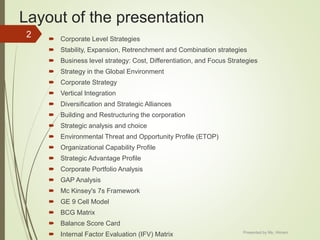
Layout of the presentation
 Corporate Level Strategies
 Stability, Expansion, Retrenchment and Combination strategies
 Business level strategy: Cost, Differentiation, and Focus Strategies
 Strategy in the Global Environment
 Corporate Strategy
 Vertical Integration
 Diversification and Strategic Alliances
 Building and Restructuring the corporation
 Strategic analysis and choice
 Environmental Threat and Opportunity Profile (ETOP)
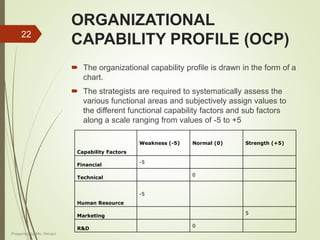
 Organizational Capability Profile
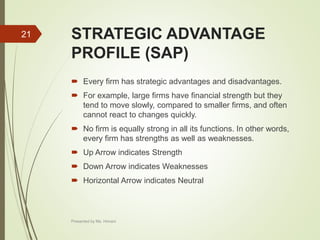
 Strategic Advantage Profile
 Corporate Portfolio Analysis
 GAP Analysis
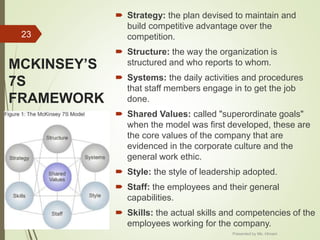
 Mc Kinsey's 7s Framework
 GE 9 Cell Model
 BCG Matrix
 Balance Score Card
 Internal Factor Evaluation (IFV) Matrix
2
Presented by Ms. Himani
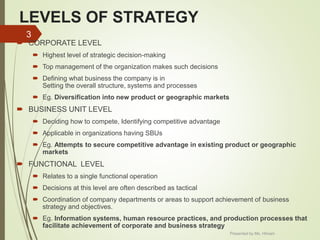
LEVELS OF STRATEGY
 CORPORATE LEVEL
 Highest level of strategic decision-making
 Top management of the organization makes such decisions
 Defining what business the company is in
Setting the overall structure, systems and processes
 Eg. Diversification into new product or geographic markets
 BUSINESS UNIT LEVEL
 Deciding how to compete, Identifying competitive advantage
 Applicable in organizations having SBUs
 Eg. Attempts to secure competitive advantage in existing product or geographic
markets
 FUNCTIONAL LEVEL
 Relates to a single functional operation
 Decisions at this level are often described as tactical
 Coordination of company departments or areas to support achievement of business
strategy and objectives.
 Eg. Information systems, human resource practices, and production processes that
facilitate achievement of corporate and business strategy
3
Presented by Ms. Himani
Continued
 Corporate strategy includes decisions regarding the
flow of financial and other resources to and from a
company’s product line and business units.
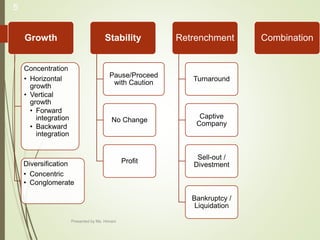
 A corporation’s strategy is composed of three general
orientations (also called grand strategies):
 A) Growth strategies expand the company’s activities.
 B) Stability strategies make no change to the
company’s current activities.
 C) Retrenchment strategies reduce the company’s
level of activities.
 D) Combination strategies is the combination of the
above three strategies.
4
Presented by Ms. Himani
Growth
Concentration
• Horizontal
growth
• Vertical
growth
• Forward
integration
• Backward
integration
Diversification
• Concentric
• Conglomerate
Stability
Pause/Proceed
with Caution
No Change
Profit
Retrenchment
Turnaround
Captive
Company
Sell-out /
Divestment
Bankruptcy /
Liquidation
Combination
5
Presented by Ms. Himani
1. Growth strategies
(i) Concentration: If a company’s current product lines
have real growth potential, concentration of resources
on those product lines makes sense as a strategy for
growth.
 Horizontal growth: can be achieved by expanding the
firm’s products into other geographic locations and/or
by increasing the range of products and services
offered to current market.
 Vertical growth: The company grows by making its own
supplies and/or by distributing its own products.
 Forward integration: Assuming a function previously provided
by a distributor
 Backward integration: Assuming a function previously provided
by a supplier
6
Presented by Ms. Himani
Continued
(ii) Diversification: When an industry matures, most of
the surviving firms have reached the limits of growth
using vertical and horizontal growth strategies.
Unless they are able to expand internationally into
less mature markets, they may have no choice but to
diversify into different industries if they want to
continue growing. The two basic diversification
strategies are concentric and conglomerate.
 Concentric: Into a related industry may be a very
appropriate corporate strategy when a firm has a
strong competitive position.
 Conglomerate: Takes place when mgt. realizes that
the current industry is unattractive and that the firms
lacks outstanding abilities or skills that it could easily
transfer to related products.
7
Presented by Ms. Himani
2. Stability strategies
 (i) Pause/Proceed With Caution Strategy: In
effect, a time out or an opportunity to rest
before continuing a growth or retrenchment
strategy.
 (ii) No Change Strategy: Is a decision to do
nothing new (a choice to continue current
operation and policies for the foreseeable
future).
 (iii) Profit Strategy: Is a decision to do nothing
new in worsening situation but instead to act as
though the company’s problems are only
temporary.
8
Presented by Ms. Himani
3. Retrenchment strategies
 A company may pursue retrenchment strategies when it has a
weak competitive position in some or all of its product lines.
 (i) Turnaround: Emphasizes the improvement of operational
efficiency. Eg. Infosys in 2013 retrenched 1500 employees
 (ii) Captive Company: Is the giving up of independence in
exchange for security. Management desperately searches for an
“angel” for company’s continued existence with a long term
contract.
 (iii) Sell-out / Divestment: The sell out strategy makes sense if
management can still obtain a good price for its shareholders and
the employees can keep their jobs by selling the entire company
to another firm.
 (iv) Bankruptcy / Liquidation: Because no one is interested in
buying a weak company in an unattractive industry.
9
Presented by Ms. Himani
Business Strategy
 The plans and actions that firms devise to
compete in a given product/market scope or
setting and asks the question “How do we
compete within an industry?” is a business
strategy.
 Competitive – battling against all competitors for
an advantage which includes
 Low-cost leadership: Eg. Big Bazaar
 Differentiation: Eg. Mercedes and BMW
 Focus strategies: Eg. Organic foods, Retro Cams
 Cooperative – working with one or more
competitors to gain advantage against other
competitors which is also known as Strategic
alliances
10
Presented by Ms. Himani
Strategic Alliance
 A Strategic Alliance is a cooperative agreement
between companies who are competitors from
different industries.
 A strategic alliance is an arrangement between two
companies that have decided to share resources to
undertake a specific, mutually beneficial project.
 A strategic alliance is less involved and less
permanent than a joint venture, in which two
companies typically pool resources to create a
separate business entity.
 In the computer hardware industry, Toshiba and
Samsung have formed a strategic alliance for
manufacturing advanced memory chips.
11
Presented by Ms. Himani
Some examples of Strategic
Alliances
 Microsoft and Nokia - a software partnership for
Nokia’s Windows Phones.
 CISCO Systems’ agreement with China’s biggest
on-line commercial company Alibaba, to explore
business services for SMEs.
 Abbott (US)’s alliance with Zydus - Cadila of
Ahmedabad whereby Abbott will license 24
branded generics of Zydus in 15 emerging
markets.
 WIPRO – GE joint venture to distribute
approximately 85% of GE’s healthcare products
and solutions in India.
12
Presented by Ms. Himani
Porter's Generic Strategies
Analysis
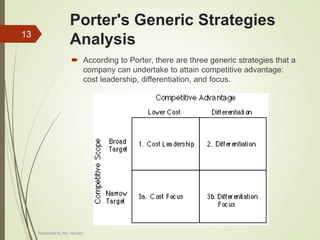
 According to Porter, there are three generic strategies that a
company can undertake to attain competitive advantage:
cost leadership, differentiation, and focus.
13
Presented by Ms. Himani
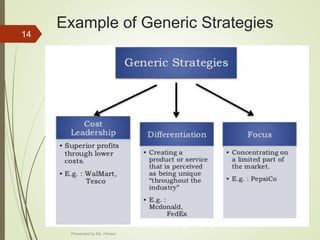
Example of Generic Strategies
14
Presented by Ms. Himani
Functional Strategy
 Functional strategy is the approach, a functional area takes
to achieve corporate and business unit objectives and
strategies by maximizing resource productivity.
 It is concerned with developing and nurturing a distinctive
competence to provide a company and business firm with
a competitive advantage.
 The orientation of the functional strategy is dictated by its
parent business unit’s strategy.
 For eg.: An HR functional strategy that emphasizes the
hiring and training of a highly skilled but costly workforce.
 Eg. Marketing functional strategy that emphasizes
distribution channel “pull” using “advertising” to increase
consumer demand over “push” using promotional
allowances to retailers.
15
Presented by Ms. Himani
BUILDING THE
CORPORATION Start-up route: In this route, the
business is started from the scratch
by building facilities, purchasing
equipments, recruiting employees,
opening up distribution outlet and so
on. Eg: Snapdeal, Flipkart, OLA,
Bigbasket
 Acquisition: Acquisition involves
purchasing an established company,
complete with all facilities, equipment
and personnel. Eg. Tata Group
Acquired Corus, Bharti Airtel acquired
Zain Africa, Hindalco Industires
acquired Novelis
16
Presented by Ms. Himani
 Joint Venture: Joint venture involves starting a new
venture with the help of a partner. Eg. Green Gas
Ltd., Nokia Siemens Networks, Sony-Ericsson, Hero
Honda
 Merger: Merger involves fusion of two or more
companies into one company. Lipton and Brooke
Bond, Anmol Dairy Ltd. Merged into Dairy Den Ltd.,
Cheminor Drugs Ltd. Into Dr. Reddys Laboratories
Ltd.
 Takeover: A company which is in financial distress
can undergo the process of takeover. A takeover can
be voluntary when the company requests another
company to take over the assets and liabilities and
save it from becoming bankrupt.
17
Presented by Ms. Himani
RE-STRUCTURING THE CORP
 Re-structuring involves strategies for reducing the scope of the firm by
exiting from unprofitable business.
 Retrenchment: Retrenchment strategies are adopted when the firm’s
performance is poor and its competitive position is weak.
 Divestment Strategy: Divestment strategy requires dropping of some
of the businesses or part of the business of the firm.
 Spin-off: Bidding of a business unit to independent investors is known
as spin-off. It is the best way to recover the initial investment as much
as possible.
 Management-buyout: Selling off the divested unit to its management
is known as management buyout.
 Harvest strategy: A harvest strategy involves halting investment in a
unit in order to maximize short- to- medium term cash flow from that
unit before liquidating it.
 Liquidation: It is pursued as a last step because the employees lose
jobs and it is considered to be a sign of failure of the top management.
18
Presented by Ms. Himani
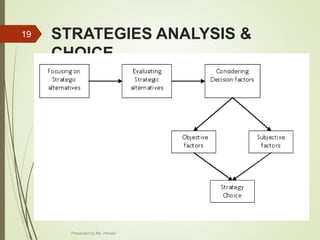
STRATEGIES ANALYSIS &
CHOICE
19
Presented by Ms. Himani
ENVIRONMENT THREAT AND
OPPORTUNITY PROFILE
(ETOP)
Environmental Scanning
Appraising the Environment
Structuring Environmental
Appraisal
20
Presented by Ms. Himani
STRATEGIC ADVANTAGE
PROFILE (SAP)
 Every firm has strategic advantages and disadvantages.
 For example, large firms have financial strength but they
tend to move slowly, compared to smaller firms, and often
cannot react to changes quickly.
 No firm is equally strong in all its functions. In other words,
every firm has strengths as well as weaknesses.
 Up Arrow indicates Strength
 Down Arrow indicates Weaknesses
 Horizontal Arrow indicates Neutral
21
Presented by Ms. Himani
ORGANIZATIONAL
CAPABILITY PROFILE (OCP)
 The organizational capability profile is drawn in the form of a
chart.
 The strategists are required to systematically assess the
various functional areas and subjectively assign values to
the different functional capability factors and sub factors
along a scale ranging from values of -5 to +5
Capability Factors
Weakness (-5) Normal (0) Strength (+5)
Financial
-5
Technical
0
Human Resource
-5
Marketing
5
R&D
0
22
Presented by Ms. Himani
MCKINSEY’S
7S
FRAMEWORK
 Strategy: the plan devised to maintain and
build competitive advantage over the
competition.
 Structure: the way the organization is
structured and who reports to whom.
 Systems: the daily activities and procedures
that staff members engage in to get the job
done.
 Shared Values: called "superordinate goals"
when the model was first developed, these are
the core values of the company that are
evidenced in the corporate culture and the
general work ethic.
 Style: the style of leadership adopted.
 Staff: the employees and their general
capabilities.
 Skills: the actual skills and competencies of the
employees working for the company.
23
Presented by Ms. Himani
CORPORATE PORTFOLIO
ANALYSISKey strategy is to produce a balanced
portfolio of products, some with low risk but
dull growth and some with high risk but great
potential for growth and profits. This is what
we call as portfolio analysis.
The aim of portfolio analysis is
to analyze its current business portfolio and
decide which businesses should receive more or
less investment
to develop growth strategies, for adding new
businesses to the portfolio
to decide which business should not longer be
retained
24
Presented by Ms. Himani
Continued
 Balancing the portfolio –
 Balancing the portfolio means that the
different products or businesses in the
portfolio have to be balanced with respect to
four basic aspects –
 Profitability
 Cash flow
 Growth
 Risk
 This analysis can be done by any of the
following technologies –
 BCG matrix
 GE nine cell matrix
25
Presented by Ms. Himani
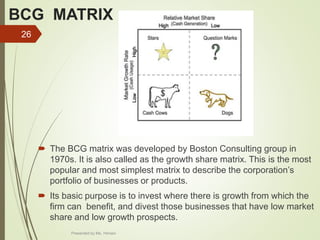
BCG MATRIX
 The BCG matrix was developed by Boston Consulting group in
1970s. It is also called as the growth share matrix. This is the most
popular and most simplest matrix to describe the corporation’s
portfolio of businesses or products.
 Its basic purpose is to invest where there is growth from which the
firm can benefit, and divest those businesses that have low market
share and low growth prospects.
26
Presented by Ms. Himani
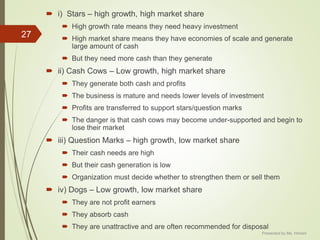
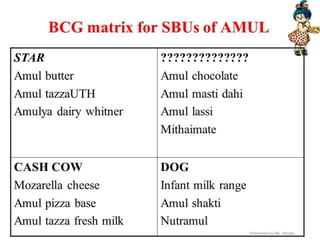
 i) Stars – high growth, high market share
 High growth rate means they need heavy investment
 High market share means they have economies of scale and generate
large amount of cash
 But they need more cash than they generate
 ii) Cash Cows – Low growth, high market share
 They generate both cash and profits
 The business is mature and needs lower levels of investment
 Profits are transferred to support stars/question marks
 The danger is that cash cows may become under-supported and begin to
lose their market
 iii) Question Marks – high growth, low market share
 Their cash needs are high
 But their cash generation is low
 Organization must decide whether to strengthen them or sell them
 iv) Dogs – Low growth, low market share
 They are not profit earners
 They absorb cash
 They are unattractive and are often recommended for disposal
27
Presented by Ms. Himani
28
Presented by Ms. Himani
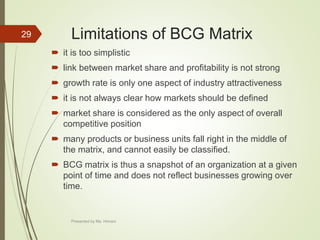
Limitations of BCG Matrix
 it is too simplistic
 link between market share and profitability is not strong
 growth rate is only one aspect of industry attractiveness
 it is not always clear how markets should be defined
 market share is considered as the only aspect of overall
competitive position
 many products or business units fall right in the middle of
the matrix, and cannot easily be classified.
 BCG matrix is thus a snapshot of an organization at a given
point of time and does not reflect businesses growing over
time.
29
Presented by Ms. Himani
GE Matrix
30
Presented by Ms. Himani
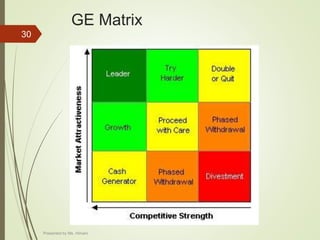
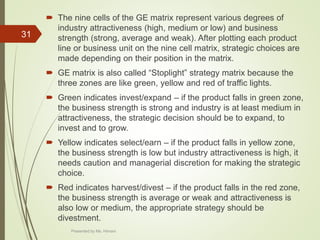
 The nine cells of the GE matrix represent various degrees of
industry attractiveness (high, medium or low) and business
strength (strong, average and weak). After plotting each product
line or business unit on the nine cell matrix, strategic choices are
made depending on their position in the matrix.
 GE matrix is also called “Stoplight” strategy matrix because the
three zones are like green, yellow and red of traffic lights.
 Green indicates invest/expand – if the product falls in green zone,
the business strength is strong and industry is at least medium in
attractiveness, the strategic decision should be to expand, to
invest and to grow.
 Yellow indicates select/earn – if the product falls in yellow zone,
the business strength is low but industry attractiveness is high, it
needs caution and managerial discretion for making the strategic
choice.
 Red indicates harvest/divest – if the product falls in the red zone,
the business strength is average or weak and attractiveness is
also low or medium, the appropriate strategy should be
divestment.
31
Presented by Ms. Himani
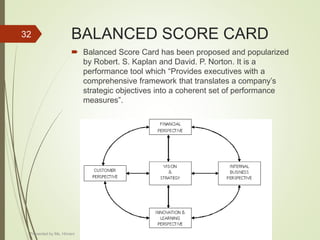
BALANCED SCORE CARD
 Balanced Score Card has been proposed and popularized
by Robert. S. Kaplan and David. P. Norton. It is a
performance tool which “Provides executives with a
comprehensive framework that translates a company’s
strategic objectives into a coherent set of performance
measures”.
32
Presented by Ms. Himani
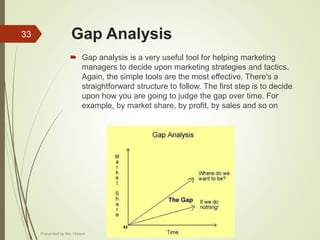
Gap Analysis
 Gap analysis is a very useful tool for helping marketing
managers to decide upon marketing strategies and tactics.
Again, the simple tools are the most effective. There's a
straightforward structure to follow. The first step is to decide
upon how you are going to judge the gap over time. For
example, by market share, by profit, by sales and so on
33
Presented by Ms. Himani
34

Unit 3 Chapter 3 Strategic alternatives

  • 1.
  • 2.
    Layout of thepresentation  Corporate Level Strategies  Stability, Expansion, Retrenchment and Combination strategies  Business level strategy: Cost, Differentiation, and Focus Strategies  Strategy in the Global Environment  Corporate Strategy  Vertical Integration  Diversification and Strategic Alliances  Building and Restructuring the corporation  Strategic analysis and choice  Environmental Threat and Opportunity Profile (ETOP)  Organizational Capability Profile  Strategic Advantage Profile  Corporate Portfolio Analysis  GAP Analysis  Mc Kinsey's 7s Framework  GE 9 Cell Model  BCG Matrix  Balance Score Card  Internal Factor Evaluation (IFV) Matrix 2 Presented by Ms. Himani
  • 3.
    LEVELS OF STRATEGY CORPORATE LEVEL  Highest level of strategic decision-making  Top management of the organization makes such decisions  Defining what business the company is in Setting the overall structure, systems and processes  Eg. Diversification into new product or geographic markets  BUSINESS UNIT LEVEL  Deciding how to compete, Identifying competitive advantage  Applicable in organizations having SBUs  Eg. Attempts to secure competitive advantage in existing product or geographic markets  FUNCTIONAL LEVEL  Relates to a single functional operation  Decisions at this level are often described as tactical  Coordination of company departments or areas to support achievement of business strategy and objectives.  Eg. Information systems, human resource practices, and production processes that facilitate achievement of corporate and business strategy 3 Presented by Ms. Himani
  • 4.
    Continued  Corporate strategyincludes decisions regarding the flow of financial and other resources to and from a company’s product line and business units.  A corporation’s strategy is composed of three general orientations (also called grand strategies):  A) Growth strategies expand the company’s activities.  B) Stability strategies make no change to the company’s current activities.  C) Retrenchment strategies reduce the company’s level of activities.  D) Combination strategies is the combination of the above three strategies. 4 Presented by Ms. Himani
  • 5.
    Growth Concentration • Horizontal growth • Vertical growth •Forward integration • Backward integration Diversification • Concentric • Conglomerate Stability Pause/Proceed with Caution No Change Profit Retrenchment Turnaround Captive Company Sell-out / Divestment Bankruptcy / Liquidation Combination 5 Presented by Ms. Himani
  • 6.
    1. Growth strategies (i)Concentration: If a company’s current product lines have real growth potential, concentration of resources on those product lines makes sense as a strategy for growth.  Horizontal growth: can be achieved by expanding the firm’s products into other geographic locations and/or by increasing the range of products and services offered to current market.  Vertical growth: The company grows by making its own supplies and/or by distributing its own products.  Forward integration: Assuming a function previously provided by a distributor  Backward integration: Assuming a function previously provided by a supplier 6 Presented by Ms. Himani
  • 7.
    Continued (ii) Diversification: Whenan industry matures, most of the surviving firms have reached the limits of growth using vertical and horizontal growth strategies. Unless they are able to expand internationally into less mature markets, they may have no choice but to diversify into different industries if they want to continue growing. The two basic diversification strategies are concentric and conglomerate.  Concentric: Into a related industry may be a very appropriate corporate strategy when a firm has a strong competitive position.  Conglomerate: Takes place when mgt. realizes that the current industry is unattractive and that the firms lacks outstanding abilities or skills that it could easily transfer to related products. 7 Presented by Ms. Himani
  • 8.
    2. Stability strategies (i) Pause/Proceed With Caution Strategy: In effect, a time out or an opportunity to rest before continuing a growth or retrenchment strategy.  (ii) No Change Strategy: Is a decision to do nothing new (a choice to continue current operation and policies for the foreseeable future).  (iii) Profit Strategy: Is a decision to do nothing new in worsening situation but instead to act as though the company’s problems are only temporary. 8 Presented by Ms. Himani
  • 9.
    3. Retrenchment strategies A company may pursue retrenchment strategies when it has a weak competitive position in some or all of its product lines.  (i) Turnaround: Emphasizes the improvement of operational efficiency. Eg. Infosys in 2013 retrenched 1500 employees  (ii) Captive Company: Is the giving up of independence in exchange for security. Management desperately searches for an “angel” for company’s continued existence with a long term contract.  (iii) Sell-out / Divestment: The sell out strategy makes sense if management can still obtain a good price for its shareholders and the employees can keep their jobs by selling the entire company to another firm.  (iv) Bankruptcy / Liquidation: Because no one is interested in buying a weak company in an unattractive industry. 9 Presented by Ms. Himani
  • 10.
    Business Strategy  Theplans and actions that firms devise to compete in a given product/market scope or setting and asks the question “How do we compete within an industry?” is a business strategy.  Competitive – battling against all competitors for an advantage which includes  Low-cost leadership: Eg. Big Bazaar  Differentiation: Eg. Mercedes and BMW  Focus strategies: Eg. Organic foods, Retro Cams  Cooperative – working with one or more competitors to gain advantage against other competitors which is also known as Strategic alliances 10 Presented by Ms. Himani
  • 11.
    Strategic Alliance  AStrategic Alliance is a cooperative agreement between companies who are competitors from different industries.  A strategic alliance is an arrangement between two companies that have decided to share resources to undertake a specific, mutually beneficial project.  A strategic alliance is less involved and less permanent than a joint venture, in which two companies typically pool resources to create a separate business entity.  In the computer hardware industry, Toshiba and Samsung have formed a strategic alliance for manufacturing advanced memory chips. 11 Presented by Ms. Himani
  • 12.
    Some examples ofStrategic Alliances  Microsoft and Nokia - a software partnership for Nokia’s Windows Phones.  CISCO Systems’ agreement with China’s biggest on-line commercial company Alibaba, to explore business services for SMEs.  Abbott (US)’s alliance with Zydus - Cadila of Ahmedabad whereby Abbott will license 24 branded generics of Zydus in 15 emerging markets.  WIPRO – GE joint venture to distribute approximately 85% of GE’s healthcare products and solutions in India. 12 Presented by Ms. Himani
  • 13.
    Porter's Generic Strategies Analysis According to Porter, there are three generic strategies that a company can undertake to attain competitive advantage: cost leadership, differentiation, and focus. 13 Presented by Ms. Himani
  • 14.
    Example of GenericStrategies 14 Presented by Ms. Himani
  • 15.
    Functional Strategy  Functionalstrategy is the approach, a functional area takes to achieve corporate and business unit objectives and strategies by maximizing resource productivity.  It is concerned with developing and nurturing a distinctive competence to provide a company and business firm with a competitive advantage.  The orientation of the functional strategy is dictated by its parent business unit’s strategy.  For eg.: An HR functional strategy that emphasizes the hiring and training of a highly skilled but costly workforce.  Eg. Marketing functional strategy that emphasizes distribution channel “pull” using “advertising” to increase consumer demand over “push” using promotional allowances to retailers. 15 Presented by Ms. Himani
  • 16.
    BUILDING THE CORPORATION Start-uproute: In this route, the business is started from the scratch by building facilities, purchasing equipments, recruiting employees, opening up distribution outlet and so on. Eg: Snapdeal, Flipkart, OLA, Bigbasket  Acquisition: Acquisition involves purchasing an established company, complete with all facilities, equipment and personnel. Eg. Tata Group Acquired Corus, Bharti Airtel acquired Zain Africa, Hindalco Industires acquired Novelis 16 Presented by Ms. Himani
  • 17.
     Joint Venture:Joint venture involves starting a new venture with the help of a partner. Eg. Green Gas Ltd., Nokia Siemens Networks, Sony-Ericsson, Hero Honda  Merger: Merger involves fusion of two or more companies into one company. Lipton and Brooke Bond, Anmol Dairy Ltd. Merged into Dairy Den Ltd., Cheminor Drugs Ltd. Into Dr. Reddys Laboratories Ltd.  Takeover: A company which is in financial distress can undergo the process of takeover. A takeover can be voluntary when the company requests another company to take over the assets and liabilities and save it from becoming bankrupt. 17 Presented by Ms. Himani
  • 18.
    RE-STRUCTURING THE CORP Re-structuring involves strategies for reducing the scope of the firm by exiting from unprofitable business.  Retrenchment: Retrenchment strategies are adopted when the firm’s performance is poor and its competitive position is weak.  Divestment Strategy: Divestment strategy requires dropping of some of the businesses or part of the business of the firm.  Spin-off: Bidding of a business unit to independent investors is known as spin-off. It is the best way to recover the initial investment as much as possible.  Management-buyout: Selling off the divested unit to its management is known as management buyout.  Harvest strategy: A harvest strategy involves halting investment in a unit in order to maximize short- to- medium term cash flow from that unit before liquidating it.  Liquidation: It is pursued as a last step because the employees lose jobs and it is considered to be a sign of failure of the top management. 18 Presented by Ms. Himani
  • 19.
  • 20.
    ENVIRONMENT THREAT AND OPPORTUNITYPROFILE (ETOP) Environmental Scanning Appraising the Environment Structuring Environmental Appraisal 20 Presented by Ms. Himani
  • 21.
    STRATEGIC ADVANTAGE PROFILE (SAP) Every firm has strategic advantages and disadvantages.  For example, large firms have financial strength but they tend to move slowly, compared to smaller firms, and often cannot react to changes quickly.  No firm is equally strong in all its functions. In other words, every firm has strengths as well as weaknesses.  Up Arrow indicates Strength  Down Arrow indicates Weaknesses  Horizontal Arrow indicates Neutral 21 Presented by Ms. Himani
  • 22.
    ORGANIZATIONAL CAPABILITY PROFILE (OCP) The organizational capability profile is drawn in the form of a chart.  The strategists are required to systematically assess the various functional areas and subjectively assign values to the different functional capability factors and sub factors along a scale ranging from values of -5 to +5 Capability Factors Weakness (-5) Normal (0) Strength (+5) Financial -5 Technical 0 Human Resource -5 Marketing 5 R&D 0 22 Presented by Ms. Himani
  • 23.
    MCKINSEY’S 7S FRAMEWORK  Strategy: theplan devised to maintain and build competitive advantage over the competition.  Structure: the way the organization is structured and who reports to whom.  Systems: the daily activities and procedures that staff members engage in to get the job done.  Shared Values: called "superordinate goals" when the model was first developed, these are the core values of the company that are evidenced in the corporate culture and the general work ethic.  Style: the style of leadership adopted.  Staff: the employees and their general capabilities.  Skills: the actual skills and competencies of the employees working for the company. 23 Presented by Ms. Himani
  • 24.
    CORPORATE PORTFOLIO ANALYSISKey strategyis to produce a balanced portfolio of products, some with low risk but dull growth and some with high risk but great potential for growth and profits. This is what we call as portfolio analysis. The aim of portfolio analysis is to analyze its current business portfolio and decide which businesses should receive more or less investment to develop growth strategies, for adding new businesses to the portfolio to decide which business should not longer be retained 24 Presented by Ms. Himani
  • 25.
    Continued  Balancing theportfolio –  Balancing the portfolio means that the different products or businesses in the portfolio have to be balanced with respect to four basic aspects –  Profitability  Cash flow  Growth  Risk  This analysis can be done by any of the following technologies –  BCG matrix  GE nine cell matrix 25 Presented by Ms. Himani
  • 26.
    BCG MATRIX  TheBCG matrix was developed by Boston Consulting group in 1970s. It is also called as the growth share matrix. This is the most popular and most simplest matrix to describe the corporation’s portfolio of businesses or products.  Its basic purpose is to invest where there is growth from which the firm can benefit, and divest those businesses that have low market share and low growth prospects. 26 Presented by Ms. Himani
  • 27.
     i) Stars– high growth, high market share  High growth rate means they need heavy investment  High market share means they have economies of scale and generate large amount of cash  But they need more cash than they generate  ii) Cash Cows – Low growth, high market share  They generate both cash and profits  The business is mature and needs lower levels of investment  Profits are transferred to support stars/question marks  The danger is that cash cows may become under-supported and begin to lose their market  iii) Question Marks – high growth, low market share  Their cash needs are high  But their cash generation is low  Organization must decide whether to strengthen them or sell them  iv) Dogs – Low growth, low market share  They are not profit earners  They absorb cash  They are unattractive and are often recommended for disposal 27 Presented by Ms. Himani
  • 28.
  • 29.
    Limitations of BCGMatrix  it is too simplistic  link between market share and profitability is not strong  growth rate is only one aspect of industry attractiveness  it is not always clear how markets should be defined  market share is considered as the only aspect of overall competitive position  many products or business units fall right in the middle of the matrix, and cannot easily be classified.  BCG matrix is thus a snapshot of an organization at a given point of time and does not reflect businesses growing over time. 29 Presented by Ms. Himani
  • 30.
  • 31.
     The ninecells of the GE matrix represent various degrees of industry attractiveness (high, medium or low) and business strength (strong, average and weak). After plotting each product line or business unit on the nine cell matrix, strategic choices are made depending on their position in the matrix.  GE matrix is also called “Stoplight” strategy matrix because the three zones are like green, yellow and red of traffic lights.  Green indicates invest/expand – if the product falls in green zone, the business strength is strong and industry is at least medium in attractiveness, the strategic decision should be to expand, to invest and to grow.  Yellow indicates select/earn – if the product falls in yellow zone, the business strength is low but industry attractiveness is high, it needs caution and managerial discretion for making the strategic choice.  Red indicates harvest/divest – if the product falls in the red zone, the business strength is average or weak and attractiveness is also low or medium, the appropriate strategy should be divestment. 31 Presented by Ms. Himani
  • 32.
    BALANCED SCORE CARD Balanced Score Card has been proposed and popularized by Robert. S. Kaplan and David. P. Norton. It is a performance tool which “Provides executives with a comprehensive framework that translates a company’s strategic objectives into a coherent set of performance measures”. 32 Presented by Ms. Himani
  • 33.
    Gap Analysis  Gapanalysis is a very useful tool for helping marketing managers to decide upon marketing strategies and tactics. Again, the simple tools are the most effective. There's a straightforward structure to follow. The first step is to decide upon how you are going to judge the gap over time. For example, by market share, by profit, by sales and so on 33 Presented by Ms. Himani
  • 34.