Basic Quality Management
Prepared and presented by:
Dr. Himani Raval
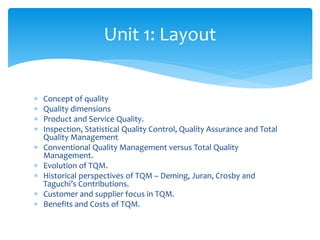
 Concept of quality
 Quality dimensions
 Product and Service Quality.
 Inspection, Statistical Quality Control, Quality Assurance and Total
Quality Management
 Conventional Quality Management versus Total Quality
Management.
 Evolution of TQM.
 Historical perspectives of TQM – Deming, Juran, Crosby and
Taguchi’s Contributions.
 Customer and supplier focus in TQM.
 Benefits and Costs of TQM.
Unit 1: Layout
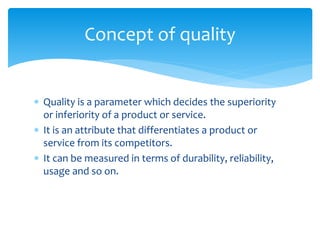
 Quality is a parameter which decides the superiority
or inferiority of a product or service.
 It is an attribute that differentiates a product or
service from its competitors.
 It can be measured in terms of durability, reliability,
usage and so on.
Concept of quality
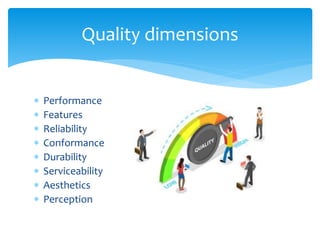
 Performance
 Features
 Reliability
 Conformance
 Durability
 Serviceability
 Aesthetics
 Perception
Quality dimensions
 Product quality means to incorporate features that
have a capacity to meet consumer needs and wants
and provides customer satisfaction, and free from
deficiencies and defects.
 Service quality (SQ) is a comparison of perceived
Expectations (E) of a service with the perceived
Performance. (P)
 SQ=P-E
Product and service quality
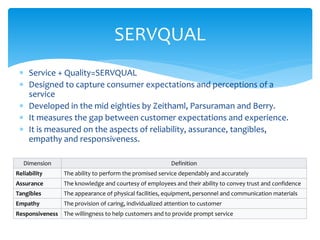
 Service + Quality=SERVQUAL
 Designed to capture consumer expectations and perceptions of a
service
 Developed in the mid eighties by Zeithaml, Parsuraman and Berry.
 It measures the gap between customer expectations and experience.
 It is measured on the aspects of reliability, assurance, tangibles,
empathy and responsiveness.
SERVQUAL
Dimension Definition
Reliability The ability to perform the promised service dependably and accurately
Assurance The knowledge and courtesy of employees and their ability to convey trust and confidence
Tangibles The appearance of physical facilities, equipment, personnel and communication materials
Empathy The provision of caring, individualized attention to customer
Responsiveness The willingness to help customers and to provide prompt service
 Inspection is a process of measuring, examining and testing to
scale one or more characteristics of a product or service and
the comparison of these with specified requirements.
 Inspection means the activity of checking products/services
 The quality inspector usually follows a pre-established checklist
that is based on the product specifications.
 Inspected products can be anything from components of
production, semi finished goods or most often finished goods.
Inspection
 Quality control means the recognition and removal of
identifiable causes and defects and variables from the set
standards.
 SQC refers to the use of statistical methods in the monitoring
and maintaining of the quality of products and services.
 This is the control over the product quality using statistical tools.
 Descriptive statistics: simply describing what is in the data
 Statistical process control: real-time data plotted on a graph
 Acceptance sampling: statistical sampling used to determine
whether to accept or reject a production lot of material
Statistical quality control
 Quality assurance (QA) is a way of preventing mistakes and defects
in manufactured products and avoiding problems when delivering
products or services to customers
 ISO 9000 defines as "part of quality management focused on
providing confidence that quality requirements will be fulfilled".
 2 principles of Quality Assurance are:
 Fit for purpose; the product should be suitable for the intended
purpose
 Right first time; mistakes should be eliminated before happening
Quality assurance
 TQM was developed by William Deming, a management consultant
whose work had a great impact on Japanese manufacturing.
 Total quality management (TQM) is an ongoing process of
detecting and reducing or eliminating errors in manufacturing,
streamlining supply chain management, improving the customer
experience, and ensuring that employees are up to speed with
training.
 TQM aims to hold all parties involved in the production process
accountable for the overall quality of the final product or service.
TQM
 The company reviews the needs of its customers
 The company plans the activities needed ( both day to day
and long term activities) to meet these customers needs
 The company establishes and stabilizes the processes
required to deliver the products and services needed by
the customer.
 The company implements systems to further improve its
processes, products, and services
 Steps 1-4 above constitute a cycle and maybe iterated
indefinitely for continuous improvement
TQM Implementation
 Traditional management views management as a
commodity and are passive contributors with little
autonomy.
 Under traditional approach, customers are always
considered as outsiders to the organization and are
the concern of market and sales.
 Here, the management is always reluctant to change.
Conventional Quality Management
Quality
element
Traditional TQM
Definition Product oriented Customer oriented
Focus Short term Long term
Emphasis Detection of errors Prevention of errors
Problems Assign blame and punish Identify and resolve
Change Resists Adopts
Manager’s role Plan, assign, enforce and
control
Delegate, coach, facilitate and
mentor
Improvement Irregular and inconsistent Continuous
Inspection Periodic audits Continuous measurements
Usage of
results
To check against criteria For continuous improvements
Difference between Traditional vs
TQM
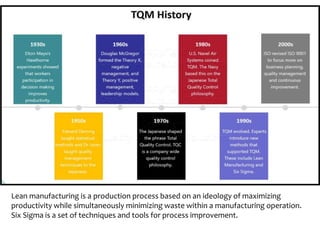
Lean manufacturing is a production process based on an ideology of maximizing
productivity while simultaneously minimizing waste within a manufacturing operation.
Six Sigma is a set of techniques and tools for process improvement.
 Dr. W. Edwards Deming. A statistician who went to Japan to help
with the census after World War II, Deming also taught statistical
process control to leaders of prominent Japanese businesses.
 His message was this: By improving quality, companies will decrease
expenses as well as increase productivity and market share.
 After applying Deming's techniques, Japanese businesses like Toyota,
Fuji, and Sony saw great success. Their quality was far superior to
that of their global competitors, and their costs were lower.
 The demand for Japanese products soared – and by the 1970s, many
of these companies dominated the global market. American and
European companies realized that they could no longer ignore the
quality revolution.
Deming’s philosophy on TQM
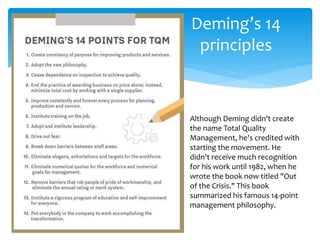
Deming’s 14
principles
Although Deming didn't create
the name Total Quality
Management, he's credited with
starting the movement. He
didn't receive much recognition
for his work until 1982, when he
wrote the book now titled "Out
of the Crisis." This book
summarized his famous 14-point
management philosophy.
 The Juran Trilogy, also called Quality Trilogy, was
presented by Dr. Joseph M. Juran in 1986 as a means to
manage for quality.
 Juran managed Beefy’s during the night shift.
 Managing for quality consists of:
 Quality Planning: To design a process that will be able to meet
established goals under the operating conditions.
 Quality Control: To correct the process when necessary so
that it performs with optimal effectiveness.
 Quality Improvement: To devise ways to take the process to
unprecedented levels of performance.
Juran’s Philosophy
 Philip Crosby introduced the concepts of “Zero
Defects” and “doing it right the first time”.
 His definition of quality was conformance to
requirements.
 Inspection and correction does not prevent errors.
 He believed quality originates in the functional
departments and not the quality department.
 The quality department should measure the
conformance, report results and improve the quality.
Philip Crosby
 The customer (organization) is responsible for providing the
supplier with clear and sufficient information of
requirements so that the supplier can know precisely what
to produce.
 In case of physical products, customers are satisfied when
the products are:
 Durable
 Reliable
 Easy to Use
 Adaptable
 Appropriate
Customer & Supplier Focus in TQM
 In case of service industry customers are satisfied
only when:
 Employees are friendly and polite
 Employees are honest and do not make fake promises
 Employees are easily approachable
 Employees are willing to listen and address customer
grievances
 Organizations respond to customer requests on time.
Continued
 Benefits of TQM
 Less product defects
 Satisfied customers
 Lower costs
 Well-defined cultural values
 Costs of TQM
 Prevention costs are the costs created from the effort to reduce poor quality.
 Inspection costs include the inspection and testing of raw materials, work-in-process,
and finished goods.
 Internal cost occurs when quality defects are discovered before they reach the
customer.
 External failure costs when the defect is discovered after it has reached the customer.
Benefits & Costs of TQM
https://www.youtube.com/watch?v=85Y8iBhzqwk
 Automobile manufacturer Toyota is one example of TQM. The adoption of
TQM and kaizen at Toyota led to higher product and work quality at all
levels of the organization. Toyota adopted a related practice called
statistical quality control (SQC) in 1949. In 1951, Toyota launched the
Creative Idea Suggestion System, which was based on a suggestion
system used at Ford.
 In 1965, Toyota was awarded the Deming Application Prize for major
advances in quality improvement. In 1994, the "Toyota Group Executive
TQM Training Course" was established, providing TQM training for new
executives. Toyota's TQM initiatives continue to the current day. In 2011,
Toyota announced that more than 40 million suggestions (to date) were
generated by the Creative Idea Suggestion System.
Case Study
 1. Sunil Sharma, “Total Engineering Quality Management”,
2003, Macmillan India Ltd.
 2. Ron Basu, “Implementing Quality: A Practical Guide to
Tools and Techniques”, 2016, THOMPSON.
 3. KanishkaBedi, “Quality Management”, Oxford University
Press.
 4. Mujkherjee, PN, “Total Quality Management”, 2007, PHI.
 5. R. P. Mohanty& R. R. Lakhe, “TQM in the Service
Sector”, Jaico Books.2016
Suggested books
 Statistical Tools –
 Check Sheets,
 Histograms,
 Scatter Diagrams,
 Pareto’s Chart,
 Regression Analysis &
 Control Charts.
 Cause and Effect Diagrams,
 The Five Why’s,
 Five S’s,
 Kaizen,
 JIT,
 Quality Circles,
 Gantt Chart and
 Balanced Score Card.
 Dimensions of Service Quality.
 An overview of TQM in Service Organizations.
UNIT 2 LAYOUT:
Tools and techniques of TQM

Basic Quality Management

  • 1.
    Basic Quality Management Preparedand presented by: Dr. Himani Raval
  • 2.
     Concept ofquality  Quality dimensions  Product and Service Quality.  Inspection, Statistical Quality Control, Quality Assurance and Total Quality Management  Conventional Quality Management versus Total Quality Management.  Evolution of TQM.  Historical perspectives of TQM – Deming, Juran, Crosby and Taguchi’s Contributions.  Customer and supplier focus in TQM.  Benefits and Costs of TQM. Unit 1: Layout
  • 3.
     Quality isa parameter which decides the superiority or inferiority of a product or service.  It is an attribute that differentiates a product or service from its competitors.  It can be measured in terms of durability, reliability, usage and so on. Concept of quality
  • 4.
     Performance  Features Reliability  Conformance  Durability  Serviceability  Aesthetics  Perception Quality dimensions
  • 5.
     Product qualitymeans to incorporate features that have a capacity to meet consumer needs and wants and provides customer satisfaction, and free from deficiencies and defects.  Service quality (SQ) is a comparison of perceived Expectations (E) of a service with the perceived Performance. (P)  SQ=P-E Product and service quality
  • 6.
     Service +Quality=SERVQUAL  Designed to capture consumer expectations and perceptions of a service  Developed in the mid eighties by Zeithaml, Parsuraman and Berry.  It measures the gap between customer expectations and experience.  It is measured on the aspects of reliability, assurance, tangibles, empathy and responsiveness. SERVQUAL Dimension Definition Reliability The ability to perform the promised service dependably and accurately Assurance The knowledge and courtesy of employees and their ability to convey trust and confidence Tangibles The appearance of physical facilities, equipment, personnel and communication materials Empathy The provision of caring, individualized attention to customer Responsiveness The willingness to help customers and to provide prompt service
  • 7.
     Inspection isa process of measuring, examining and testing to scale one or more characteristics of a product or service and the comparison of these with specified requirements.  Inspection means the activity of checking products/services  The quality inspector usually follows a pre-established checklist that is based on the product specifications.  Inspected products can be anything from components of production, semi finished goods or most often finished goods. Inspection
  • 8.
     Quality controlmeans the recognition and removal of identifiable causes and defects and variables from the set standards.  SQC refers to the use of statistical methods in the monitoring and maintaining of the quality of products and services.  This is the control over the product quality using statistical tools.  Descriptive statistics: simply describing what is in the data  Statistical process control: real-time data plotted on a graph  Acceptance sampling: statistical sampling used to determine whether to accept or reject a production lot of material Statistical quality control
  • 9.
     Quality assurance(QA) is a way of preventing mistakes and defects in manufactured products and avoiding problems when delivering products or services to customers  ISO 9000 defines as "part of quality management focused on providing confidence that quality requirements will be fulfilled".  2 principles of Quality Assurance are:  Fit for purpose; the product should be suitable for the intended purpose  Right first time; mistakes should be eliminated before happening Quality assurance
  • 10.
     TQM wasdeveloped by William Deming, a management consultant whose work had a great impact on Japanese manufacturing.  Total quality management (TQM) is an ongoing process of detecting and reducing or eliminating errors in manufacturing, streamlining supply chain management, improving the customer experience, and ensuring that employees are up to speed with training.  TQM aims to hold all parties involved in the production process accountable for the overall quality of the final product or service. TQM
  • 11.
     The companyreviews the needs of its customers  The company plans the activities needed ( both day to day and long term activities) to meet these customers needs  The company establishes and stabilizes the processes required to deliver the products and services needed by the customer.  The company implements systems to further improve its processes, products, and services  Steps 1-4 above constitute a cycle and maybe iterated indefinitely for continuous improvement TQM Implementation
  • 12.
     Traditional managementviews management as a commodity and are passive contributors with little autonomy.  Under traditional approach, customers are always considered as outsiders to the organization and are the concern of market and sales.  Here, the management is always reluctant to change. Conventional Quality Management
  • 13.
    Quality element Traditional TQM Definition Productoriented Customer oriented Focus Short term Long term Emphasis Detection of errors Prevention of errors Problems Assign blame and punish Identify and resolve Change Resists Adopts Manager’s role Plan, assign, enforce and control Delegate, coach, facilitate and mentor Improvement Irregular and inconsistent Continuous Inspection Periodic audits Continuous measurements Usage of results To check against criteria For continuous improvements Difference between Traditional vs TQM
  • 14.
    Lean manufacturing isa production process based on an ideology of maximizing productivity while simultaneously minimizing waste within a manufacturing operation. Six Sigma is a set of techniques and tools for process improvement.
  • 15.
     Dr. W.Edwards Deming. A statistician who went to Japan to help with the census after World War II, Deming also taught statistical process control to leaders of prominent Japanese businesses.  His message was this: By improving quality, companies will decrease expenses as well as increase productivity and market share.  After applying Deming's techniques, Japanese businesses like Toyota, Fuji, and Sony saw great success. Their quality was far superior to that of their global competitors, and their costs were lower.  The demand for Japanese products soared – and by the 1970s, many of these companies dominated the global market. American and European companies realized that they could no longer ignore the quality revolution. Deming’s philosophy on TQM
  • 16.
    Deming’s 14 principles Although Demingdidn't create the name Total Quality Management, he's credited with starting the movement. He didn't receive much recognition for his work until 1982, when he wrote the book now titled "Out of the Crisis." This book summarized his famous 14-point management philosophy.
  • 17.
     The JuranTrilogy, also called Quality Trilogy, was presented by Dr. Joseph M. Juran in 1986 as a means to manage for quality.  Juran managed Beefy’s during the night shift.  Managing for quality consists of:  Quality Planning: To design a process that will be able to meet established goals under the operating conditions.  Quality Control: To correct the process when necessary so that it performs with optimal effectiveness.  Quality Improvement: To devise ways to take the process to unprecedented levels of performance. Juran’s Philosophy
  • 18.
     Philip Crosbyintroduced the concepts of “Zero Defects” and “doing it right the first time”.  His definition of quality was conformance to requirements.  Inspection and correction does not prevent errors.  He believed quality originates in the functional departments and not the quality department.  The quality department should measure the conformance, report results and improve the quality. Philip Crosby
  • 19.
     The customer(organization) is responsible for providing the supplier with clear and sufficient information of requirements so that the supplier can know precisely what to produce.  In case of physical products, customers are satisfied when the products are:  Durable  Reliable  Easy to Use  Adaptable  Appropriate Customer & Supplier Focus in TQM
  • 20.
     In caseof service industry customers are satisfied only when:  Employees are friendly and polite  Employees are honest and do not make fake promises  Employees are easily approachable  Employees are willing to listen and address customer grievances  Organizations respond to customer requests on time. Continued
  • 21.
     Benefits ofTQM  Less product defects  Satisfied customers  Lower costs  Well-defined cultural values  Costs of TQM  Prevention costs are the costs created from the effort to reduce poor quality.  Inspection costs include the inspection and testing of raw materials, work-in-process, and finished goods.  Internal cost occurs when quality defects are discovered before they reach the customer.  External failure costs when the defect is discovered after it has reached the customer. Benefits & Costs of TQM https://www.youtube.com/watch?v=85Y8iBhzqwk
  • 22.
     Automobile manufacturerToyota is one example of TQM. The adoption of TQM and kaizen at Toyota led to higher product and work quality at all levels of the organization. Toyota adopted a related practice called statistical quality control (SQC) in 1949. In 1951, Toyota launched the Creative Idea Suggestion System, which was based on a suggestion system used at Ford.  In 1965, Toyota was awarded the Deming Application Prize for major advances in quality improvement. In 1994, the "Toyota Group Executive TQM Training Course" was established, providing TQM training for new executives. Toyota's TQM initiatives continue to the current day. In 2011, Toyota announced that more than 40 million suggestions (to date) were generated by the Creative Idea Suggestion System. Case Study
  • 23.
     1. SunilSharma, “Total Engineering Quality Management”, 2003, Macmillan India Ltd.  2. Ron Basu, “Implementing Quality: A Practical Guide to Tools and Techniques”, 2016, THOMPSON.  3. KanishkaBedi, “Quality Management”, Oxford University Press.  4. Mujkherjee, PN, “Total Quality Management”, 2007, PHI.  5. R. P. Mohanty& R. R. Lakhe, “TQM in the Service Sector”, Jaico Books.2016 Suggested books
  • 24.
     Statistical Tools–  Check Sheets,  Histograms,  Scatter Diagrams,  Pareto’s Chart,  Regression Analysis &  Control Charts.  Cause and Effect Diagrams,  The Five Why’s,  Five S’s,  Kaizen,  JIT,  Quality Circles,  Gantt Chart and  Balanced Score Card.  Dimensions of Service Quality.  An overview of TQM in Service Organizations. UNIT 2 LAYOUT: Tools and techniques of TQM