ULCERS, SINUSES & FISTULAE
DR. NEERAJ K JAIN
DEPARTMENT OF GENERAL
SURGERY
ULCER
• Breach or discontinuity
of an epithelium or
mucosal surface.
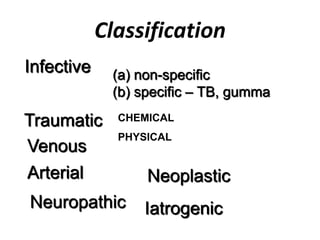
Classification
Infective (a) non-specific
(b) specific – TB, gumma
Traumatic
Venous
Arterial
Neuropathic
Neoplastic
Iatrogenic
CHEMICAL
PHYSICAL
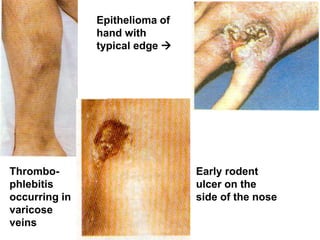
Thrombo-
phlebitis
occurring in
varicose
veins
Epithelioma of
hand with
typical edge 
Early rodent
ulcer on the
side of the nose
Diagnosis –
• 1. History:
–age (young – infective, >40 Ca, 60 Rodent)
–sex (female – varicose, male – squamous
cell Ca)
–Race (Chinese – Varicose ulcer)
–Religion (Muslim/Jews - squamous cell Ca)
–Occupation - prolong standing
(baker/hairdresser/surgeons/traffic police –
varicose veins)
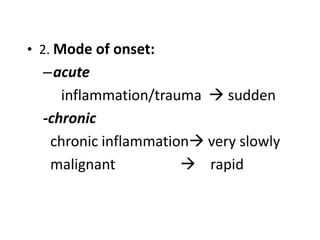
• 2. Mode of onset:
–acute
inflammation/trauma  sudden
-chronic
chronic inflammation very slowly
malignant  rapid
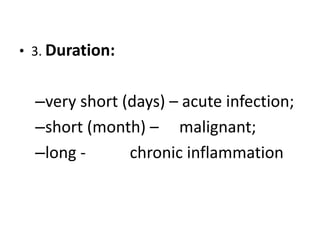
• 3. Duration:
–very short (days) – acute infection;
–short (month) – malignant;
–long - chronic inflammation
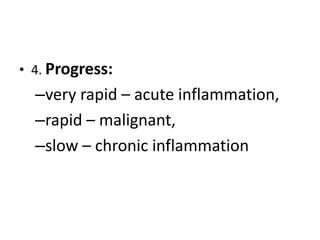
• 4. Progress:
–very rapid – acute inflammation,
–rapid – malignant,
–slow – chronic inflammation
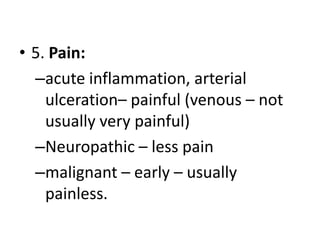
• 5. Pain:
–acute inflammation, arterial
ulceration– painful (venous – not
usually very painful)
–Neuropathic – less pain
–malignant – early – usually
painless.
• 6. Fever: infective/TB
• 7. Loss of weight:malignant/TB
• 8. Smoking: Buerger's disease,
artherosclerosis
• Past History – TB, Syphilis, Diabetes
Mellitus, Hypertension
• Responses to Antibiotics:
(+) in infection (-) in malignancy
PHYSICAL EXAMINATION
• General – cachexia, anaemia,weight
loss (Ca, TB)
• Local:
1. Number (single or multiple –TB)
2. Site
Rodent –lobule of ear & angle of
the mouth;
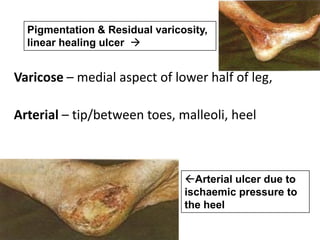
Varicose – medial aspect of lower half of leg,
Arterial – tip/between toes, malleoli, heel
Pigmentation & Residual varicosity,
linear healing ulcer 
Arterial ulcer due to
ischaemic pressure to
the heel
Squamous cell Carcinoma
SCC – lower lip, Gumma – s/c bone ~
tibia/sternum/skull
Diabetic/Perforating/trophic – heel/ball of
the foot (head of 1st /2nd metatarsals
TB – neck, axilla, groin
Lupus – face, fingers, hands,
Chancre/soft sore – ext.genitalia
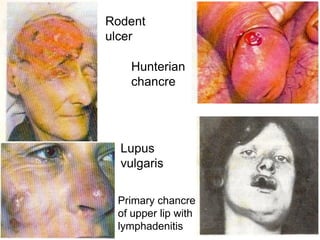
Rodent
ulcer
Lupus
vulgaris
Hunterian
chancre
Primary chancre
of upper lip with
lymphadenitis
• 3. Size (depends on duration
& rate of growth)
• 4. Shape (oval – varicose,
circular – rodent,
irregular – malignant)
• 5. Edge: (a) flat sloping ~
simple or healing ulcer,
venous ulcer (edge red,
blue, transparent zone)
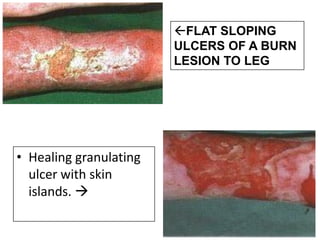
• Healing granulating
ulcer with skin
islands. 
FLAT SLOPING
ULCERS OF A BURN
LESION TO LEG
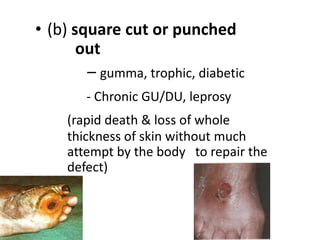
• (b) square cut or punched
out
– gumma, trophic, diabetic
- Chronic GU/DU, leprosy
(rapid death & loss of whole
thickness of skin without much
attempt by the body to repair the
defect)
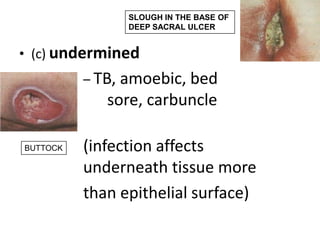
• (c) undermined
– TB, amoebic, bed
sore, carbuncle
(infection affects
underneath tissue more
than epithelial surface)
BUTTOCK
SLOUGH IN THE BASE OF
DEEP SACRAL ULCER
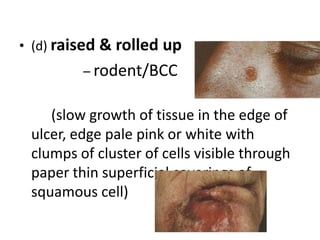
• (d) raised & rolled up
– rodent/BCC
(slow growth of tissue in the edge of
ulcer, edge pale pink or white with
clumps of cluster of cells visible through
paper thin superficial coverings of
squamous cell)
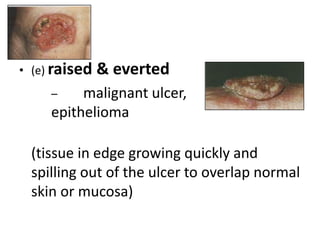
• (e) raised & everted
– malignant ulcer,
epithelioma
(tissue in edge growing quickly and
spilling out of the ulcer to overlap normal
skin or mucosa)
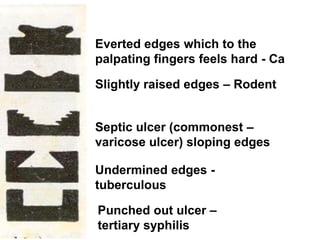
Everted edges which to the
palpating fingers feels hard - Ca
Slightly raised edges – Rodent
Septic ulcer (commonest –
varicose ulcer) sloping edges
Undermined edges -
tuberculous
Punched out ulcer –
tertiary syphilis
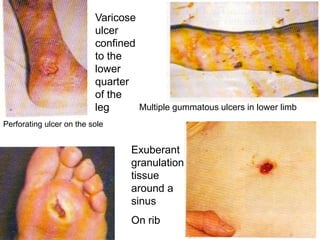
Multiple gummatous ulcers in lower limb
Varicose
ulcer
confined
to the
lower
quarter
of the
leg
Perforating ulcer on the sole
Exuberant
granulation
tissue
around a
sinus
On rib
Colour of the Edge
• Red  inflammation
• Pale or cyanosed  ischaemia
• Late  blue, purple, black
• Pigmentation  venous ulcer,
malignant melanoma
• Pearly edge  BCC
• Keratinization  Neuropathic ulcer
• 6. Floor:
Haemorrhage & necrotic slough–
malignant
purulent - acute infection
washed leather- gumma
bluish unhealthy granulation tissue
TB (whitish in brownish space/
apple jelly)
solid brown or gray – dead tissue
full thickness skin death
• 7. Discharge:
On dressing gauze – serous,
sero-sanguinous,
purulent, offensive, copious, or
so slight – dries up into a scab.
• 8. Surrounding skin, state of local
tissue, blood supply, innervation
Surrounding skin of infln – infective,
scar – TB
PALPATION
• Temperature difference/tenderness - in
acute infected ulcer
• Base – induration +/-,
• Mobility of ulcer over underlying
structures –
– fixed – malignant; bleed on touch +/-
• regional lymphatics –
enlarged -> inflammation
hard – malignant
Systemic Examination:
• Infection – constitutional symptoms
- TB
• cachexia, anaemia, loss of weight-
- malignant
• hypertension, artherosclerosis –
- ischaemic ulcer
• Hensens’, tabes dorsalis, peripheral
numbness
- neuropathic
Investigation
• D. Mellitus – Urine sugar/ RBS/FBS
• Infective - fbc, culture
TB - CXR, AFB, ESR
Syphilis- KT, VDRL
• Discharge – smear, Gram stain, C&S
• Biopsy - wedge/incisional biopsy
margin of the ulcer & normal
tissue which allows
» (a) comparison with normal tissue
» (b) known organ &
» (c) +/- or infiltration
• Curling’s ulcer
– acute peptic ulcer in burn as a
reaction to stress
• Cushing’s ulcer
– acute PU in head injury, early
days following spinal cord injury
• Marjolin’s ulcer
– malignant change in a scar, ulcer,
sinus (Chr.venous ulcer, burn,
Chr.OM sinus – slow growth –
avascular, painless – scar not
have cut. nerve fibres, late lymphatic
spread – obliterated lymphatics)
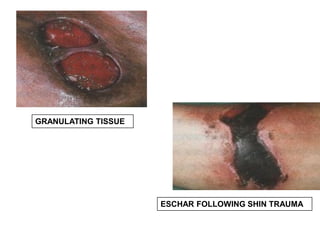
GRANULATING TISSUE
ESCHAR FOLLOWING SHIN TRAUMA
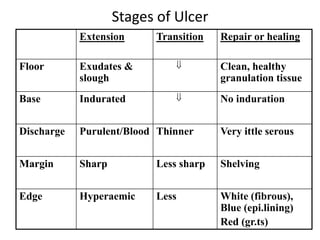
Stages of Ulcer
Extension Transition Repair or healing
Floor Exudates &
slough
 Clean, healthy
granulation tissue
Base Indurated  No induration
Discharge Purulent/Blood Thinner Very ittle serous
Margin Sharp Less sharp Shelving
Edge Hyperaemic Less White (fibrous),
Blue (epi.lining)
Red (gr.ts)
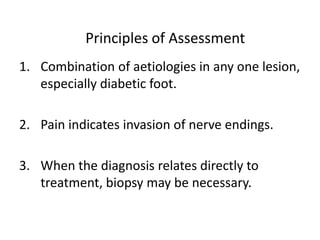
Principles of Assessment
1. Combination of aetiologies in any one lesion,
especially diabetic foot.
2. Pain indicates invasion of nerve endings.
3. When the diagnosis relates directly to
treatment, biopsy may be necessary.
Next lecture on
SINUS & FISTULA
with Assessment test on wound
Healing
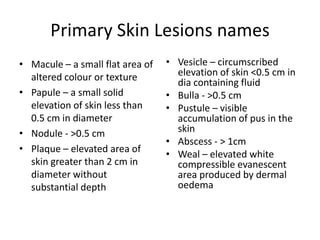
Primary Skin Lesions names
• Macule – a small flat area of
altered colour or texture
• Papule – a small solid
elevation of skin less than
0.5 cm in diameter
• Nodule - >0.5 cm
• Plaque – elevated area of
skin greater than 2 cm in
diameter without
substantial depth
• Vesicle – circumscribed
elevation of skin <0.5 cm in
dia containing fluid
• Bulla - >0.5 cm
• Pustule – visible
accumulation of pus in the
skin
• Abscess - > 1cm
• Weal – elevated white
compressible evanescent
area produced by dermal
oedema
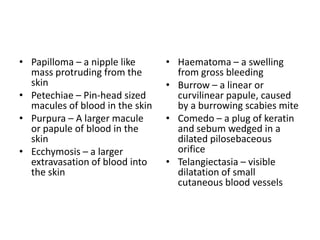
• Papilloma – a nipple like
mass protruding from the
skin
• Petechiae – Pin-head sized
macules of blood in the skin
• Purpura – A larger macule
or papule of blood in the
skin
• Ecchymosis – a larger
extravasation of blood into
the skin
• Haematoma – a swelling
from gross bleeding
• Burrow – a linear or
curvilinear papule, caused
by a burrowing scabies mite
• Comedo – a plug of keratin
and sebum wedged in a
dilated pilosebaceous
orifice
• Telangiectasia – visible
dilatation of small
cutaneous blood vessels
Secondary lesions (evolved from primary lesion
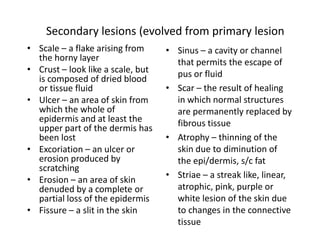
• Scale – a flake arising from
the horny layer
• Crust – look like a scale, but
is composed of dried blood
or tissue fluid
• Ulcer – an area of skin from
which the whole of
epidermis and at least the
upper part of the dermis has
been lost
• Excoriation – an ulcer or
erosion produced by
scratching
• Erosion – an area of skin
denuded by a complete or
partial loss of the epidermis
• Fissure – a slit in the skin
• Sinus – a cavity or channel
that permits the escape of
pus or fluid
• Scar – the result of healing
in which normal structures
are permanently replaced by
fibrous tissue
• Atrophy – thinning of the
skin due to diminution of
the epi/dermis, s/c fat
• Striae – a streak like, linear,
atrophic, pink, purple or
white lesion of the skin due
to changes in the connective
tissue

Ulcer drneerajjain

  • 1.
    ULCERS, SINUSES &FISTULAE DR. NEERAJ K JAIN DEPARTMENT OF GENERAL SURGERY
  • 2.
    ULCER • Breach ordiscontinuity of an epithelium or mucosal surface.
  • 3.
    Classification Infective (a) non-specific (b)specific – TB, gumma Traumatic Venous Arterial Neuropathic Neoplastic Iatrogenic CHEMICAL PHYSICAL
  • 4.
    Thrombo- phlebitis occurring in varicose veins Epithelioma of handwith typical edge  Early rodent ulcer on the side of the nose
  • 5.
    Diagnosis – • 1.History: –age (young – infective, >40 Ca, 60 Rodent) –sex (female – varicose, male – squamous cell Ca) –Race (Chinese – Varicose ulcer) –Religion (Muslim/Jews - squamous cell Ca) –Occupation - prolong standing (baker/hairdresser/surgeons/traffic police – varicose veins)
  • 6.
    • 2. Modeof onset: –acute inflammation/trauma  sudden -chronic chronic inflammation very slowly malignant  rapid
  • 7.
    • 3. Duration: –veryshort (days) – acute infection; –short (month) – malignant; –long - chronic inflammation
  • 8.
    • 4. Progress: –veryrapid – acute inflammation, –rapid – malignant, –slow – chronic inflammation
  • 9.
    • 5. Pain: –acuteinflammation, arterial ulceration– painful (venous – not usually very painful) –Neuropathic – less pain –malignant – early – usually painless.
  • 10.
    • 6. Fever:infective/TB • 7. Loss of weight:malignant/TB • 8. Smoking: Buerger's disease, artherosclerosis • Past History – TB, Syphilis, Diabetes Mellitus, Hypertension • Responses to Antibiotics: (+) in infection (-) in malignancy
  • 11.
    PHYSICAL EXAMINATION • General– cachexia, anaemia,weight loss (Ca, TB) • Local: 1. Number (single or multiple –TB) 2. Site Rodent –lobule of ear & angle of the mouth;
  • 12.
    Varicose – medialaspect of lower half of leg, Arterial – tip/between toes, malleoli, heel Pigmentation & Residual varicosity, linear healing ulcer  Arterial ulcer due to ischaemic pressure to the heel
  • 13.
    Squamous cell Carcinoma SCC– lower lip, Gumma – s/c bone ~ tibia/sternum/skull Diabetic/Perforating/trophic – heel/ball of the foot (head of 1st /2nd metatarsals TB – neck, axilla, groin Lupus – face, fingers, hands, Chancre/soft sore – ext.genitalia
  • 14.
  • 15.
    • 3. Size(depends on duration & rate of growth) • 4. Shape (oval – varicose, circular – rodent, irregular – malignant) • 5. Edge: (a) flat sloping ~ simple or healing ulcer, venous ulcer (edge red, blue, transparent zone)
  • 16.
    • Healing granulating ulcerwith skin islands.  FLAT SLOPING ULCERS OF A BURN LESION TO LEG
  • 17.
    • (b) squarecut or punched out – gumma, trophic, diabetic - Chronic GU/DU, leprosy (rapid death & loss of whole thickness of skin without much attempt by the body to repair the defect)
  • 18.
    • (c) undermined –TB, amoebic, bed sore, carbuncle (infection affects underneath tissue more than epithelial surface) BUTTOCK SLOUGH IN THE BASE OF DEEP SACRAL ULCER
  • 19.
    • (d) raised& rolled up – rodent/BCC (slow growth of tissue in the edge of ulcer, edge pale pink or white with clumps of cluster of cells visible through paper thin superficial coverings of squamous cell)
  • 20.
    • (e) raised& everted – malignant ulcer, epithelioma (tissue in edge growing quickly and spilling out of the ulcer to overlap normal skin or mucosa)
  • 21.
    Everted edges whichto the palpating fingers feels hard - Ca Slightly raised edges – Rodent Septic ulcer (commonest – varicose ulcer) sloping edges Undermined edges - tuberculous Punched out ulcer – tertiary syphilis
  • 22.
    Multiple gummatous ulcersin lower limb Varicose ulcer confined to the lower quarter of the leg Perforating ulcer on the sole Exuberant granulation tissue around a sinus On rib
  • 23.
    Colour of theEdge • Red  inflammation • Pale or cyanosed  ischaemia • Late  blue, purple, black • Pigmentation  venous ulcer, malignant melanoma • Pearly edge  BCC • Keratinization  Neuropathic ulcer
  • 24.
    • 6. Floor: Haemorrhage& necrotic slough– malignant purulent - acute infection washed leather- gumma bluish unhealthy granulation tissue TB (whitish in brownish space/ apple jelly) solid brown or gray – dead tissue full thickness skin death
  • 25.
    • 7. Discharge: Ondressing gauze – serous, sero-sanguinous, purulent, offensive, copious, or so slight – dries up into a scab. • 8. Surrounding skin, state of local tissue, blood supply, innervation Surrounding skin of infln – infective, scar – TB
  • 26.
    PALPATION • Temperature difference/tenderness- in acute infected ulcer • Base – induration +/-, • Mobility of ulcer over underlying structures – – fixed – malignant; bleed on touch +/- • regional lymphatics – enlarged -> inflammation hard – malignant
  • 27.
    Systemic Examination: • Infection– constitutional symptoms - TB • cachexia, anaemia, loss of weight- - malignant • hypertension, artherosclerosis – - ischaemic ulcer • Hensens’, tabes dorsalis, peripheral numbness - neuropathic
  • 28.
    Investigation • D. Mellitus– Urine sugar/ RBS/FBS • Infective - fbc, culture TB - CXR, AFB, ESR Syphilis- KT, VDRL • Discharge – smear, Gram stain, C&S • Biopsy - wedge/incisional biopsy margin of the ulcer & normal tissue which allows » (a) comparison with normal tissue » (b) known organ & » (c) +/- or infiltration
  • 29.
    • Curling’s ulcer –acute peptic ulcer in burn as a reaction to stress • Cushing’s ulcer – acute PU in head injury, early days following spinal cord injury • Marjolin’s ulcer – malignant change in a scar, ulcer, sinus (Chr.venous ulcer, burn, Chr.OM sinus – slow growth – avascular, painless – scar not have cut. nerve fibres, late lymphatic spread – obliterated lymphatics)
  • 30.
  • 31.
    Stages of Ulcer ExtensionTransition Repair or healing Floor Exudates & slough  Clean, healthy granulation tissue Base Indurated  No induration Discharge Purulent/Blood Thinner Very ittle serous Margin Sharp Less sharp Shelving Edge Hyperaemic Less White (fibrous), Blue (epi.lining) Red (gr.ts)
  • 32.
    Principles of Assessment 1.Combination of aetiologies in any one lesion, especially diabetic foot. 2. Pain indicates invasion of nerve endings. 3. When the diagnosis relates directly to treatment, biopsy may be necessary.
  • 33.
    Next lecture on SINUS& FISTULA with Assessment test on wound Healing
  • 35.
    Primary Skin Lesionsnames • Macule – a small flat area of altered colour or texture • Papule – a small solid elevation of skin less than 0.5 cm in diameter • Nodule - >0.5 cm • Plaque – elevated area of skin greater than 2 cm in diameter without substantial depth • Vesicle – circumscribed elevation of skin <0.5 cm in dia containing fluid • Bulla - >0.5 cm • Pustule – visible accumulation of pus in the skin • Abscess - > 1cm • Weal – elevated white compressible evanescent area produced by dermal oedema
  • 36.
    • Papilloma –a nipple like mass protruding from the skin • Petechiae – Pin-head sized macules of blood in the skin • Purpura – A larger macule or papule of blood in the skin • Ecchymosis – a larger extravasation of blood into the skin • Haematoma – a swelling from gross bleeding • Burrow – a linear or curvilinear papule, caused by a burrowing scabies mite • Comedo – a plug of keratin and sebum wedged in a dilated pilosebaceous orifice • Telangiectasia – visible dilatation of small cutaneous blood vessels
  • 37.
    Secondary lesions (evolvedfrom primary lesion • Scale – a flake arising from the horny layer • Crust – look like a scale, but is composed of dried blood or tissue fluid • Ulcer – an area of skin from which the whole of epidermis and at least the upper part of the dermis has been lost • Excoriation – an ulcer or erosion produced by scratching • Erosion – an area of skin denuded by a complete or partial loss of the epidermis • Fissure – a slit in the skin • Sinus – a cavity or channel that permits the escape of pus or fluid • Scar – the result of healing in which normal structures are permanently replaced by fibrous tissue • Atrophy – thinning of the skin due to diminution of the epi/dermis, s/c fat • Striae – a streak like, linear, atrophic, pink, purple or white lesion of the skin due to changes in the connective tissue