By : Dr. VALLURI MUKESH KRISHNA
GINGIVOBUCCAL COMPLEX CANCER
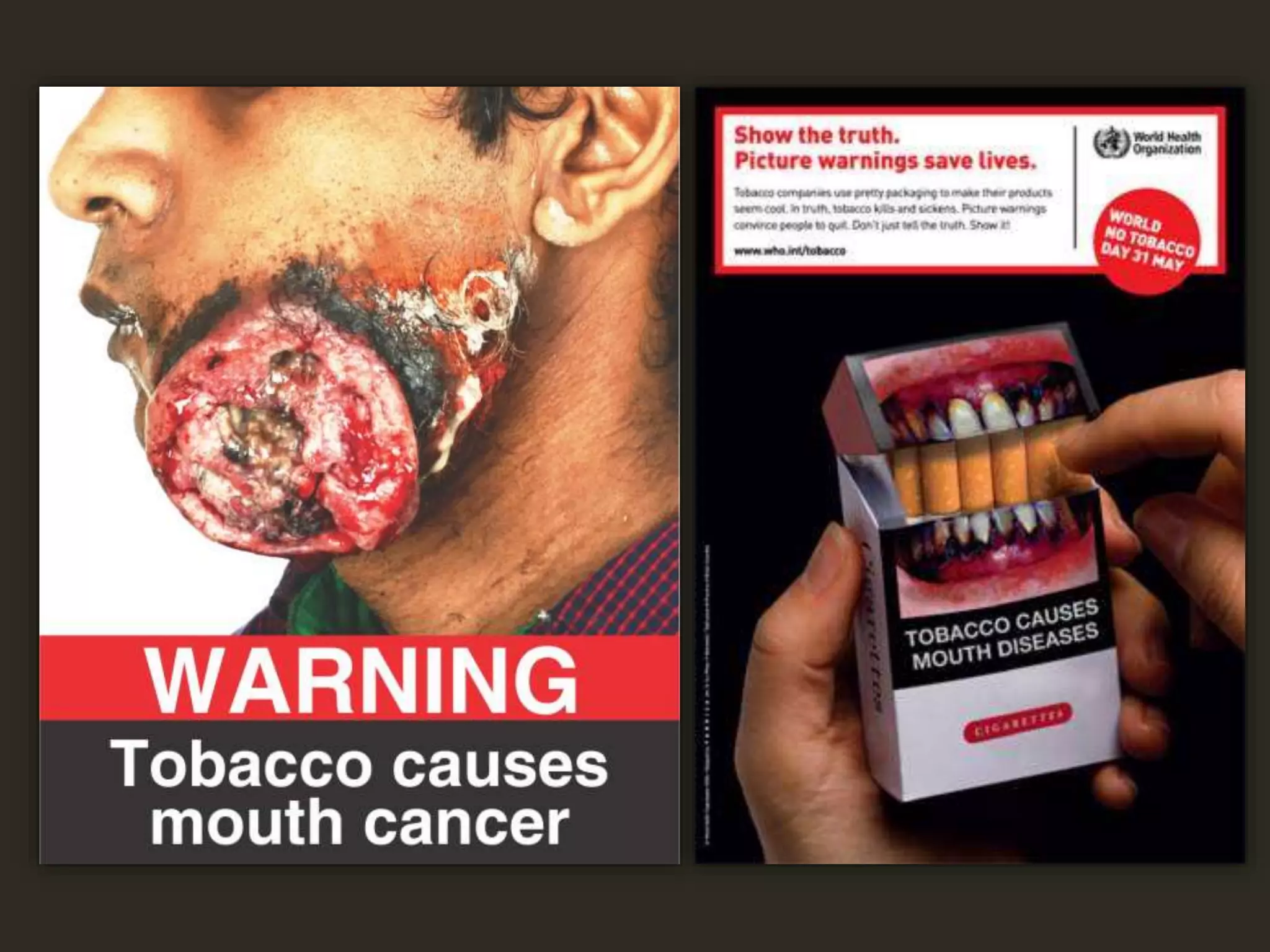
 India has one of the highest incidence in the world.
 Oral cancer rank no.1 in males and 3 in females.
 12% in males and 8% in females of all cancers.
4
 Buccal Mucosa & Gingiva are involved
 Indian Oral Cancer
 Due to keeping Tobacco in Gingivobuccal Sulcus
 Indian Oral Cancer
ORAL CAVITY
Consists of
1. Lips
2. The Floor of the Mouth
3. Anterior 2/3rd of the Tongue
4. Buccal Mucosa
5. Upper & Lower Alveolar Ridges
6. Hard Palate
7. Retromolar Trigone
The entire oral cavity is lined with mucous membrane
tissue. The oral cavity consists of the following two
areas:
1. The VESTIBULE is the space between the teeth and
the inner mucosal lining of the lips and checks.
2. The ORAL CAVITY PROPER is the space contained
within the upper and lower dental arches.
 Extends from the LIPS to the OROPHARYNGEAL
ISTHMUS.
• Its ROOF consists of the HARD and SOFT PALATES.
• The FLOOR is formed mainly of soft tissues, which
include
•MUSCULAR DIAPHRAGM
•The TONGUE
•The LATERAL WALLS (cheeks) are muscular and merge
anteriorly with the lips surrounding the oral fissure
• ORAL FISSURE (The Anterior Opening Of The Oral
Cavity).
• OROPHARYNGEAL ISTHMUS opens into the oral part
of the pharynx (Posterior Aperture Of The Oral Cavity )
o SLIT LIKE SPACE between the CHEEKS and the GUMS
Superiorly and inferiorly limited by the reflection of
MUCOUS MEMBRANE from LIPS and CHEEK onto the
GUMS.
The lateral wall of the vestibule is formed by the
CHEEK.
o It is the cavity within the ALVEOLAR MARGINS of the
MAXILLA and the MANDIBLE
Its ROOF is formed by the HARD PALATE
ANTERIORLY and the SOFT PALATE POSTERIORLY
Its FLOOR is formed by the MYLOHYOID MUSCLE.
The ANTERIOR 2/3RD OF THE TONGUE lies on the
floor.
Made up of 3 Structures :
1. A MUSCULAR DIAPHRAGM, which fills the u-shaped
gap between the Left and Right sides of the Body of the
MANDIBLE and is composed of the paired MYLOHYOID
MUSCLES;
2.Two cord-like GENIOHYOID MUSCLES above the
diaphragm, which run from the MANDIBLE in front to the
HYOID BONE behind;
3.The TONGUE, which is Superior to the Geniohyoid
muscles.
Also present in the floor of the oral cavity proper are
salivary glands and their ducts.
Muscles Origin Insertions Innervation Function
Mylohyoid Mylohyoid line
of mandible
Median fibrous
raphe and
adjacent part
of hyoid bone
Nerve to
mylohyoid from
the inferior
alveolar branch
of mandibular
nerve [V3]
Supports &
elevates floor
of oral cavity;
depresses
mandible when
hyoid is fixed;
elevates & pulls
hyoid forward
when mandible
is fixed
Geniohyoid Inferior mental
spines of
mandible
Body of hyoid
bone
C1 Elevates & pulls
hyoid forward
when mandible
is fixed;
depresses
mandible when
hyoid is fixed
 Sensory
• ROOF: by GREATER PALATINE and NASOPALATINE
nerves (branches of Maxillary Nerve)
• FLOOR: by LINGUAL nerve (branch of Mandibular
Nerve)
• CHEEK: by BUCCAL nerve (branch of Mandibular Nerve)
 Motor
• Muscle in the cheek (BUCCINATOR) and the lip
(ORBICULARIS ORIS) are supplied by the branches of the
FACIAL NERVE
 Parasympathetic fibers & Taste
Branches of the FACIAL NERVE [VII], which join and
are distributed with branches of the TRIGEMINAL
NERVE [V];
Sympathetic fibers
From SPINAL CORD LEVEL T1, synapse in the
SUPERIOR CERVICAL SYMPATHETIC GANGLION, and
are distributed along branches of the TRIGEMINAL
NERVE [V]
All muscles of the tongue are innervated by the
HYPOGLOSSAL NERVE [XII],
Except the PALATOGLOSSUS muscle; vagus nerve
[X].
Muscles of the soft palate are innervated by the
vagus nerve [X]
Except for the tensor veli palatini; branch from the
mandibular nerve [V3].
The muscle, mylohyoid, that forms the floor of the
oral cavity is also innervated by the mandibular nerve
[V3].
TONGUE
 APEX OF TONGUE : Directed anteriorly and sits
immediately behind the incisor teeth. Triangular in shape
& blunt.
 ROOT OF TONGUE : is attached to the mandible and
the hyoid bone.
The superior surface of the oral part of the tongue is covered by
hundreds of papillae:
1. FILIFORM PAPILLAE are small cone-shaped projections of the
mucosa that end in one or more points;
2. FUNGIFORM PAPILLAE are rounder in shape and larger than
the filiform papillae, and tend to be concentrated along the
margins of the tongue;
3. VALLATE PAPILLAE, the largest of the papillae, which are blunt-
ended cylindrical papillae in invaginations in the tongue's surface-
there are only about 8 to 12 vallate papillae in a single v-
shaped line immediately anterior to the terminal sulcus of tongue;
4. FOLIATE PAPILLAE are linear folds of mucosa on the sides of
the tongue near the terminal sulcus of tongue.
 The bulk of the tongue is composed of muscle.
 The tongue is completely divided into a left and right
half by a median sagittal septum composed of
connective tissue.
 This means that all muscles of the tongue are paired.
There are INTRINSIC and EXTRINSIC lingual muscles.
Except for the palatoglossus, which is innervated by
the vagus nerve [X], all muscles of the tongue are
innervated by the hypoglossal nerve [XII].
The intrinsic muscles of the tongue originate and insert
within the substance of the tongue.
They are :
1. SUPERIOR LONGITUDINAL,
2. INFERIOR LONGITUDINAL,
3. TRANSVERSE,
4. VERTICAL MUSCLES
Extrinsic muscles of the tongue originate from structures
outside the tongue and insert into the tongue.
There are 4 major extrinsic muscles on each side :
1. GENIOGLOSSUS
2. HYOGLOSSUS
3. STYLOGLOSSUS
4. PALATOGLOSSUS.
 LINGUAL ARTERY : is the major ARTERY to the tongue.
 It originates from the External Carotid Artery.
 Also supplies the sublingual gland, gingiva, and oral
mucosa in the floor of the oral cavity.
DORSAL and DEEP LINGUAL VEINS : They accompany
the lingual arteries in anterior parts of the tongue, but
become separated posteriorly by the hyoglossus
muscles.
It joins the Internal Jugular Vein in the neck.
 GLOSSOPHARYNGEAL NERVE [IX] : Taste and general
sensation from the pharyngeal part of the tongue.
 LINGUAL NERVE : General sensory innervation from the
anterior two-thirds or oral part of the tongue.
FACIAL NERVE [VII] : Taste from the oral part of the
tongue is carried into the central nervous system.
HYPOGLOSSAL NERVE [XII] : All muscles of the tongue
are innervated by the hypoglossal nerve [XII] except for
the Palatoglossus Muscle, which is innervated by the
VAGUS NERVE [X].
GINGIVOBUCCAL COMPLEX
Extends from
 Upper Alveolus to Lower Alveolus &
Comissure in front to Retromolar Trigone behind
The part of oral mucosa that covers the alveolar
processes of jaws
It has 4 parts
1. Gingival Sulcus
2. Free Gingiva
3. Interdental Gingiva
4. Attached Gingiva
Triangle-shaped
area of mucosa
posterior to last
mandibular molar
that covers anterior
surface of lower
ascending ramus of
mandible.
ORAL CANCER
1. Tobacco
2. Alcohol
3. Areca nut/ pan masala
4. Human Papilloma Virus
5. Epstein Barr Virus
6. Plummer Vinson Syndrome
7. Poor Nutrition
RELATIVE RISK FACTORS FOR ORAL CANCERS
HABIT RELATIVE RISK %
None 1%
Betel nut Chewing 4%
Smoking only 3-6%
Betel chewing + Tobacco chewing 8-15%
Betel chewing + Smoking 4-25%
Betel+Tobacco+smoking 20%
EPIDEMIOLOGICAL TRIAD
HOST
ENVIRONMENTALAGENT
47
HOST FACTOR
1. AGE ( Old Age )
2. SEX ( Males )
3. RACE ( Whites )
4. CUSTOMS AND HABITS ( Tobacco & Reverse
Smoking )
5. NUTRITION AND DIET ( Vit A, Vit C Iron Deficincy )
6. GENETIC PREDISPOSITION
7. OCCUPATION ( Solar & UV Radiation )
48
AGENT FACTOR
1. Tobacco
2. Biological
• Virus ( HSV, EBV, HPV, Herpes Simplex )
• Fungal infection.
3. Mechanical
4. Chemical (Arsenic, Dyes, nickel, Aromatic amines )
5. Nutritional (Saccharin and Aflatoxin, High Fats,
Low Protein, Folic Acid, Vit C Deficinecy diets. )
49
ENVIRONMENTAL FACTOR
1. Ultra-violet radiation ( Ca Lips )
2. Occupations - farming, fishing, forestry ( risk due
to prolong exposure )
3. Countries near tropics and equator where air is
cleaner and UV rays are not trapped cancers can
account for about 60% of all oral cancers.
4. Air pollution ( Aromatic hydrocarbons )
5. Water and air contaminated by toxins of
industries
50
ORAL CANCER
HIGH RISK LESIONS
•Erythroplakia
•Speckled Erythroplakia
•Chronic Hyperplastic Candidiasis
MEDIUM RISK LESIONS
•Oral Submucous Fibrosis
•Syphilitic Glossitis
•Sideropenic Dysphagia
LOW RISK / EQUIVOCAL RISK
•Oral Lichen Planus
•Discoid Lupus Erethematosus
•Discoid Keratosis Congenita
 Any white patch or plaque that cannot be
characterized clinically or pathologically.
• Small, Well Circumscribed Homogenous White Plaque.
• Extensive lesions involving surface of oral mucus.
• Smooth or Wrinkled or Fissured
• White
• ~ 5mm
• Cannot be scraped off
• Cracks, Bleeding, Redness, Erosions – turning malignant.
• Regression in 40% of cases
• 1-20% become malignant – 1 to 30 years.
 Any lesion of the oral mucosa that presents as a
bright red plaque which cannot be characterized
clinically or pathologically as any other recognizable
condition.
• Irregular or Nodular
• May coexist with Leukoplakia
• Eroded area with demarcation against normal
appearing mucosa.
ORAL CANCER
 Progressive disease in which fibrous bands form
beneath oral mucosa.
• Scarring > Contracture > Limited Mouth Opening
• Patho – Epithilial Fibrosis + Atrophy + Epithelial
Hyperplasia & Dysplasia
• Associated – Pan Masala / Areca nut / Tobacco /
Alochol
Produce dense plaques of Leukoplakia ( commissures )
•Extends to Vermillion or Facial Skin
•High incidence of Malignant Transformation ( Candida
Albicans )
Rx = Topical Antifungals X 6 Weeks or
Systemic Antifungals X 2 Weeks
 Sx = Excision or Laser Vaporization
PREMALIGNANT LESIONS PREMALIGNANT CONDITIONS
Leukoplakia Oral submucous fibrosis
Erythroplakia Oral lichen planus
Leukokeratosis nicotina palatinae Actinic keratosis
Candidiasis Syphilis
Carcinoma in situ Discoid lupus erythematosus
Sideropenic dysphagia
ORAL PRECANCER – An intermediate clinical state with
increased cancer risk, which can be recognized and
treated with a much better prognosis than a full blown
cancer.
PREMALIGNANT LESION – Morphologically altered
tissue in which cancer is more likely to develop than its
apparently normal counterpart.
PREMALIGNANT CONDITION – A generalized state
associated with significantly increased risk of cancer.
62
Oral Cancer

Oral Cancer

  • 1.
    By : Dr.VALLURI MUKESH KRISHNA
  • 3.
  • 4.
     India hasone of the highest incidence in the world.  Oral cancer rank no.1 in males and 3 in females.  12% in males and 8% in females of all cancers. 4
  • 5.
     Buccal Mucosa& Gingiva are involved  Indian Oral Cancer  Due to keeping Tobacco in Gingivobuccal Sulcus  Indian Oral Cancer
  • 6.
  • 7.
    Consists of 1. Lips 2.The Floor of the Mouth 3. Anterior 2/3rd of the Tongue 4. Buccal Mucosa 5. Upper & Lower Alveolar Ridges 6. Hard Palate 7. Retromolar Trigone
  • 8.
    The entire oralcavity is lined with mucous membrane tissue. The oral cavity consists of the following two areas: 1. The VESTIBULE is the space between the teeth and the inner mucosal lining of the lips and checks. 2. The ORAL CAVITY PROPER is the space contained within the upper and lower dental arches.
  • 10.
     Extends fromthe LIPS to the OROPHARYNGEAL ISTHMUS. • Its ROOF consists of the HARD and SOFT PALATES. • The FLOOR is formed mainly of soft tissues, which include •MUSCULAR DIAPHRAGM •The TONGUE •The LATERAL WALLS (cheeks) are muscular and merge anteriorly with the lips surrounding the oral fissure • ORAL FISSURE (The Anterior Opening Of The Oral Cavity). • OROPHARYNGEAL ISTHMUS opens into the oral part of the pharynx (Posterior Aperture Of The Oral Cavity )
  • 12.
    o SLIT LIKESPACE between the CHEEKS and the GUMS Superiorly and inferiorly limited by the reflection of MUCOUS MEMBRANE from LIPS and CHEEK onto the GUMS. The lateral wall of the vestibule is formed by the CHEEK.
  • 14.
    o It isthe cavity within the ALVEOLAR MARGINS of the MAXILLA and the MANDIBLE Its ROOF is formed by the HARD PALATE ANTERIORLY and the SOFT PALATE POSTERIORLY Its FLOOR is formed by the MYLOHYOID MUSCLE. The ANTERIOR 2/3RD OF THE TONGUE lies on the floor.
  • 16.
    Made up of3 Structures : 1. A MUSCULAR DIAPHRAGM, which fills the u-shaped gap between the Left and Right sides of the Body of the MANDIBLE and is composed of the paired MYLOHYOID MUSCLES; 2.Two cord-like GENIOHYOID MUSCLES above the diaphragm, which run from the MANDIBLE in front to the HYOID BONE behind; 3.The TONGUE, which is Superior to the Geniohyoid muscles. Also present in the floor of the oral cavity proper are salivary glands and their ducts.
  • 17.
    Muscles Origin InsertionsInnervation Function Mylohyoid Mylohyoid line of mandible Median fibrous raphe and adjacent part of hyoid bone Nerve to mylohyoid from the inferior alveolar branch of mandibular nerve [V3] Supports & elevates floor of oral cavity; depresses mandible when hyoid is fixed; elevates & pulls hyoid forward when mandible is fixed Geniohyoid Inferior mental spines of mandible Body of hyoid bone C1 Elevates & pulls hyoid forward when mandible is fixed; depresses mandible when hyoid is fixed
  • 18.
     Sensory • ROOF:by GREATER PALATINE and NASOPALATINE nerves (branches of Maxillary Nerve) • FLOOR: by LINGUAL nerve (branch of Mandibular Nerve) • CHEEK: by BUCCAL nerve (branch of Mandibular Nerve)  Motor • Muscle in the cheek (BUCCINATOR) and the lip (ORBICULARIS ORIS) are supplied by the branches of the FACIAL NERVE
  • 19.
     Parasympathetic fibers& Taste Branches of the FACIAL NERVE [VII], which join and are distributed with branches of the TRIGEMINAL NERVE [V]; Sympathetic fibers From SPINAL CORD LEVEL T1, synapse in the SUPERIOR CERVICAL SYMPATHETIC GANGLION, and are distributed along branches of the TRIGEMINAL NERVE [V]
  • 20.
    All muscles ofthe tongue are innervated by the HYPOGLOSSAL NERVE [XII], Except the PALATOGLOSSUS muscle; vagus nerve [X]. Muscles of the soft palate are innervated by the vagus nerve [X] Except for the tensor veli palatini; branch from the mandibular nerve [V3]. The muscle, mylohyoid, that forms the floor of the oral cavity is also innervated by the mandibular nerve [V3].
  • 21.
  • 22.
     APEX OFTONGUE : Directed anteriorly and sits immediately behind the incisor teeth. Triangular in shape & blunt.  ROOT OF TONGUE : is attached to the mandible and the hyoid bone.
  • 23.
    The superior surfaceof the oral part of the tongue is covered by hundreds of papillae: 1. FILIFORM PAPILLAE are small cone-shaped projections of the mucosa that end in one or more points; 2. FUNGIFORM PAPILLAE are rounder in shape and larger than the filiform papillae, and tend to be concentrated along the margins of the tongue; 3. VALLATE PAPILLAE, the largest of the papillae, which are blunt- ended cylindrical papillae in invaginations in the tongue's surface- there are only about 8 to 12 vallate papillae in a single v- shaped line immediately anterior to the terminal sulcus of tongue; 4. FOLIATE PAPILLAE are linear folds of mucosa on the sides of the tongue near the terminal sulcus of tongue.
  • 25.
     The bulkof the tongue is composed of muscle.  The tongue is completely divided into a left and right half by a median sagittal septum composed of connective tissue.  This means that all muscles of the tongue are paired. There are INTRINSIC and EXTRINSIC lingual muscles. Except for the palatoglossus, which is innervated by the vagus nerve [X], all muscles of the tongue are innervated by the hypoglossal nerve [XII].
  • 26.
    The intrinsic musclesof the tongue originate and insert within the substance of the tongue. They are : 1. SUPERIOR LONGITUDINAL, 2. INFERIOR LONGITUDINAL, 3. TRANSVERSE, 4. VERTICAL MUSCLES
  • 27.
    Extrinsic muscles ofthe tongue originate from structures outside the tongue and insert into the tongue. There are 4 major extrinsic muscles on each side : 1. GENIOGLOSSUS 2. HYOGLOSSUS 3. STYLOGLOSSUS 4. PALATOGLOSSUS.
  • 29.
     LINGUAL ARTERY: is the major ARTERY to the tongue.  It originates from the External Carotid Artery.  Also supplies the sublingual gland, gingiva, and oral mucosa in the floor of the oral cavity. DORSAL and DEEP LINGUAL VEINS : They accompany the lingual arteries in anterior parts of the tongue, but become separated posteriorly by the hyoglossus muscles. It joins the Internal Jugular Vein in the neck.
  • 31.
     GLOSSOPHARYNGEAL NERVE[IX] : Taste and general sensation from the pharyngeal part of the tongue.  LINGUAL NERVE : General sensory innervation from the anterior two-thirds or oral part of the tongue. FACIAL NERVE [VII] : Taste from the oral part of the tongue is carried into the central nervous system. HYPOGLOSSAL NERVE [XII] : All muscles of the tongue are innervated by the hypoglossal nerve [XII] except for the Palatoglossus Muscle, which is innervated by the VAGUS NERVE [X].
  • 36.
  • 37.
    Extends from  UpperAlveolus to Lower Alveolus & Comissure in front to Retromolar Trigone behind
  • 40.
    The part oforal mucosa that covers the alveolar processes of jaws It has 4 parts 1. Gingival Sulcus 2. Free Gingiva 3. Interdental Gingiva 4. Attached Gingiva
  • 42.
    Triangle-shaped area of mucosa posteriorto last mandibular molar that covers anterior surface of lower ascending ramus of mandible.
  • 44.
  • 45.
    1. Tobacco 2. Alcohol 3.Areca nut/ pan masala 4. Human Papilloma Virus 5. Epstein Barr Virus 6. Plummer Vinson Syndrome 7. Poor Nutrition
  • 46.
    RELATIVE RISK FACTORSFOR ORAL CANCERS HABIT RELATIVE RISK % None 1% Betel nut Chewing 4% Smoking only 3-6% Betel chewing + Tobacco chewing 8-15% Betel chewing + Smoking 4-25% Betel+Tobacco+smoking 20%
  • 47.
  • 48.
    HOST FACTOR 1. AGE( Old Age ) 2. SEX ( Males ) 3. RACE ( Whites ) 4. CUSTOMS AND HABITS ( Tobacco & Reverse Smoking ) 5. NUTRITION AND DIET ( Vit A, Vit C Iron Deficincy ) 6. GENETIC PREDISPOSITION 7. OCCUPATION ( Solar & UV Radiation ) 48
  • 49.
    AGENT FACTOR 1. Tobacco 2.Biological • Virus ( HSV, EBV, HPV, Herpes Simplex ) • Fungal infection. 3. Mechanical 4. Chemical (Arsenic, Dyes, nickel, Aromatic amines ) 5. Nutritional (Saccharin and Aflatoxin, High Fats, Low Protein, Folic Acid, Vit C Deficinecy diets. ) 49
  • 50.
    ENVIRONMENTAL FACTOR 1. Ultra-violetradiation ( Ca Lips ) 2. Occupations - farming, fishing, forestry ( risk due to prolong exposure ) 3. Countries near tropics and equator where air is cleaner and UV rays are not trapped cancers can account for about 60% of all oral cancers. 4. Air pollution ( Aromatic hydrocarbons ) 5. Water and air contaminated by toxins of industries 50
  • 51.
  • 52.
    HIGH RISK LESIONS •Erythroplakia •SpeckledErythroplakia •Chronic Hyperplastic Candidiasis MEDIUM RISK LESIONS •Oral Submucous Fibrosis •Syphilitic Glossitis •Sideropenic Dysphagia LOW RISK / EQUIVOCAL RISK •Oral Lichen Planus •Discoid Lupus Erethematosus •Discoid Keratosis Congenita
  • 53.
     Any whitepatch or plaque that cannot be characterized clinically or pathologically. • Small, Well Circumscribed Homogenous White Plaque. • Extensive lesions involving surface of oral mucus. • Smooth or Wrinkled or Fissured • White • ~ 5mm • Cannot be scraped off
  • 54.
    • Cracks, Bleeding,Redness, Erosions – turning malignant. • Regression in 40% of cases • 1-20% become malignant – 1 to 30 years.
  • 55.
     Any lesionof the oral mucosa that presents as a bright red plaque which cannot be characterized clinically or pathologically as any other recognizable condition. • Irregular or Nodular • May coexist with Leukoplakia • Eroded area with demarcation against normal appearing mucosa.
  • 57.
  • 58.
     Progressive diseasein which fibrous bands form beneath oral mucosa. • Scarring > Contracture > Limited Mouth Opening • Patho – Epithilial Fibrosis + Atrophy + Epithelial Hyperplasia & Dysplasia • Associated – Pan Masala / Areca nut / Tobacco / Alochol
  • 60.
    Produce dense plaquesof Leukoplakia ( commissures ) •Extends to Vermillion or Facial Skin •High incidence of Malignant Transformation ( Candida Albicans ) Rx = Topical Antifungals X 6 Weeks or Systemic Antifungals X 2 Weeks  Sx = Excision or Laser Vaporization
  • 61.
    PREMALIGNANT LESIONS PREMALIGNANTCONDITIONS Leukoplakia Oral submucous fibrosis Erythroplakia Oral lichen planus Leukokeratosis nicotina palatinae Actinic keratosis Candidiasis Syphilis Carcinoma in situ Discoid lupus erythematosus Sideropenic dysphagia
  • 62.
    ORAL PRECANCER –An intermediate clinical state with increased cancer risk, which can be recognized and treated with a much better prognosis than a full blown cancer. PREMALIGNANT LESION – Morphologically altered tissue in which cancer is more likely to develop than its apparently normal counterpart. PREMALIGNANT CONDITION – A generalized state associated with significantly increased risk of cancer. 62