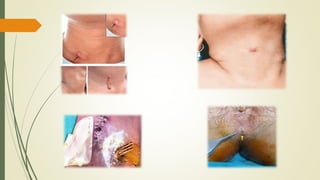
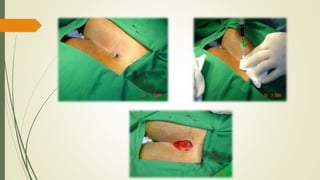
SINUS AND FISTULA
BY
Dr.Surabhi Sushma Reddy
Internee
MGM Hospital, Warangal.
DEFINITION
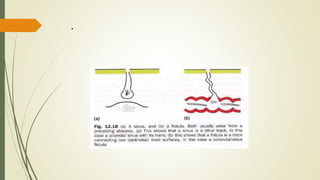
SINUS:
 Blind track lined by granulation tissue leading
from epithelial surface down into the tissues.
 Latin: Hollow (or) a bay
CAUSES
CONGENITAL ACQUIRED
Preauricular sinus TB sinus
Pilonidal sinus
Median mental sinus
Actinomycosis
FISTULA:
 ABNORMAL communication between lumen of one
viscus and lumen of another (INTERNAL FISTULA)
(or)
between lumen of one hollow viscus to the
exterior (EXTERNAL FISTULA)
(or)
between any two vessels
Latin : flute (or) a pipe (or) a tube
.
CAUSES
CONGENITAL
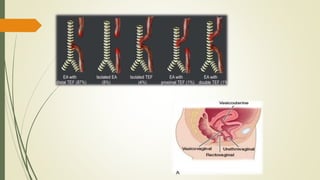
 Branchial fistula
 Tracheo-esophageal
 Umbilical
 Congenital AV fistula
 Thyroglossal fistula
ACQUIRED
I. Traumatic
II. Inflammatory
III.Malignancy
IV.Iatrogenic
ACQUIRED
I. TRAUMATIC:
(A) following surgery : eg., intestinal fistulas
(faecal,biliary,pancreatic)
(B) following instrumental delivery (or) difficult
labour
e.g., vesicovaginal,rectovaginal,
ureterovaginal fistula
II. INFLAMMATORY:
Intestinal actinomycosis, TB
III. MALIGNANCY:
when growth of one organ penetrates into the
nearby organ.
e.g., Rectovesical fistula in carcinoma rectum
IV. IATROGENIC:
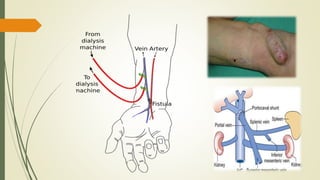
Cimino fistula- AVF for hemodialysis
ECK fistula- to treat esophageal varices in portal HTN
FISTULA
EXTERNAL
 Orocutaneous
 Enterocutaneous
 Appendicular
 Thyroglossal
 Branchial
INTERNAL
 Tracheo-esophageal
 Colovesical
 Rectovesical
 AVF
 Cholecystoduodenal
.
Causes for persistence of sinus (or) fistula
 Presence of a foreign body. e.g., suture material
 Presence of necrotic tissue underneath.
e.g.,sequestrum
 Insufficient (or) non-dependent drainage.
e.g., TB sinus
 Distal obstruction. e.g., faecal (or) biliary fistula
 Persistent drainage like urine/faeces/CSF
 Lack of rest
[contd.]
 Epithelialisation (or) endothelisation of the track.
e.g., AVF
 Malignancy.
 Dense fibrosis
 Irradiation
 Malnutrition
 Specific causes. e.g., TB, actinomycosis
 Ischemia
 Drugs. e.g., steroids
 Interference by the patient
PATHOPHYSIOLOGY
CONGENITAL:
Arise from remnants of embryonic ducts that
persist instead of being obliterated and
disappearing completely during embryonic
development.
e.g., pre-auricular sinus, branchial fistula, TOF,
congenital AVF.
ACQUIRED :
Usually secondary to presence of foreign body,
necrotic tissue in affected area (or) microbial
infection (or) following inadequate drainage of
abscess.
e.g., perianal abscess when bursts spontaneously
into skin forming a sinus and when bursts into both
skin and anal canal forming a fistula.
CLINICAL FEATURES
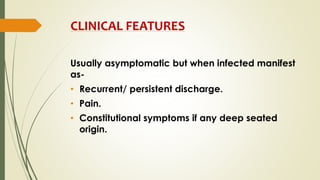
Usually asymptomatic but when infected manifest
as-
• Recurrent/ persistent discharge.
• Pain.
• Constitutional symptoms if any deep seated
origin.
CLINICAL EXAMINATION
INSPECTION:
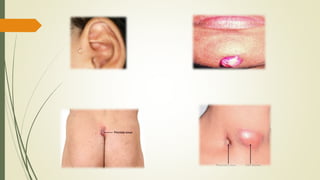
1. Location: usually gives diagnosis in most of the cases.
SINUS: pre-auricular- root of helix of ear.
median mental- symphysis menti.
TB- neck.
FISTULA: branchial- sternomastoid ant border.
parotid- parotid region
thyroglossal- midline of neck below hyoid.
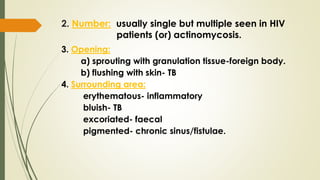
2. Number: usually single but multiple seen in HIV
patients (or) actinomycosis.
3. Opening:
a) sprouting with granulation tissue-foreign body.
b) flushing with skin- TB
4. Surrounding area:
erythematous- inflammatory
bluish- TB
excoriated- faecal
pigmented- chronic sinus/fistulae.
5. Discharge:
 White thin caseous, cheesy like- TB sinus
 Faecal- faecal fistula
 Yellow sulphur granules- actinomycosis
 Bony granules- osteomyelitis
 Yellow purulent- staph. infections
 Thin mucous like- brachial fistula
 Saliva- parotid fistula
Palpation:
a) Temperature and tenderness:
b) Discharge: after application of pressure over the
surrounding area.
c) Induration: present in chronic fistulae/sinus as in
actinomycosis, OM
TB Sinus induration absent.
d) Fixity:
e) Palpation at deeper plane:
lymph nodes- TB
Thickening of bone underneath- OM
INVESTIGATIONS
 CBP- Hb, TLC, DLC, ESR.
 Discharge for C/S , AFB, cytology, Gram staining.
 X-RAY of the part to rule out OM, foreign body.
 X-RAY KUB and USG abdomen in cases of lumbar
fistula to rule out staghorn calculi.
 MRI
 BIOPSY from edge of sinus
 CT Sinusogram
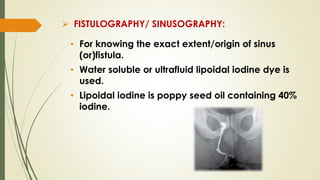
 FISTULOGRAPHY/ SINUSOGRAPHY:
• For knowing the exact extent/origin of sinus
(or)fistula.
• Water soluble or ultrafluid lipoidal iodine dye is
used.
• Lipoidal iodine is poppy seed oil containing 40%
iodine.
TREATMENT
BASIC PRINCIPLES:
 Antibiotics
 Adequate rest
 Adequate excision
 Adequate drainage.
 After excision specimen SHOULD be sent for
HPE.
 Treating the cause.
e.g., ATT for TB sinus.
removal of any foreign body.
sequestrectomy for OM.
TUBERCULAR SINUS OF NECK
Causative organism: mostly M.tuberculosis
but also M.bovis
Site and mode of infection:
a) lymph nodes in anterior triangle from tonsils.
b) lymph nodes in posterior triangle from adenoids.
c) supraclavicular nodes from apex of the lung.
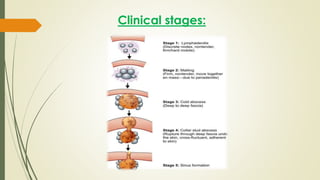
Clinical stages:
Stage of lymphadentis:
non-tender,discrete,mobile,firm lymph nodes
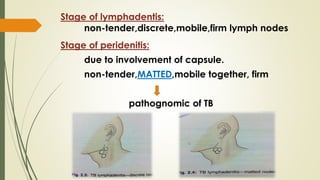
Stage of peridenitis:
due to involvement of capsule.
non-tender,MATTED,mobile together, firm
pathognomic of TB
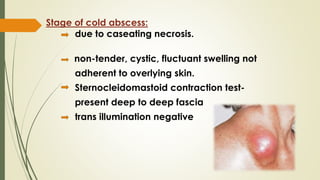
Stage of cold abscess:
due to caseating necrosis.
non-tender, cystic, fluctuant swelling not
adherent to overlying skin.
Sternocleidomastoid contraction test-
present deep to deep fascia
trans illumination negative
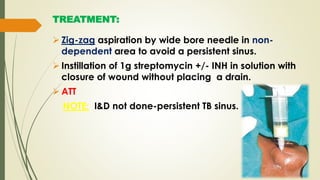
TREATMENT:
 Zig-zag aspiration by wide bore needle in non-
dependent area to avoid a persistent sinus.
 Instillation of 1g streptomycin +/- INH in solution with
closure of wound without placing a drain.
 ATT
NOTE: I&D not done-persistent TB sinus.
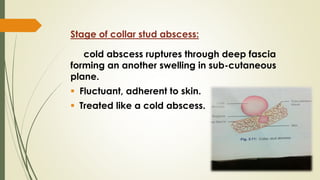
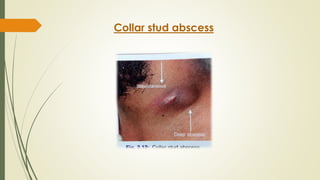
Stage of collar stud abscess:
cold abscess ruptures through deep fascia
forming an another swelling in sub-cutaneous
plane.
 Fluctuant, adherent to skin.
 Treated like a cold abscess.
Collar stud abscess
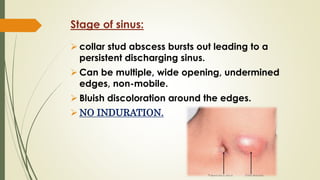
Stage of sinus:
 collar stud abscess bursts out leading to a
persistent discharging sinus.
 Can be multiple, wide opening, undermined
edges, non-mobile.
 Bluish discoloration around the edges.
 NO INDURATION.
INVESTIGATIONS
• Hematocrit, ESR , S.albumin , S.globulin
• FNAC of lymph nodes and smear for AFB and
C/S
• Open node biopsy of lymph nodes.
• Edge biopsy of sinus- granuloma.
• mantoux test
• Chest X ray
• Sputum for AFB
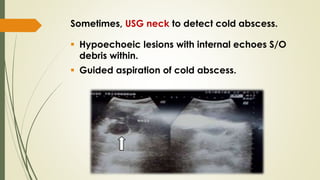
Sometimes, USG neck to detect cold abscess.
 Hypoechoeic lesions with internal echoes S/O
debris within.
 Guided aspiration of cold abscess.
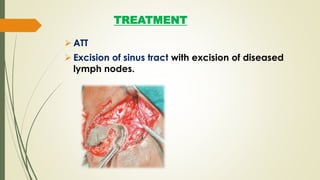
TREATMENT
 ATT
 Excision of sinus tract with excision of diseased
lymph nodes.
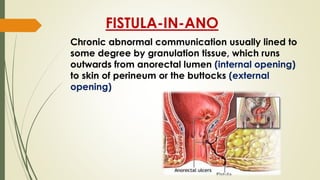
FISTULA-IN-ANO
Chronic abnormal communication usually lined to
some degree by granulation tissue, which runs
outwards from anorectal lumen (internal opening)
to skin of perineum or the buttocks (external
opening)
AETIOPATHOGENESIS
 Cryptoglandular (90% cases)
 Non cryptoglandular (10% cases)
TB
Diabetes mellitus
Crohn’s disease
Carcinoma rectum
Trauma
Lymphogranuloma venereum
Radiotherapy
Immunocompromised patients (HIV etc.,)
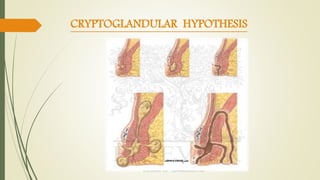
CRYPTOGLANDULAR HYPOTHESIS
CLASSIFICATION
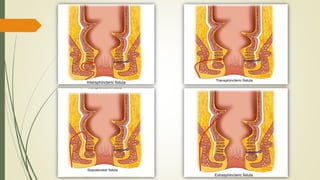
PARK’S CLASSIFICATION:
(relation of primary tract to external sphincter)
• Inter sphincteric (45%)
• Trans sphincteric (40%)
• Supra sphincteric
• Extra sphincteric
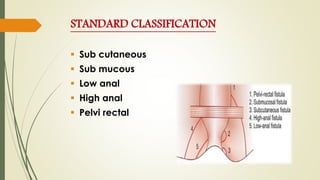
STANDARD CLASSIFICATION
 Sub cutaneous
 Sub mucous
 Low anal
 High anal
 Pelvi rectal
 Can be
low level fistula- open into anal canal below
the internal ring.
high level fistula- at/ above the internal ring.
 Can be
Simple- without any extensions
Complex- with extensions
 Can be
single
multiple- TB, ulcerative colitis, crohn’s, HIV, LGV
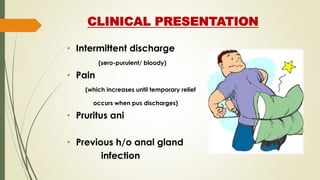
CLINICAL PRESENTATION
• Intermittent discharge
(sero-purulent/ bloody)
• Pain
(which increases until temporary relief
occurs when pus discharges)
• Pruritus ani
• Previous h/o anal gland
infection
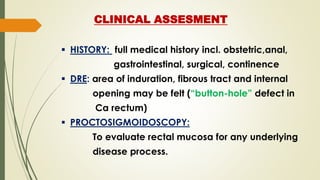
CLINICAL ASSESMENT
 HISTORY: full medical history incl. obstetric,anal,
gastrointestinal, surgical, continence
 DRE: area of induration, fibrous tract and internal
opening may be felt (“button-hole” defect in
Ca rectum)
 PROCTOSIGMOIDOSCOPY:
To evaluate rectal mucosa for any underlying
disease process.
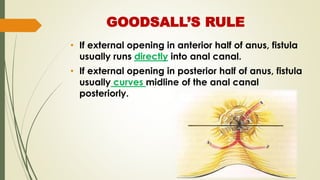
GOODSALL’S RULE
• If external opening in anterior half of anus, fistula
usually runs directly into anal canal.
• If external opening in posterior half of anus, fistula
usually curves midline of the anal canal
posteriorly.
IMAGING
 Fistulography
 Endoanal ultrasound
 MRI
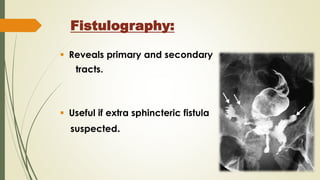
Fistulography:
 Reveals primary and secondary
tracts.
 Useful if extra sphincteric fistula
suspected.
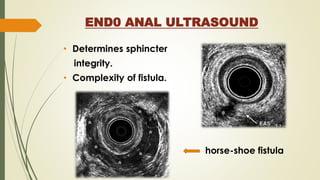
END0 ANAL ULTRASOUND
• Determines sphincter
integrity.
• Complexity of fistula.
horse-shoe fistula
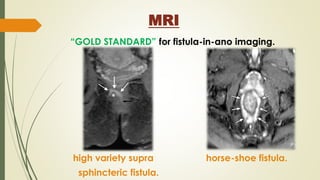
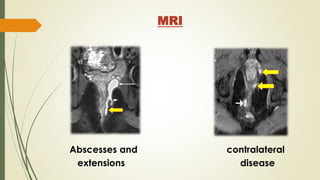
MRI
“GOLD STANDARD” for fistula-in-ano imaging.
high variety supra horse-shoe fistula.
sphincteric fistula.
MRI
Abscesses and contralateral
extensions disease
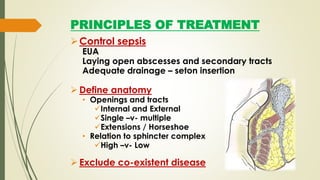
PRINCIPLES OF TREATMENT
Control sepsis
EUA
Laying open abscesses and secondary tracts
Adequate drainage – seton insertion
 Define anatomy
• Openings and tracts
Internal and External
Single –v- multiple
Extensions / Horseshoe
• Relation to sphincter complex
High –v- Low
 Exclude co-existent disease
SURGICAL MANAGEMENT
 Fistulotomy (The laying open technique)
 Fistulectomy
 Seton techniques
 Fibrin glue sphincter preserving
 Anal fistula plug techniques.
 Advancement flap
 LIFT procedure.
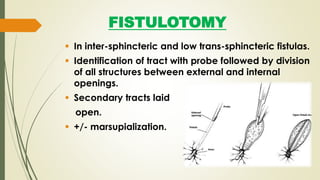
FISTULOTOMY
 In inter-sphincteric and low trans-sphincteric fistulas.
 Identification of tract with probe followed by division
of all structures between external and internal
openings.
 Secondary tracts laid
open.
 +/- marsupialization.
Advantages
least chance of recurrence
relatively easy procedure
minor degree of incontinence.
Risks
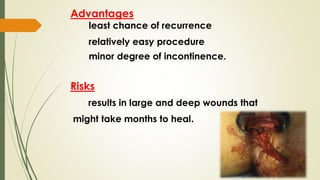
results in large and deep wounds that
might take months to heal.
FISTULECTOMY
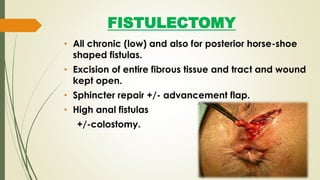
• All chronic (low) and also for posterior horse-shoe
shaped fistulas.
• Excision of entire fibrous tissue and tract and wound
kept open.
• Sphincter repair +/- advancement flap.
• High anal fistulas
+/-colostomy.
SETON SUTURE PLACEMENT
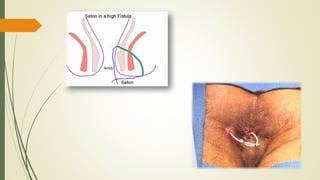
• Preferable surgical option for high variety.
• Setons are usually made from rubber slings
• 2 types of seton suture can be placed
• Draining Seton
Facilitates draining of sepsis
Left loose and allows fistula to heal by fibrosis
• Cutting Seto
Slowly "cheese-wires" though the sphincter muscle
Allows fibrosis to take place behind as it gradually
cuts through
FIBRIN GLUE
 Multi component system containing mainly
human plasma fibrinogen and thrombin.
 Injected into fistula track which hardens in few
minutes and fills the track.
ANAL FISTULA PLUG
 The Anal fistula plug is a minimally invasive and
sphincter-preserving alternative to traditional
fistula surgery.
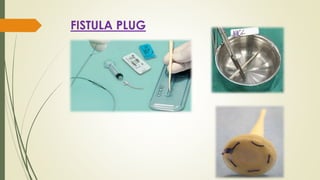
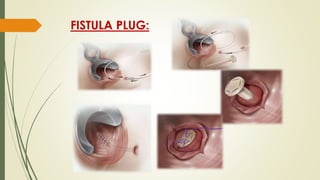
 The plug is a conical device and is placed by
drawing it through the fistula tract and suturing it in
place.
 the plug, once implanted, incorporates naturally
over time into the human tissue (human cells and
tissues will 'grow' into the plug), thus facilitating
the closure of the fistula.
FISTULA PLUG
FISTULA PLUG:
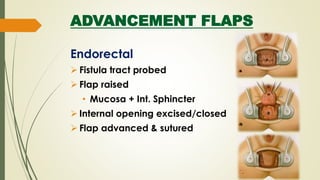
ADVANCEMENT FLAPS
Endorectal
 Fistula tract probed
 Flap raised
• Mucosa + Int. Sphincter
 Internal opening excised/closed
 Flap advanced & sutured
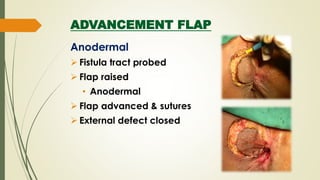
ADVANCEMENT FLAP
Anodermal
 Fistula tract probed
 Flap raised
• Anodermal
 Flap advanced & sutures
 External defect closed
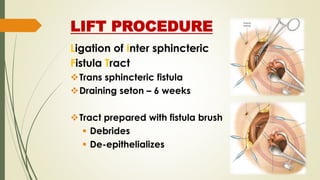
LIFT PROCEDURE
Ligation of Inter sphincteric
Fistula Tract
Trans sphincteric fistula
Draining seton – 6 weeks
Tract prepared with fistula brush
 Debrides
 De-epithelializes
FOLLOW UP
As with most anorectal disorders, follow-up care
includes:
 Perianal baths,
 analgesics for pain,
 stool bulking agents, and
 good perianal hygiene
Sinus and fistula

Sinus and fistula

  • 1.
    SINUS AND FISTULA BY Dr.SurabhiSushma Reddy Internee MGM Hospital, Warangal.
  • 2.
    DEFINITION SINUS:  Blind tracklined by granulation tissue leading from epithelial surface down into the tissues.  Latin: Hollow (or) a bay
  • 3.
    CAUSES CONGENITAL ACQUIRED Preauricular sinusTB sinus Pilonidal sinus Median mental sinus Actinomycosis
  • 4.
    FISTULA:  ABNORMAL communicationbetween lumen of one viscus and lumen of another (INTERNAL FISTULA) (or) between lumen of one hollow viscus to the exterior (EXTERNAL FISTULA) (or) between any two vessels
  • 5.
    Latin : flute(or) a pipe (or) a tube .
  • 6.
    CAUSES CONGENITAL  Branchial fistula Tracheo-esophageal  Umbilical  Congenital AV fistula  Thyroglossal fistula ACQUIRED I. Traumatic II. Inflammatory III.Malignancy IV.Iatrogenic
  • 7.
    ACQUIRED I. TRAUMATIC: (A) followingsurgery : eg., intestinal fistulas (faecal,biliary,pancreatic) (B) following instrumental delivery (or) difficult labour e.g., vesicovaginal,rectovaginal, ureterovaginal fistula
  • 8.
    II. INFLAMMATORY: Intestinal actinomycosis,TB III. MALIGNANCY: when growth of one organ penetrates into the nearby organ. e.g., Rectovesical fistula in carcinoma rectum IV. IATROGENIC: Cimino fistula- AVF for hemodialysis ECK fistula- to treat esophageal varices in portal HTN
  • 10.
    FISTULA EXTERNAL  Orocutaneous  Enterocutaneous Appendicular  Thyroglossal  Branchial INTERNAL  Tracheo-esophageal  Colovesical  Rectovesical  AVF  Cholecystoduodenal
  • 11.
  • 12.
    Causes for persistenceof sinus (or) fistula  Presence of a foreign body. e.g., suture material  Presence of necrotic tissue underneath. e.g.,sequestrum  Insufficient (or) non-dependent drainage. e.g., TB sinus  Distal obstruction. e.g., faecal (or) biliary fistula  Persistent drainage like urine/faeces/CSF  Lack of rest [contd.]
  • 13.
     Epithelialisation (or)endothelisation of the track. e.g., AVF  Malignancy.  Dense fibrosis  Irradiation  Malnutrition  Specific causes. e.g., TB, actinomycosis  Ischemia  Drugs. e.g., steroids  Interference by the patient
  • 14.
    PATHOPHYSIOLOGY CONGENITAL: Arise from remnantsof embryonic ducts that persist instead of being obliterated and disappearing completely during embryonic development. e.g., pre-auricular sinus, branchial fistula, TOF, congenital AVF.
  • 15.
    ACQUIRED : Usually secondaryto presence of foreign body, necrotic tissue in affected area (or) microbial infection (or) following inadequate drainage of abscess. e.g., perianal abscess when bursts spontaneously into skin forming a sinus and when bursts into both skin and anal canal forming a fistula.
  • 17.
    CLINICAL FEATURES Usually asymptomaticbut when infected manifest as- • Recurrent/ persistent discharge. • Pain. • Constitutional symptoms if any deep seated origin.
  • 18.
    CLINICAL EXAMINATION INSPECTION: 1. Location:usually gives diagnosis in most of the cases. SINUS: pre-auricular- root of helix of ear. median mental- symphysis menti. TB- neck. FISTULA: branchial- sternomastoid ant border. parotid- parotid region thyroglossal- midline of neck below hyoid.
  • 21.
    2. Number: usuallysingle but multiple seen in HIV patients (or) actinomycosis. 3. Opening: a) sprouting with granulation tissue-foreign body. b) flushing with skin- TB 4. Surrounding area: erythematous- inflammatory bluish- TB excoriated- faecal pigmented- chronic sinus/fistulae.
  • 22.
    5. Discharge:  Whitethin caseous, cheesy like- TB sinus  Faecal- faecal fistula  Yellow sulphur granules- actinomycosis  Bony granules- osteomyelitis  Yellow purulent- staph. infections  Thin mucous like- brachial fistula  Saliva- parotid fistula
  • 23.
    Palpation: a) Temperature andtenderness: b) Discharge: after application of pressure over the surrounding area. c) Induration: present in chronic fistulae/sinus as in actinomycosis, OM TB Sinus induration absent. d) Fixity: e) Palpation at deeper plane: lymph nodes- TB Thickening of bone underneath- OM
  • 24.
    INVESTIGATIONS  CBP- Hb,TLC, DLC, ESR.  Discharge for C/S , AFB, cytology, Gram staining.  X-RAY of the part to rule out OM, foreign body.  X-RAY KUB and USG abdomen in cases of lumbar fistula to rule out staghorn calculi.  MRI  BIOPSY from edge of sinus  CT Sinusogram
  • 25.
     FISTULOGRAPHY/ SINUSOGRAPHY: •For knowing the exact extent/origin of sinus (or)fistula. • Water soluble or ultrafluid lipoidal iodine dye is used. • Lipoidal iodine is poppy seed oil containing 40% iodine.
  • 26.
    TREATMENT BASIC PRINCIPLES:  Antibiotics Adequate rest  Adequate excision  Adequate drainage.
  • 27.
     After excisionspecimen SHOULD be sent for HPE.  Treating the cause. e.g., ATT for TB sinus. removal of any foreign body. sequestrectomy for OM.
  • 29.
    TUBERCULAR SINUS OFNECK Causative organism: mostly M.tuberculosis but also M.bovis Site and mode of infection: a) lymph nodes in anterior triangle from tonsils. b) lymph nodes in posterior triangle from adenoids. c) supraclavicular nodes from apex of the lung.
  • 30.
  • 31.
    Stage of lymphadentis: non-tender,discrete,mobile,firmlymph nodes Stage of peridenitis: due to involvement of capsule. non-tender,MATTED,mobile together, firm pathognomic of TB
  • 32.
    Stage of coldabscess: due to caseating necrosis. non-tender, cystic, fluctuant swelling not adherent to overlying skin. Sternocleidomastoid contraction test- present deep to deep fascia trans illumination negative
  • 33.
    TREATMENT:  Zig-zag aspirationby wide bore needle in non- dependent area to avoid a persistent sinus.  Instillation of 1g streptomycin +/- INH in solution with closure of wound without placing a drain.  ATT NOTE: I&D not done-persistent TB sinus.
  • 34.
    Stage of collarstud abscess: cold abscess ruptures through deep fascia forming an another swelling in sub-cutaneous plane.  Fluctuant, adherent to skin.  Treated like a cold abscess.
  • 35.
  • 36.
    Stage of sinus: collar stud abscess bursts out leading to a persistent discharging sinus.  Can be multiple, wide opening, undermined edges, non-mobile.  Bluish discoloration around the edges.  NO INDURATION.
  • 37.
    INVESTIGATIONS • Hematocrit, ESR, S.albumin , S.globulin • FNAC of lymph nodes and smear for AFB and C/S • Open node biopsy of lymph nodes. • Edge biopsy of sinus- granuloma. • mantoux test • Chest X ray • Sputum for AFB
  • 38.
    Sometimes, USG neckto detect cold abscess.  Hypoechoeic lesions with internal echoes S/O debris within.  Guided aspiration of cold abscess.
  • 39.
    TREATMENT  ATT  Excisionof sinus tract with excision of diseased lymph nodes.
  • 40.
    FISTULA-IN-ANO Chronic abnormal communicationusually lined to some degree by granulation tissue, which runs outwards from anorectal lumen (internal opening) to skin of perineum or the buttocks (external opening)
  • 41.
    AETIOPATHOGENESIS  Cryptoglandular (90%cases)  Non cryptoglandular (10% cases) TB Diabetes mellitus Crohn’s disease Carcinoma rectum Trauma Lymphogranuloma venereum Radiotherapy Immunocompromised patients (HIV etc.,)
  • 42.
  • 43.
    CLASSIFICATION PARK’S CLASSIFICATION: (relation ofprimary tract to external sphincter) • Inter sphincteric (45%) • Trans sphincteric (40%) • Supra sphincteric • Extra sphincteric
  • 45.
    STANDARD CLASSIFICATION  Subcutaneous  Sub mucous  Low anal  High anal  Pelvi rectal
  • 46.
     Can be lowlevel fistula- open into anal canal below the internal ring. high level fistula- at/ above the internal ring.  Can be Simple- without any extensions Complex- with extensions  Can be single multiple- TB, ulcerative colitis, crohn’s, HIV, LGV
  • 47.
    CLINICAL PRESENTATION • Intermittentdischarge (sero-purulent/ bloody) • Pain (which increases until temporary relief occurs when pus discharges) • Pruritus ani • Previous h/o anal gland infection
  • 48.
    CLINICAL ASSESMENT  HISTORY:full medical history incl. obstetric,anal, gastrointestinal, surgical, continence  DRE: area of induration, fibrous tract and internal opening may be felt (“button-hole” defect in Ca rectum)  PROCTOSIGMOIDOSCOPY: To evaluate rectal mucosa for any underlying disease process.
  • 49.
    GOODSALL’S RULE • Ifexternal opening in anterior half of anus, fistula usually runs directly into anal canal. • If external opening in posterior half of anus, fistula usually curves midline of the anal canal posteriorly.
  • 50.
  • 51.
    Fistulography:  Reveals primaryand secondary tracts.  Useful if extra sphincteric fistula suspected.
  • 52.
    END0 ANAL ULTRASOUND •Determines sphincter integrity. • Complexity of fistula. horse-shoe fistula
  • 53.
    MRI “GOLD STANDARD” forfistula-in-ano imaging. high variety supra horse-shoe fistula. sphincteric fistula.
  • 54.
  • 55.
    PRINCIPLES OF TREATMENT Controlsepsis EUA Laying open abscesses and secondary tracts Adequate drainage – seton insertion  Define anatomy • Openings and tracts Internal and External Single –v- multiple Extensions / Horseshoe • Relation to sphincter complex High –v- Low  Exclude co-existent disease
  • 56.
    SURGICAL MANAGEMENT  Fistulotomy(The laying open technique)  Fistulectomy  Seton techniques  Fibrin glue sphincter preserving  Anal fistula plug techniques.  Advancement flap  LIFT procedure.
  • 57.
    FISTULOTOMY  In inter-sphinctericand low trans-sphincteric fistulas.  Identification of tract with probe followed by division of all structures between external and internal openings.  Secondary tracts laid open.  +/- marsupialization.
  • 58.
    Advantages least chance ofrecurrence relatively easy procedure minor degree of incontinence. Risks results in large and deep wounds that might take months to heal.
  • 59.
    FISTULECTOMY • All chronic(low) and also for posterior horse-shoe shaped fistulas. • Excision of entire fibrous tissue and tract and wound kept open. • Sphincter repair +/- advancement flap. • High anal fistulas +/-colostomy.
  • 60.
    SETON SUTURE PLACEMENT •Preferable surgical option for high variety. • Setons are usually made from rubber slings • 2 types of seton suture can be placed • Draining Seton Facilitates draining of sepsis Left loose and allows fistula to heal by fibrosis • Cutting Seto Slowly "cheese-wires" though the sphincter muscle Allows fibrosis to take place behind as it gradually cuts through
  • 62.
    FIBRIN GLUE  Multicomponent system containing mainly human plasma fibrinogen and thrombin.  Injected into fistula track which hardens in few minutes and fills the track.
  • 63.
    ANAL FISTULA PLUG The Anal fistula plug is a minimally invasive and sphincter-preserving alternative to traditional fistula surgery.  The plug is a conical device and is placed by drawing it through the fistula tract and suturing it in place.  the plug, once implanted, incorporates naturally over time into the human tissue (human cells and tissues will 'grow' into the plug), thus facilitating the closure of the fistula.
  • 64.
  • 65.
  • 66.
    ADVANCEMENT FLAPS Endorectal  Fistulatract probed  Flap raised • Mucosa + Int. Sphincter  Internal opening excised/closed  Flap advanced & sutured
  • 67.
    ADVANCEMENT FLAP Anodermal  Fistulatract probed  Flap raised • Anodermal  Flap advanced & sutures  External defect closed
  • 68.
    LIFT PROCEDURE Ligation ofInter sphincteric Fistula Tract Trans sphincteric fistula Draining seton – 6 weeks Tract prepared with fistula brush  Debrides  De-epithelializes
  • 69.
    FOLLOW UP As withmost anorectal disorders, follow-up care includes:  Perianal baths,  analgesics for pain,  stool bulking agents, and  good perianal hygiene