SKIN ULCERS OVERVIEW
DR OKOYE C.
Outline
• Introduction
• Epidemiology
• Characteristics of an ulcer
• Classification
• Specific ulcers
• Non-Specific Ulcers
• Management
– History
– Examination
– Investigation
– Treatment
• Complications
• Follow-up
• Conclusion
• References
Introduction
• An ulcer is the loss of continuity of the surface
epithelium.
• The underlying tissues may be affected.
• There are several causes of an ulcer but
necrosis or death of the cells is the immediate
cause
Epidemiology
• It accounts for about 25-30% of general plastic
surgery visits in industrialized countries
• In developing countries it constitutes about
35-40% of plastic surgery clinic
• About 80% of the ulcers are in the lower third
of the leg
• In the industrialized countries the commonest
cause are venous, diabetic trauma
• In developing countries the common causes
are infection, trauma, venous
Characteristics of an ulcer
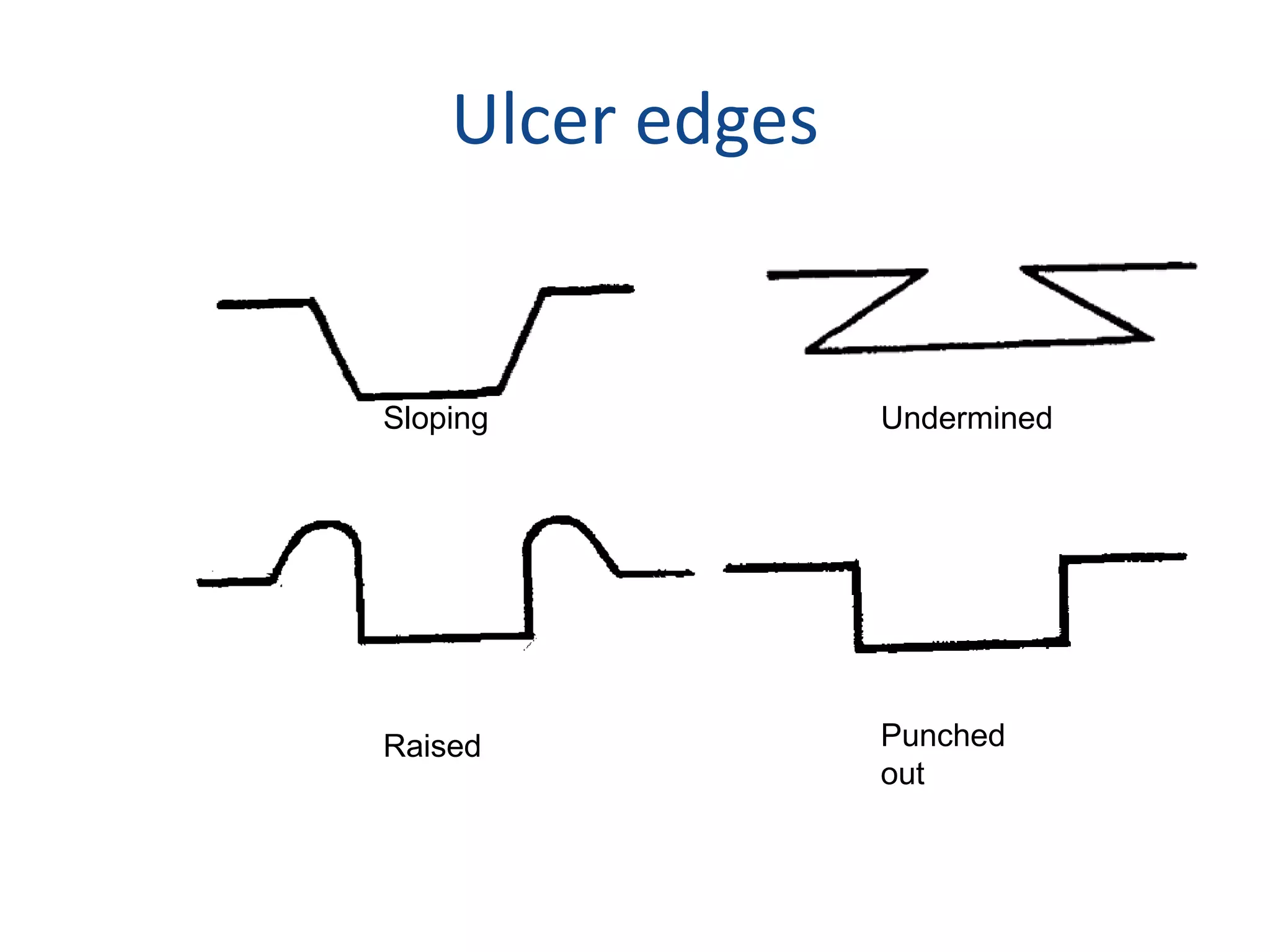
EDGE
It is where the healthy skin (epithelium)begins.
• Sloping in a non-specific ulcers
• Undermined in a Tuberculous ulcers
• Raised in Malignant
• Punched out in syphilis
Ulcer edges
Sloping Undermined
Raised Punched
out
FLOOR:
It is what is seen.
• Sloughing with a profuse, offensive, yellowish
discharge
• Red granulation with a thin serous discharge
• Nodular
BASE:
It is what is palpated.
• It may be indurated or hard (malignant or
longstanding callous ulcer)
Classification of Ulcers
A . Specific ulcers:
• Tropical ulcers.
• Tuberculous ulcers.
• Buruli ulcers.
• Syphilitic ulcers.
• Yaws ulcers.
B. Non-specific ulcers:
• Traumatic ulcers.
• Pyogenic ulcers.
• Ulcers of vascular origin:
(i) Venous (gravitational) ulcers.
(ii) Arterial ulcers.
• Neurotropic (trophic) ulcers:
(i) Leprosy.
(ii) Diabetic neuropathy .
(iii) Cord lesions.
(iv) Peripheral neuropathies.
(v) Syringomyelia.
C. Neoplastic ulcers
• Squamous cell carcinoma.
• Rodent ulcer.
• Malignant melanoma.
• Kaposi's sarcoma.
• Penetrating malignant tumour.
Specific Ulcers
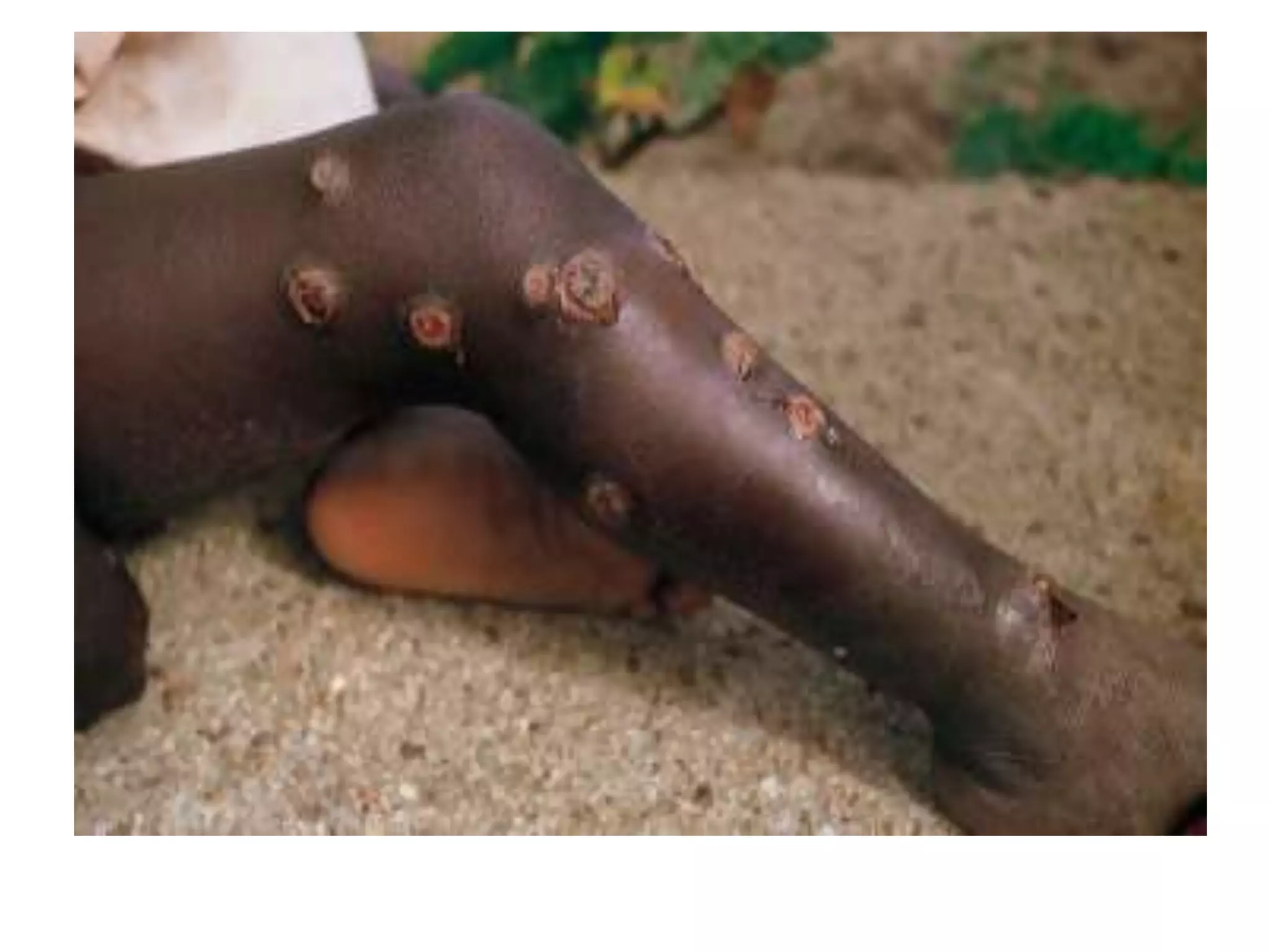
TROPICAL ULCER
• Acute ulcerative cutaneous lesion caused
synergistically by the anaerobic
Fusobacteria(Bacteriodes fusiformis) and the
aerobic Borrelia vincenti.
• Starts as a Painful septic blister which sloughs
to form an ulcer.
Predisposing Factors
• Males
• Poor personal hygiene
• Malnutrition
• Walking barefooted
Pathology
• Painful septic blister or vesicle containing sero-
sanguinous fluid surrounded by oedematous
inflamed skin
• Ruptures after a few days to expose a foul-smelling,
ragged, yellowish brown, grey or black slough of the
skin and subcutaneous tissues
• Lymphadenitis or lymphangitis
• Can affect deeper structures such as muscles and
tendons causing them too to slough off
• Blood vessels, if affected get thrombosed.
• Gangrene may result if it is an end artery.
• Bones------- periostitis.
• The slough with time liquefies, discharges
offensive pus and separates.
• A circular ulcer about 4-l0cm in diameter then
forms
TB ULCER
• Irregular outline and the edges are thin, blue
and undermined
• Floor is covered with pale granulations and
the discharge is thin and watery. The base is
soft.
• There may be satellite sinuses and enlarged
lymph nodes.
• There may be a tuberculous focus in the lung
or bone.
BURULI ULCER
• Mycobacterium ulcerans
• Temperatures lower than central body
temperature- 30-320C.
• This toxin is thought to be responsible for the
necrosis of the dermis and subcutaneous
tissues seen in typical lesions.
Clinical classification
• A. Pre-ulcerative disease
• B. Ulcerative disease
PRE-ULCERATIVE
– Papule
– Nodule PAINLESS
– Plaque
– Oedematous lesions
– Mixed lesions PAINFUL
ULCERATIVE
• Necrotic stage; typical white central plug of
necrotic fat, if not interfered with forms a
necrotic slough.
• Organising Stage: the slough separates leaving
an ulcer with edematous base and
undermined edges.
• Healing Stage: the ulcer at this stage is fairly
clean and healing starts.
SYPHILITIC (GUMMATOUS) ULCER
• It is now uncommon.
• It follows breakdown of a subcutaneous
gumma especially around the knee.
• It has a serpiginous outline because as it heals
in some parts it spreads in others.
YAWS
• Starts as a small erythematous macule which
becomes an enlarging papule up to 5cm wide.
• The skin often ulcerates and exudes a serous
fluid. It heals spontaneously.
• Ulceration and secondary infection may occur.
• Resembling syphilitic ulcers, they are punched
out with sloughing base.
• They heal spontaneously after a few weeks, the
skin over them often becoming depigmented.
The regional lymph nodes are enlarged
B. Non-Specific Ulcers
Skin ulcers go through the following phases.
• 1. Acute or Infective phase:
– Ulcer is painful. The sloughing floor is covered
with purulent discharge in which different types of
bacteria may be identified.
– The edge is sharp and surrounded by damaged
cells. The surrounding skin is oedematous, warm
and tender
• 2. Transition phase:
– The slough separates, the pus drains, infection
subsides, granulation tissue grows and the floor
becomes clean and red.
– The edge, which is sloping, has a thin bluish-white
layer of young epithelium growing inwards.
– The surrounding skin is slightly hyperaemic or
normal.
• 3. Reparative or healing phase;
– The ulcer is now painless. The healthy granulation
tissue fills the floor and the epithelium grows from
the edge.
• 4. Chronic, indolent or callous phase:
– Some ulcers may remain unhealthy for a long
time
– The edges are then ragged, the floor greyish or
creamy pink with profuse offensive discharge, and
the surrounding skin warm and oedematous.
TYPES OF NON-SPECIFIC ULCERS
• 1. TRAUMATIC ULCERS
• 2. PYOGENIC/INFECTIVE ULCERS
• 3. VASCULAR ULCERS
• 4. PRESSURE ULCERS
• 5. NON-SPECIFIC ULCERS ASSOCIATED WITH
METABOLIC OR SYSTEMIC DISEASE
• 6. NEOPLASTIC ULCERS
MANAGEMENT
HISTORY
• Onset and course
• Symptoms
• Medical History
• Family History
• Drug History
• Personal Habits
PHYSICAL EXAM
• General
• Peripheral
neuropathy
• Peripheral pulses
• Regional LNs
2. Clinical Examination
• (a) Ulcer:
• (i) Number:- Multiple ulcers may be due to
Kaposi’s sarcoma, yaws, spherocytosis, ulcerative
colitis or self inflicted injuries
• (ii) Anatomical site: - An ulcer near the medial
malleolus may be venous, traumatic or due to
SCDx
• One in the groin or neck is probably tuberculous.
• (iii) The size.
• (iv) The shape; whether round, oval, irregular or
serpiginous (syphilitic).
• (v) Edge:-This is the most important part of the ulcer.
– Sloping edge - non-specific ulcer.
– Raised and everted -malignant ulcer.
– Raised and rolled - rodent ulcer.
– Undermined- tuberculous or Buruli ulcer.
– Punched out – syphilitic or yaws.
• (vi) Floor - whether sloughy and discharging;
clean and pink (healing) or nodular
(malignant). Type of discharge is also noted.
• (vii) Base - whether slightly indurated as in
chronic nonspecific ulcer or indurated and
fixed as in carcinoma or callous non-specific
ulcer.
• (viii) The surrounding skin - whether it is inflamed or
pigmented.
• (ix) The state of local circulation - presence of dilated
veins. Oedema of tissues, temperature and colour
of skin or toe nails.
• (x) State of innervation - any loss of sensation or
motor function.
• (xii) Regional lymph nodes - this is important
especially in carcinomatous ulcers. If enlarged,
tender or mobile
INVESTIGATIONS
• BLOOD
– VDRL
– RBS
– HB GENOTYPE
– FBC
– MANTOUX
– EUCr
– SERUM PROTEIN/ ALBUMIN
• BACTERIOLOGY– Wound swab & biopsy
• HISTOPATHOLOGY- WEDGE BIOPSY
• ANKLE BRACHIAL PRESSURE INDEX
• RADIOLOGY
– DUPLEX DOPPLER SCANNING
– CHEST XRAY
– CT
– MRI
TREATMENT (Specific ulcers)
• Acute
– Tropical
– Admit
– Antibiotics
– Sloughectomy [surgical or non-operative].TT,SPLINTING,PHYSIO
• Chronic
– Tuberculous
– Antituberculous regimen
– Syphilitic
– Penicillin
– Buruli
– Medical
– Antituberculous drug
– Heat treatment
– Surgical
– Pre-ulcerative –nodulectomy, wide excision
– Ulcerative –debridement, split skin graft/flap
TREATMENT (Non-specific ulcers)
• Acute
– Admit, bed rest and elevate affected limb
– Broad-spectrum antibiotics and Antitetanus.
– Wound dressings
– The affected limb is splinted in the position of function to
prevent formation of contracture.
– Physiotherapy is started early to prevent wastage of muscle
and contractures.
– Once the ulcer becomes healthy, it is covered appropriately
• Chronic
– Wide excision
– Skin graft/flap
Others
 Trauma
• Wound debridement
• Regular wound dressing
• Medication: antibiotics, analgesics, antitetanus
• Skin wound closure
 Infective
◦ Appropriate antibiotics
◦ Wound debridement
 Venous
◦ Conservative
 Elevation
 Compression-compression stocking, supportive bandage
◦ Surgical
 Superficial vein stripping
 Ligation of incompetent valves/perforators
 Arterial
◦ Trans-luminal angioplasty
◦ Endarterectomy
◦ Arterial grafting
 Neuropathic:
◦ Regular wound dressing
◦ Treat underlying condition, if treatable
 Diabetic
◦ Control diabetes
◦ Give antibiotics to prevent infections
◦ Wound dressing with sugar/honey
◦ Skin graft
 Haemoglobinopathy
◦ Difficult to treat
◦ Bed rest
◦ Exchange blood transfusion, folic acid
◦ Anti-malarial drugs
◦ Prevent precipitating factors
 Malignant
◦ Treat underlying cause
Complications
• Recurrence
• Septicemia
• Wasting
• Osteomyelitis
• Periostitis
• Gangrene
• Tetanus
• Contracture
• Non healing
Follow up
• 1. the patient is advised to protect the affected
skin for example- the legs and feet by wearing
comfortable socks and shoes.
• 2. Farmers are advised to wear protective
clothing and boots.
• 3. Advised about proper foot hygiene.
• 4. Where there is extensive scarring, the patient
is advised to continue wearing medical stocking
or crepe bandage.
• 5. To seek prompt attention for any abrasion or
laceration to the affected skin.
Conclusion
• Management of patients with skin ulcers has
to be multidisciplinary.
• Should include detailed history, physical
examination, investigations, basic and newer
treatment modalities.
• While educating patients on issues of correct
skin care and the importance of seeking early
medical advice.
References
• O. Amir, A. Liu, and A. L. S. Chang, “Stratification of highest-risk patients
with chronic skin ulcers in a Stanford retrospective cohort includes
diabetes, need for systemic antibiotics, and albumin levels,” Ulcers, vol.
2012, Article ID 767861, 7 pages, 2012.
• C. K. Sen, G. M. Gordillo, S. Roy et al., “Human skin wounds: a major and
snowballing threat to public health and the economy,” Wound Repair and
Regeneration, vol. 17, no. 6, pp. 763–771, 2009.
• Oluwatosin OM. Wounds and Wound Healing.In Oluwatosin OM ed.
Methods of Repair.Abeokuta.Sagaf Publishers 2007. 6thedition.
•THANK YOU.

Skin Ulcers Overview ppt

  • 1.
  • 2.
    Outline • Introduction • Epidemiology •Characteristics of an ulcer • Classification • Specific ulcers • Non-Specific Ulcers • Management – History – Examination – Investigation – Treatment • Complications • Follow-up • Conclusion • References
  • 3.
    Introduction • An ulceris the loss of continuity of the surface epithelium. • The underlying tissues may be affected. • There are several causes of an ulcer but necrosis or death of the cells is the immediate cause
  • 4.
    Epidemiology • It accountsfor about 25-30% of general plastic surgery visits in industrialized countries • In developing countries it constitutes about 35-40% of plastic surgery clinic • About 80% of the ulcers are in the lower third of the leg • In the industrialized countries the commonest cause are venous, diabetic trauma • In developing countries the common causes are infection, trauma, venous
  • 5.
    Characteristics of anulcer EDGE It is where the healthy skin (epithelium)begins. • Sloping in a non-specific ulcers • Undermined in a Tuberculous ulcers • Raised in Malignant • Punched out in syphilis
  • 6.
  • 7.
    FLOOR: It is whatis seen. • Sloughing with a profuse, offensive, yellowish discharge • Red granulation with a thin serous discharge • Nodular
  • 8.
    BASE: It is whatis palpated. • It may be indurated or hard (malignant or longstanding callous ulcer)
  • 9.
    Classification of Ulcers A. Specific ulcers: • Tropical ulcers. • Tuberculous ulcers. • Buruli ulcers. • Syphilitic ulcers. • Yaws ulcers.
  • 10.
    B. Non-specific ulcers: •Traumatic ulcers. • Pyogenic ulcers. • Ulcers of vascular origin: (i) Venous (gravitational) ulcers. (ii) Arterial ulcers.
  • 11.
    • Neurotropic (trophic)ulcers: (i) Leprosy. (ii) Diabetic neuropathy . (iii) Cord lesions. (iv) Peripheral neuropathies. (v) Syringomyelia.
  • 12.
    C. Neoplastic ulcers •Squamous cell carcinoma. • Rodent ulcer. • Malignant melanoma. • Kaposi's sarcoma. • Penetrating malignant tumour.
  • 13.
    Specific Ulcers TROPICAL ULCER •Acute ulcerative cutaneous lesion caused synergistically by the anaerobic Fusobacteria(Bacteriodes fusiformis) and the aerobic Borrelia vincenti. • Starts as a Painful septic blister which sloughs to form an ulcer.
  • 14.
    Predisposing Factors • Males •Poor personal hygiene • Malnutrition • Walking barefooted
  • 15.
    Pathology • Painful septicblister or vesicle containing sero- sanguinous fluid surrounded by oedematous inflamed skin • Ruptures after a few days to expose a foul-smelling, ragged, yellowish brown, grey or black slough of the skin and subcutaneous tissues • Lymphadenitis or lymphangitis • Can affect deeper structures such as muscles and tendons causing them too to slough off
  • 16.
    • Blood vessels,if affected get thrombosed. • Gangrene may result if it is an end artery. • Bones------- periostitis. • The slough with time liquefies, discharges offensive pus and separates. • A circular ulcer about 4-l0cm in diameter then forms
  • 17.
    TB ULCER • Irregularoutline and the edges are thin, blue and undermined • Floor is covered with pale granulations and the discharge is thin and watery. The base is soft. • There may be satellite sinuses and enlarged lymph nodes. • There may be a tuberculous focus in the lung or bone.
  • 18.
    BURULI ULCER • Mycobacteriumulcerans • Temperatures lower than central body temperature- 30-320C. • This toxin is thought to be responsible for the necrosis of the dermis and subcutaneous tissues seen in typical lesions.
  • 19.
    Clinical classification • A.Pre-ulcerative disease • B. Ulcerative disease PRE-ULCERATIVE – Papule – Nodule PAINLESS – Plaque – Oedematous lesions – Mixed lesions PAINFUL
  • 20.
    ULCERATIVE • Necrotic stage;typical white central plug of necrotic fat, if not interfered with forms a necrotic slough. • Organising Stage: the slough separates leaving an ulcer with edematous base and undermined edges. • Healing Stage: the ulcer at this stage is fairly clean and healing starts.
  • 21.
    SYPHILITIC (GUMMATOUS) ULCER •It is now uncommon. • It follows breakdown of a subcutaneous gumma especially around the knee. • It has a serpiginous outline because as it heals in some parts it spreads in others.
  • 22.
    YAWS • Starts asa small erythematous macule which becomes an enlarging papule up to 5cm wide. • The skin often ulcerates and exudes a serous fluid. It heals spontaneously. • Ulceration and secondary infection may occur. • Resembling syphilitic ulcers, they are punched out with sloughing base. • They heal spontaneously after a few weeks, the skin over them often becoming depigmented. The regional lymph nodes are enlarged
  • 24.
    B. Non-Specific Ulcers Skinulcers go through the following phases. • 1. Acute or Infective phase: – Ulcer is painful. The sloughing floor is covered with purulent discharge in which different types of bacteria may be identified. – The edge is sharp and surrounded by damaged cells. The surrounding skin is oedematous, warm and tender
  • 25.
    • 2. Transitionphase: – The slough separates, the pus drains, infection subsides, granulation tissue grows and the floor becomes clean and red. – The edge, which is sloping, has a thin bluish-white layer of young epithelium growing inwards. – The surrounding skin is slightly hyperaemic or normal.
  • 26.
    • 3. Reparativeor healing phase; – The ulcer is now painless. The healthy granulation tissue fills the floor and the epithelium grows from the edge.
  • 27.
    • 4. Chronic,indolent or callous phase: – Some ulcers may remain unhealthy for a long time – The edges are then ragged, the floor greyish or creamy pink with profuse offensive discharge, and the surrounding skin warm and oedematous.
  • 28.
    TYPES OF NON-SPECIFICULCERS • 1. TRAUMATIC ULCERS • 2. PYOGENIC/INFECTIVE ULCERS • 3. VASCULAR ULCERS • 4. PRESSURE ULCERS • 5. NON-SPECIFIC ULCERS ASSOCIATED WITH METABOLIC OR SYSTEMIC DISEASE • 6. NEOPLASTIC ULCERS
  • 29.
    MANAGEMENT HISTORY • Onset andcourse • Symptoms • Medical History • Family History • Drug History • Personal Habits PHYSICAL EXAM • General • Peripheral neuropathy • Peripheral pulses • Regional LNs
  • 30.
    2. Clinical Examination •(a) Ulcer: • (i) Number:- Multiple ulcers may be due to Kaposi’s sarcoma, yaws, spherocytosis, ulcerative colitis or self inflicted injuries • (ii) Anatomical site: - An ulcer near the medial malleolus may be venous, traumatic or due to SCDx • One in the groin or neck is probably tuberculous.
  • 31.
    • (iii) Thesize. • (iv) The shape; whether round, oval, irregular or serpiginous (syphilitic). • (v) Edge:-This is the most important part of the ulcer. – Sloping edge - non-specific ulcer. – Raised and everted -malignant ulcer. – Raised and rolled - rodent ulcer. – Undermined- tuberculous or Buruli ulcer. – Punched out – syphilitic or yaws.
  • 32.
    • (vi) Floor- whether sloughy and discharging; clean and pink (healing) or nodular (malignant). Type of discharge is also noted. • (vii) Base - whether slightly indurated as in chronic nonspecific ulcer or indurated and fixed as in carcinoma or callous non-specific ulcer.
  • 33.
    • (viii) Thesurrounding skin - whether it is inflamed or pigmented. • (ix) The state of local circulation - presence of dilated veins. Oedema of tissues, temperature and colour of skin or toe nails. • (x) State of innervation - any loss of sensation or motor function. • (xii) Regional lymph nodes - this is important especially in carcinomatous ulcers. If enlarged, tender or mobile
  • 34.
    INVESTIGATIONS • BLOOD – VDRL –RBS – HB GENOTYPE – FBC – MANTOUX – EUCr – SERUM PROTEIN/ ALBUMIN
  • 35.
    • BACTERIOLOGY– Woundswab & biopsy • HISTOPATHOLOGY- WEDGE BIOPSY • ANKLE BRACHIAL PRESSURE INDEX • RADIOLOGY – DUPLEX DOPPLER SCANNING – CHEST XRAY – CT – MRI
  • 36.
    TREATMENT (Specific ulcers) •Acute – Tropical – Admit – Antibiotics – Sloughectomy [surgical or non-operative].TT,SPLINTING,PHYSIO • Chronic – Tuberculous – Antituberculous regimen – Syphilitic – Penicillin – Buruli – Medical – Antituberculous drug – Heat treatment – Surgical – Pre-ulcerative –nodulectomy, wide excision – Ulcerative –debridement, split skin graft/flap
  • 37.
    TREATMENT (Non-specific ulcers) •Acute – Admit, bed rest and elevate affected limb – Broad-spectrum antibiotics and Antitetanus. – Wound dressings – The affected limb is splinted in the position of function to prevent formation of contracture. – Physiotherapy is started early to prevent wastage of muscle and contractures. – Once the ulcer becomes healthy, it is covered appropriately • Chronic – Wide excision – Skin graft/flap
  • 38.
    Others  Trauma • Wounddebridement • Regular wound dressing • Medication: antibiotics, analgesics, antitetanus • Skin wound closure  Infective ◦ Appropriate antibiotics ◦ Wound debridement
  • 39.
     Venous ◦ Conservative Elevation  Compression-compression stocking, supportive bandage ◦ Surgical  Superficial vein stripping  Ligation of incompetent valves/perforators  Arterial ◦ Trans-luminal angioplasty ◦ Endarterectomy ◦ Arterial grafting
  • 40.
     Neuropathic: ◦ Regularwound dressing ◦ Treat underlying condition, if treatable  Diabetic ◦ Control diabetes ◦ Give antibiotics to prevent infections ◦ Wound dressing with sugar/honey ◦ Skin graft  Haemoglobinopathy ◦ Difficult to treat ◦ Bed rest ◦ Exchange blood transfusion, folic acid ◦ Anti-malarial drugs ◦ Prevent precipitating factors  Malignant ◦ Treat underlying cause
  • 41.
    Complications • Recurrence • Septicemia •Wasting • Osteomyelitis • Periostitis • Gangrene • Tetanus • Contracture • Non healing
  • 42.
    Follow up • 1.the patient is advised to protect the affected skin for example- the legs and feet by wearing comfortable socks and shoes. • 2. Farmers are advised to wear protective clothing and boots. • 3. Advised about proper foot hygiene. • 4. Where there is extensive scarring, the patient is advised to continue wearing medical stocking or crepe bandage. • 5. To seek prompt attention for any abrasion or laceration to the affected skin.
  • 43.
    Conclusion • Management ofpatients with skin ulcers has to be multidisciplinary. • Should include detailed history, physical examination, investigations, basic and newer treatment modalities. • While educating patients on issues of correct skin care and the importance of seeking early medical advice.
  • 44.
    References • O. Amir,A. Liu, and A. L. S. Chang, “Stratification of highest-risk patients with chronic skin ulcers in a Stanford retrospective cohort includes diabetes, need for systemic antibiotics, and albumin levels,” Ulcers, vol. 2012, Article ID 767861, 7 pages, 2012. • C. K. Sen, G. M. Gordillo, S. Roy et al., “Human skin wounds: a major and snowballing threat to public health and the economy,” Wound Repair and Regeneration, vol. 17, no. 6, pp. 763–771, 2009. • Oluwatosin OM. Wounds and Wound Healing.In Oluwatosin OM ed. Methods of Repair.Abeokuta.Sagaf Publishers 2007. 6thedition.
  • 47.