Typhoid fever
Dr. Shubhangi S. Kshirsagar
Assistant professor
Department of Swasthavritta & Yoga
drssksagar@gmail.com
Typhoid fever
▪ Typhoid fever is the result of systemic infection
mainly by S. typhi found only in man.
▪ The disease is clinically characterized by a
typical continuous fever for 3 to 4 weeks
relative bradycardia with involvement of
lymphoid tissue and considerable
constitutional symptoms.
▪ The term “enteric fever” includes both typhoid
and paratyphoid fevers.
▪ It may occur sporadically, epidemically or
endemically
Agent factors
1. Agent
▪ S. typhi is the major cause of enteric fever.
▪ S. para A and S. para B are relatively
infrequent
▪ S. Typhi has three main antigens O, H and Vi
and a number of phage types (at least 80).
▪ S. typhi survives intracellularly in the tissues of
various organs.
▪ It is readily killed by drying, pasteurization, and
common disinfectants.
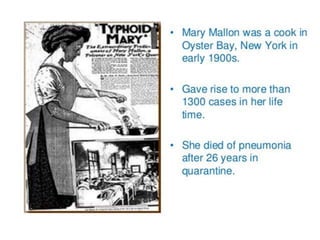
2. Reservoir of infection
Human is the only reservoir of infection.
a. Cases
▪ The case may be
mild, missed or
severe.
▪ A case (or
carrier) is
infectious as
long as bacilli
appear in stools
or urine.
b. Carriers
▪ Temporary
(incubatory,
convalescent) or
chronic.
▪ Convalescent carriers
excrete the bacilli for 6
to 8 weeks.
▪ Chronic carrier
excretes basilli for
3. Source of infection
▪ The primary sources of infection are faeces
and urine of cases or carriers
▪ The secondary sources contaminated water,
food, fingers and flies.
Host factors
1. Age – Highest incidence in the 5-19 yrs of age
group.
2. Sex – More in males than female, but carrier rate
more in females
3. Immunity –
▪ All ages are susceptible to infection.
▪ Antibody may be stimulated by the infection or by
immunization.
▪ The antibody to the somatic antigen (O) is usually
higher in the patient with the disease and the
antibody to the flagellar antigen (H) is usually
higher in immunized individuals.
Environmental factors
▪ Peak incidence in July –September
▪ Outside the human body, bacilli found in water, ice, food,
milk and soil
✓ Water – survive for 7 days, but do not multiply
✓ Ice & icecream – survive for over a month
✓ Soil – survive for upto 70 days in soil irrigated with
sewage
✓ Food – multiply & survive for sometime
✓ Milk – grows rapidly
▪ Vegetable grows in sewage farm
▪ Social factors – pollution of drinking water supplies, open
air defecation and urination, low standards of food and
personal hygiene and health ignorance.
▪ Typhoid fever may therefore be regarded as an index of
Incubation period
▪ Usually 10-14 days.
▪ But it may be as short as 3 days or as long
as three weeks depending upon the dose of
the bacilli ingested.
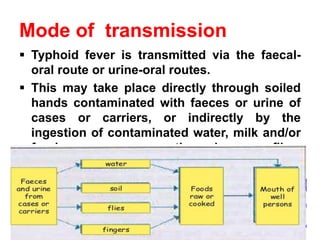
Mode of transmission
▪ Typhoid fever is transmitted via the faecal-
oral route or urine-oral routes.
▪ This may take place directly through soiled
hands contaminated with faeces or urine of
cases or carriers, or indirectly by the
ingestion of contaminated water, milk and/or
food, or through flies.
Clinical features
▪ Malaise, headache, cough and sore throat,
often with abdominal pain and constipation.
▪ The fever ascends in a step-ladder fashion.
▪ After about 7-10 days, the fever reaches a
plateau and the patient looks toxic,
appearing exhausted and often prostrated.
▪ There may be marked constipation,
especially in early stage or pea soup
diarrhoea.
▪ Later, splenomegaly, abdominal distension
and tenderness, relative bradycardia, dicrotic
pulse, and occasionally meningismus
appear.
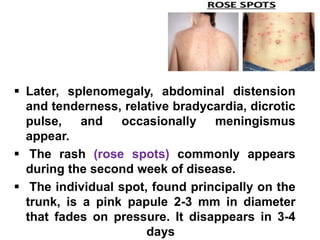
▪ The rash (rose spots) commonly appears
during the second week of disease.
▪ The individual spot, found principally on the
trunk, is a pink papule 2-3 mm in diameter
that fades on pressure. It disappears in 3-4
days
▪ Serious complications occur in up to 10 per
cent of
typhoid fever patients, especially in those
who have been ill longer than 2 weeks, and
who have not received proper treatment.
▪ Intestinal haemorrhage is manifested by a
sudden
drop in temperature and signs of shock,
followed by dark or fresh blood in the stool.
▪ Intestinal perforation is most likely to occur
during the third week.
▪ Less frequent complications are urinary
retention, pneumonia, thrombophlebitis,
Laboratory diagnosis
1. Microbiological procedure –blood culture
2. Serological procedure – Felix-Widal test
3. New diagnostic tests –
▪ IDL tubex
▪ Typhidot
▪ Typhidot-M
▪ Typhidot rapid
▪ IgM dipstick test
Control of typhoid fever
1. Control of reservoir
2. Control of sanitation
3. Immunization
Control of reservoir
a. Case
1. Early diagnosis by culture of blood & stool
2. Notification – where it is mandatory
3. Isolation - till 3 bacteriologically negative stool
& urine reports
4. Treatment – fluoroquinolones drug of choice
5. Disinfection of stool & urine by 5% cresol for 2
hours and soiled cloths by 2% chlorine.
6. Follow-up examination of stools and urine
should be done for S. typhi 3 to 4 months after
discharge of the patient and again after 12
months to prevent the development of the
b. Carriers
1. Identification by cultural and serological
exam
2. Treatment – intensive course of ampicillin
or amoxycillin with probenecid for 6 weeks
3. Surgery – Chlolecystectomy if needed
4. Kept under Surveillance, They should be
prevented from handling food, milk or water
for others.
5. Health education regarding washing of
hands with soap, after defecation or
urination, and before preparing food is an
2. Control of sanitation
▪ Essential measures to interrupt transmission
of typhoid fever are –
a. Protection and purification of drinking water
supplies
b. Improvement of basic sanitation
c. Promotion of food hygiene
3. Immunization
▪ Immunization is recommended to -
✓ Those living in endemic areas
✓ Household contacts
✓ Groups at risk of infection such as school
children and hospital staff
✓ Travelers proceeding to endemic areas
✓ Those attending melas and yatras.
▪ Anti-typhoid vaccine -
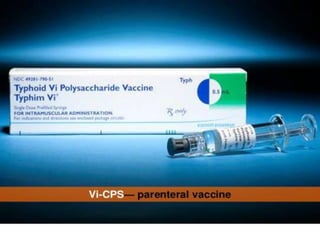
1. Vi polysaccharide vaccine
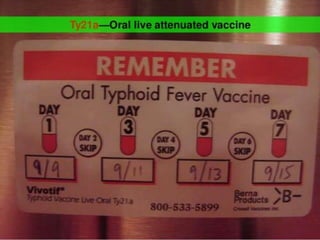
2. Ty 21 a vaccine
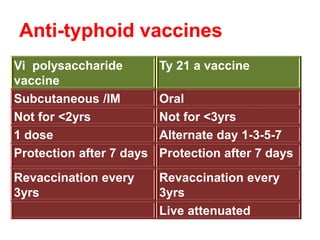
Anti-typhoid vaccines
Vi polysaccharide
vaccine
Ty 21 a vaccine
Subcutaneous /IM Oral
Not for <2yrs Not for <3yrs
1 dose Alternate day 1-3-5-7
Protection after 7 days Protection after 7 days
Revaccination every
3yrs
Revaccination every
3yrs
Live attenuated
Thank You !

Typhoid fever

  • 1.
    Typhoid fever Dr. ShubhangiS. Kshirsagar Assistant professor Department of Swasthavritta & Yoga drssksagar@gmail.com
  • 2.
    Typhoid fever ▪ Typhoidfever is the result of systemic infection mainly by S. typhi found only in man. ▪ The disease is clinically characterized by a typical continuous fever for 3 to 4 weeks relative bradycardia with involvement of lymphoid tissue and considerable constitutional symptoms. ▪ The term “enteric fever” includes both typhoid and paratyphoid fevers. ▪ It may occur sporadically, epidemically or endemically
  • 3.
    Agent factors 1. Agent ▪S. typhi is the major cause of enteric fever. ▪ S. para A and S. para B are relatively infrequent ▪ S. Typhi has three main antigens O, H and Vi and a number of phage types (at least 80). ▪ S. typhi survives intracellularly in the tissues of various organs. ▪ It is readily killed by drying, pasteurization, and common disinfectants.
  • 4.
    2. Reservoir ofinfection Human is the only reservoir of infection. a. Cases ▪ The case may be mild, missed or severe. ▪ A case (or carrier) is infectious as long as bacilli appear in stools or urine. b. Carriers ▪ Temporary (incubatory, convalescent) or chronic. ▪ Convalescent carriers excrete the bacilli for 6 to 8 weeks. ▪ Chronic carrier excretes basilli for
  • 6.
    3. Source ofinfection ▪ The primary sources of infection are faeces and urine of cases or carriers ▪ The secondary sources contaminated water, food, fingers and flies.
  • 7.
    Host factors 1. Age– Highest incidence in the 5-19 yrs of age group. 2. Sex – More in males than female, but carrier rate more in females 3. Immunity – ▪ All ages are susceptible to infection. ▪ Antibody may be stimulated by the infection or by immunization. ▪ The antibody to the somatic antigen (O) is usually higher in the patient with the disease and the antibody to the flagellar antigen (H) is usually higher in immunized individuals.
  • 8.
    Environmental factors ▪ Peakincidence in July –September ▪ Outside the human body, bacilli found in water, ice, food, milk and soil ✓ Water – survive for 7 days, but do not multiply ✓ Ice & icecream – survive for over a month ✓ Soil – survive for upto 70 days in soil irrigated with sewage ✓ Food – multiply & survive for sometime ✓ Milk – grows rapidly ▪ Vegetable grows in sewage farm ▪ Social factors – pollution of drinking water supplies, open air defecation and urination, low standards of food and personal hygiene and health ignorance. ▪ Typhoid fever may therefore be regarded as an index of
  • 9.
    Incubation period ▪ Usually10-14 days. ▪ But it may be as short as 3 days or as long as three weeks depending upon the dose of the bacilli ingested.
  • 10.
    Mode of transmission ▪Typhoid fever is transmitted via the faecal- oral route or urine-oral routes. ▪ This may take place directly through soiled hands contaminated with faeces or urine of cases or carriers, or indirectly by the ingestion of contaminated water, milk and/or food, or through flies.
  • 11.
    Clinical features ▪ Malaise,headache, cough and sore throat, often with abdominal pain and constipation. ▪ The fever ascends in a step-ladder fashion. ▪ After about 7-10 days, the fever reaches a plateau and the patient looks toxic, appearing exhausted and often prostrated. ▪ There may be marked constipation, especially in early stage or pea soup diarrhoea.
  • 12.
    ▪ Later, splenomegaly,abdominal distension and tenderness, relative bradycardia, dicrotic pulse, and occasionally meningismus appear. ▪ The rash (rose spots) commonly appears during the second week of disease. ▪ The individual spot, found principally on the trunk, is a pink papule 2-3 mm in diameter that fades on pressure. It disappears in 3-4 days
  • 13.
    ▪ Serious complicationsoccur in up to 10 per cent of typhoid fever patients, especially in those who have been ill longer than 2 weeks, and who have not received proper treatment. ▪ Intestinal haemorrhage is manifested by a sudden drop in temperature and signs of shock, followed by dark or fresh blood in the stool. ▪ Intestinal perforation is most likely to occur during the third week. ▪ Less frequent complications are urinary retention, pneumonia, thrombophlebitis,
  • 14.
    Laboratory diagnosis 1. Microbiologicalprocedure –blood culture 2. Serological procedure – Felix-Widal test 3. New diagnostic tests – ▪ IDL tubex ▪ Typhidot ▪ Typhidot-M ▪ Typhidot rapid ▪ IgM dipstick test
  • 15.
    Control of typhoidfever 1. Control of reservoir 2. Control of sanitation 3. Immunization
  • 16.
    Control of reservoir a.Case 1. Early diagnosis by culture of blood & stool 2. Notification – where it is mandatory 3. Isolation - till 3 bacteriologically negative stool & urine reports 4. Treatment – fluoroquinolones drug of choice 5. Disinfection of stool & urine by 5% cresol for 2 hours and soiled cloths by 2% chlorine. 6. Follow-up examination of stools and urine should be done for S. typhi 3 to 4 months after discharge of the patient and again after 12 months to prevent the development of the
  • 17.
    b. Carriers 1. Identificationby cultural and serological exam 2. Treatment – intensive course of ampicillin or amoxycillin with probenecid for 6 weeks 3. Surgery – Chlolecystectomy if needed 4. Kept under Surveillance, They should be prevented from handling food, milk or water for others. 5. Health education regarding washing of hands with soap, after defecation or urination, and before preparing food is an
  • 18.
    2. Control ofsanitation ▪ Essential measures to interrupt transmission of typhoid fever are – a. Protection and purification of drinking water supplies b. Improvement of basic sanitation c. Promotion of food hygiene
  • 19.
    3. Immunization ▪ Immunizationis recommended to - ✓ Those living in endemic areas ✓ Household contacts ✓ Groups at risk of infection such as school children and hospital staff ✓ Travelers proceeding to endemic areas ✓ Those attending melas and yatras. ▪ Anti-typhoid vaccine - 1. Vi polysaccharide vaccine 2. Ty 21 a vaccine
  • 20.
    Anti-typhoid vaccines Vi polysaccharide vaccine Ty21 a vaccine Subcutaneous /IM Oral Not for <2yrs Not for <3yrs 1 dose Alternate day 1-3-5-7 Protection after 7 days Protection after 7 days Revaccination every 3yrs Revaccination every 3yrs Live attenuated
  • 24.