Concept & Levels of
Prevention
Dr. Shubhangi Kshirsagar
Assistant Professor
Department of Swasthavritta &Yoga
The goals of medicine are
 To promote health
 To preserve health
 To restore health
when it is impaired and to minimize suffering
and distress.
• These goals are embodied in the word
"prevention”.
2
Dr. Shubhangi Kshirsagar
Prevention
 Definition - Actions aimed at eradicating,
eliminating or minimizing the impact of
disease and disability, or if none of these are
feasible, retarding the progress of the disease
and disability.
3
Dr. Shubhangi Kshirsagar
Determinants of Prevention
Successful prevention depends upon:
 Knowledge of causation.
 Dynamics of transmission.
 Identification of risk factors and risk groups.
 Availability of prophylactic or early detection
and treatment measures.
 An organization for applying these measures
to appropriate persons or groups.
 Continuous evaluation of and development of
procedures applied.
4
Dr. Shubhangi Kshirsagar
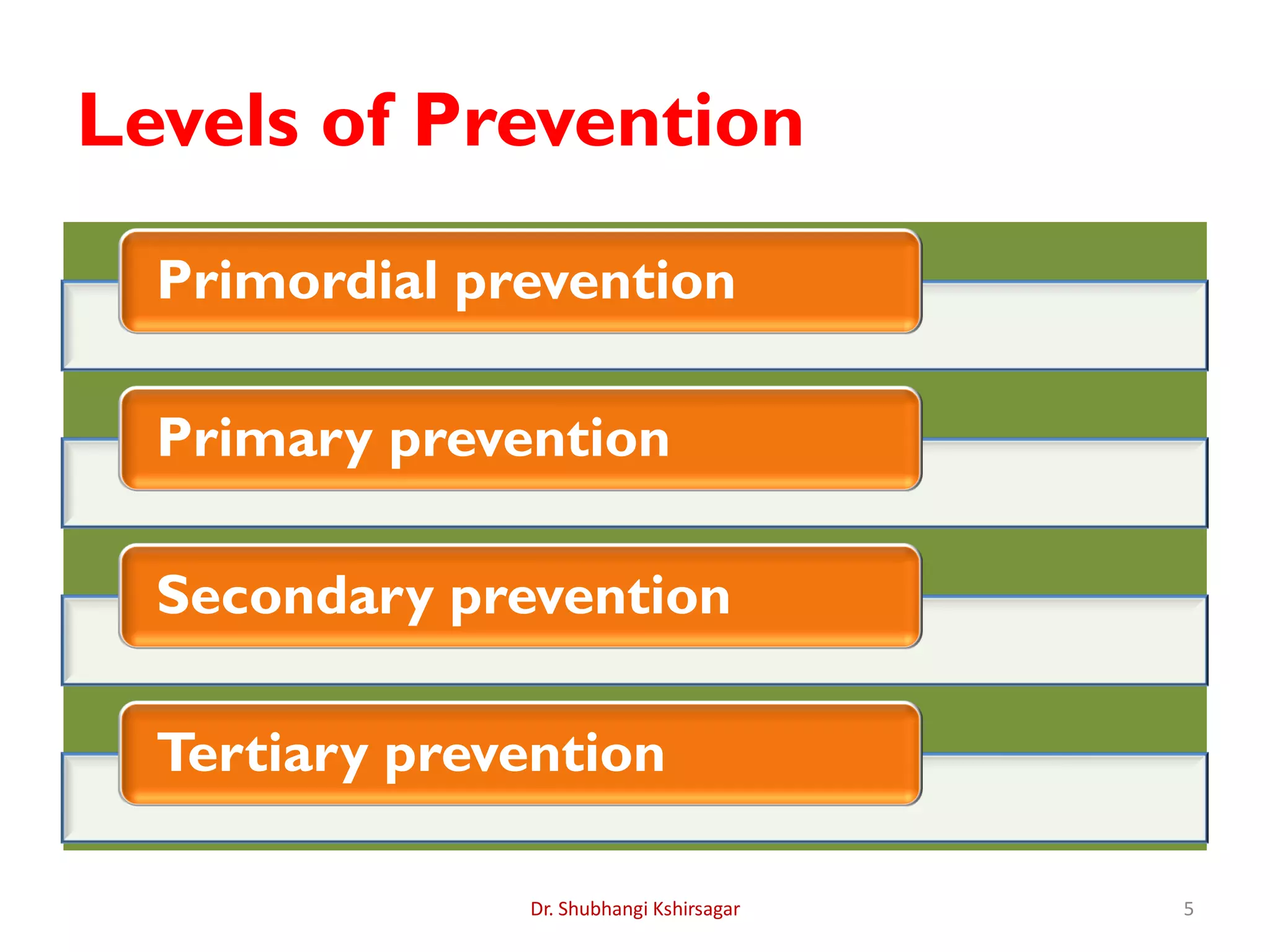
Levels of Prevention
Primordial prevention
Primary prevention
Secondary prevention
Tertiary prevention
5
Dr. Shubhangi Kshirsagar
Dr. Shubhangi Kshirsagar 6
Primordial prevention
1. Primordial prevention
 Special attention in prevention of chronic diseases.
 Prevention of the emergence or development of
risk factors in countries or population groups in
which they have not yet appeared.
 Ex. Many adult health problems (obesity,
hypertension) have their early origin in childhood,
because this is the time when lifestyles are formed
 For ex. Smoking, eating patterns, physical
experience
7
Dr. Shubhangi Kshirsagar
 In primordial prevention, efforts are
directed towards discouraging children
from adopting harmful lifestyles.
 The main intervention in primordial
prevention is through individual and
mass education.
8
Dr. Shubhangi Kshirsagar
Dr. Shubhangi Kshirsagar 9
Primary prevention
2. Primary prevention
 Primary prevention can be defined as,
the
, which removes the possibility
that the disease will ever occur.
 It signifies intervention in the
or
health problem.(ex. LBW)
10
Dr. Shubhangi Kshirsagar
2. Primary prevention
• It includes the concept of ",
a concept that encourages achievement
and maintenance of "an acceptable level of
health that will enable every individual to
lead a socially and economically productive
life".
• Primary prevention may be accomplished
by measures designed to
.
(Health promotion and specific protection)
11
Dr. Shubhangi Kshirsagar
Dr. Shubhangi Kshirsagar 12
Primary prevention
Specific protection
Health promotion
Achieved by
Health education
Environmental
modifications
Nutritional interventions
Life style and
behavioral changes
Immunization
chemoprophylaxis
Use of specific nutrients
Protection against occupational hazards
Safety of drugs and foods
Control of environmental hazards,
Approaches for Primary Prevention
 The WHO has recommended the
following approaches for the primary
prevention of chronic diseases where the
risk factors are established:
a. Population (mass) strategy
b. High -risk strategy
13
Dr. Shubhangi Kshirsagar
a. Population (mass) strategy
 “Population strategy" is directed at the
whole population irrespective of individual
risk levels.
 For example, studies have shown that even
a small reduction in the average blood
pressure or serum cholesterol of a
population would produce a large reduction
in the incidence of cardiovascular disease.
 The population approach is directed
towards socio-economic, behavioral and
lifestyle changes
14
Dr. Shubhangi Kshirsagar
b. High risk strategy
• The high -risk strategy aims to bring
preventive care to individuals at special
risk.
• This requires detection of individuals at
high risk by the optimum use of clinical
methods.
15
Dr. Shubhangi Kshirsagar
Dr. Shubhangi Kshirsagar 16
Secondary prevention
Secondary Prevention
 It is defined as “ action which halts the
progress of a disease at its incipient
stage and prevents complications.”
 The specific interventions are:
a. Early diagnosis (e.g. screening tests,
and case finding program)
b. Adequate treatment.
17
Dr. Shubhangi Kshirsagar
3. Secondary prevention
 Secondary prevention attempts to –
Arrest the disease process
Restore health by seeking out unrecognized
disease and
Treating it before irreversible pathological
changes take place
Reverse communicability of infectious
diseases.
18
Dr. Shubhangi Kshirsagar
 It thus protects others from in the community
from acquiring the infection.
 Thus provide at once -
a. Secondary prevention for the infected ones.
b. Primary prevention for their potential
contacts.
 Secondary prevention is largely the domain of
clinical medicine.
 The health programmes initiated by
government are usually at the level of
secondary prevention.
19
Dr. Shubhangi Kshirsagar
 Drawbacks of secondary prevention
1. Patient has already been subject to mental
anguish, physical pain.
2. Community to loss of productivity
 Imperfect tool in the control of transmission
of disease
 More expensive and less effective than
primary prevention.
20
Dr. Shubhangi Kshirsagar
Dr. Shubhangi Kshirsagar 21
Tertiary prevention
Tertiary prevention
 It is used when the disease process has advanced
beyond its early stages.
 Intervention in late pathogenesis phase.
 It is defined as, “all the measures available -
 to reduce or limit impairments and disabilities,
 minimize suffering caused by existing departures
from good health
 to promote the patients’ adjustment to
irremediable conditions.”
22
Dr. Shubhangi Kshirsagar
4.Tertiary prevention
• Intervention that should be accomplished in
the stage of tertiary prevention are disability
limitation and rehabilitation
23
Dr. Shubhangi Kshirsagar
Dr. Shubhangi Kshirsagar 24
Dr. Shubhangi Kshirsagar 25
ThankYou

Concpt & levels of prevention

  • 1.
    Concept & Levelsof Prevention Dr. Shubhangi Kshirsagar Assistant Professor Department of Swasthavritta &Yoga
  • 2.
    The goals ofmedicine are  To promote health  To preserve health  To restore health when it is impaired and to minimize suffering and distress. • These goals are embodied in the word "prevention”. 2 Dr. Shubhangi Kshirsagar
  • 3.
    Prevention  Definition -Actions aimed at eradicating, eliminating or minimizing the impact of disease and disability, or if none of these are feasible, retarding the progress of the disease and disability. 3 Dr. Shubhangi Kshirsagar
  • 4.
    Determinants of Prevention Successfulprevention depends upon:  Knowledge of causation.  Dynamics of transmission.  Identification of risk factors and risk groups.  Availability of prophylactic or early detection and treatment measures.  An organization for applying these measures to appropriate persons or groups.  Continuous evaluation of and development of procedures applied. 4 Dr. Shubhangi Kshirsagar
  • 5.
    Levels of Prevention Primordialprevention Primary prevention Secondary prevention Tertiary prevention 5 Dr. Shubhangi Kshirsagar
  • 6.
    Dr. Shubhangi Kshirsagar6 Primordial prevention
  • 7.
    1. Primordial prevention Special attention in prevention of chronic diseases.  Prevention of the emergence or development of risk factors in countries or population groups in which they have not yet appeared.  Ex. Many adult health problems (obesity, hypertension) have their early origin in childhood, because this is the time when lifestyles are formed  For ex. Smoking, eating patterns, physical experience 7 Dr. Shubhangi Kshirsagar
  • 8.
     In primordialprevention, efforts are directed towards discouraging children from adopting harmful lifestyles.  The main intervention in primordial prevention is through individual and mass education. 8 Dr. Shubhangi Kshirsagar
  • 9.
    Dr. Shubhangi Kshirsagar9 Primary prevention
  • 10.
    2. Primary prevention Primary prevention can be defined as, the , which removes the possibility that the disease will ever occur.  It signifies intervention in the or health problem.(ex. LBW) 10 Dr. Shubhangi Kshirsagar 2. Primary prevention
  • 11.
    • It includesthe concept of ", a concept that encourages achievement and maintenance of "an acceptable level of health that will enable every individual to lead a socially and economically productive life". • Primary prevention may be accomplished by measures designed to . (Health promotion and specific protection) 11 Dr. Shubhangi Kshirsagar
  • 12.
    Dr. Shubhangi Kshirsagar12 Primary prevention Specific protection Health promotion Achieved by Health education Environmental modifications Nutritional interventions Life style and behavioral changes Immunization chemoprophylaxis Use of specific nutrients Protection against occupational hazards Safety of drugs and foods Control of environmental hazards,
  • 13.
    Approaches for PrimaryPrevention  The WHO has recommended the following approaches for the primary prevention of chronic diseases where the risk factors are established: a. Population (mass) strategy b. High -risk strategy 13 Dr. Shubhangi Kshirsagar
  • 14.
    a. Population (mass)strategy  “Population strategy" is directed at the whole population irrespective of individual risk levels.  For example, studies have shown that even a small reduction in the average blood pressure or serum cholesterol of a population would produce a large reduction in the incidence of cardiovascular disease.  The population approach is directed towards socio-economic, behavioral and lifestyle changes 14 Dr. Shubhangi Kshirsagar
  • 15.
    b. High riskstrategy • The high -risk strategy aims to bring preventive care to individuals at special risk. • This requires detection of individuals at high risk by the optimum use of clinical methods. 15 Dr. Shubhangi Kshirsagar
  • 16.
    Dr. Shubhangi Kshirsagar16 Secondary prevention
  • 17.
    Secondary Prevention  Itis defined as “ action which halts the progress of a disease at its incipient stage and prevents complications.”  The specific interventions are: a. Early diagnosis (e.g. screening tests, and case finding program) b. Adequate treatment. 17 Dr. Shubhangi Kshirsagar 3. Secondary prevention
  • 18.
     Secondary preventionattempts to – Arrest the disease process Restore health by seeking out unrecognized disease and Treating it before irreversible pathological changes take place Reverse communicability of infectious diseases. 18 Dr. Shubhangi Kshirsagar
  • 19.
     It thusprotects others from in the community from acquiring the infection.  Thus provide at once - a. Secondary prevention for the infected ones. b. Primary prevention for their potential contacts.  Secondary prevention is largely the domain of clinical medicine.  The health programmes initiated by government are usually at the level of secondary prevention. 19 Dr. Shubhangi Kshirsagar
  • 20.
     Drawbacks ofsecondary prevention 1. Patient has already been subject to mental anguish, physical pain. 2. Community to loss of productivity  Imperfect tool in the control of transmission of disease  More expensive and less effective than primary prevention. 20 Dr. Shubhangi Kshirsagar
  • 21.
    Dr. Shubhangi Kshirsagar21 Tertiary prevention
  • 22.
    Tertiary prevention  Itis used when the disease process has advanced beyond its early stages.  Intervention in late pathogenesis phase.  It is defined as, “all the measures available -  to reduce or limit impairments and disabilities,  minimize suffering caused by existing departures from good health  to promote the patients’ adjustment to irremediable conditions.” 22 Dr. Shubhangi Kshirsagar 4.Tertiary prevention
  • 23.
    • Intervention thatshould be accomplished in the stage of tertiary prevention are disability limitation and rehabilitation 23 Dr. Shubhangi Kshirsagar
  • 24.
  • 25.