Typhoid Fever
in
Children
Epidemiology, Etiology, Clinical Features, Diagnosis
Complications, Management and Prevention
Prof. Imran Iqbal
Fellowship in Pediatric Neurology (Australia)
Prof of Paediatrics (2003-2018)
Prof of Pediatrics Emeritus, CHICH
Prof of Pediatrics, CIMS
Multan, Pakistan
(God speaking to Prophet Muhammad (PBUH)
Whatsoever is in the heavens and whatsoever is on the earth is
continuously in praise of Allah;
The King, The Noble, The Mighty and The Wise
Al Quran surah Al-Jumaa 21:1
Clinical Case Scenario
• An 8 year old child presents with fever for the last 8 days.
• Mother says child had gradual rise of fever
• Fever comes down with antipyretics but rises again with
chills after a few hours
• He does not have cough
• He has mild diarrhea
• On examination, his temperature is 104 F
Clinical Case Scenario
• On examination, his temperature is 104 F
• Skin rashes or jaundice are not present
• Respiratory rate is 25 per minute. Chest auscultation is
normal
• Throat examination are normal
• Liver and spleen are palpable by 2 cm each.
• SOMI are negative
 What is the likely clinical diagnosis ?
Typhoid fever
An infectious disease
caused by
Salmonella enterica serovar typhi
and
characterized by
high fever and abdominal symptoms
Enteric Fever
• Typhoid Fever – Salmonella enterica serovar typhi
• Paratyphoid Fever – Salmonella enterica serovar
paratyphi A & B
• Typhoid and Paratyphoid fever may have similar
presentations
• Typhoid fever is more common than Paratyphoid
fevers
Epidemiology
• Very common in all areas of Pakistan
• Frequent in Summer season
• Can occur from infancy to old age
• Children 2 to 15 years very commonly affected
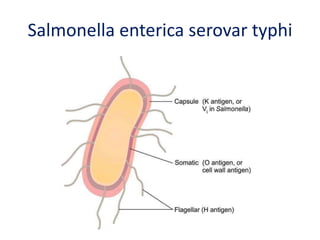
Salmonella enterica serovar typhi
Transmission of Disease
 Source – stools of infected patients
- stools of typhoid carriers
 Transmission – feco-oral
 Route of entry – contaminated water
-- contaminated milk
-- contaminated food
 Incubation Period - 7 – 14 days
(Range 3 – 30 days)
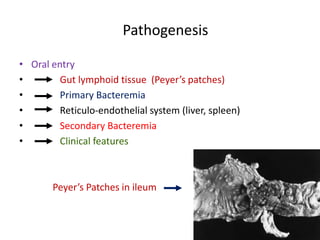
Pathogenesis
• Oral entry
• Gut lymphoid tissue (Peyer’s patches)
• Primary Bacteremia
• Reticulo-endothelial system (liver, spleen)
• Secondary Bacteremia
• Clinical features
Peyer’s Patches in ileum
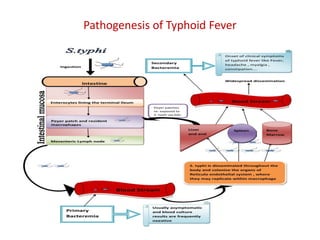
Pathogenesis of Typhoid Fever
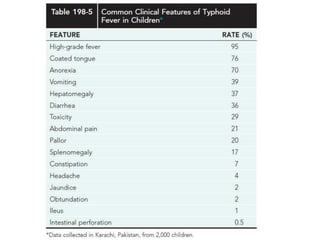
Clinical Features
Clinical Features in Typhoid Fever
• First Week - Fever
- gradual (step-ladder) rise
- moderate to high (rarely low grade)
- abdominal fullness
• Second Week - Other symptoms and signs
- lethargy
- mild cough
- hepato-splenomegaly
• Third Week – Abdominal complications
- diarrhea
- intestinal hemorrhage
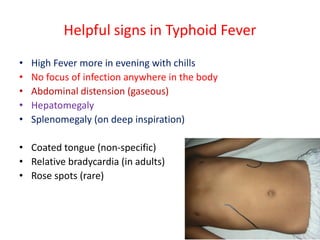
Helpful signs in Typhoid Fever
• High Fever more in evening with chills
• No focus of infection anywhere in the body
• Abdominal distension (gaseous)
• Hepatomegaly
• Splenomegaly (on deep inspiration)
• Coated tongue (non-specific)
• Relative bradycardia (in adults)
• Rose spots (rare)
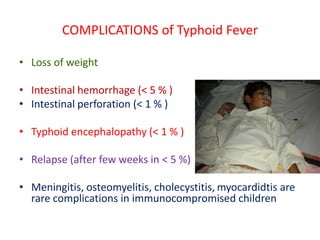
COMPLICATIONS of Typhoid Fever
• Loss of weight
• Intestinal hemorrhage (< 5 % )
• Intestinal perforation (< 1 % )
• Typhoid encephalopathy (< 1 % )
• Relapse (after few weeks in < 5 %)
• Meningitis, osteomyelitis, cholecystitis, myocardidtis are
rare complications in immunocompromised children
Diagnosis of Typhoid Fever
Clinical Diagnosis
• Age 5 – 15 years
• Gradual rise of fever
• No localizing signs of focal infection
• Coated tongue
• Relative bradycardia (rare in children)
• Mild dry cough
• Abdominal distention
• Hepatomegaly
• Splenomegaly
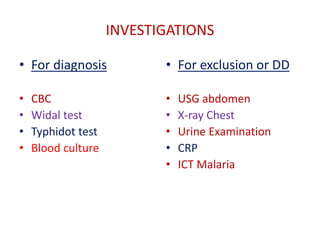
INVESTIGATIONS
• For diagnosis
• CBC
• Widal test
• Typhidot test
• Blood culture
• For exclusion or DD
• USG abdomen
• X-ray Chest
• Urine Examination
• CRP
• ICT Malaria
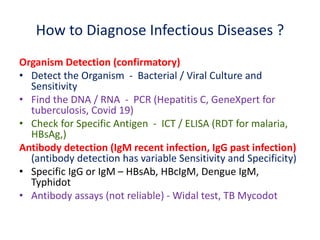
How to Diagnose Infectious Diseases ?
Organism Detection (confirmatory)
• Detect the Organism - Bacterial / Viral Culture and
Sensitivity
• Find the DNA / RNA - PCR (Hepatitis C, GeneXpert for
tuberculosis, Covid 19)
• Check for Specific Antigen - ICT / ELISA (RDT for malaria,
HBsAg,)
Antibody detection (IgM recent infection, IgG past infection)
(antibody detection has variable Sensitivity and Specificity)
• Specific IgG or IgM – HBsAb, HBcIgM, Dengue IgM,
Typhidot
• Antibody assays (not reliable) - Widal test, TB Mycodot
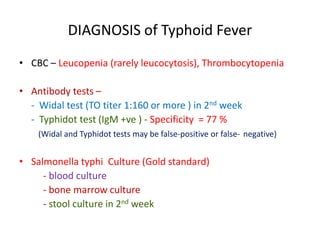
DIAGNOSIS of Typhoid Fever
• CBC – Leucopenia (rarely leucocytosis), Thrombocytopenia
• Antibody tests –
- Widal test (TO titer 1:160 or more ) in 2nd week
- Typhidot test (IgM +ve ) - Specificity = 77 %
(Widal and Typhidot tests may be false-positive or false- negative)
• Salmonella typhi Culture (Gold standard)
- blood culture
- bone marrow culture
- stool culture in 2nd week
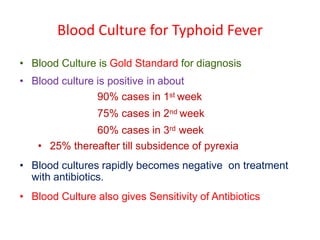
Blood Culture for Typhoid Fever
• Blood Culture is Gold Standard for diagnosis
• Blood culture is positive in about
90% cases in 1st week
75% cases in 2nd week
60% cases in 3rd week
• 25% thereafter till subsidence of pyrexia
• Blood cultures rapidly becomes negative on treatment
with antibiotics.
• Blood Culture also gives Sensitivity of Antibiotics
MANAGEMENT
MANAGEMENT
• Symptomatic management
• Supportive management
• Specific management
• Manage complications
Symptomatic and Supportive MANAGEMENT
• Antipyretics – Paracetamol, Ibuprofen
- Tap water sponging
• Hydration – Oral / IV fluids
• Nutrition – small frequent feeds
-- Give usual diet which the child likes
-- Do not stop roti or usual food
-- No need to give soft diet if abdomen is not tender.
-- Soft diet was needed in the past when specific treatment
and antibiotics were not available
Antibiotics for Typhoid Fever
Choice of Antibiotic for an infection depends upon
• Severity of illness
• Route of administration - Oral or IM or IV antibiotics
• Adverse effects of antibiotics
• Antibiotic Resistance (local resistance pattern)
-- -- Inappropriate use of antibiotics promotes resistance
---- Anti-microbial resistance to bacteria is increasing
Antibiotics for different Types of Typhoid Fever
• Non-resistant Sensitive Typhoid
• Treated by Amoxycillin, Chloramphenicol and Co-trimoxazole
• Multi–drug resistant (MDR) typhoid - from 1990 onwards
• Salmonella typhi resistant to previously used antibiotics
• Sensitive to Ceftriaxone, Cefixime, Ciprofloxacin
• Extremely Drug Resistant (XDR) Typhoid – 2016
• Salmonella typhi resistant to all previously used antibiotics
• Resistant to Amoxycillin, Cephalosporins, Quinolones
• Sensitive to Azithromycin and Carbapenems only
XDR Typhoid in Pakistan - 2016
• Between Nov 30, 2016, and Dec 30, 2017, 486
people with ceftriaxone-resistant S Typhi were
identified from Hyderabad.
• The outbreak is suspected to be attributed to the
contaminated drinking water, especially the
mixing of sewage with drinking water.
• The Lancet 18(12), P1368-1376, DECEMBER 01, 2018
• Outbreak investigation of ceftriaxone-resistant Salmonella enterica serotype Typhi and
its risk factors among the general population in Hyderabad, Pakistan: a matched case-
control study
Specific management of Typhoid Fever
• Initial Treatment for MDR typhoid
• Ceftriaxone IV (50 – 75 mg/kg/d) for 5 -7 days
OR
• Cefixime Oral (20 mg/kg/d) for 7- 10 days
• If no response – Treatment for XDR Typhoid
• Azithromycin Oral (20 mg/kg/d) for 5-7 days
OR
• Imipenem / Meropenem IV (60 mg/kg/day)
PREVENTION
Protection against Infections
• Vaccination
• Handwashing
• Face Masks
• Social distancing
• Unpolluted air
• Breastfeeding
• Adequate Nutrition
• Micronutrients
• Safe water
• Clean food
Avoid Salmonella typhi
• Clean boiled / filtered water
• Boiled / Packed / Powdered Milk / milk products
• Food - cooked thoroughly
• Fruits / vegetables - peel yourself
• HANDWASHING
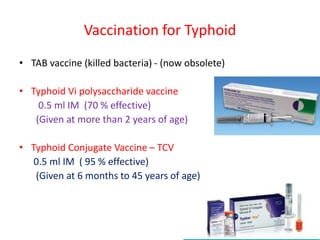
Vaccination for Typhoid
• TAB vaccine (killed bacteria) - (now obsolete)
• Typhoid Vi polysaccharide vaccine
0.5 ml IM (70 % effective)
(Given at more than 2 years of age)
• Typhoid Conjugate Vaccine – TCV
0.5 ml IM ( 95 % effective)
(Given at 6 months to 45 years of age)
Typhoid Conjugate Vaccine - TCV
• Typhoid Conjugate Vaccine – TCV contains purified Vi
capsular polysaccharide of Salmonella typhi Ty2 which is
conjugated to Tetanus Toxoid carrier protein.
• Typhoid Conjugate Vaccine – TCV is T-cell dependent which
induces Vi antibodies that neutralize Vi antigen of Typhoid
bacillus
• Typhoid Conjugate Vaccine – TCV can be administered to
infants of age ≥6 months to ≤ 45 years, children and adults as
a single dose intramuscularly.
• Typhoid Conjugate Vaccine – TCV is being added to Expanded
Program of Immunization in Pakistan administered at 9
months of age
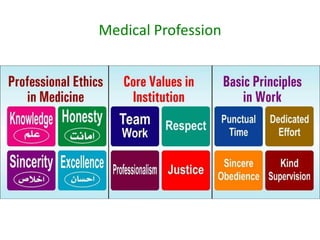
Medical Profession
Thankyou

Typhoid fever in children 2021

  • 1.
    Typhoid Fever in Children Epidemiology, Etiology,Clinical Features, Diagnosis Complications, Management and Prevention Prof. Imran Iqbal Fellowship in Pediatric Neurology (Australia) Prof of Paediatrics (2003-2018) Prof of Pediatrics Emeritus, CHICH Prof of Pediatrics, CIMS Multan, Pakistan
  • 2.
    (God speaking toProphet Muhammad (PBUH) Whatsoever is in the heavens and whatsoever is on the earth is continuously in praise of Allah; The King, The Noble, The Mighty and The Wise Al Quran surah Al-Jumaa 21:1
  • 3.
    Clinical Case Scenario •An 8 year old child presents with fever for the last 8 days. • Mother says child had gradual rise of fever • Fever comes down with antipyretics but rises again with chills after a few hours • He does not have cough • He has mild diarrhea • On examination, his temperature is 104 F
  • 4.
    Clinical Case Scenario •On examination, his temperature is 104 F • Skin rashes or jaundice are not present • Respiratory rate is 25 per minute. Chest auscultation is normal • Throat examination are normal • Liver and spleen are palpable by 2 cm each. • SOMI are negative  What is the likely clinical diagnosis ?
  • 5.
    Typhoid fever An infectiousdisease caused by Salmonella enterica serovar typhi and characterized by high fever and abdominal symptoms
  • 6.
    Enteric Fever • TyphoidFever – Salmonella enterica serovar typhi • Paratyphoid Fever – Salmonella enterica serovar paratyphi A & B • Typhoid and Paratyphoid fever may have similar presentations • Typhoid fever is more common than Paratyphoid fevers
  • 7.
    Epidemiology • Very commonin all areas of Pakistan • Frequent in Summer season • Can occur from infancy to old age • Children 2 to 15 years very commonly affected
  • 8.
  • 9.
    Transmission of Disease Source – stools of infected patients - stools of typhoid carriers  Transmission – feco-oral  Route of entry – contaminated water -- contaminated milk -- contaminated food  Incubation Period - 7 – 14 days (Range 3 – 30 days)
  • 10.
    Pathogenesis • Oral entry •Gut lymphoid tissue (Peyer’s patches) • Primary Bacteremia • Reticulo-endothelial system (liver, spleen) • Secondary Bacteremia • Clinical features Peyer’s Patches in ileum
  • 11.
  • 12.
  • 14.
    Clinical Features inTyphoid Fever • First Week - Fever - gradual (step-ladder) rise - moderate to high (rarely low grade) - abdominal fullness • Second Week - Other symptoms and signs - lethargy - mild cough - hepato-splenomegaly • Third Week – Abdominal complications - diarrhea - intestinal hemorrhage
  • 15.
    Helpful signs inTyphoid Fever • High Fever more in evening with chills • No focus of infection anywhere in the body • Abdominal distension (gaseous) • Hepatomegaly • Splenomegaly (on deep inspiration) • Coated tongue (non-specific) • Relative bradycardia (in adults) • Rose spots (rare)
  • 16.
    COMPLICATIONS of TyphoidFever • Loss of weight • Intestinal hemorrhage (< 5 % ) • Intestinal perforation (< 1 % ) • Typhoid encephalopathy (< 1 % ) • Relapse (after few weeks in < 5 %) • Meningitis, osteomyelitis, cholecystitis, myocardidtis are rare complications in immunocompromised children
  • 17.
  • 18.
    Clinical Diagnosis • Age5 – 15 years • Gradual rise of fever • No localizing signs of focal infection • Coated tongue • Relative bradycardia (rare in children) • Mild dry cough • Abdominal distention • Hepatomegaly • Splenomegaly
  • 19.
    INVESTIGATIONS • For diagnosis •CBC • Widal test • Typhidot test • Blood culture • For exclusion or DD • USG abdomen • X-ray Chest • Urine Examination • CRP • ICT Malaria
  • 20.
    How to DiagnoseInfectious Diseases ? Organism Detection (confirmatory) • Detect the Organism - Bacterial / Viral Culture and Sensitivity • Find the DNA / RNA - PCR (Hepatitis C, GeneXpert for tuberculosis, Covid 19) • Check for Specific Antigen - ICT / ELISA (RDT for malaria, HBsAg,) Antibody detection (IgM recent infection, IgG past infection) (antibody detection has variable Sensitivity and Specificity) • Specific IgG or IgM – HBsAb, HBcIgM, Dengue IgM, Typhidot • Antibody assays (not reliable) - Widal test, TB Mycodot
  • 21.
    DIAGNOSIS of TyphoidFever • CBC – Leucopenia (rarely leucocytosis), Thrombocytopenia • Antibody tests – - Widal test (TO titer 1:160 or more ) in 2nd week - Typhidot test (IgM +ve ) - Specificity = 77 % (Widal and Typhidot tests may be false-positive or false- negative) • Salmonella typhi Culture (Gold standard) - blood culture - bone marrow culture - stool culture in 2nd week
  • 22.
    Blood Culture forTyphoid Fever • Blood Culture is Gold Standard for diagnosis • Blood culture is positive in about 90% cases in 1st week 75% cases in 2nd week 60% cases in 3rd week • 25% thereafter till subsidence of pyrexia • Blood cultures rapidly becomes negative on treatment with antibiotics. • Blood Culture also gives Sensitivity of Antibiotics
  • 23.
  • 24.
    MANAGEMENT • Symptomatic management •Supportive management • Specific management • Manage complications
  • 25.
    Symptomatic and SupportiveMANAGEMENT • Antipyretics – Paracetamol, Ibuprofen - Tap water sponging • Hydration – Oral / IV fluids • Nutrition – small frequent feeds -- Give usual diet which the child likes -- Do not stop roti or usual food -- No need to give soft diet if abdomen is not tender. -- Soft diet was needed in the past when specific treatment and antibiotics were not available
  • 26.
    Antibiotics for TyphoidFever Choice of Antibiotic for an infection depends upon • Severity of illness • Route of administration - Oral or IM or IV antibiotics • Adverse effects of antibiotics • Antibiotic Resistance (local resistance pattern) -- -- Inappropriate use of antibiotics promotes resistance ---- Anti-microbial resistance to bacteria is increasing
  • 27.
    Antibiotics for differentTypes of Typhoid Fever • Non-resistant Sensitive Typhoid • Treated by Amoxycillin, Chloramphenicol and Co-trimoxazole • Multi–drug resistant (MDR) typhoid - from 1990 onwards • Salmonella typhi resistant to previously used antibiotics • Sensitive to Ceftriaxone, Cefixime, Ciprofloxacin • Extremely Drug Resistant (XDR) Typhoid – 2016 • Salmonella typhi resistant to all previously used antibiotics • Resistant to Amoxycillin, Cephalosporins, Quinolones • Sensitive to Azithromycin and Carbapenems only
  • 28.
    XDR Typhoid inPakistan - 2016 • Between Nov 30, 2016, and Dec 30, 2017, 486 people with ceftriaxone-resistant S Typhi were identified from Hyderabad. • The outbreak is suspected to be attributed to the contaminated drinking water, especially the mixing of sewage with drinking water. • The Lancet 18(12), P1368-1376, DECEMBER 01, 2018 • Outbreak investigation of ceftriaxone-resistant Salmonella enterica serotype Typhi and its risk factors among the general population in Hyderabad, Pakistan: a matched case- control study
  • 29.
    Specific management ofTyphoid Fever • Initial Treatment for MDR typhoid • Ceftriaxone IV (50 – 75 mg/kg/d) for 5 -7 days OR • Cefixime Oral (20 mg/kg/d) for 7- 10 days • If no response – Treatment for XDR Typhoid • Azithromycin Oral (20 mg/kg/d) for 5-7 days OR • Imipenem / Meropenem IV (60 mg/kg/day)
  • 30.
  • 31.
    Protection against Infections •Vaccination • Handwashing • Face Masks • Social distancing • Unpolluted air • Breastfeeding • Adequate Nutrition • Micronutrients • Safe water • Clean food
  • 32.
    Avoid Salmonella typhi •Clean boiled / filtered water • Boiled / Packed / Powdered Milk / milk products • Food - cooked thoroughly • Fruits / vegetables - peel yourself • HANDWASHING
  • 33.
    Vaccination for Typhoid •TAB vaccine (killed bacteria) - (now obsolete) • Typhoid Vi polysaccharide vaccine 0.5 ml IM (70 % effective) (Given at more than 2 years of age) • Typhoid Conjugate Vaccine – TCV 0.5 ml IM ( 95 % effective) (Given at 6 months to 45 years of age)
  • 34.
    Typhoid Conjugate Vaccine- TCV • Typhoid Conjugate Vaccine – TCV contains purified Vi capsular polysaccharide of Salmonella typhi Ty2 which is conjugated to Tetanus Toxoid carrier protein. • Typhoid Conjugate Vaccine – TCV is T-cell dependent which induces Vi antibodies that neutralize Vi antigen of Typhoid bacillus • Typhoid Conjugate Vaccine – TCV can be administered to infants of age ≥6 months to ≤ 45 years, children and adults as a single dose intramuscularly. • Typhoid Conjugate Vaccine – TCV is being added to Expanded Program of Immunization in Pakistan administered at 9 months of age
  • 35.
  • 36.