Enteric fever
TYPHOID FEVER
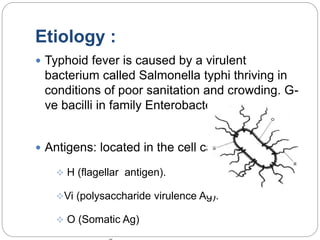
Etiology :
 Typhoid fever is caused by a virulent
bacterium called Salmonella typhi thriving in
conditions of poor sanitation and crowding. G-
ve bacilli in family Enterobacteriaceae
 Antigens: located in the cell capsule
 H (flagellar antigen).
Vi (polysaccharide virulence Ag).
 O (Somatic Ag)
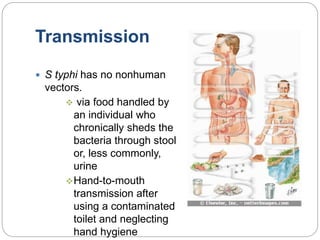
Transmission
 S typhi has no nonhuman
vectors.
 via food handled by
an individual who
chronically sheds the
bacteria through stool
or, less commonly,
urine
Hand-to-mouth
transmission after
using a contaminated
toilet and neglecting
hand hygiene
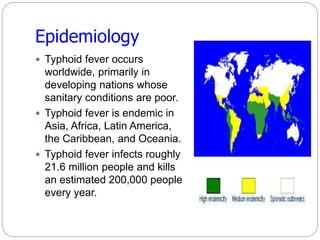
Epidemiology
 Typhoid fever occurs
worldwide, primarily in
developing nations whose
sanitary conditions are poor.
 Typhoid fever is endemic in
Asia, Africa, Latin America,
the Caribbean, and Oceania.
 Typhoid fever infects roughly
21.6 million people and kills
an estimated 200,000 people
every year.
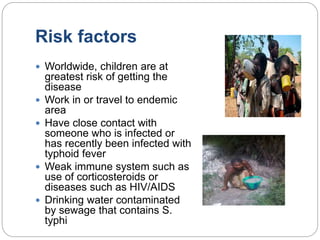
Risk factors
 Worldwide, children are at
greatest risk of getting the
disease
 Work in or travel to endemic
area
 Have close contact with
someone who is infected or
has recently been infected with
typhoid fever
 Weak immune system such as
use of corticosteroids or
diseases such as HIV/AIDS
 Drinking water contaminated
by sewage that contains S.
typhi
Pathogenesis
The organisms penetrate ileal mucosa
reach mesentric lymph nodes via
Lymphatics , Multiply,
Invade Blood stream via thoracic duct
In 7 – 10 days through blood stream
infect
Liver, Gall Bladder,, spleen, Kidney,
Bone marrow.
After multiplication, bacilli pass into blood
causing secondary and heavier
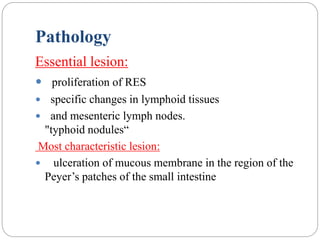
Pathology
Essential lesion:
 proliferation of RES
 specific changes in lymphoid tissues
 and mesenteric lymph nodes.
"typhoid nodules“
Most characteristic lesion:
 ulceration of mucous membrane in the region of the
Peyer’s patches of the small intestine
Clinical presentation
The incubation period for typhoid fever
is 7-14 days (range 3-60 days)
If not treated, the symptoms develop
over four weeks, with new symptoms
appearing each week but with treatment,
symptoms should quickly improve.
Clinical manifestations
The initial period (early stage due to
bacteremia)
 First week: non-specific, insidious onset of fever
Fever up to 39-400C in 5-7 days, step-ladder( now
seen in < 12%), headache
chills, toxic, tired, sore throat, cough,
abdominal pain and diarrhea or constipation.
The fastigium stage
 second and third weeks.
 fever reaches a plateau at 39-40. Last 10-14 days.
 more toxic and anorexic with significant weight
loss. The conjunctivae are injected, and the patient
is tachypneic with a thready pulse and crackles
over the lung bases. Abdominal distension is
severe. Some patients experience foul, green-
yellow, liquid diarrhea (pea soup diarrhea). The(
typhoid state) is characterized by apathy,
confusion, and even psychosis. Necrotic Peyer
patches may cause bowel perforation and
peritonitis. This complication may be masked by
corticosteroids. At this point, overwhelming
 Signs and symptoms:
relative bradycardia.
 Splenomegaly, hepatomegaly
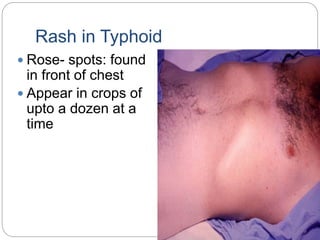
 rash ( rose-spots):30%, maculopapular
a faint pale color, slightly raised
round or lenticular, fade on pressure
2-4 mm in diameter, less than 10 in No.
on the trunk, disappear in 2-3 days.
Rash in Typhoid
 Rose- spots: found
in front of chest
 Appear in crops of
upto a dozen at a
time
defervescence stage
 By the fourth week of infection:
If the individual survives , the fever, mental state,
and abdominal distension slowly improve over a
few days. Intestinal and neurologic
complications may still occur. Weight loss and
debilitating weakness last months. Some
survivors become asymptomatic carriers and
have the potential to transmit the bacteria
indefinitely
convalescence stage
 the fifth week: disappearance of all symptoms,
but can relapse
Atypical manifestations :
 Mild infection:
very common seen recently
symptom and signs are mild
good general condition
temperature is 380C
short period of disease
recovery expected in 1~3 weeks
seen in early antibiotic users
in young children more common
easy to misdiagnose
 Persistent infection:
disease continue > 5 weeks
 Ambulatory infection:
mild symptoms,early intestinal bleeding or
perforation.
 Fulminant infection:
rapid onset, severe toxemia and septicemia.
High fever, chill, circulatory failure, shock,
delirium, coma, myocarditis, bleeding and
other complications, DIC.
 In the aged
temperature not high, weakness common.
More complications.
High mortality.
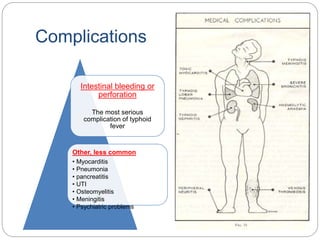
Complications
Intestinal bleeding or
perforation
The most serious
complication of typhoid
fever
Other, less common
• Myocarditis
• Pneumonia
• pancreatitis
• UTI
• Osteomyelitis
• Meningitis
• Psychiatric problems
Complications
Intestinal hemorrhage
Commonly appear during the second-third week
may be mild or severe bleeding
often caused by unsuitable food, and diarrhea
serious bleeding in about 2~8%
clues: sudden drop in temperature, rise in pulse, and
signs of shock followed by dark or fresh blood in the
stool.
Intestinal perforation:
 more serious. Incidence:1-4%
 Commonly appear during 2nd-3rd week.
 Take place at the lower end of ileum.
 Before perforation,abdominal pain or
diarrhea,intestinal bleeding .
 When perforation: ↑ abdominal pain, sweating, drop in temperature,
and increase in pulse rate, then rebound tenderness +ve
reduce or disappear in the dullness of liver, leukocytosis .
 Temperature rise when peritonitis appear.
 free air in abdominal x-ray.
 Toxic hepatitis:
common,1-3 weeks
hepatomegaly, ALT elevated
get better with improvement of disease in 2~3 weeks
 Toxic myocarditis.
seen in 2nd-3rd week, usually severe toxemia.
 Bronchitis, bronchopneumonia.
seen in early stage
Blood cultures in Typhoid fever
 In Adults 5-10 ml of Blood is inoculated into 50 –
100 ml of Bile broth ( 0.5 % ).
 Larger volumes 10-30 ml and clot cultures
increase sensitivity
 Blood culture is positive as follows:
1st week in 90%
2nd week in 75%
3rd week in 60%
4th week and later in 25%
 Bone marrow culture
the most sensitive test
even in patients pretreated (up to 5 days) with antibiotics.
 Urine and stool cultures
increase the diagnostic yield
positive less frequently
stool culture better in 3rd~4th weeks
 Duodenal string test to culture bile useful for
the diagnosis of carriers.
Widal test
 Serum agglutinins raise abruptly during the
2nd or 3rd week, it is +ve by 10th day, but max.
during 18-23rd day
 The widal test detects antibodies against O
and H antigens
 Two serum specimens obtained at intervals of
7 – 10 days to read the rise of antibodies.
 The test is neither sensitive nor specific
TREATMENT
1-General :
 Isolation and rest
 suitable diet include easy digested food or half-liquid
food and drinking more water
 IV fluid to maintain water and acid-base and electrolyte
balance
 Symptomatic : antipyretic
Drug treatment
 Ciprofloxacin: 15 mg/kg/d for 7 days
 For quinolone-resistant: azithromycin 10mg/kg/d
for 7 days OR ceftriaxone 75mg/kg/d for 10-14
days
steroids
 dexamethasone: initial dose 3 mg/kg by
slow i.v. infusion over 30 minutes and
after six hours, 1 mg/kg is administered
and subsequently repeated at six-hourly
intervals on seven further occasions,
mortality can be reduced by some 80-
90% in high-risk patients (high fever with
obtundation and meningeal irritation
signs)
Carrier
Asymptomatic and have positive stool or
rectal swab cultures for S. typhi a year
following recovery from acute illness.
Treatment: co-trimoxazole 2 tab twice/d
for 6 wk, OR
ciprofloxacin 750 mg twice/d for 4 wk
Carrier
Carriers should be excluded from
activities involving food preparation and
serving. Food handlers should not
resume their duties until they have had
three negative stool cultures at least one
month apart.
 Vi Ab is used as a screening technique
to identify carriers among food handlers
and in outbreak investigations. Vi Abs
are very high in chronic S. typhi carriers
Relapse
 Apparent recovery can be followed by relapse
in 5 – 10 % of untreated patient
 culture +ve of S.typhi after 1-3 wks of
defervescence
 Symptom and signs reappear
 the bacilli have not been completely removed
 Some cases relapse more than once
 On few occasions relapses can be severe and
may be fatal.
Prognosis:
 Case fatality 0.5-1%.
 but high in old ages, infant, and serious
complications
 immunity long lasting
 About 3% of patients become fecal carriers .
Vaccines for Typhoid Prevention
 Two types :
1. Oral – A live vaccine ( typhoral )
One capsule given orally taken before food,
with a glass of water or milk, on day 1, 3, 5 (
three doses )
No antibiotics should be taken during the
period of administration of vaccine
2. The injectable vaccine, ( typhim –vi)
Given as single sc or im injection
Vaccines for Typhoid
Both vaccines are given to only children > 5 years
of age.
Immunity lasts for 3 years
Need a booster
Vaccines are not effective in prevention
of Paratyphoid fevers
Paratyphoid fever
 It is similar in its symptoms to typhoid fever,
but tends to be milder, with a lower fatality
rate.
 It is caused by Paratyphi A, B, and C
 Rash may be more abundant
 May present as gastroenteritis specially in
children
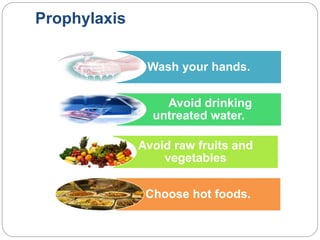
Prophylaxis
Wash your hands.
Avoid drinking
untreated water.
Avoid raw fruits and
vegetables
Choose hot foods.

Typhoid_Fever.ppt

  • 1.
  • 2.
    Etiology :  Typhoidfever is caused by a virulent bacterium called Salmonella typhi thriving in conditions of poor sanitation and crowding. G- ve bacilli in family Enterobacteriaceae  Antigens: located in the cell capsule  H (flagellar antigen). Vi (polysaccharide virulence Ag).  O (Somatic Ag)
  • 3.
    Transmission  S typhihas no nonhuman vectors.  via food handled by an individual who chronically sheds the bacteria through stool or, less commonly, urine Hand-to-mouth transmission after using a contaminated toilet and neglecting hand hygiene
  • 4.
    Epidemiology  Typhoid feveroccurs worldwide, primarily in developing nations whose sanitary conditions are poor.  Typhoid fever is endemic in Asia, Africa, Latin America, the Caribbean, and Oceania.  Typhoid fever infects roughly 21.6 million people and kills an estimated 200,000 people every year.
  • 5.
    Risk factors  Worldwide,children are at greatest risk of getting the disease  Work in or travel to endemic area  Have close contact with someone who is infected or has recently been infected with typhoid fever  Weak immune system such as use of corticosteroids or diseases such as HIV/AIDS  Drinking water contaminated by sewage that contains S. typhi
  • 6.
    Pathogenesis The organisms penetrateileal mucosa reach mesentric lymph nodes via Lymphatics , Multiply, Invade Blood stream via thoracic duct In 7 – 10 days through blood stream infect Liver, Gall Bladder,, spleen, Kidney, Bone marrow. After multiplication, bacilli pass into blood causing secondary and heavier
  • 7.
    Pathology Essential lesion:  proliferationof RES  specific changes in lymphoid tissues  and mesenteric lymph nodes. "typhoid nodules“ Most characteristic lesion:  ulceration of mucous membrane in the region of the Peyer’s patches of the small intestine
  • 8.
    Clinical presentation The incubationperiod for typhoid fever is 7-14 days (range 3-60 days) If not treated, the symptoms develop over four weeks, with new symptoms appearing each week but with treatment, symptoms should quickly improve.
  • 9.
    Clinical manifestations The initialperiod (early stage due to bacteremia)  First week: non-specific, insidious onset of fever Fever up to 39-400C in 5-7 days, step-ladder( now seen in < 12%), headache chills, toxic, tired, sore throat, cough, abdominal pain and diarrhea or constipation.
  • 10.
    The fastigium stage second and third weeks.  fever reaches a plateau at 39-40. Last 10-14 days.  more toxic and anorexic with significant weight loss. The conjunctivae are injected, and the patient is tachypneic with a thready pulse and crackles over the lung bases. Abdominal distension is severe. Some patients experience foul, green- yellow, liquid diarrhea (pea soup diarrhea). The( typhoid state) is characterized by apathy, confusion, and even psychosis. Necrotic Peyer patches may cause bowel perforation and peritonitis. This complication may be masked by corticosteroids. At this point, overwhelming
  • 11.
     Signs andsymptoms: relative bradycardia.  Splenomegaly, hepatomegaly  rash ( rose-spots):30%, maculopapular a faint pale color, slightly raised round or lenticular, fade on pressure 2-4 mm in diameter, less than 10 in No. on the trunk, disappear in 2-3 days.
  • 12.
    Rash in Typhoid Rose- spots: found in front of chest  Appear in crops of upto a dozen at a time
  • 13.
    defervescence stage  Bythe fourth week of infection: If the individual survives , the fever, mental state, and abdominal distension slowly improve over a few days. Intestinal and neurologic complications may still occur. Weight loss and debilitating weakness last months. Some survivors become asymptomatic carriers and have the potential to transmit the bacteria indefinitely convalescence stage  the fifth week: disappearance of all symptoms, but can relapse
  • 14.
    Atypical manifestations : Mild infection: very common seen recently symptom and signs are mild good general condition temperature is 380C short period of disease recovery expected in 1~3 weeks seen in early antibiotic users in young children more common easy to misdiagnose
  • 15.
     Persistent infection: diseasecontinue > 5 weeks  Ambulatory infection: mild symptoms,early intestinal bleeding or perforation.
  • 16.
     Fulminant infection: rapidonset, severe toxemia and septicemia. High fever, chill, circulatory failure, shock, delirium, coma, myocarditis, bleeding and other complications, DIC.
  • 17.
     In theaged temperature not high, weakness common. More complications. High mortality.
  • 18.
    Complications Intestinal bleeding or perforation Themost serious complication of typhoid fever Other, less common • Myocarditis • Pneumonia • pancreatitis • UTI • Osteomyelitis • Meningitis • Psychiatric problems
  • 19.
    Complications Intestinal hemorrhage Commonly appearduring the second-third week may be mild or severe bleeding often caused by unsuitable food, and diarrhea serious bleeding in about 2~8% clues: sudden drop in temperature, rise in pulse, and signs of shock followed by dark or fresh blood in the stool.
  • 20.
    Intestinal perforation:  moreserious. Incidence:1-4%  Commonly appear during 2nd-3rd week.  Take place at the lower end of ileum.  Before perforation,abdominal pain or diarrhea,intestinal bleeding .  When perforation: ↑ abdominal pain, sweating, drop in temperature, and increase in pulse rate, then rebound tenderness +ve reduce or disappear in the dullness of liver, leukocytosis .  Temperature rise when peritonitis appear.  free air in abdominal x-ray.
  • 21.
     Toxic hepatitis: common,1-3weeks hepatomegaly, ALT elevated get better with improvement of disease in 2~3 weeks  Toxic myocarditis. seen in 2nd-3rd week, usually severe toxemia.  Bronchitis, bronchopneumonia. seen in early stage
  • 22.
    Blood cultures inTyphoid fever  In Adults 5-10 ml of Blood is inoculated into 50 – 100 ml of Bile broth ( 0.5 % ).  Larger volumes 10-30 ml and clot cultures increase sensitivity  Blood culture is positive as follows: 1st week in 90% 2nd week in 75% 3rd week in 60% 4th week and later in 25%
  • 23.
     Bone marrowculture the most sensitive test even in patients pretreated (up to 5 days) with antibiotics.  Urine and stool cultures increase the diagnostic yield positive less frequently stool culture better in 3rd~4th weeks  Duodenal string test to culture bile useful for the diagnosis of carriers.
  • 24.
    Widal test  Serumagglutinins raise abruptly during the 2nd or 3rd week, it is +ve by 10th day, but max. during 18-23rd day  The widal test detects antibodies against O and H antigens  Two serum specimens obtained at intervals of 7 – 10 days to read the rise of antibodies.  The test is neither sensitive nor specific
  • 25.
    TREATMENT 1-General :  Isolationand rest  suitable diet include easy digested food or half-liquid food and drinking more water  IV fluid to maintain water and acid-base and electrolyte balance  Symptomatic : antipyretic
  • 26.
    Drug treatment  Ciprofloxacin:15 mg/kg/d for 7 days  For quinolone-resistant: azithromycin 10mg/kg/d for 7 days OR ceftriaxone 75mg/kg/d for 10-14 days
  • 27.
    steroids  dexamethasone: initialdose 3 mg/kg by slow i.v. infusion over 30 minutes and after six hours, 1 mg/kg is administered and subsequently repeated at six-hourly intervals on seven further occasions, mortality can be reduced by some 80- 90% in high-risk patients (high fever with obtundation and meningeal irritation signs)
  • 28.
    Carrier Asymptomatic and havepositive stool or rectal swab cultures for S. typhi a year following recovery from acute illness. Treatment: co-trimoxazole 2 tab twice/d for 6 wk, OR ciprofloxacin 750 mg twice/d for 4 wk
  • 29.
    Carrier Carriers should beexcluded from activities involving food preparation and serving. Food handlers should not resume their duties until they have had three negative stool cultures at least one month apart.  Vi Ab is used as a screening technique to identify carriers among food handlers and in outbreak investigations. Vi Abs are very high in chronic S. typhi carriers
  • 30.
    Relapse  Apparent recoverycan be followed by relapse in 5 – 10 % of untreated patient  culture +ve of S.typhi after 1-3 wks of defervescence  Symptom and signs reappear  the bacilli have not been completely removed  Some cases relapse more than once  On few occasions relapses can be severe and may be fatal.
  • 31.
    Prognosis:  Case fatality0.5-1%.  but high in old ages, infant, and serious complications  immunity long lasting  About 3% of patients become fecal carriers .
  • 32.
    Vaccines for TyphoidPrevention  Two types : 1. Oral – A live vaccine ( typhoral ) One capsule given orally taken before food, with a glass of water or milk, on day 1, 3, 5 ( three doses ) No antibiotics should be taken during the period of administration of vaccine 2. The injectable vaccine, ( typhim –vi) Given as single sc or im injection
  • 33.
    Vaccines for Typhoid Bothvaccines are given to only children > 5 years of age. Immunity lasts for 3 years Need a booster Vaccines are not effective in prevention of Paratyphoid fevers
  • 34.
    Paratyphoid fever  Itis similar in its symptoms to typhoid fever, but tends to be milder, with a lower fatality rate.  It is caused by Paratyphi A, B, and C  Rash may be more abundant  May present as gastroenteritis specially in children
  • 35.
    Prophylaxis Wash your hands. Avoiddrinking untreated water. Avoid raw fruits and vegetables Choose hot foods.