2
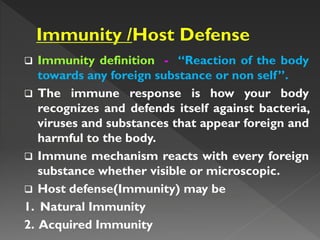
 Immunity definition - “Reaction of the body
towards any foreign substance or non self”.
 The immune response is how your body
recognizes and defends itself against bacteria,
viruses and substances that appear foreign and
harmful to the body.
 Immune mechanism reacts with every foreign
substance whether visible or microscopic.
 Host defense(Immunity) may be
1. Natural Immunity
2. Acquired Immunity
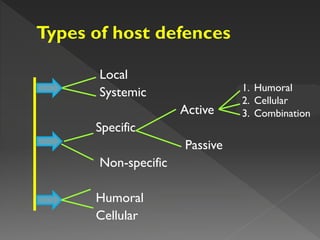
Local
Systemic
Active
Specific
Passive
Non-specific
Humoral
Cellular
1. Humoral
2. Cellular
3. Combination
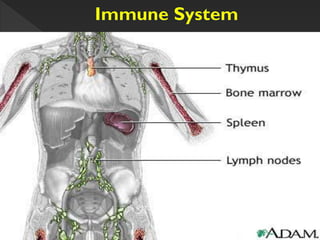
 Immune system includes barriers.
 These barriers are innate immunity, (with you
from birth) skin, stomach acid, mucus (which
traps bacteria and small particles), the cough
reflex, and enzymes in tears and skin oils.
 If an antigen gets passed the external barriers,
it is attacked and destroyed by other parts of
the immune system.
6
Blood components
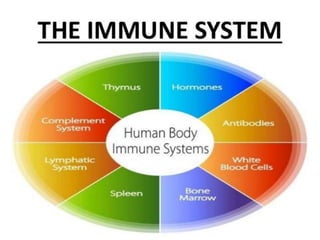
 The immune system includes certain types of
white blood cells.
 It also includes chemicals and proteins in the
blood, such as complement proteins and
interferon.
 Some of these directly attack foreign
substances in the body, and others work
together to help the immune system cells.
7
Inflammation
 The inflammatory response (inflammation)
occurs when tissues are injured by bacteria,
trauma, toxins, heat, or any other cause.
 Chemicals including histamine, bradykinin,
serotonin, and others are released by
damaged tissue.
 These chemicals cause blood vessels to leak
fluid into the tissues, causing swelling.
 This helps isolate the foreign substance
from further contact with body tissues.
 Definition - “An antigen is a substance
which when introduced into the body
stimulates specific immune response”.
 Chemically an antigen may be a
protein, carbohydrate, lipid or nucleic
acid and usually foreign or non self to
the body.
 Definition - “An antibody is a protein
substance produced in response to a
specific antigen with which it combines
chemically”.
 This reaction of antibody results in
neutralization and elimination of antigen.
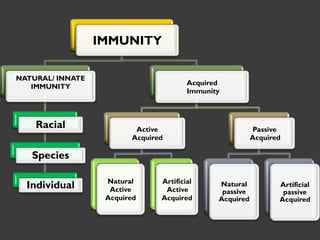
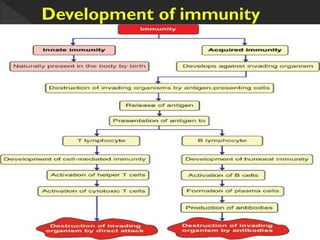
IMMUNITY
NATURAL/ INNATE
IMMUNITY
Racial
Species
Individual
Acquired
Immunity
Active
Acquired
Natural
Active
Acquired
Artificial
Active
Acquired
Passive
Acquired
Natural
passive
Acquired
Artificial
passive
Acquired
Innate or Natural
immunity
 Immunity which may be genetically passed
from one generation to another .
 Types of innate immunity –
1. Species innate immunity
2. Racial innate immunity
3. Individual innate immunity
1. Species innate immunity –
 Resistance to pathogen, shown by all
members of a particular species.
 Ex. Anthrax bacilli present in soil.
 Anthrax infects human because absence of
immunity against anthrax.
 Chickens - immunity present against
anthrax.
 Ex. Rats, mice and dog against tuberculosis
2. Racial innate Immunity –
 Resistance towards micro-organism
among races of species.
 Ex. American Negros are more
susceptible to tuberculosis than American
white.
 American Nigros – 80%TB cases
 AmericanWhite – 20%TB cases
 E.g. Genetic resistance Plasmodium
falciparum malaria resistance in Africa
 Ex. Negro's to yellow fever.
3. Individual innate immunity
 Resistance to infection varies with
different individuals of same race and
species.
 E.x. Adult – more immunity
Children and old - less immunity
Acquired Immunity
 Resistance acquired by individual during
life (birth to death)
 It may be active and passive.
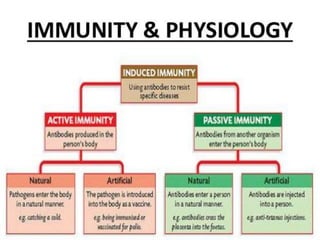
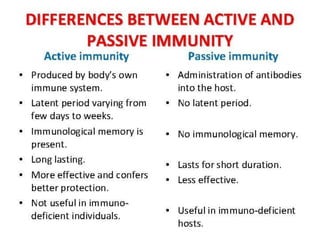
It is the immunity which when one individual
develops as a result of infection or by specific
immunization.
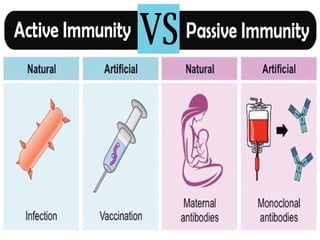
a. Natural active immunity
Through clinical or subclinical infection or
disease.
b. Artificial active immunity
Obtained by vaccination ex. BCG, measles
vaccine.
 It develops as a result of infection or by
specific immunization.
 It is associated with presence of antibodies
or cells having specific action on micro
organism or its toxin.
 It depends on humoral & cellular response of
the host.
 Immunity produced is specific for particular
disease or organism.
Active Immunity acquired by three ways -
1. Following Clinical infections
Ex. Chickenpox, rubella and measles
2. Following Sub-clinical or in-apparent infection
Ex. Polio and diphtheria
3. Following Immunization with an antigen
Ex. Live or killed vaccine
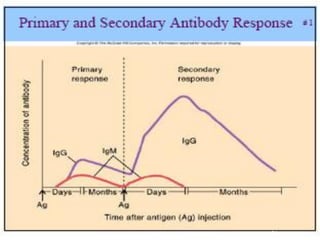
a. Primary immune response
 An antigen is administered for the first time.
 After 3-10 days antibodies appear in the blood.
 The first antibody appeared is IgM which rises
steadily for 2-3 days reaches to peak and
then declines as fast as it developed.
 If the antigenic stimulus was sufficient, IgG
antibody appears in a few days
 IgG reaches to peak in7-10 days and falls over a
period of weeks or months.
Outcome of primary response -
1. Education of reticulo- endothelial system
of the body.
2. Production of memory cells or primed
cells by by B &T lymphocytes.
3. Memory cells are responsible for
immunological memory, which becomes
established after immunization .
Response to the booster dose differs from
primary response in following ways -
 Shorter latent period.
 Production of antibody more rapid.
 Antibody more abundant.
 Antibody response maintained at higher
levels for a longer period.
 The antibody have greater capacity to
bind the antigen.
26
 .
27
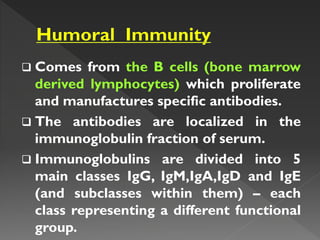
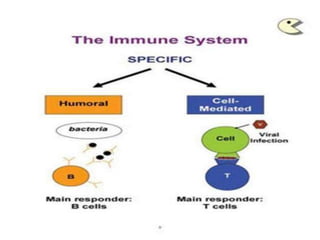
 Comes from the B cells (bone marrow
derived lymphocytes) which proliferate
and manufactures specific antibodies.
 The antibodies are localized in the
immunoglobulin fraction of serum.
 Immunoglobulins are divided into 5
main classes IgG, IgM,IgA,IgD and IgE
(and subclasses within them) – each
class representing a different functional
group.
 These antibodies circulates in the body
and neutralizes microbs or its toxin or
rendering microbe susceptible to attack by
polymorph onuclear leucocyte and
monocyte.
 Antibodies are necessary for phagocytosis
of bacteria.
 Antibodies are specific, i.e. they react with
same antigen pathogen i.e. specificity.
 Definition – Cell mediated immunity is
defined as the immunity developed by cell-
mediated response.
 It is also called as cellular immunity or T –cell
immunity.
 It involves several types of cells such as T
lymphocytes, macrophages, and natural killer
cells and hence the name is cell mediated
immunity.
 This immunity does not involves antibodies.
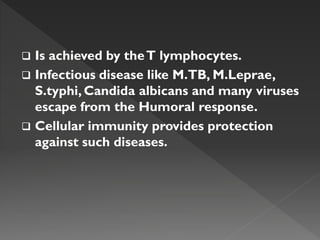
 Is achieved by theT lymphocytes.
 Infectious disease like M.TB, M.Leprae,
S.typhi, Candida albicans and many viruses
escape from the Humoral response.
 Cellular immunity provides protection
against such diseases.
 Definition - When antibodies produced in
one body (human or animal) are transferred
to another to induce protection against
disease.
 Body does not produce its own antibodies
but depends on ready-made antibodies.
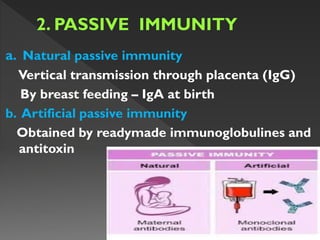
a. Natural passive immunity
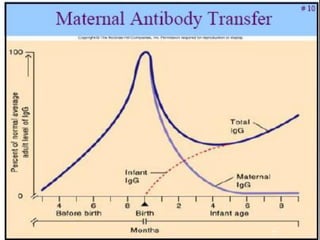
Vertical transmission through placenta (IgG)
By breast feeding – IgA at birth
b. Artificial passive immunity
Obtained by readymade immunoglobulines and
antitoxin
Passive immunity may be induced by –
1. By administration of an antibody-containing
preparation (immune globuline or
antiserum)
2. By transfer of material antibodies across
the placenta (human milk – IgA)
3. By transfer of lymphocytes – to induce
passive cellular immunity (still
experimental)
 “It is the level of resistance of a community
or group of people to a particular disease”.
 Herd immunity implies group protection
beyond that afforded by the protection of
immunized individuals.
 An epidemic declines before the whole
population becomes immune.
 If two third population in a community
becomes immune, the remaining one third
become immune.
The elements which contribute to herd
immunity are -
a. Occurrence of clinical and sub clinical
infection in the herd.
b. Immunization of the herd.
c. Herd structure (Birth, death and
population mobility).
ThankYou

Immunity host defences

  • 2.
  • 4.
     Immunity definition- “Reaction of the body towards any foreign substance or non self”.  The immune response is how your body recognizes and defends itself against bacteria, viruses and substances that appear foreign and harmful to the body.  Immune mechanism reacts with every foreign substance whether visible or microscopic.  Host defense(Immunity) may be 1. Natural Immunity 2. Acquired Immunity
  • 5.
  • 6.
     Immune systemincludes barriers.  These barriers are innate immunity, (with you from birth) skin, stomach acid, mucus (which traps bacteria and small particles), the cough reflex, and enzymes in tears and skin oils.  If an antigen gets passed the external barriers, it is attacked and destroyed by other parts of the immune system. 6
  • 7.
    Blood components  Theimmune system includes certain types of white blood cells.  It also includes chemicals and proteins in the blood, such as complement proteins and interferon.  Some of these directly attack foreign substances in the body, and others work together to help the immune system cells. 7
  • 8.
    Inflammation  The inflammatoryresponse (inflammation) occurs when tissues are injured by bacteria, trauma, toxins, heat, or any other cause.  Chemicals including histamine, bradykinin, serotonin, and others are released by damaged tissue.  These chemicals cause blood vessels to leak fluid into the tissues, causing swelling.  This helps isolate the foreign substance from further contact with body tissues.
  • 9.
     Definition -“An antigen is a substance which when introduced into the body stimulates specific immune response”.  Chemically an antigen may be a protein, carbohydrate, lipid or nucleic acid and usually foreign or non self to the body.
  • 10.
     Definition -“An antibody is a protein substance produced in response to a specific antigen with which it combines chemically”.  This reaction of antibody results in neutralization and elimination of antigen.
  • 11.
  • 12.
  • 13.
     Immunity whichmay be genetically passed from one generation to another .  Types of innate immunity – 1. Species innate immunity 2. Racial innate immunity 3. Individual innate immunity
  • 14.
    1. Species innateimmunity –  Resistance to pathogen, shown by all members of a particular species.  Ex. Anthrax bacilli present in soil.  Anthrax infects human because absence of immunity against anthrax.  Chickens - immunity present against anthrax.  Ex. Rats, mice and dog against tuberculosis
  • 15.
    2. Racial innateImmunity –  Resistance towards micro-organism among races of species.  Ex. American Negros are more susceptible to tuberculosis than American white.  American Nigros – 80%TB cases  AmericanWhite – 20%TB cases  E.g. Genetic resistance Plasmodium falciparum malaria resistance in Africa  Ex. Negro's to yellow fever.
  • 16.
    3. Individual innateimmunity  Resistance to infection varies with different individuals of same race and species.  E.x. Adult – more immunity Children and old - less immunity
  • 17.
  • 19.
     Resistance acquiredby individual during life (birth to death)  It may be active and passive.
  • 20.
    It is theimmunity which when one individual develops as a result of infection or by specific immunization. a. Natural active immunity Through clinical or subclinical infection or disease. b. Artificial active immunity Obtained by vaccination ex. BCG, measles vaccine.
  • 21.
     It developsas a result of infection or by specific immunization.  It is associated with presence of antibodies or cells having specific action on micro organism or its toxin.  It depends on humoral & cellular response of the host.  Immunity produced is specific for particular disease or organism.
  • 22.
    Active Immunity acquiredby three ways - 1. Following Clinical infections Ex. Chickenpox, rubella and measles 2. Following Sub-clinical or in-apparent infection Ex. Polio and diphtheria 3. Following Immunization with an antigen Ex. Live or killed vaccine
  • 23.
    a. Primary immuneresponse  An antigen is administered for the first time.  After 3-10 days antibodies appear in the blood.  The first antibody appeared is IgM which rises steadily for 2-3 days reaches to peak and then declines as fast as it developed.  If the antigenic stimulus was sufficient, IgG antibody appears in a few days  IgG reaches to peak in7-10 days and falls over a period of weeks or months.
  • 24.
    Outcome of primaryresponse - 1. Education of reticulo- endothelial system of the body. 2. Production of memory cells or primed cells by by B &T lymphocytes. 3. Memory cells are responsible for immunological memory, which becomes established after immunization .
  • 25.
    Response to thebooster dose differs from primary response in following ways -  Shorter latent period.  Production of antibody more rapid.  Antibody more abundant.  Antibody response maintained at higher levels for a longer period.  The antibody have greater capacity to bind the antigen.
  • 26.
  • 27.
  • 28.
     Comes fromthe B cells (bone marrow derived lymphocytes) which proliferate and manufactures specific antibodies.  The antibodies are localized in the immunoglobulin fraction of serum.  Immunoglobulins are divided into 5 main classes IgG, IgM,IgA,IgD and IgE (and subclasses within them) – each class representing a different functional group.
  • 29.
     These antibodiescirculates in the body and neutralizes microbs or its toxin or rendering microbe susceptible to attack by polymorph onuclear leucocyte and monocyte.  Antibodies are necessary for phagocytosis of bacteria.  Antibodies are specific, i.e. they react with same antigen pathogen i.e. specificity.
  • 30.
     Definition –Cell mediated immunity is defined as the immunity developed by cell- mediated response.  It is also called as cellular immunity or T –cell immunity.  It involves several types of cells such as T lymphocytes, macrophages, and natural killer cells and hence the name is cell mediated immunity.  This immunity does not involves antibodies.
  • 31.
     Is achievedby theT lymphocytes.  Infectious disease like M.TB, M.Leprae, S.typhi, Candida albicans and many viruses escape from the Humoral response.  Cellular immunity provides protection against such diseases.
  • 33.
     Definition -When antibodies produced in one body (human or animal) are transferred to another to induce protection against disease.  Body does not produce its own antibodies but depends on ready-made antibodies.
  • 34.
    a. Natural passiveimmunity Vertical transmission through placenta (IgG) By breast feeding – IgA at birth b. Artificial passive immunity Obtained by readymade immunoglobulines and antitoxin
  • 35.
    Passive immunity maybe induced by – 1. By administration of an antibody-containing preparation (immune globuline or antiserum) 2. By transfer of material antibodies across the placenta (human milk – IgA) 3. By transfer of lymphocytes – to induce passive cellular immunity (still experimental)
  • 39.
     “It isthe level of resistance of a community or group of people to a particular disease”.  Herd immunity implies group protection beyond that afforded by the protection of immunized individuals.  An epidemic declines before the whole population becomes immune.  If two third population in a community becomes immune, the remaining one third become immune.
  • 40.
    The elements whichcontribute to herd immunity are - a. Occurrence of clinical and sub clinical infection in the herd. b. Immunization of the herd. c. Herd structure (Birth, death and population mobility).
  • 41.