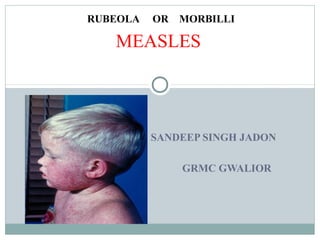
RUBEOLA OR MORBILLI
SANDEEP SINGH JADON
GRMC GWALIOR
MEASLES
DEFINITION
 Measles is an acute highly contagious viral disease
characterized by fever, catarrhal symptom of Upper
respiratory tract(coryza, cough), followed by typical rash.
koplik’s spots and maculopapules.
Totally human disease, no animal reservoir.
 The disease may complicated with branch- pneumonia,
encephalitis,hepatitis.
Epidemiological determinant
1.Agent factor
i. Agent - measles virus
ii. Source of infection - case of infection
iii. Infective material - secretion of nose, throat ,resp. tract.
iv. Period of Communicability - 4 days before and after the rashes.
v. Secondary attack rate - life long immunity from first infection.
2. Host factor-
i. Age- 6 month- 3 year. Up to 5 year in poor countries.
ii. Nutrition- malnourished children mostly affected
 3. Environmental factor
i. epidemic in winter and spring in India.
ii. Population density also affect no. of cases.
Epidemiological determinant
1. Agent.
Paramyxovirus -measles virus
RNA, spherical ,100~150nm in
diameter.
outer envelope –
i.M-protein
ii. H-protein
iii.F-protein,
internal core is- RNA.
2 .Site of detection –blood, nasal,
pharyngeal secretions.
`
 3. Three kinds of antibodies are produced after infection,
that is
3.1 complement combining antibody;
3.2 hemagglutinin inhibiting antibody
3.3 neutralizing antibody
 4 .Only one antigenic type of measles virus is known.
 5.Resistance:-measles virus is sensitive to heat or disinfectant
, it is also inactivated by ultraviolet light easily not strong .
Epidemiological determinant
Transmission
primarily person to person by Airborne transmission via
aerosolized droplet.
Measles is highly communicable, with >90% among susceptible
persons.
Measles may be transmitted from 4 days prior to 4 days after
rash onset.
Incubation period-
i. 10 days from onset of fever.
ii. 14 days to appearance of rashes.
iii. 7 days when by pass respiratory tract eg. Live
vaccine
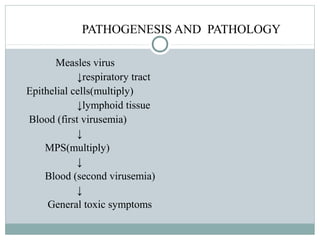
PATHOGENESIS AND PATHOLOGY
Measles virus
↓respiratory tract
Epithelial cells(multiply)
↓lymphoid tissue
Blood (first virusemia)
↓
MPS(multiply)
↓
Blood (second virusemia)
↓
General toxic symptoms
Pathogenesis
Portal of entry
Attachment:
Replication in nasopharynx and regional lymph nodes
Respiratory transmission of virus
Evade the immune system
Primary viremia 2-3 days after exposure
Secondary viremia 5-7 days after exposure with spread to tissues
Destruction of tissue:
PATHOLOGY
Rash: corium superficial blood vessel
Pigmentation:
Desquamation:
Koplik’s spots
CLINICAL MANIFESTATIONS
l Typical type
A. Predromal phase ( 3~4 days)– start after 10 days of
infection and last untill 14 day.
1 Fever
2 Coryza ,sneezing ,nasal discharge, cough,
3 Koplik’s spots;
4 Transient prodromal rashes.
5. redness of the eye, lacrimation and photophobia
Koplik's spots
Found in the mouth, these spots
look like tiny grains of white
sand, each surrounded by a red
ring. They are found especially
on the inside of the cheek (the
buccal mucosa) opposite the 1st
and 2nd upper molars.
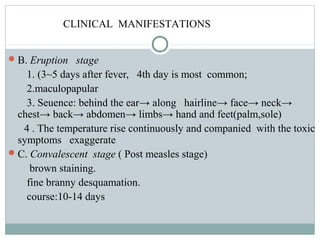
B. Eruption stage
1. (3~5 days after fever, 4th day is most common;
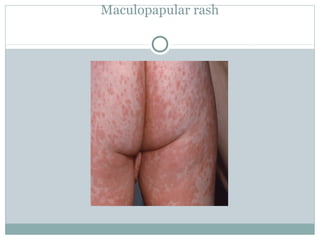
2.maculopapular
3. Seuence: behind the ear→ along hairline→ face→ neck→
chest→ back→ abdomen→ limbs→ hand and feet(palm,sole)
4 . The temperature rise continuously and companied with the toxic
symptoms exaggerate
C. Convalescent stage ( Post measles stage)
brown staining.
fine branny desquamation.
course:10-14 days
CLINICAL MANIFESTATIONS
Maculopapular rash
Measles Clinical Case Definition
Generalized rash lasting >3 days, and
Temperature >38.3 C (101 F), and
Cough, coryza, or conjunctivitis
1 . mild measles;
2 . severe measles (toxic and shock type
measles);
3. hemorrhagic measles;
4 . variant measles.
Atypical measles
COMPLICATIONS
1 .Bronchopneumonia;
2 .Myocarditis;
3 .Laryngitis;
4 .Neurologic complications:
i. Subacute sclerosing panencephalitis (1 in 1000, 000 cases)
ii. Encephalitis (very rare, 1 in 1000)
 Middle ear infections (common)
LABORATORY FINDINGS
Blood routine
Serum Ab measurement
i. Complement combining antibody;
ii. Hem-agglutinin inhibiting antibody;
iii. Neutralizing antibody;
iv. Specific antibody IgM.
Other Ag and multinucleated giant cells
The separation of virus
DIAGNOSIS
1 .Epidemiologic data;
2 .Clinical manifestations;
3. Laboratory findings:
. 3 .1 .Multinucleated giant cells are detected in nasopharyax
mucosa secretions;
3 .2 .Measles virus can be isolated in tissues culture;
. 3 .3 . Antibody titer;
. 3 .4 . WBC is relative low .
Treatment
 1 .General therapy: rest, nursing and diet
 2. Symptomatic therapy: fever and cough,
 3. Support therapy: gamma-globulin
 4.complications of treatment
PREVENTION
1 .Control source of infection;
2 .Interruption of transmissions ;
3 .Protection of the susceptible person:
3.1 . Active immunization
Lived attenuated measles vaccine.
plan immune:8m,7j
epidemic stage:before 2 m
contactor:with in 2 days
Contraindications :pregnancy et al
3.2 . Passive immunization
placenta globulin or gamma globulin.
<5 days prevent onset
>5 days relieve symptoms
censure of combined measles-
Measles Vaccines
1963 Live attenuated and killed vaccines
1965 Live further attenuated vaccine
1967 Killed vaccine withdrawn
1968 Live further attenuated vaccine
(Edmonston-Enders strain)
1971 Licensure of combined measles-
mumps-rubella vaccine
1989 Two dose schedule
Measles Vaccine
Composition Live virus
Efficacy 95% (range, 90%-98%)
Duration of
Immunity Lifelong
Schedule 2 doses
Should be administered with mumps and rubella as MMR
Measles Mumps Rubella Vaccine
12 months is the recommended and minimum age
MMR given before 12 months should not be counted as a valid
dose
Revaccinate at >12 months of age
Second Dose of Measles Vaccine
Intended to produce measles immunity in persons who
failed to respond to the first dose (primary vaccine
failure)
May boost antibody titers in some persons
Second Dose Recommendation
First dose of MMR at 12-15 months
Second dose of MMR at 4-6 years
Second dose may be given any time >4 weeks after the first
dose
Adults at Increased Risk of Measles
College students
International travelers
Health-care personnel
MMR Vaccine Failure
Measles, mumps, or rubella disease (or lack of immunity) in a
previously vaccinated person
2%-5% of recipients do not respond to the first dose
Caused by antibody, damaged vaccine, record errors
Most persons with vaccine failure will respond to second dose
MMR Adverse Reactions
Fever 5%-15%
Rash 5%
Joint symptoms 25%
Thrombocytopenia <1/30,000 doses
Parotitis rare
Deafness rare
Encephalopathy <1/1,000,000 doses
Prophylaxis
Measles vaccine is a live, attenuated measles virus
grown in chick embryo tissue culture. In the
United States, it is given as part of the MMR
vaccine.
Vaccine is about 95% effective
 Cases continue to occur among those who do not develop
or retain good immunity from vacinations.
 Most of these infections are caused by contact with infected people
who come from outside the United States
Prophylaxis
The first dose of MMR should be given on or after
the first birthday; the recommended range is from
12-15 months.
 A dose given before 12 months of age may not be counted,
so the child's medical appointment should be scheduled
with this in mind.
The second dose is usually given when the child is
4-6 years old, or before he or she enters
kindergarten or first grade. The second dose can be
given anytime as long as it is at least four weeks
after the first dose.

Measles Full PSM

  • 1.
    RUBEOLA OR MORBILLI SANDEEPSINGH JADON GRMC GWALIOR MEASLES
  • 2.
    DEFINITION  Measles isan acute highly contagious viral disease characterized by fever, catarrhal symptom of Upper respiratory tract(coryza, cough), followed by typical rash. koplik’s spots and maculopapules. Totally human disease, no animal reservoir.  The disease may complicated with branch- pneumonia, encephalitis,hepatitis.
  • 3.
    Epidemiological determinant 1.Agent factor i.Agent - measles virus ii. Source of infection - case of infection iii. Infective material - secretion of nose, throat ,resp. tract. iv. Period of Communicability - 4 days before and after the rashes. v. Secondary attack rate - life long immunity from first infection. 2. Host factor- i. Age- 6 month- 3 year. Up to 5 year in poor countries. ii. Nutrition- malnourished children mostly affected  3. Environmental factor i. epidemic in winter and spring in India. ii. Population density also affect no. of cases.
  • 4.
    Epidemiological determinant 1. Agent. Paramyxovirus-measles virus RNA, spherical ,100~150nm in diameter. outer envelope – i.M-protein ii. H-protein iii.F-protein, internal core is- RNA. 2 .Site of detection –blood, nasal, pharyngeal secretions.
  • 5.
    `  3. Threekinds of antibodies are produced after infection, that is 3.1 complement combining antibody; 3.2 hemagglutinin inhibiting antibody 3.3 neutralizing antibody  4 .Only one antigenic type of measles virus is known.  5.Resistance:-measles virus is sensitive to heat or disinfectant , it is also inactivated by ultraviolet light easily not strong . Epidemiological determinant
  • 6.
    Transmission primarily person toperson by Airborne transmission via aerosolized droplet. Measles is highly communicable, with >90% among susceptible persons. Measles may be transmitted from 4 days prior to 4 days after rash onset. Incubation period- i. 10 days from onset of fever. ii. 14 days to appearance of rashes. iii. 7 days when by pass respiratory tract eg. Live vaccine
  • 7.
    PATHOGENESIS AND PATHOLOGY Measlesvirus ↓respiratory tract Epithelial cells(multiply) ↓lymphoid tissue Blood (first virusemia) ↓ MPS(multiply) ↓ Blood (second virusemia) ↓ General toxic symptoms
  • 8.
    Pathogenesis Portal of entry Attachment: Replicationin nasopharynx and regional lymph nodes Respiratory transmission of virus Evade the immune system Primary viremia 2-3 days after exposure Secondary viremia 5-7 days after exposure with spread to tissues Destruction of tissue:
  • 9.
    PATHOLOGY Rash: corium superficialblood vessel Pigmentation: Desquamation: Koplik’s spots
  • 10.
    CLINICAL MANIFESTATIONS l Typicaltype A. Predromal phase ( 3~4 days)– start after 10 days of infection and last untill 14 day. 1 Fever 2 Coryza ,sneezing ,nasal discharge, cough, 3 Koplik’s spots; 4 Transient prodromal rashes. 5. redness of the eye, lacrimation and photophobia
  • 11.
    Koplik's spots Found inthe mouth, these spots look like tiny grains of white sand, each surrounded by a red ring. They are found especially on the inside of the cheek (the buccal mucosa) opposite the 1st and 2nd upper molars.
  • 12.
    B. Eruption stage 1.(3~5 days after fever, 4th day is most common; 2.maculopapular 3. Seuence: behind the ear→ along hairline→ face→ neck→ chest→ back→ abdomen→ limbs→ hand and feet(palm,sole) 4 . The temperature rise continuously and companied with the toxic symptoms exaggerate C. Convalescent stage ( Post measles stage) brown staining. fine branny desquamation. course:10-14 days CLINICAL MANIFESTATIONS
  • 13.
  • 14.
    Measles Clinical CaseDefinition Generalized rash lasting >3 days, and Temperature >38.3 C (101 F), and Cough, coryza, or conjunctivitis
  • 15.
    1 . mildmeasles; 2 . severe measles (toxic and shock type measles); 3. hemorrhagic measles; 4 . variant measles. Atypical measles
  • 16.
    COMPLICATIONS 1 .Bronchopneumonia; 2 .Myocarditis; 3.Laryngitis; 4 .Neurologic complications: i. Subacute sclerosing panencephalitis (1 in 1000, 000 cases) ii. Encephalitis (very rare, 1 in 1000)  Middle ear infections (common)
  • 17.
    LABORATORY FINDINGS Blood routine SerumAb measurement i. Complement combining antibody; ii. Hem-agglutinin inhibiting antibody; iii. Neutralizing antibody; iv. Specific antibody IgM. Other Ag and multinucleated giant cells The separation of virus
  • 18.
    DIAGNOSIS 1 .Epidemiologic data; 2.Clinical manifestations; 3. Laboratory findings: . 3 .1 .Multinucleated giant cells are detected in nasopharyax mucosa secretions; 3 .2 .Measles virus can be isolated in tissues culture; . 3 .3 . Antibody titer; . 3 .4 . WBC is relative low .
  • 19.
    Treatment  1 .Generaltherapy: rest, nursing and diet  2. Symptomatic therapy: fever and cough,  3. Support therapy: gamma-globulin  4.complications of treatment
  • 20.
    PREVENTION 1 .Control sourceof infection; 2 .Interruption of transmissions ; 3 .Protection of the susceptible person: 3.1 . Active immunization Lived attenuated measles vaccine. plan immune:8m,7j epidemic stage:before 2 m contactor:with in 2 days Contraindications :pregnancy et al 3.2 . Passive immunization placenta globulin or gamma globulin. <5 days prevent onset >5 days relieve symptoms
  • 21.
    censure of combinedmeasles- Measles Vaccines 1963 Live attenuated and killed vaccines 1965 Live further attenuated vaccine 1967 Killed vaccine withdrawn 1968 Live further attenuated vaccine (Edmonston-Enders strain) 1971 Licensure of combined measles- mumps-rubella vaccine 1989 Two dose schedule
  • 22.
    Measles Vaccine Composition Livevirus Efficacy 95% (range, 90%-98%) Duration of Immunity Lifelong Schedule 2 doses Should be administered with mumps and rubella as MMR
  • 23.
    Measles Mumps RubellaVaccine 12 months is the recommended and minimum age MMR given before 12 months should not be counted as a valid dose Revaccinate at >12 months of age
  • 24.
    Second Dose ofMeasles Vaccine Intended to produce measles immunity in persons who failed to respond to the first dose (primary vaccine failure) May boost antibody titers in some persons
  • 25.
    Second Dose Recommendation Firstdose of MMR at 12-15 months Second dose of MMR at 4-6 years Second dose may be given any time >4 weeks after the first dose
  • 26.
    Adults at IncreasedRisk of Measles College students International travelers Health-care personnel
  • 27.
    MMR Vaccine Failure Measles,mumps, or rubella disease (or lack of immunity) in a previously vaccinated person 2%-5% of recipients do not respond to the first dose Caused by antibody, damaged vaccine, record errors Most persons with vaccine failure will respond to second dose
  • 28.
    MMR Adverse Reactions Fever5%-15% Rash 5% Joint symptoms 25% Thrombocytopenia <1/30,000 doses Parotitis rare Deafness rare Encephalopathy <1/1,000,000 doses
  • 29.
    Prophylaxis Measles vaccine isa live, attenuated measles virus grown in chick embryo tissue culture. In the United States, it is given as part of the MMR vaccine. Vaccine is about 95% effective  Cases continue to occur among those who do not develop or retain good immunity from vacinations.  Most of these infections are caused by contact with infected people who come from outside the United States
  • 30.
    Prophylaxis The first doseof MMR should be given on or after the first birthday; the recommended range is from 12-15 months.  A dose given before 12 months of age may not be counted, so the child's medical appointment should be scheduled with this in mind. The second dose is usually given when the child is 4-6 years old, or before he or she enters kindergarten or first grade. The second dose can be given anytime as long as it is at least four weeks after the first dose.