

TYPES OF
CONTRACTS
CONSTRUCTION CONTRACTS
2
Contract as per the Indian Contract Act 1872 means
‘agreements which are enforceable as such having
been made by free consent of the parties, by persons
competent to contract for a lawful consideration and
lawful object and which are not expressly declared to
be void by any statute.’
CATEGORIES OF CONSTRUCTION CONTRACTS
3
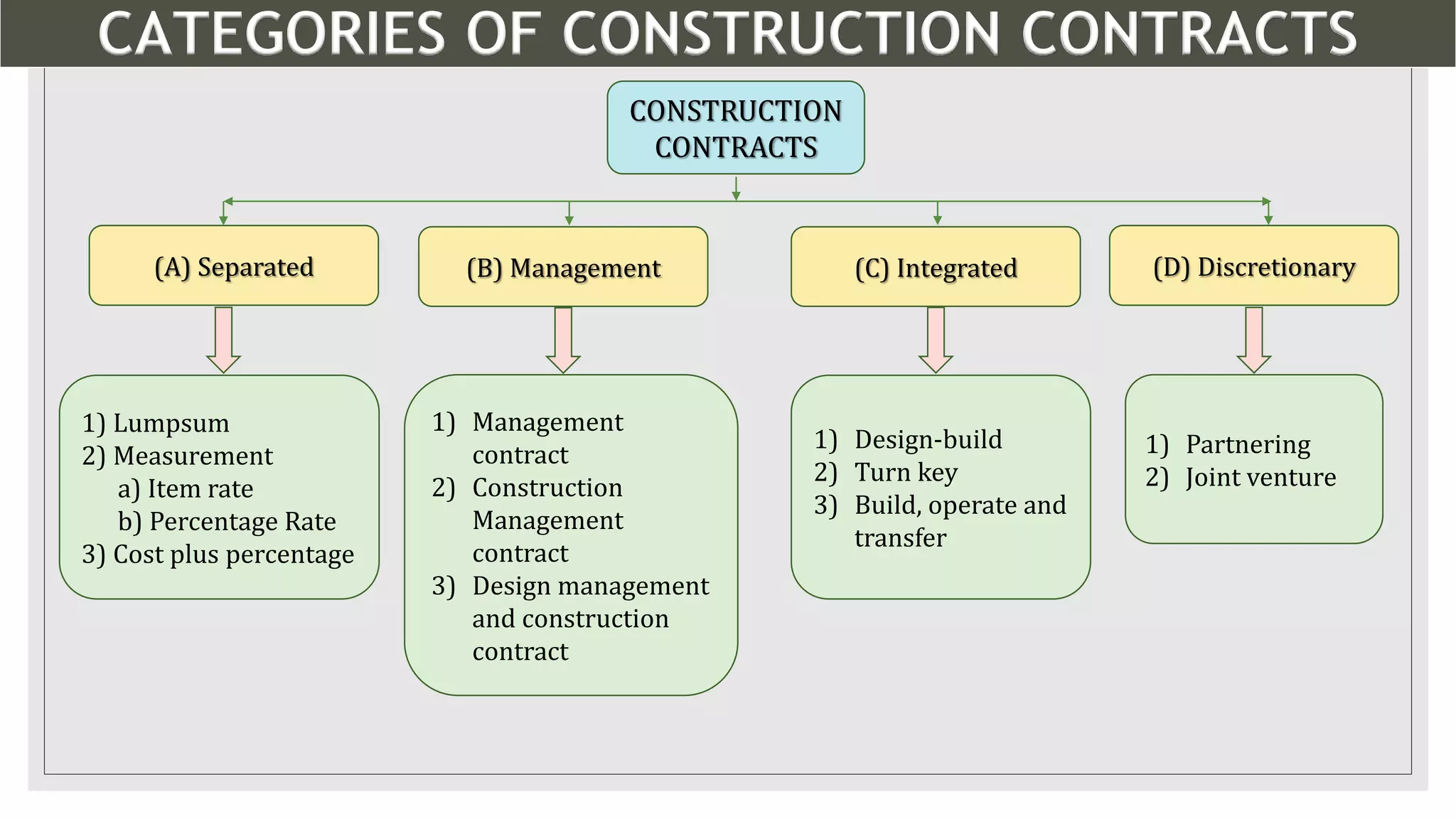
CONSTRUCTION
CONTRACTS
(A) Separated (C) Integrated(B) Management (D) Discretionary
1) Lumpsum
2) Measurement
a) Item rate
b) Percentage Rate
3) Cost plus percentage
1) Management
contract
2) Construction
Management
contract
3) Design management
and construction
contract
1) Design-build
2) Turn key
3) Build, operate and
transfer
1) Partnering
2) Joint venture
(A) SEPERATED CONTRACTS
4
 The separated contract, which is a sequential process, has been the
traditional system adopted for construction contracts.
 There is a clear division between the design and construction
responsibilities. The design phase is taken care of by some entity,
while the construction is taken care of by some other entity.
 Sufficient time is needed by all the entities . The construction
phase normally does not begin until the design is completed. As a
result, the whole of the development process gets delayed.
 Recommended for simple, small to medium-sized projects, where
time is not a critical factor.
(A)-1- Lump-sum Contract
5
 From the drawings and other details of the project provided by the client, the
contractors on the basis of their own analysis quote a single lump-sum figure,
which is the total contract value of the work.
 Refers to the total sum of money for which the contractor agrees to build the
required facility, accepting all responsibility for factors relating to the supply of raw
materials, uncertainties relating to construction hazards, and other difficulties.
 Client’s Advantage - he knows the exact amount of funds required for the
completion of the Project.
 Contract Amount in a lump-sum contract is also subject to a revision :-
a) Conditions outside the contractor’s control e.g. Force Majeure (Pandemic)
b) Change in the design or specifications by the client
c) High Changes in cost of materials based on market fluctuations
 Payment Terms :- stages or milestones are specified for the payment of bills to the
contractor on a certain predefined percentage.
(A)-2- Measurement Contracts
6
 If the Client decides the payments be made according to the actual work carried
out, which should be determined based on physical measurements. Such contracts
are referred to as ‘measurement contracts’ and could be either
(a) Item Rate
(b) Percentage Rate
Item Rate Contract :-
 In this type more than the total amount or the quantity of work in any item, it is the rate of
the item quoted by the contractor that is held more important.
 Contractor agrees to carry out a unit quantity of a particular work (m, sqm, nos., MT) for a
particular sum of money.
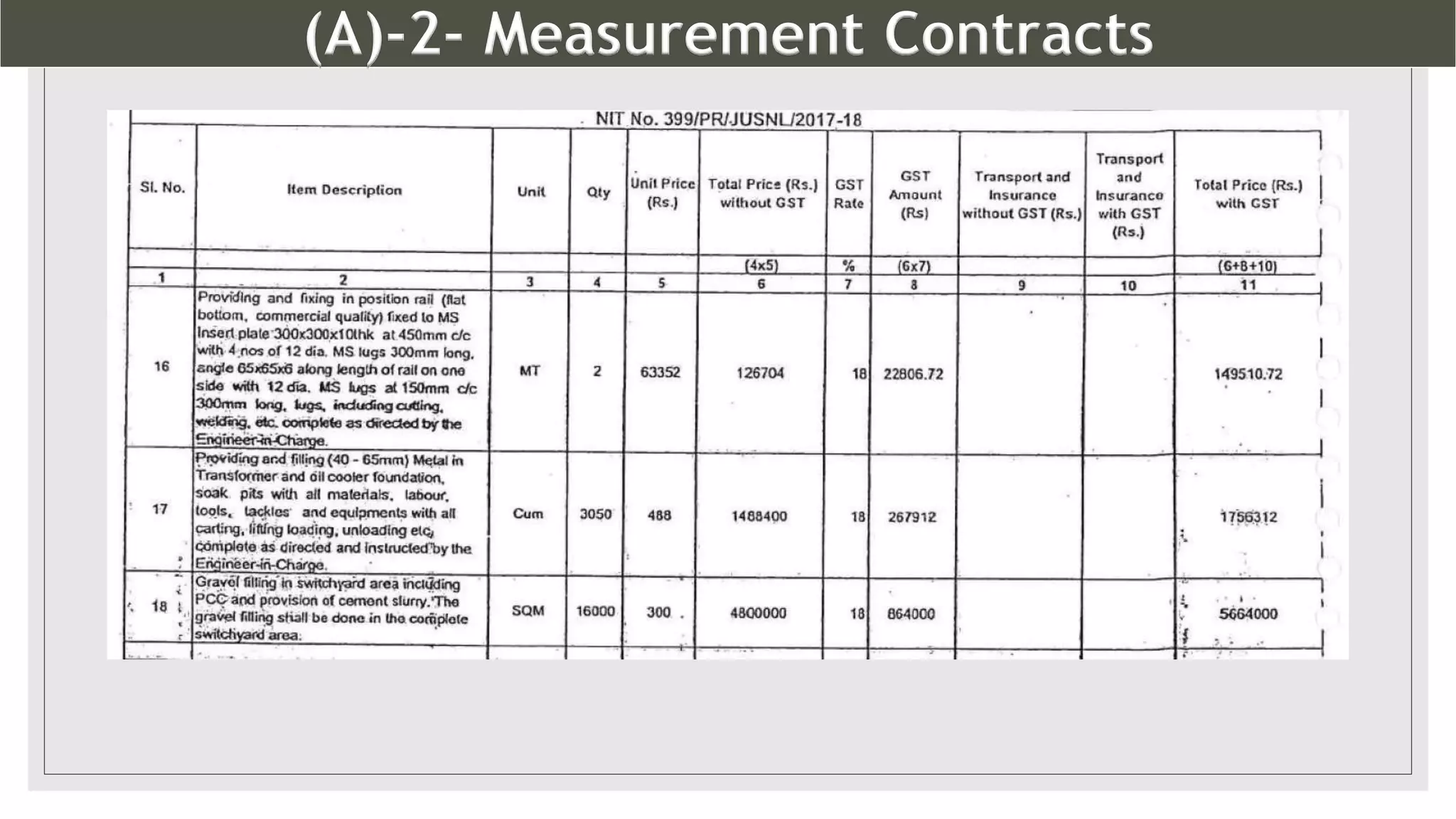
 Tender document should have a detailed Bill of Quantities (BOQ), where an estimated
quantity of the work for each item involved in the particular work is listed, along with a
detailed description. The contractor carries out a detailed analysis to determine the rate of
each individual item and quotes these rates against each item of work.
 An accurate account of the actual work (for each item) is kept, and the payment is made
only for the actual work carried out.
(A)-2- Measurement Contracts
7
(A)-2- Measurement Contracts
8
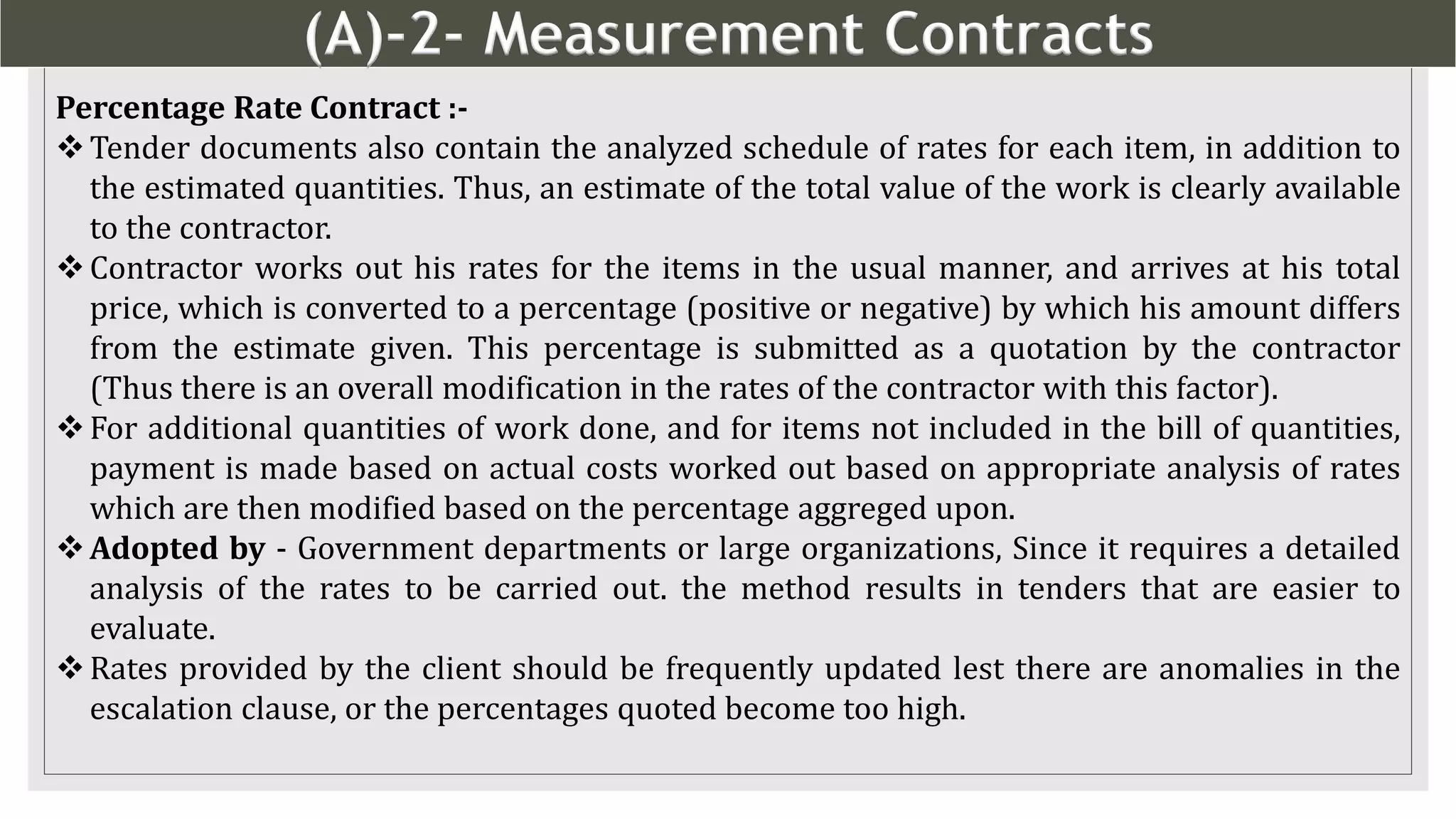
Percentage Rate Contract :-
Tender documents also contain the analyzed schedule of rates for each item, in addition to
the estimated quantities. Thus, an estimate of the total value of the work is clearly available
to the contractor.
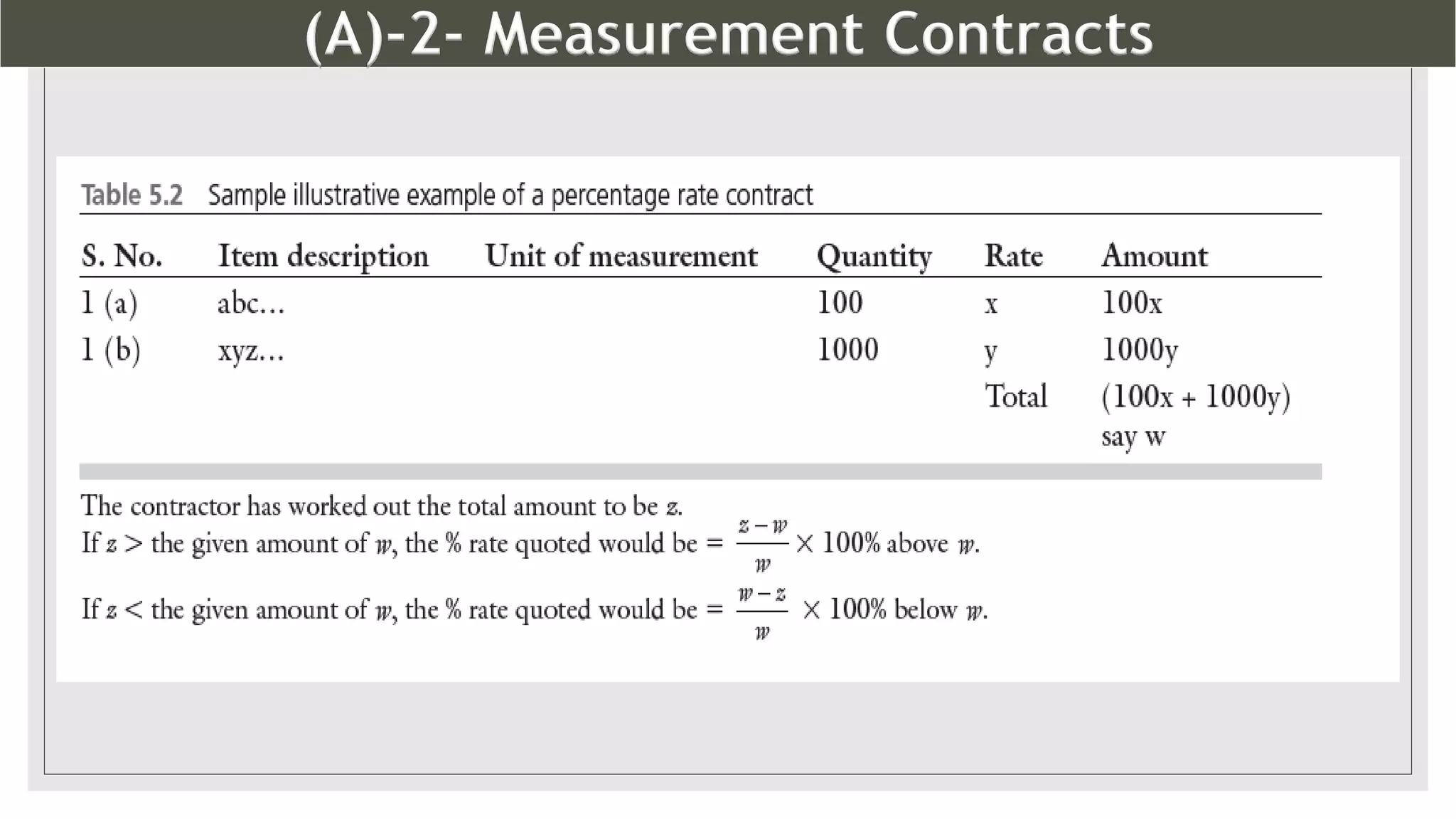
Contractor works out his rates for the items in the usual manner, and arrives at his total
price, which is converted to a percentage (positive or negative) by which his amount differs
from the estimate given. This percentage is submitted as a quotation by the contractor
(Thus there is an overall modification in the rates of the contractor with this factor).
For additional quantities of work done, and for items not included in the bill of quantities,
payment is made based on actual costs worked out based on appropriate analysis of rates
which are then modified based on the percentage aggreged upon.
Adopted by - Government departments or large organizations, Since it requires a detailed
analysis of the rates to be carried out. the method results in tenders that are easier to
evaluate.
Rates provided by the client should be frequently updated lest there are anomalies in the
escalation clause, or the percentages quoted become too high.
(A)-2- Measurement Contracts
9
(A)-3- Cost Plus Percentage
10
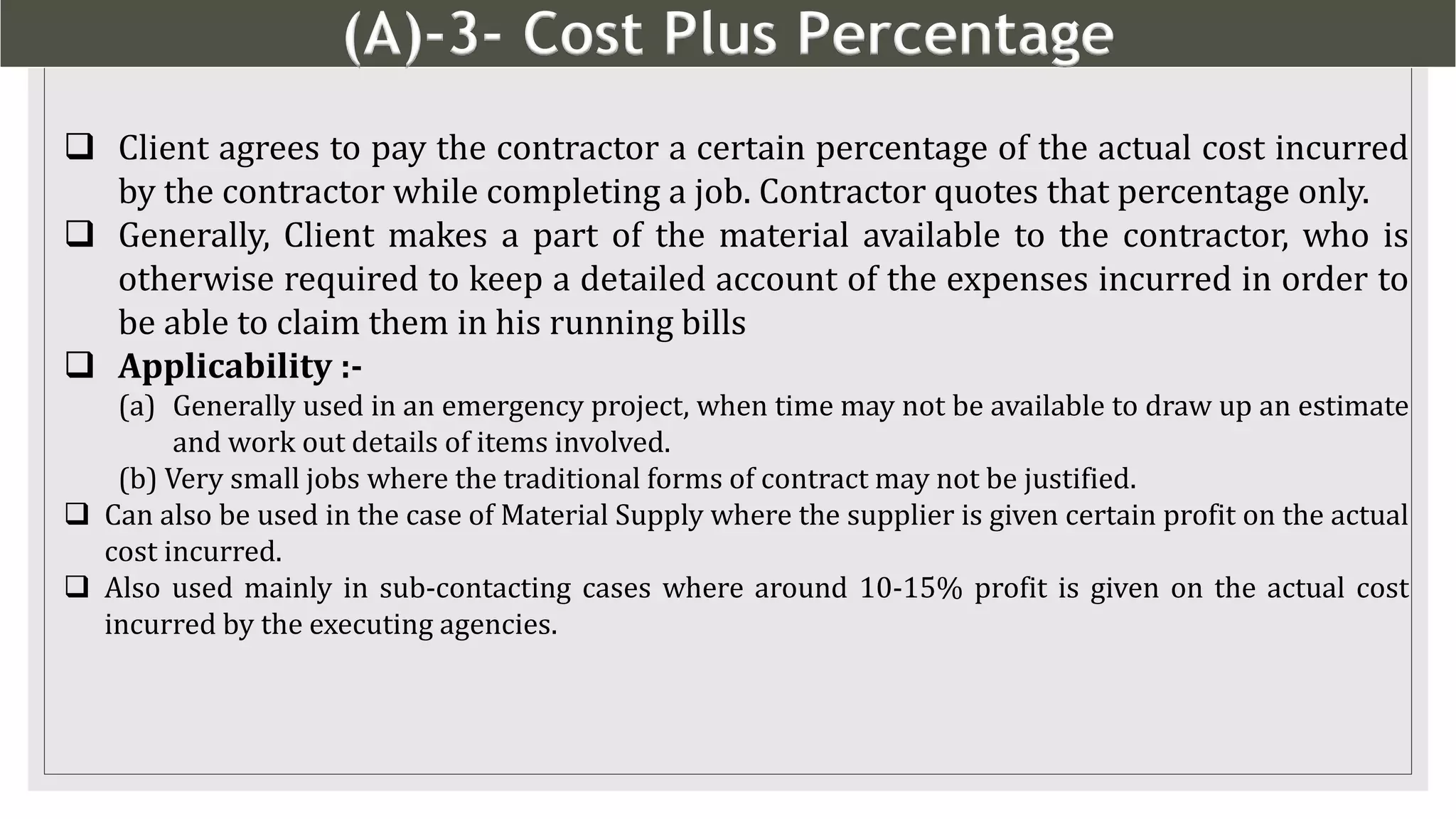
 Client agrees to pay the contractor a certain percentage of the actual cost incurred
by the contractor while completing a job. Contractor quotes that percentage only.
 Generally, Client makes a part of the material available to the contractor, who is
otherwise required to keep a detailed account of the expenses incurred in order to
be able to claim them in his running bills
 Applicability :-
(a) Generally used in an emergency project, when time may not be available to draw up an estimate
and work out details of items involved.
(b) Very small jobs where the traditional forms of contract may not be justified.
 Can also be used in the case of Material Supply where the supplier is given certain profit on the actual
cost incurred.
 Also used mainly in sub-contacting cases where around 10-15% profit is given on the actual cost
incurred by the executing agencies.
(B)-1- Management Contracts
11
 Managing contractor is appointed at the earliest possible time. This helps the client
to avoid dealing with a large number of small contractors.
 The client has to deal with a single (principal) contractor besides a designer.
 The principal contractor provides planning, management and coordination services
to the client.
 The design services are provided by the designer, who is separately appointed by
the client.
 Principal contractor is barred from executing the construction work himself, though
in some cases the principal contractor can contribute some resources such as
formwork, cranes, etc., to the subcontractors.
(B)-1- Management Contracts
12
Responsibilities assigned to the management contractor are:
 Preparation of overall construction schedule
 Preparation of work package schedule
 Coordinating with the designer to steer through the design stage
 Assistance in subcontractor(s) selection
 Coordinating among different subcontractors
(B)-2- Construction Management Contracts
13
 Construction manager is appointed by the client at an early stage to
provide planning, management and coordination.
 The owner also appoints the designer and contractors for different
works.
The role of construction manager, therefore, is mainly coordination
among different Sub-Contractors, besides ensuring timely completion of
project within the budgeted cost according to the specifications
Similar to the management contract, here too, the construction
management firm is barred from executing the construction work on its
own.
(B)-2- Construction Management Contracts
14
Some of the responsibilities assigned to the construction
manager are:
• Advising the designer
• Advising on drawing suitable work package
• Assisting in procurement
• Managing the bidding process
Activities are Similar to Management Contract but majorly
concerned with Construction Management.
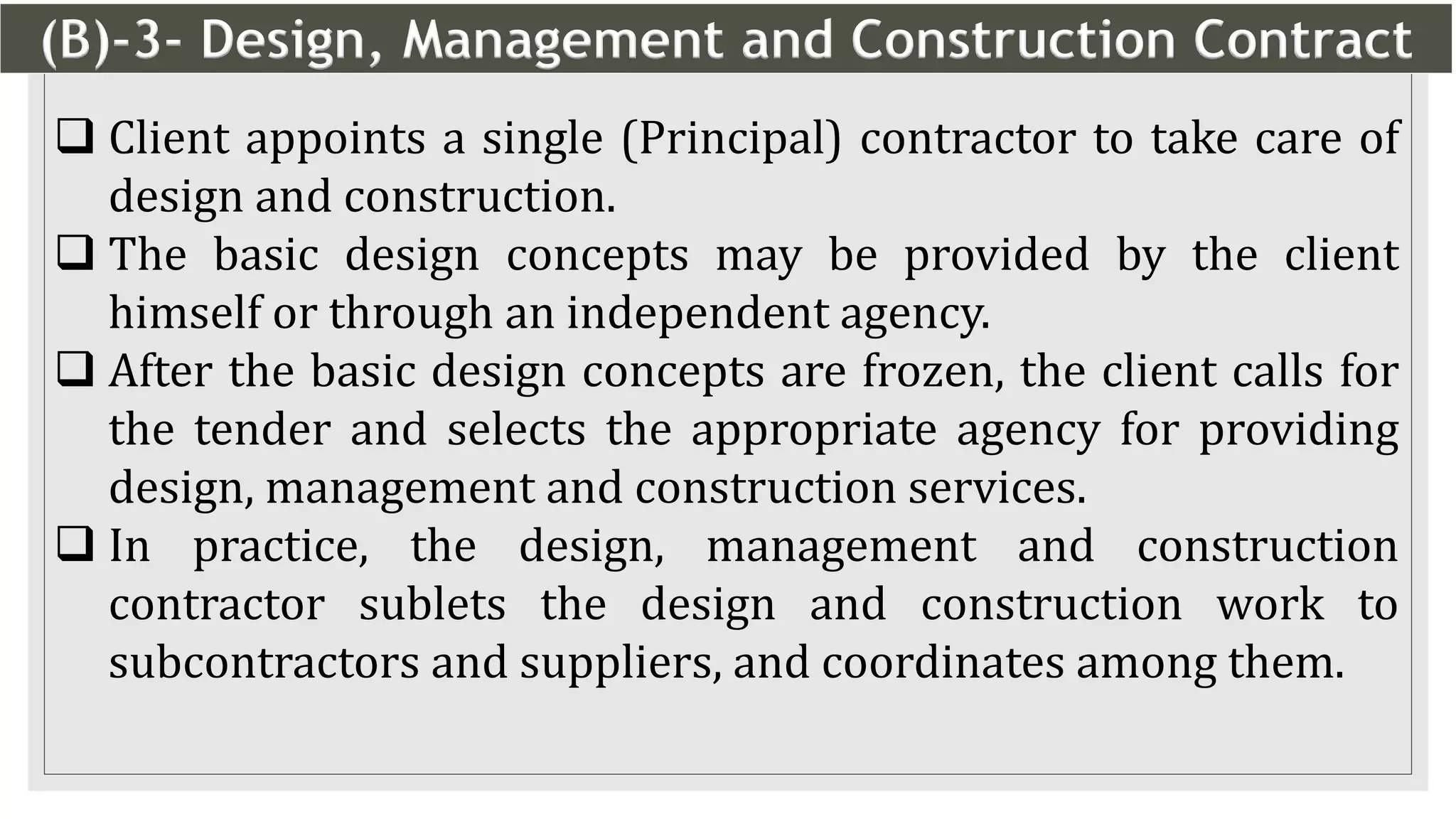
(B)-3- Design, Management and Construction Contract
15
 Client appoints a single (Principal) contractor to take care of
design and construction.
 The basic design concepts may be provided by the client
himself or through an independent agency.
 After the basic design concepts are frozen, the client calls for
the tender and selects the appropriate agency for providing
design, management and construction services.
 In practice, the design, management and construction
contractor sublets the design and construction work to
subcontractors and suppliers, and coordinates among them.
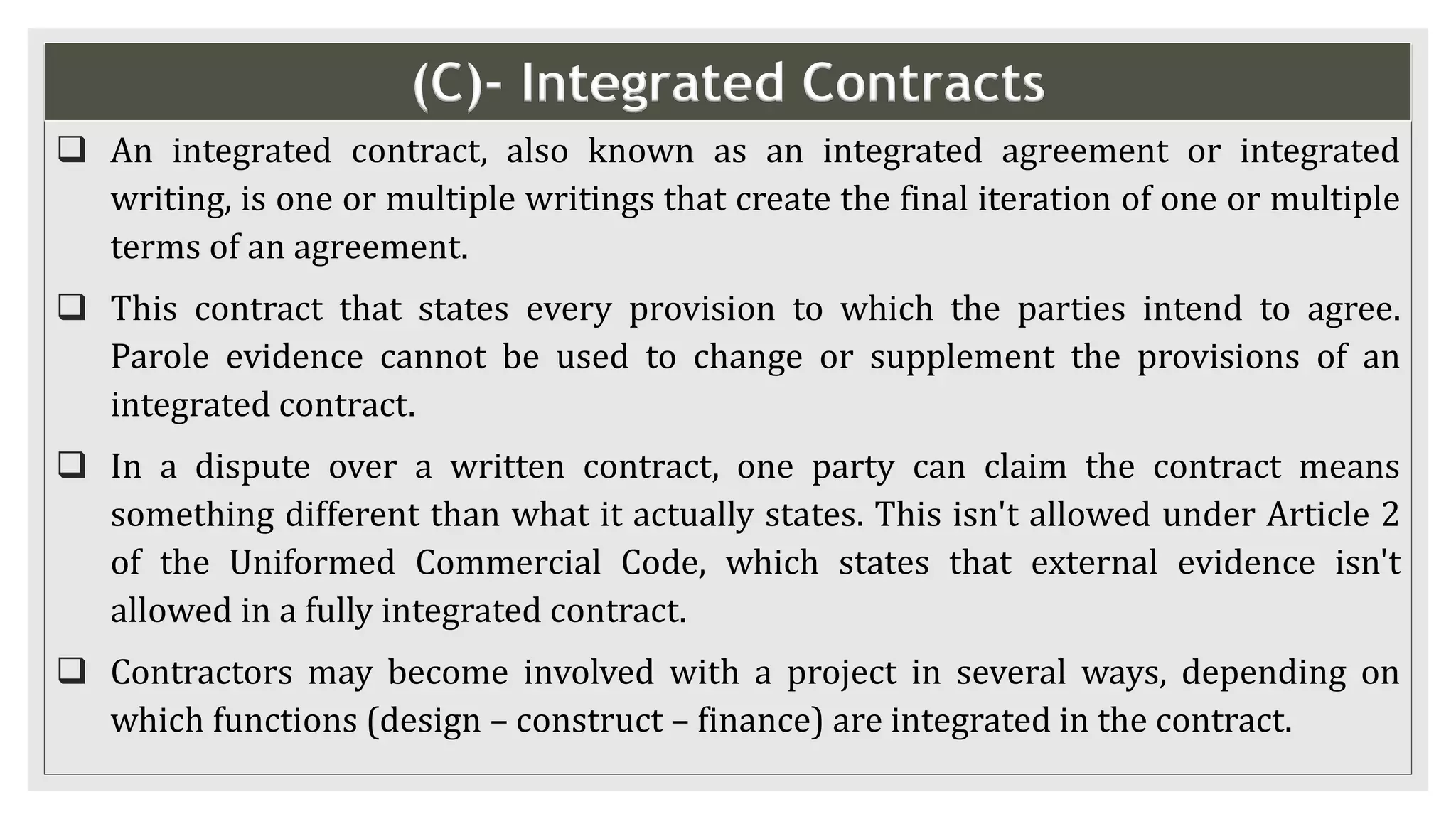
(C)- Integrated Contracts
 An integrated contract, also known as an integrated agreement or integrated
writing, is one or multiple writings that create the final iteration of one or multiple
terms of an agreement.
 This contract that states every provision to which the parties intend to agree.
Parole evidence cannot be used to change or supplement the provisions of an
integrated contract.
 In a dispute over a written contract, one party can claim the contract means
something different than what it actually states. This isn't allowed under Article 2
of the Uniformed Commercial Code, which states that external evidence isn't
allowed in a fully integrated contract.
 Contractors may become involved with a project in several ways, depending on
which functions (design – construct – finance) are integrated in the contract.
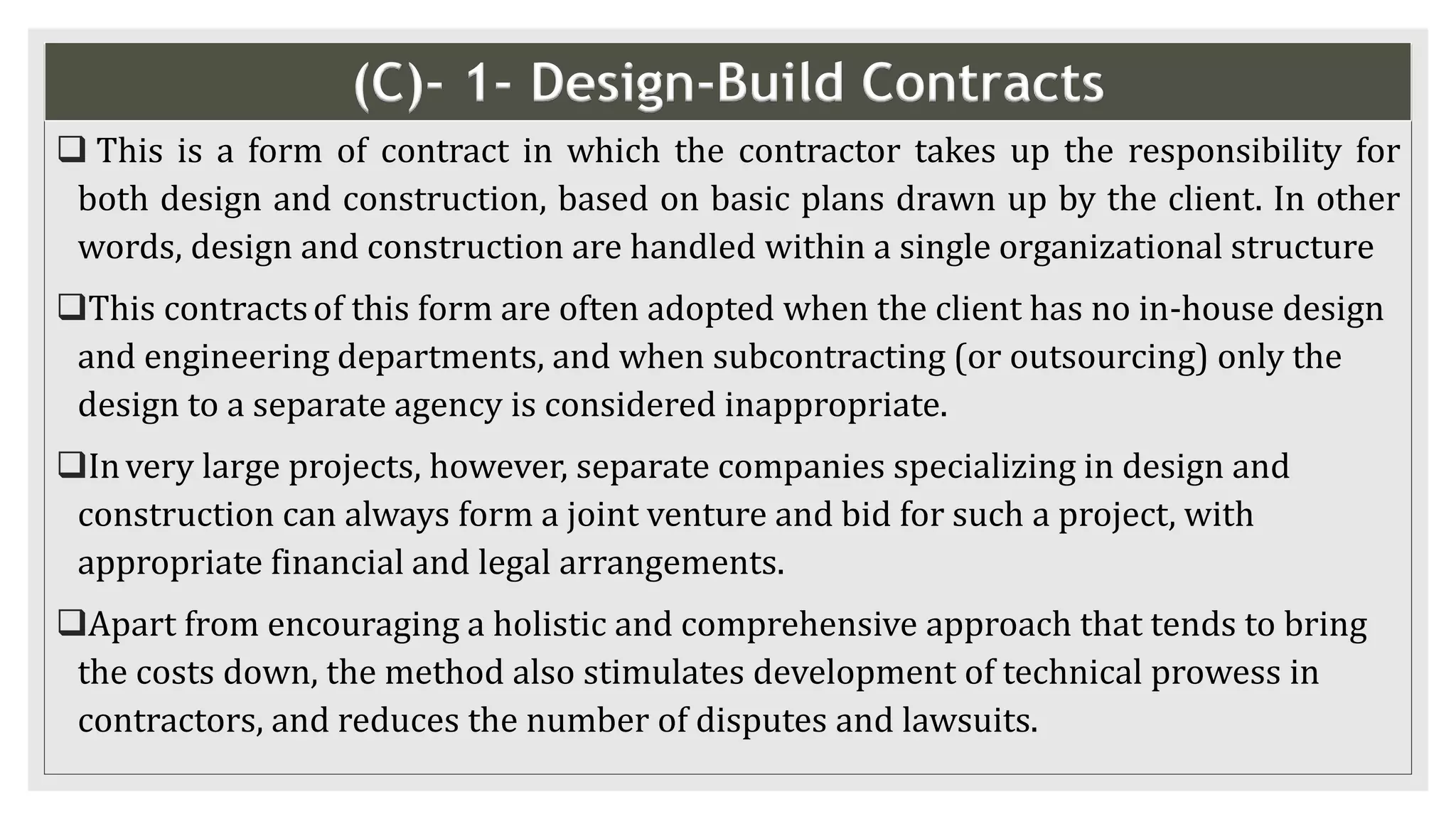
(C)- 1- Design-Build Contracts
 This is a form of contract in which the contractor takes up the responsibility for
both design and construction, based on basic plans drawn up by the client. In other
words, design and construction are handled within a single organizational structure
This contractsof this form are often adopted when the client has no in-house design
and engineering departments, and when subcontracting (or outsourcing) only the
design to a separate agency is considered inappropriate.
Invery large projects, however, separate companies specializing in design and
construction can always form a joint venture and bid for such a project, with
appropriate financial and legal arrangements.
Apart from encouraging a holistic and comprehensive approach that tends to bring
the costs down, the method also stimulates development of technical prowess in
contractors, and reduces the number of disputes and lawsuits.
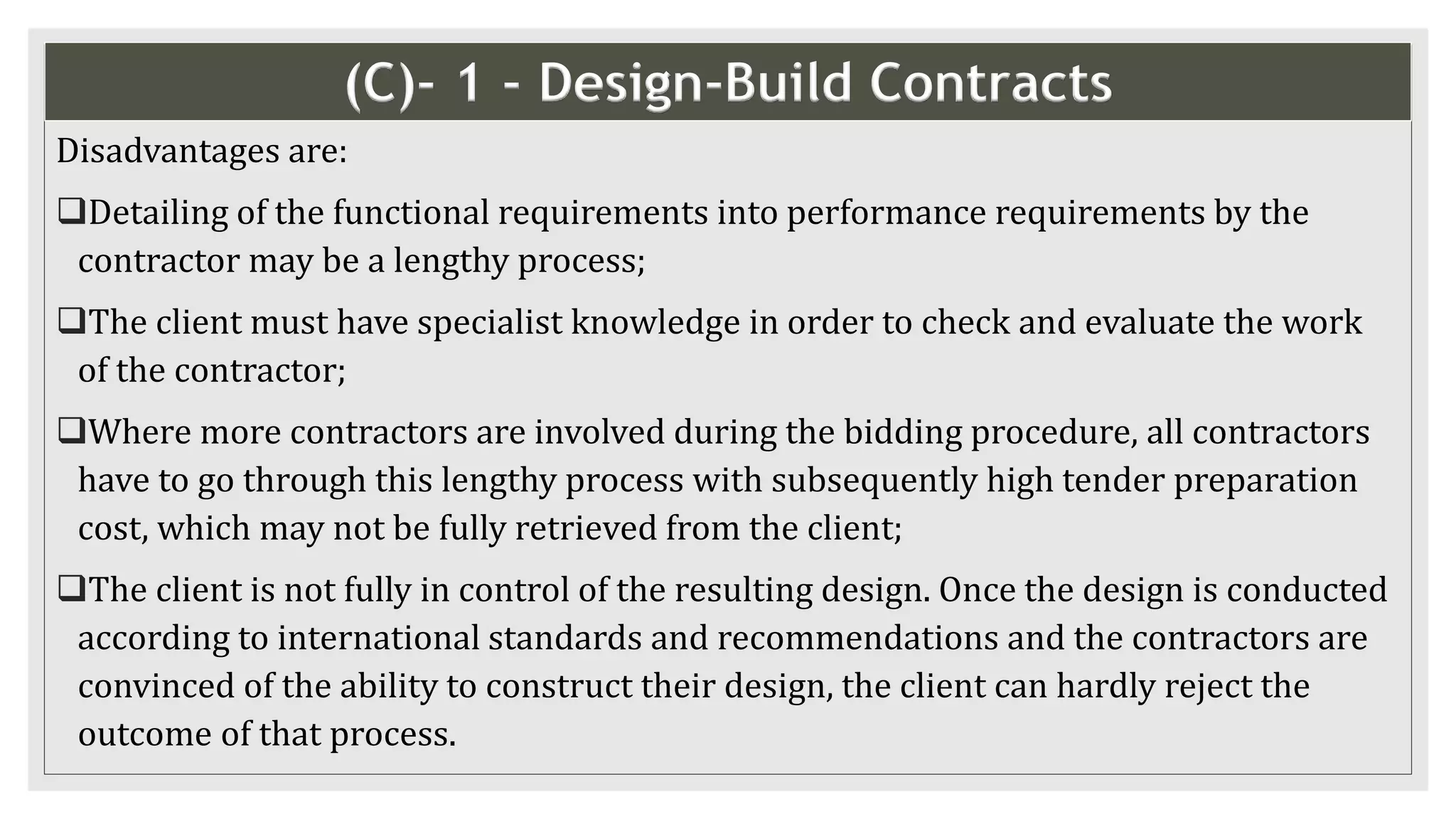
(C)- 1 - Design-Build Contracts
Disadvantages are:
Detailing of the functional requirements into performance requirements by the
contractor may be a lengthy process;
The client must have specialist knowledge in order to check and evaluate the work
of the contractor;
Where more contractors are involved during the bidding procedure, all contractors
have to go through this lengthy process with subsequently high tender preparation
cost, which may not be fully retrieved from the client;
The client is not fully in control of the resulting design. Once the design is conducted
according to international standards and recommendations and the contractors are
convinced of the ability to construct their design, the client can hardly reject the
outcome of that process.
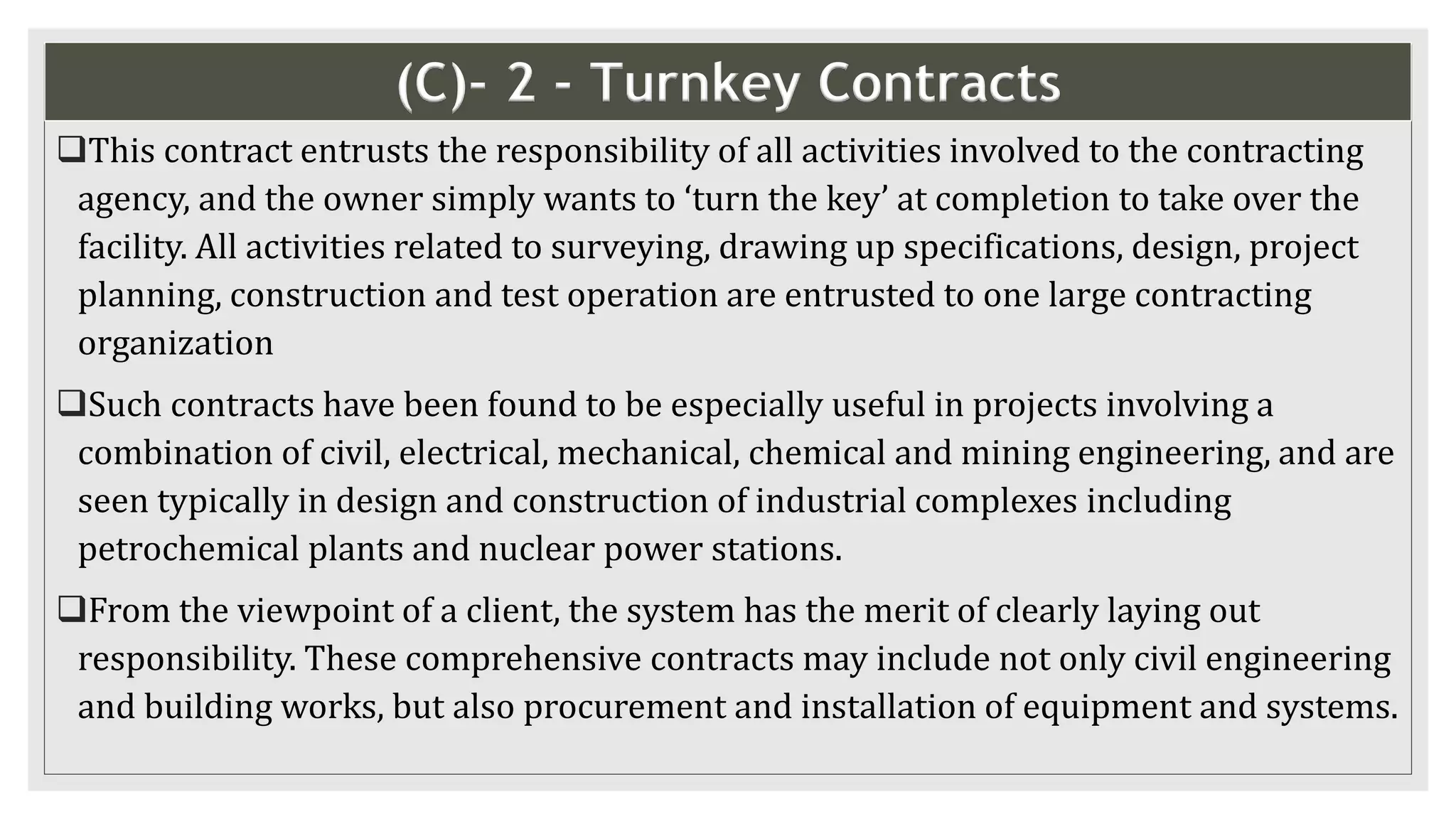
(C)- 2 - Turnkey Contracts
This contract entrusts the responsibility of all activities involved to the contracting
agency, and the owner simply wants to ‘turn the key’ at completion to take over the
facility. All activities related to surveying, drawing up specifications, design, project
planning, construction and test operation are entrusted to one large contracting
organization
Such contracts have been found to be especially useful in projects involving a
combination of civil, electrical, mechanical, chemical and mining engineering, and are
seen typically in design and construction of industrial complexes including
petrochemical plants and nuclear power stations.
From the viewpoint of a client, the system has the merit of clearly laying out
responsibility. These comprehensive contracts may include not only civil engineering
and building works, but also procurement and installation of equipment and systems.
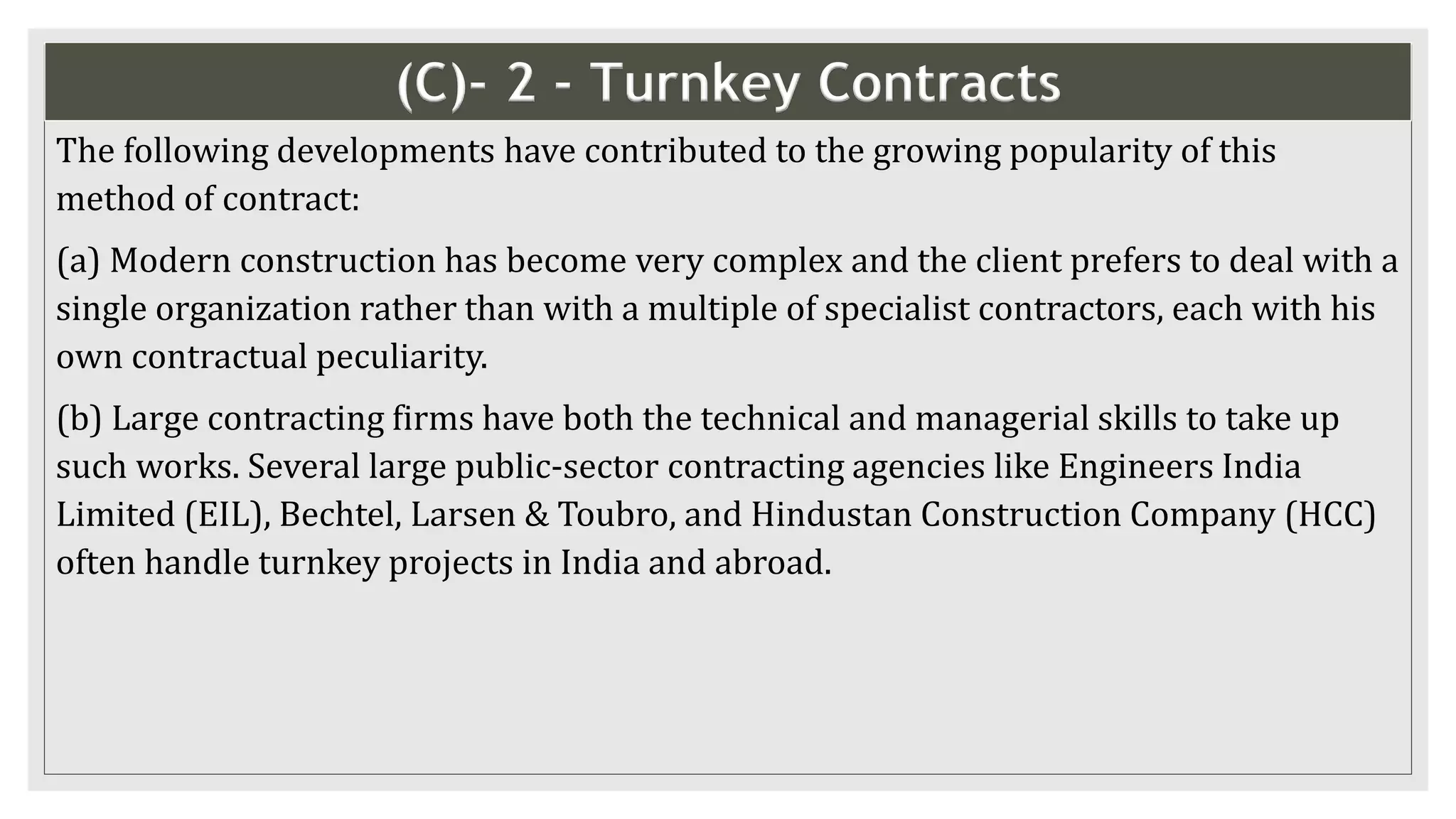
(C)- 2 - Turnkey Contracts
The following developments have contributed to the growing popularity of this
method of contract:
(a) Modern construction has become very complex and the client prefers to deal with a
single organization rather than with a multiple of specialist contractors, each with his
own contractual peculiarity.
(b) Large contracting firms have both the technical and managerial skills to take up
such works. Several large public-sector contracting agencies like Engineers India
Limited (EIL), Bechtel, Larsen & Toubro, and Hindustan Construction Company (HCC)
often handle turnkey projects in India and abroad.
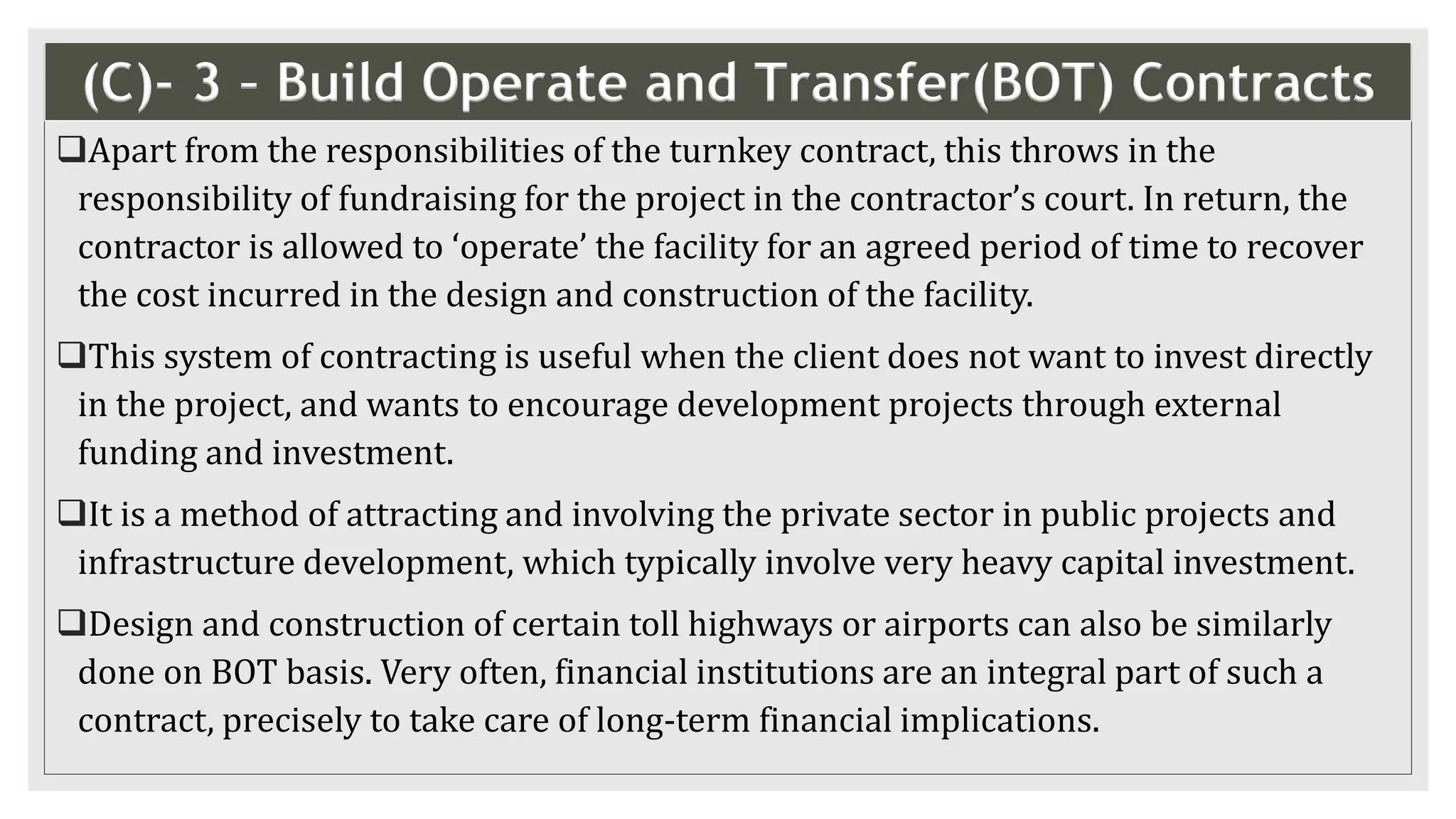
(C)- 3 – Build Operate and Transfer(BOT) Contracts
Apart from the responsibilities of the turnkey contract, this throws in the
responsibility of fundraising for the project in the contractor’s court. In return, the
contractor is allowed to ‘operate’ the facility for an agreed period of time to recover
the cost incurred in the design and construction of the facility.
This system of contracting is useful when the client does not want to invest directly
in the project, and wants to encourage development projects through external
funding and investment.
It is a method of attracting and involving the private sector in public projects and
infrastructure development, which typically involve very heavy capital investment.
Design and construction of certain toll highways or airports can also be similarly
done on BOT basis. Very often, financial institutions are an integral part of such a
contract, precisely to take care of long-term financial implications.
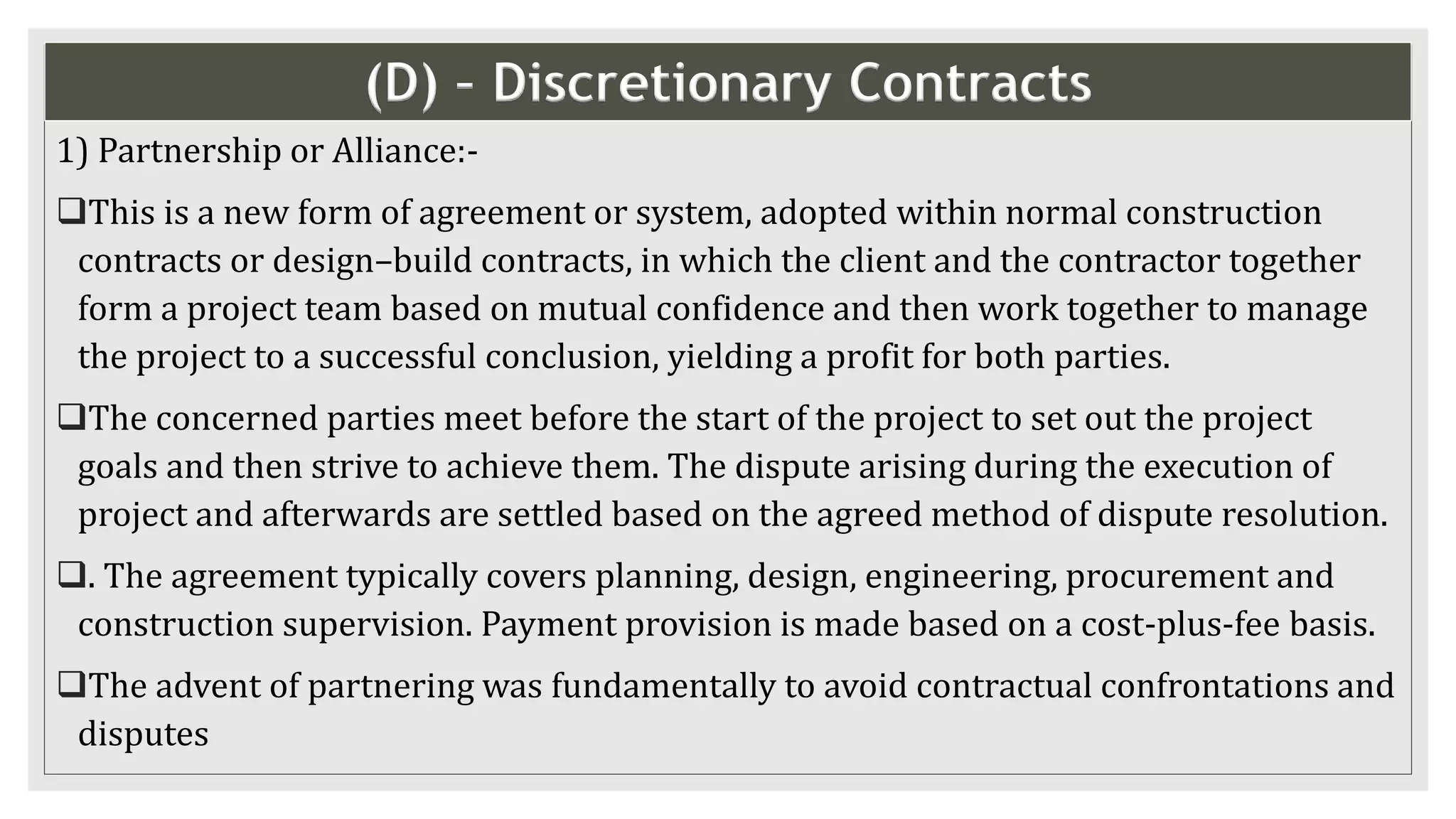
(D) – Discretionary Contracts
1) Partnership or Alliance:-
This is a new form of agreement or system, adopted within normal construction
contracts or design–build contracts, in which the client and the contractor together
form a project team based on mutual confidence and then work together to manage
the project to a successful conclusion, yielding a profit for both parties.
The concerned parties meet before the start of the project to set out the project
goals and then strive to achieve them. The dispute arising during the execution of
project and afterwards are settled based on the agreed method of dispute resolution.
. The agreement typically covers planning, design, engineering, procurement and
construction supervision. Payment provision is made based on a cost-plus-fee basis.
The advent of partnering was fundamentally to avoid contractual confrontations and
disputes
(D) – Discretionary Contracts
2) Joint Venture:-
In large projects, very often no single contracting company has adequate expertise
and/or resources to be able to bid alone and become the main contractor. In such
cases, several contractors pool in their resources and form a joint venture, and bid for
the project together.
The companies sign an MOU and form such a venture which spells out the terms and
conditions of this merger, including the individual shares of the participating
companies.
The proportions of shareholding among partners vary. A partner with 51 per cent or
more shareholding usually controls ownership of the joint venture.
The different participating companies contribute staff to a Joint Venture, as may be
clearly spelt out in the MOU. Such personnel are often treated as “on deputation”
from their parent
THANK YOU

Types of contracts

  • 1.
  • 2.
    CONSTRUCTION CONTRACTS 2 Contract asper the Indian Contract Act 1872 means ‘agreements which are enforceable as such having been made by free consent of the parties, by persons competent to contract for a lawful consideration and lawful object and which are not expressly declared to be void by any statute.’
  • 3.
    CATEGORIES OF CONSTRUCTIONCONTRACTS 3 CONSTRUCTION CONTRACTS (A) Separated (C) Integrated(B) Management (D) Discretionary 1) Lumpsum 2) Measurement a) Item rate b) Percentage Rate 3) Cost plus percentage 1) Management contract 2) Construction Management contract 3) Design management and construction contract 1) Design-build 2) Turn key 3) Build, operate and transfer 1) Partnering 2) Joint venture
  • 4.
    (A) SEPERATED CONTRACTS 4 The separated contract, which is a sequential process, has been the traditional system adopted for construction contracts.  There is a clear division between the design and construction responsibilities. The design phase is taken care of by some entity, while the construction is taken care of by some other entity.  Sufficient time is needed by all the entities . The construction phase normally does not begin until the design is completed. As a result, the whole of the development process gets delayed.  Recommended for simple, small to medium-sized projects, where time is not a critical factor.
  • 5.
    (A)-1- Lump-sum Contract 5 From the drawings and other details of the project provided by the client, the contractors on the basis of their own analysis quote a single lump-sum figure, which is the total contract value of the work.  Refers to the total sum of money for which the contractor agrees to build the required facility, accepting all responsibility for factors relating to the supply of raw materials, uncertainties relating to construction hazards, and other difficulties.  Client’s Advantage - he knows the exact amount of funds required for the completion of the Project.  Contract Amount in a lump-sum contract is also subject to a revision :- a) Conditions outside the contractor’s control e.g. Force Majeure (Pandemic) b) Change in the design or specifications by the client c) High Changes in cost of materials based on market fluctuations  Payment Terms :- stages or milestones are specified for the payment of bills to the contractor on a certain predefined percentage.
  • 6.
    (A)-2- Measurement Contracts 6 If the Client decides the payments be made according to the actual work carried out, which should be determined based on physical measurements. Such contracts are referred to as ‘measurement contracts’ and could be either (a) Item Rate (b) Percentage Rate Item Rate Contract :-  In this type more than the total amount or the quantity of work in any item, it is the rate of the item quoted by the contractor that is held more important.  Contractor agrees to carry out a unit quantity of a particular work (m, sqm, nos., MT) for a particular sum of money.  Tender document should have a detailed Bill of Quantities (BOQ), where an estimated quantity of the work for each item involved in the particular work is listed, along with a detailed description. The contractor carries out a detailed analysis to determine the rate of each individual item and quotes these rates against each item of work.  An accurate account of the actual work (for each item) is kept, and the payment is made only for the actual work carried out.
  • 7.
  • 8.
    (A)-2- Measurement Contracts 8 PercentageRate Contract :- Tender documents also contain the analyzed schedule of rates for each item, in addition to the estimated quantities. Thus, an estimate of the total value of the work is clearly available to the contractor. Contractor works out his rates for the items in the usual manner, and arrives at his total price, which is converted to a percentage (positive or negative) by which his amount differs from the estimate given. This percentage is submitted as a quotation by the contractor (Thus there is an overall modification in the rates of the contractor with this factor). For additional quantities of work done, and for items not included in the bill of quantities, payment is made based on actual costs worked out based on appropriate analysis of rates which are then modified based on the percentage aggreged upon. Adopted by - Government departments or large organizations, Since it requires a detailed analysis of the rates to be carried out. the method results in tenders that are easier to evaluate. Rates provided by the client should be frequently updated lest there are anomalies in the escalation clause, or the percentages quoted become too high.
  • 9.
  • 10.
    (A)-3- Cost PlusPercentage 10  Client agrees to pay the contractor a certain percentage of the actual cost incurred by the contractor while completing a job. Contractor quotes that percentage only.  Generally, Client makes a part of the material available to the contractor, who is otherwise required to keep a detailed account of the expenses incurred in order to be able to claim them in his running bills  Applicability :- (a) Generally used in an emergency project, when time may not be available to draw up an estimate and work out details of items involved. (b) Very small jobs where the traditional forms of contract may not be justified.  Can also be used in the case of Material Supply where the supplier is given certain profit on the actual cost incurred.  Also used mainly in sub-contacting cases where around 10-15% profit is given on the actual cost incurred by the executing agencies.
  • 11.
    (B)-1- Management Contracts 11 Managing contractor is appointed at the earliest possible time. This helps the client to avoid dealing with a large number of small contractors.  The client has to deal with a single (principal) contractor besides a designer.  The principal contractor provides planning, management and coordination services to the client.  The design services are provided by the designer, who is separately appointed by the client.  Principal contractor is barred from executing the construction work himself, though in some cases the principal contractor can contribute some resources such as formwork, cranes, etc., to the subcontractors.
  • 12.
    (B)-1- Management Contracts 12 Responsibilitiesassigned to the management contractor are:  Preparation of overall construction schedule  Preparation of work package schedule  Coordinating with the designer to steer through the design stage  Assistance in subcontractor(s) selection  Coordinating among different subcontractors
  • 13.
    (B)-2- Construction ManagementContracts 13  Construction manager is appointed by the client at an early stage to provide planning, management and coordination.  The owner also appoints the designer and contractors for different works. The role of construction manager, therefore, is mainly coordination among different Sub-Contractors, besides ensuring timely completion of project within the budgeted cost according to the specifications Similar to the management contract, here too, the construction management firm is barred from executing the construction work on its own.
  • 14.
    (B)-2- Construction ManagementContracts 14 Some of the responsibilities assigned to the construction manager are: • Advising the designer • Advising on drawing suitable work package • Assisting in procurement • Managing the bidding process Activities are Similar to Management Contract but majorly concerned with Construction Management.
  • 15.
    (B)-3- Design, Managementand Construction Contract 15  Client appoints a single (Principal) contractor to take care of design and construction.  The basic design concepts may be provided by the client himself or through an independent agency.  After the basic design concepts are frozen, the client calls for the tender and selects the appropriate agency for providing design, management and construction services.  In practice, the design, management and construction contractor sublets the design and construction work to subcontractors and suppliers, and coordinates among them.
  • 16.
    (C)- Integrated Contracts An integrated contract, also known as an integrated agreement or integrated writing, is one or multiple writings that create the final iteration of one or multiple terms of an agreement.  This contract that states every provision to which the parties intend to agree. Parole evidence cannot be used to change or supplement the provisions of an integrated contract.  In a dispute over a written contract, one party can claim the contract means something different than what it actually states. This isn't allowed under Article 2 of the Uniformed Commercial Code, which states that external evidence isn't allowed in a fully integrated contract.  Contractors may become involved with a project in several ways, depending on which functions (design – construct – finance) are integrated in the contract.
  • 17.
    (C)- 1- Design-BuildContracts  This is a form of contract in which the contractor takes up the responsibility for both design and construction, based on basic plans drawn up by the client. In other words, design and construction are handled within a single organizational structure This contractsof this form are often adopted when the client has no in-house design and engineering departments, and when subcontracting (or outsourcing) only the design to a separate agency is considered inappropriate. Invery large projects, however, separate companies specializing in design and construction can always form a joint venture and bid for such a project, with appropriate financial and legal arrangements. Apart from encouraging a holistic and comprehensive approach that tends to bring the costs down, the method also stimulates development of technical prowess in contractors, and reduces the number of disputes and lawsuits.
  • 18.
    (C)- 1 -Design-Build Contracts Disadvantages are: Detailing of the functional requirements into performance requirements by the contractor may be a lengthy process; The client must have specialist knowledge in order to check and evaluate the work of the contractor; Where more contractors are involved during the bidding procedure, all contractors have to go through this lengthy process with subsequently high tender preparation cost, which may not be fully retrieved from the client; The client is not fully in control of the resulting design. Once the design is conducted according to international standards and recommendations and the contractors are convinced of the ability to construct their design, the client can hardly reject the outcome of that process.
  • 19.
    (C)- 2 -Turnkey Contracts This contract entrusts the responsibility of all activities involved to the contracting agency, and the owner simply wants to ‘turn the key’ at completion to take over the facility. All activities related to surveying, drawing up specifications, design, project planning, construction and test operation are entrusted to one large contracting organization Such contracts have been found to be especially useful in projects involving a combination of civil, electrical, mechanical, chemical and mining engineering, and are seen typically in design and construction of industrial complexes including petrochemical plants and nuclear power stations. From the viewpoint of a client, the system has the merit of clearly laying out responsibility. These comprehensive contracts may include not only civil engineering and building works, but also procurement and installation of equipment and systems.
  • 20.
    (C)- 2 -Turnkey Contracts The following developments have contributed to the growing popularity of this method of contract: (a) Modern construction has become very complex and the client prefers to deal with a single organization rather than with a multiple of specialist contractors, each with his own contractual peculiarity. (b) Large contracting firms have both the technical and managerial skills to take up such works. Several large public-sector contracting agencies like Engineers India Limited (EIL), Bechtel, Larsen & Toubro, and Hindustan Construction Company (HCC) often handle turnkey projects in India and abroad.
  • 21.
    (C)- 3 –Build Operate and Transfer(BOT) Contracts Apart from the responsibilities of the turnkey contract, this throws in the responsibility of fundraising for the project in the contractor’s court. In return, the contractor is allowed to ‘operate’ the facility for an agreed period of time to recover the cost incurred in the design and construction of the facility. This system of contracting is useful when the client does not want to invest directly in the project, and wants to encourage development projects through external funding and investment. It is a method of attracting and involving the private sector in public projects and infrastructure development, which typically involve very heavy capital investment. Design and construction of certain toll highways or airports can also be similarly done on BOT basis. Very often, financial institutions are an integral part of such a contract, precisely to take care of long-term financial implications.
  • 22.
    (D) – DiscretionaryContracts 1) Partnership or Alliance:- This is a new form of agreement or system, adopted within normal construction contracts or design–build contracts, in which the client and the contractor together form a project team based on mutual confidence and then work together to manage the project to a successful conclusion, yielding a profit for both parties. The concerned parties meet before the start of the project to set out the project goals and then strive to achieve them. The dispute arising during the execution of project and afterwards are settled based on the agreed method of dispute resolution. . The agreement typically covers planning, design, engineering, procurement and construction supervision. Payment provision is made based on a cost-plus-fee basis. The advent of partnering was fundamentally to avoid contractual confrontations and disputes
  • 23.
    (D) – DiscretionaryContracts 2) Joint Venture:- In large projects, very often no single contracting company has adequate expertise and/or resources to be able to bid alone and become the main contractor. In such cases, several contractors pool in their resources and form a joint venture, and bid for the project together. The companies sign an MOU and form such a venture which spells out the terms and conditions of this merger, including the individual shares of the participating companies. The proportions of shareholding among partners vary. A partner with 51 per cent or more shareholding usually controls ownership of the joint venture. The different participating companies contribute staff to a Joint Venture, as may be clearly spelt out in the MOU. Such personnel are often treated as “on deputation” from their parent
  • 24.