FIDIC FORM
OF
CONTRACT
- CONTRACT LAWS & REGULATION
M. Tech (Construction Engineering Management), 2nd Semester.
KIIT UNIVERSITY.
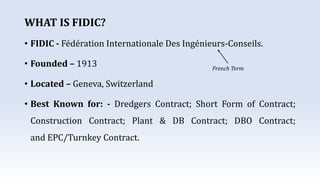
WHAT IS FIDIC?
• FIDIC - Fédération Internationale Des Ingénieurs-Conseils.
• Founded – 1913
• Located – Geneva, Switzerland
• Best Known for: - Dredgers Contract; Short Form of Contract;
Construction Contract; Plant & DB Contract; DBO Contract;
and EPC/Turnkey Contract.
French Term
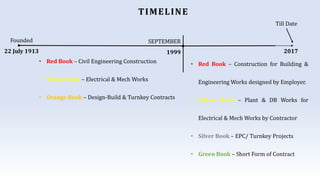
TIMELINE
SEPTEMBER
1999
Till Date
Founded
22 July 1913
• Red Book – Civil Engineering Construction
• Yellow Book – Electrical & Mech Works
• Orange Book – Design-Build & Turnkey Contracts
• Red Book – Construction for Building &
Engineering Works designed by Employer.
• Yellow Book – Plant & DB Works for
Electrical & Mech Works by Contractor
• Silver Book – EPC/ Turnkey Projects
• Green Book – Short Form of Contract
2017
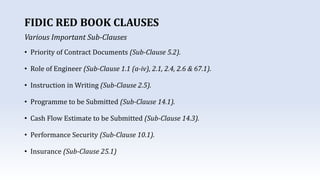
• Priority of Contract Documents (Sub-Clause 5.2).
• Role of Engineer (Sub-Clause 1.1 (a-iv), 2.1, 2.4, 2.6 & 67.1).
• Instruction in Writing (Sub-Clause 2.5).
• Programme to be Submitted (Sub-Clause 14.1).
• Cash Flow Estimate to be Submitted (Sub-Clause 14.3).
• Performance Security (Sub-Clause 10.1).
• Insurance (Sub-Clause 25.1)
FIDIC RED BOOK CLAUSES
Various Important Sub-Clauses
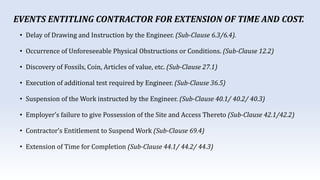
• Delay of Drawing and Instruction by the Engineer. (Sub-Clause 6.3/6.4).
• Occurrence of Unforeseeable Physical Obstructions or Conditions. (Sub-Clause 12.2)
• Discovery of Fossils, Coin, Articles of value, etc. (Sub-Clause 27.1)
• Execution of additional test required by Engineer. (Sub-Clause 36.5)
• Suspension of the Work instructed by the Engineer. (Sub-Clause 40.1/ 40.2/ 40.3)
• Employer’s failure to give Possession of the Site and Access Thereto (Sub-Clause 42.1/42.2)
• Contractor’s Entitlement to Suspend Work (Sub-Clause 69.4)
• Extension of Time for Completion (Sub-Clause 44.1/ 44.2/ 44.3)
EVENTS ENTITLING CONTRACTOR FOR EXTENSION OF TIME AND COST.
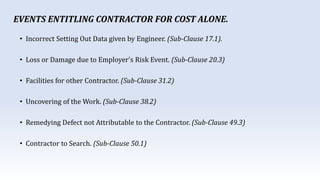
• Incorrect Setting Out Data given by Engineer. (Sub-Clause 17.1).
• Loss or Damage due to Employer's Risk Event. (Sub-Clause 20.3)
• Facilities for other Contractor. (Sub-Clause 31.2)
• Uncovering of the Work. (Sub-Clause 38.2)
• Remedying Defect not Attributable to the Contractor. (Sub-Clause 49.3)
• Contractor to Search. (Sub-Clause 50.1)
EVENTS ENTITLING CONTRACTOR FOR COST ALONE.
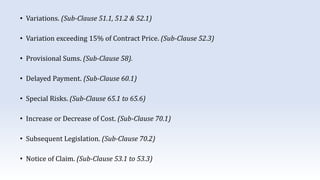
• Variations. (Sub-Clause 51.1, 51.2 & 52.1)
• Variation exceeding 15% of Contract Price. (Sub-Clause 52.3)
• Provisional Sums. (Sub-Clause 58).
• Delayed Payment. (Sub-Clause 60.1)
• Special Risks. (Sub-Clause 65.1 to 65.6)
• Increase or Decrease of Cost. (Sub-Clause 70.1)
• Subsequent Legislation. (Sub-Clause 70.2)
• Notice of Claim. (Sub-Clause 53.1 to 53.3)
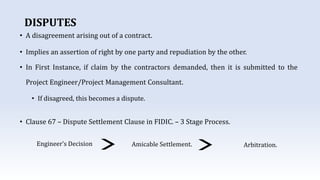
DISPUTES
• A disagreement arising out of a contract.
• Implies an assertion of right by one party and repudiation by the other.
• In First Instance, if claim by the contractors demanded, then it is submitted to the
Project Engineer/Project Management Consultant.
• If disagreed, this becomes a dispute.
• Clause 67 – Dispute Settlement Clause in FIDIC. – 3 Stage Process.
Engineer’s Decision Amicable Settlement. Arbitration.
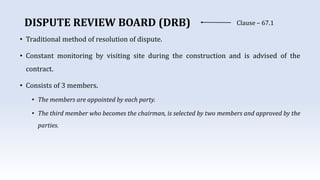
DISPUTE REVIEW BOARD (DRB) Clause – 67.1
• Traditional method of resolution of dispute.
• Constant monitoring by visiting site during the construction and is advised of the
contract.
• Consists of 3 members.
• The members are appointed by each party.
• The third member who becomes the chairman, is selected by two members and approved by the
parties.
• The members are expected to have: -
• Experience with the Type of Construction.
• Familiarity with Interpreting Contract Documents.
• Adequate Background in the Construction Industry.
• The must not have any Affiliation with the Parties.
• After recording submissions, they suggest for settlement, if not, they put in further
efforts or pursue litigations or arbitrations.
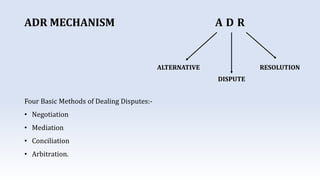
ADR MECHANISM A D R
ALTERNATIVE
DISPUTE
RESOLUTION
Four Basic Methods of Dealing Disputes:-
• Negotiation
• Mediation
• Conciliation
• Arbitration.
CLAIM
CLAIM is a demand or assertion by one of the parties seeking, as a matter of right, adjustment
or interpretation of contract terms, payment of money, extension of time or other reliefs w.r.t.
terms of contract.
Construction Claims:-
• Conflicting Conditions of Contract.
• Delay in Supply of Drawings by the Client.
• Incorrect Drawing Supplied by the Client.
• Drawing/ Specifications Discrepancies.
• Insufficient Specifications.
• Late Information/ Approval by Client.
• Discovery of Fossil, Coins, Articles or Value.
• Execution of Additional Test Required by the Client.
• Suspension/Termination of Work by Client.
• Delay in Commencement of the Project.
• Damage Due to Force Majeure.
• Loss or Damage to Works due to the Use or Occupation by the Employer.
• Bad Weather.
• Variation in Total Contract Price.
• Delay in Supply of Materials, When the same is in Client’s Scope.
• Delay in Payment by the Client.
CLASSIFICATION OF CLAIM
• CONTRACTUAL CLAIMS.
• EXTRA CONTRACTUAL CLAIMS.
• QUANTUM MERUIT CLAIMS
• EX-GRATIA CLAIMS.
• COUNTER CLAIMS.
THANK YOU

Fidic Form of Contract.

  • 1.
    FIDIC FORM OF CONTRACT - CONTRACTLAWS & REGULATION M. Tech (Construction Engineering Management), 2nd Semester. KIIT UNIVERSITY.
  • 2.
    WHAT IS FIDIC? •FIDIC - Fédération Internationale Des Ingénieurs-Conseils. • Founded – 1913 • Located – Geneva, Switzerland • Best Known for: - Dredgers Contract; Short Form of Contract; Construction Contract; Plant & DB Contract; DBO Contract; and EPC/Turnkey Contract. French Term
  • 3.
    TIMELINE SEPTEMBER 1999 Till Date Founded 22 July1913 • Red Book – Civil Engineering Construction • Yellow Book – Electrical & Mech Works • Orange Book – Design-Build & Turnkey Contracts • Red Book – Construction for Building & Engineering Works designed by Employer. • Yellow Book – Plant & DB Works for Electrical & Mech Works by Contractor • Silver Book – EPC/ Turnkey Projects • Green Book – Short Form of Contract 2017
  • 4.
    • Priority ofContract Documents (Sub-Clause 5.2). • Role of Engineer (Sub-Clause 1.1 (a-iv), 2.1, 2.4, 2.6 & 67.1). • Instruction in Writing (Sub-Clause 2.5). • Programme to be Submitted (Sub-Clause 14.1). • Cash Flow Estimate to be Submitted (Sub-Clause 14.3). • Performance Security (Sub-Clause 10.1). • Insurance (Sub-Clause 25.1) FIDIC RED BOOK CLAUSES Various Important Sub-Clauses
  • 5.
    • Delay ofDrawing and Instruction by the Engineer. (Sub-Clause 6.3/6.4). • Occurrence of Unforeseeable Physical Obstructions or Conditions. (Sub-Clause 12.2) • Discovery of Fossils, Coin, Articles of value, etc. (Sub-Clause 27.1) • Execution of additional test required by Engineer. (Sub-Clause 36.5) • Suspension of the Work instructed by the Engineer. (Sub-Clause 40.1/ 40.2/ 40.3) • Employer’s failure to give Possession of the Site and Access Thereto (Sub-Clause 42.1/42.2) • Contractor’s Entitlement to Suspend Work (Sub-Clause 69.4) • Extension of Time for Completion (Sub-Clause 44.1/ 44.2/ 44.3) EVENTS ENTITLING CONTRACTOR FOR EXTENSION OF TIME AND COST.
  • 6.
    • Incorrect SettingOut Data given by Engineer. (Sub-Clause 17.1). • Loss or Damage due to Employer's Risk Event. (Sub-Clause 20.3) • Facilities for other Contractor. (Sub-Clause 31.2) • Uncovering of the Work. (Sub-Clause 38.2) • Remedying Defect not Attributable to the Contractor. (Sub-Clause 49.3) • Contractor to Search. (Sub-Clause 50.1) EVENTS ENTITLING CONTRACTOR FOR COST ALONE.
  • 7.
    • Variations. (Sub-Clause51.1, 51.2 & 52.1) • Variation exceeding 15% of Contract Price. (Sub-Clause 52.3) • Provisional Sums. (Sub-Clause 58). • Delayed Payment. (Sub-Clause 60.1) • Special Risks. (Sub-Clause 65.1 to 65.6) • Increase or Decrease of Cost. (Sub-Clause 70.1) • Subsequent Legislation. (Sub-Clause 70.2) • Notice of Claim. (Sub-Clause 53.1 to 53.3)
  • 8.
    DISPUTES • A disagreementarising out of a contract. • Implies an assertion of right by one party and repudiation by the other. • In First Instance, if claim by the contractors demanded, then it is submitted to the Project Engineer/Project Management Consultant. • If disagreed, this becomes a dispute. • Clause 67 – Dispute Settlement Clause in FIDIC. – 3 Stage Process. Engineer’s Decision Amicable Settlement. Arbitration.
  • 9.
    DISPUTE REVIEW BOARD(DRB) Clause – 67.1 • Traditional method of resolution of dispute. • Constant monitoring by visiting site during the construction and is advised of the contract. • Consists of 3 members. • The members are appointed by each party. • The third member who becomes the chairman, is selected by two members and approved by the parties.
  • 10.
    • The membersare expected to have: - • Experience with the Type of Construction. • Familiarity with Interpreting Contract Documents. • Adequate Background in the Construction Industry. • The must not have any Affiliation with the Parties. • After recording submissions, they suggest for settlement, if not, they put in further efforts or pursue litigations or arbitrations.
  • 11.
    ADR MECHANISM AD R ALTERNATIVE DISPUTE RESOLUTION Four Basic Methods of Dealing Disputes:- • Negotiation • Mediation • Conciliation • Arbitration.
  • 12.
    CLAIM CLAIM is ademand or assertion by one of the parties seeking, as a matter of right, adjustment or interpretation of contract terms, payment of money, extension of time or other reliefs w.r.t. terms of contract. Construction Claims:- • Conflicting Conditions of Contract. • Delay in Supply of Drawings by the Client. • Incorrect Drawing Supplied by the Client. • Drawing/ Specifications Discrepancies. • Insufficient Specifications. • Late Information/ Approval by Client. • Discovery of Fossil, Coins, Articles or Value. • Execution of Additional Test Required by the Client.
  • 13.
    • Suspension/Termination ofWork by Client. • Delay in Commencement of the Project. • Damage Due to Force Majeure. • Loss or Damage to Works due to the Use or Occupation by the Employer. • Bad Weather. • Variation in Total Contract Price. • Delay in Supply of Materials, When the same is in Client’s Scope. • Delay in Payment by the Client.
  • 14.
    CLASSIFICATION OF CLAIM •CONTRACTUAL CLAIMS. • EXTRA CONTRACTUAL CLAIMS. • QUANTUM MERUIT CLAIMS • EX-GRATIA CLAIMS. • COUNTER CLAIMS.
  • 15.