

PROFESSIONAL PRACTICE 1
(QSB 60604)
GROUP ASSIGNMENT
GROUP MEMBER
• Ng Wai Khong (0317980)
• Leong Karr Khei (0324362)
• Loh Pey Mun (0318572)
• Sherlyn Ang (0317977)
• Michael Chang (0319198)
The Malaysian economic downturn has affected
developers in delivering and meeting key
property development and sales targets
Due to inventory fluctuation, unstable market
condition and tighter lending requirements
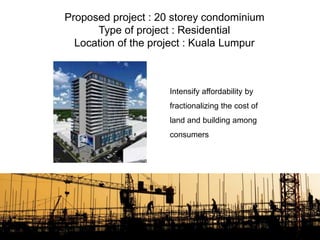
Proposed project : 20 storey condominium
Type of project : Residential
Location of the project : Kuala Lumpur
Intensify affordability by
fractionalizing the cost of
land and building among
consumers
What is construction procurement?
• A process whereby client chooses a specialized method
to implement a project
• Involves setting up a contractual network of designers,
contractors, financiers and other agents to design,
construct and manage a project
• Identify the best way of achieving the objectives of client
Factors to consider when selecting procurement
methods
• Time
• Capital cost
• Operating cost
• Environment
• Market value of the project
• Flexibility and
• Prestige
• Traditional procurement method
• Management contracting
• Construction management
• Design and Build
Common procurement methods
Traditional Procurement
Method
• The ‘least risk’ approach
• The client will selects and appoints the consultant team comprising
of architect, engineer, quantity surveyor, etc to design the building
and prepare tender documents
• Design will normally be completed before the main construction
contract is let
• Contractors are then selected through open tender, selective tender
or negotiation
Traditional Procurement Method
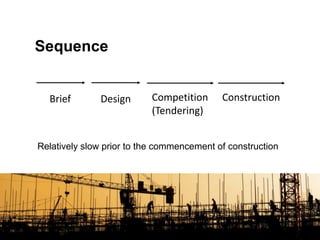
Sequence
ConstructionCompetition
(Tendering)
DesignBrief
Relatively slow prior to the commencement of construction
• Competitive fairness
• Relatively low tender preparation costs
• Satisfactory public accountability
• Procedures well known
• Design changes reasonably easily arranged
Advantages
• Slow to start on site (no concurrent working)
• Open to abuse when design incomplete (resulting in less
certainty)
• Contractor not involved in design or planning (poor
buildability)
• Potential for adversarial relationships
• Design risk rests with the client
Disadvantages
MANAGEMENT
CONTRACTOR
• Procurement route which is fairly similar to
Construction Manager.
• MC will be appointed in the early stage (design is not
completed et)
• The construction duration will be shorten.
• Enhance buildability development in terms of cost.
Management Contractor (MC)
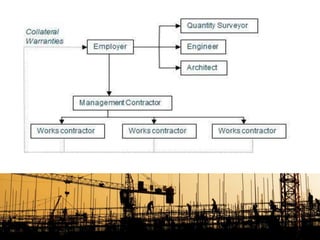
• MC are responsible and works direct with different
work contractors.
• MC act as a dominant.
• Client only have direct contract with the MC
Differences between MC and CM
• An agreement and contractual relationship
between parties that would exist.
• Insurance to designers or sub-contractors where
the client may provide coverage to them when
dispute arises.
Collateral Warranty
• MC provides services:
• -advising and planning on the development schedule.
• -cost planning.
• -cost control.
• -monitoring the site and key performance.
Why client prefer MC?
• MC can participate in the early stage where the design
process and construction process can overlapped where it
generally helps to reduce the development time.
• The contract sum will be the total of each separate work
trades that are tendered differently because all the works
trade will be break down into various work packages.
Pro’s of MC
• Management contracting will not be able to be precise and
certain of the final cost unless the final works and contract
have been sign with confirmation.
• Variation may occur during the construction period where
the cost of variations and re-measurement can lead to a
higher cost than the original traditional method.
Con’s of MC
COMPARISON
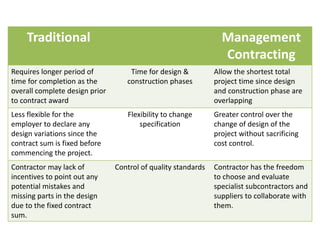
Traditional Management
Contracting
Requires longer period of
time for completion as the
overall complete design prior
to contract award
Time for design &
construction phases
Allow the shortest total
project time since design
and construction phase are
overlapping
Less flexible for the
employer to declare any
design variations since the
contract sum is fixed before
commencing the project.
Flexibility to change
specification
Greater control over the
change of design of the
project without sacrificing
cost control.
Contractor may lack of
incentives to point out any
potential mistakes and
missing parts in the design
due to the fixed contract
sum.
Control of quality standards Contractor has the freedom
to choose and evaluate
specialist subcontractors and
suppliers to collaborate with
them.
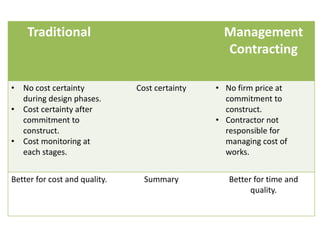
Traditional Management
Contracting
• No cost certainty
during design phases.
• Cost certainty after
commitment to
construct.
• Cost monitoring at
each stages.
Cost certainty • No firm price at
commitment to
construct.
• Contractor not
responsible for
managing cost of
works.
Better for cost and quality. Summary Better for time and
quality.
DESIGN & BUILD
• Popular & modern procurement route
• Main Contractor is responsible to design and
construct
• Single point of responsibility - Contractor
Design & Build
• Client appoints Design Consultants to draft a layout of design (50%). Tender document
will be prepared according to Approximate BOQ.
• Approximated BOQ is given to few selected D&B contractor including the design layout.
Everything need to be done according to Employer’s Requirements.
• After the selection has done, and the D&B contractor has done all the design and
details drawing. The employer’s QS will then produce a Final BQ based on Approximate
BOQ.
• Once Final BQ is agreed by both parties, it will be converted into Lump Sum Contract
Design & Build Steps
• Submitted to Client by D&B Contractor.
• Provide client an amount of project cost.
• If the final cost exceeds GMP, sum payable by
client remains as GMP
• If lower than GMP, saving will be shared among
Client and Contractor in 70:30 basis.
Design & Build
Guarantee Maximum Price (GMP)
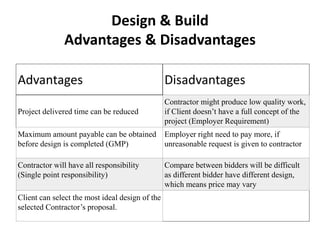
Design & Build
Advantages & Disadvantages
Advantages Disadvantages
Project delivered time can be reduced
Contractor might produce low quality work,
if Client doesn’t have a full concept of the
project (Employer Requirement)
Maximum amount payable can be obtained
before design is completed (GMP)
Employer right need to pay more, if
unreasonable request is given to contractor
Contractor will have all responsibility
(Single point responsibility)
Compare between bidders will be difficult
as different bidder have different design,
which means price may vary
Client can select the most ideal design of the
selected Contractor’s proposal.
• The management contractor(MC) is reimbursed
for completed work and plus a management
fees as his profit.
• To avoid any argument, the 2 parties should
specify how much is the reimbursable fees to
the MC before the project start
Type of Contract
[ Cost Reimbursement Contract ]
• Cost Plus Fixed Fee Contract (CPFF)
• Cost Plus Incentive Fee Contract (CPIF)
• Cost Plus Award Fee (CPAF)
• Cost Plus Percentage of Cost (CPPC)
Cost Reimbursable Contracts can be
allocated into 4 categories :
• MC is paid for all incurred costs and then plus a
fixed amount, which is agree in both parties
before enter into the project, and it will not be
change.
• MC can’t to overprice a job to cover profit for any
unknown work. So, client has the benefit in
financial. Client only pay for works that carry out
by the MC.
Cost Plus Fixed Fee Contract (CPFF)
• This agreement allow the client to have more
flexibility to change designs and material during
the projects procees.
• Client have the control in the decision of
making process and with the controlling of
money spent.
• Client has the right to know all the details about
the project, for example the cost of materials and
labour at every stage of the construction process.
• Final cost may be less compare with the fixed
price contract because MC can’t to increase the
price to cover their risk.
• This is so called “open book process.
• And also is a monitoring system .
• Client can’t know exactly how much is the cost
for the project, and making it difficult to budget.
• Client take an indeterminism risk that the
construction works will not spiral out of control,
even legally and there is very little incentive for
the MC to have the job done with quickly and
inexpensively.
• Client requires a high level of trust, good
relationship, and good communication between
the parties.
• To overcome the problem and to limit the risk of
the client, client can hire a specialist construction
lawyer to draft a special conditions and request
to be included in the CPFF contract and client
should be cautious after obtaining the required
legal advice before enter into the contract.
• To overcome the problem and to limit the risk
of the client, client can hire a specialist
construction lawyer to draft a special
conditions and request to be included in the
CPFF contract and client should be cautious
after obtaining the required legal advice
before enter into the contract.
CONCLUSION
QUALITY COST
RESOURCES WORKMANSHIP
Management Contractor (MC)
• Homebuyers are more attracted to quality
rather than on price.
• Quality can be control through MC.
• Through discussion between MC and client
during construction process can improve the
quality.
Quality
• More transparent cost data.
• Through CPFF, the contractor will limit it cost
so that it won’t exceed the fixed fee cost.
Cost
• Contractually in relationship with different
work packages.
• Different work packages provide different
resources from different sources.
Resources
• Contractually in relationship with different
work packages.
• Different work packages provide well-trained
skilled workers.
• Save time hence maintain the quality of
works.
Workmanship
• Variation is less due to typical floors in
condominium.
• For specialized project and not suitable for
typical condominium.
• Fast track project.
In Compare to D&B
THE END
~ THANK YOU ~

Professional practice-1-presentation

  • 1.
    PROFESSIONAL PRACTICE 1 (QSB60604) GROUP ASSIGNMENT
  • 2.
    GROUP MEMBER • NgWai Khong (0317980) • Leong Karr Khei (0324362) • Loh Pey Mun (0318572) • Sherlyn Ang (0317977) • Michael Chang (0319198)
  • 3.
    The Malaysian economicdownturn has affected developers in delivering and meeting key property development and sales targets Due to inventory fluctuation, unstable market condition and tighter lending requirements
  • 4.
    Proposed project :20 storey condominium Type of project : Residential Location of the project : Kuala Lumpur Intensify affordability by fractionalizing the cost of land and building among consumers
  • 5.
    What is constructionprocurement? • A process whereby client chooses a specialized method to implement a project • Involves setting up a contractual network of designers, contractors, financiers and other agents to design, construct and manage a project • Identify the best way of achieving the objectives of client
  • 6.
    Factors to considerwhen selecting procurement methods • Time • Capital cost • Operating cost • Environment • Market value of the project • Flexibility and • Prestige
  • 7.
    • Traditional procurementmethod • Management contracting • Construction management • Design and Build Common procurement methods
  • 8.
  • 9.
    • The ‘leastrisk’ approach • The client will selects and appoints the consultant team comprising of architect, engineer, quantity surveyor, etc to design the building and prepare tender documents • Design will normally be completed before the main construction contract is let • Contractors are then selected through open tender, selective tender or negotiation Traditional Procurement Method
  • 10.
  • 11.
    • Competitive fairness •Relatively low tender preparation costs • Satisfactory public accountability • Procedures well known • Design changes reasonably easily arranged Advantages
  • 12.
    • Slow tostart on site (no concurrent working) • Open to abuse when design incomplete (resulting in less certainty) • Contractor not involved in design or planning (poor buildability) • Potential for adversarial relationships • Design risk rests with the client Disadvantages
  • 13.
  • 15.
    • Procurement routewhich is fairly similar to Construction Manager. • MC will be appointed in the early stage (design is not completed et) • The construction duration will be shorten. • Enhance buildability development in terms of cost. Management Contractor (MC)
  • 16.
    • MC areresponsible and works direct with different work contractors. • MC act as a dominant. • Client only have direct contract with the MC Differences between MC and CM
  • 17.
    • An agreementand contractual relationship between parties that would exist. • Insurance to designers or sub-contractors where the client may provide coverage to them when dispute arises. Collateral Warranty
  • 18.
    • MC providesservices: • -advising and planning on the development schedule. • -cost planning. • -cost control. • -monitoring the site and key performance. Why client prefer MC?
  • 19.
    • MC canparticipate in the early stage where the design process and construction process can overlapped where it generally helps to reduce the development time. • The contract sum will be the total of each separate work trades that are tendered differently because all the works trade will be break down into various work packages. Pro’s of MC
  • 20.
    • Management contractingwill not be able to be precise and certain of the final cost unless the final works and contract have been sign with confirmation. • Variation may occur during the construction period where the cost of variations and re-measurement can lead to a higher cost than the original traditional method. Con’s of MC
  • 21.
  • 22.
    Traditional Management Contracting Requires longerperiod of time for completion as the overall complete design prior to contract award Time for design & construction phases Allow the shortest total project time since design and construction phase are overlapping Less flexible for the employer to declare any design variations since the contract sum is fixed before commencing the project. Flexibility to change specification Greater control over the change of design of the project without sacrificing cost control. Contractor may lack of incentives to point out any potential mistakes and missing parts in the design due to the fixed contract sum. Control of quality standards Contractor has the freedom to choose and evaluate specialist subcontractors and suppliers to collaborate with them.
  • 23.
    Traditional Management Contracting • Nocost certainty during design phases. • Cost certainty after commitment to construct. • Cost monitoring at each stages. Cost certainty • No firm price at commitment to construct. • Contractor not responsible for managing cost of works. Better for cost and quality. Summary Better for time and quality.
  • 24.
  • 25.
    • Popular &modern procurement route • Main Contractor is responsible to design and construct • Single point of responsibility - Contractor Design & Build
  • 26.
    • Client appointsDesign Consultants to draft a layout of design (50%). Tender document will be prepared according to Approximate BOQ. • Approximated BOQ is given to few selected D&B contractor including the design layout. Everything need to be done according to Employer’s Requirements. • After the selection has done, and the D&B contractor has done all the design and details drawing. The employer’s QS will then produce a Final BQ based on Approximate BOQ. • Once Final BQ is agreed by both parties, it will be converted into Lump Sum Contract Design & Build Steps
  • 27.
    • Submitted toClient by D&B Contractor. • Provide client an amount of project cost. • If the final cost exceeds GMP, sum payable by client remains as GMP • If lower than GMP, saving will be shared among Client and Contractor in 70:30 basis. Design & Build Guarantee Maximum Price (GMP)
  • 28.
    Design & Build Advantages& Disadvantages Advantages Disadvantages Project delivered time can be reduced Contractor might produce low quality work, if Client doesn’t have a full concept of the project (Employer Requirement) Maximum amount payable can be obtained before design is completed (GMP) Employer right need to pay more, if unreasonable request is given to contractor Contractor will have all responsibility (Single point responsibility) Compare between bidders will be difficult as different bidder have different design, which means price may vary Client can select the most ideal design of the selected Contractor’s proposal.
  • 29.
    • The managementcontractor(MC) is reimbursed for completed work and plus a management fees as his profit. • To avoid any argument, the 2 parties should specify how much is the reimbursable fees to the MC before the project start Type of Contract [ Cost Reimbursement Contract ]
  • 30.
    • Cost PlusFixed Fee Contract (CPFF) • Cost Plus Incentive Fee Contract (CPIF) • Cost Plus Award Fee (CPAF) • Cost Plus Percentage of Cost (CPPC) Cost Reimbursable Contracts can be allocated into 4 categories :
  • 31.
    • MC ispaid for all incurred costs and then plus a fixed amount, which is agree in both parties before enter into the project, and it will not be change. • MC can’t to overprice a job to cover profit for any unknown work. So, client has the benefit in financial. Client only pay for works that carry out by the MC. Cost Plus Fixed Fee Contract (CPFF)
  • 32.
    • This agreementallow the client to have more flexibility to change designs and material during the projects procees. • Client have the control in the decision of making process and with the controlling of money spent.
  • 33.
    • Client hasthe right to know all the details about the project, for example the cost of materials and labour at every stage of the construction process. • Final cost may be less compare with the fixed price contract because MC can’t to increase the price to cover their risk. • This is so called “open book process. • And also is a monitoring system .
  • 34.
    • Client can’tknow exactly how much is the cost for the project, and making it difficult to budget. • Client take an indeterminism risk that the construction works will not spiral out of control, even legally and there is very little incentive for the MC to have the job done with quickly and inexpensively.
  • 35.
    • Client requiresa high level of trust, good relationship, and good communication between the parties. • To overcome the problem and to limit the risk of the client, client can hire a specialist construction lawyer to draft a special conditions and request to be included in the CPFF contract and client should be cautious after obtaining the required legal advice before enter into the contract.
  • 36.
    • To overcomethe problem and to limit the risk of the client, client can hire a specialist construction lawyer to draft a special conditions and request to be included in the CPFF contract and client should be cautious after obtaining the required legal advice before enter into the contract.
  • 37.
  • 38.
  • 39.
    • Homebuyers aremore attracted to quality rather than on price. • Quality can be control through MC. • Through discussion between MC and client during construction process can improve the quality. Quality
  • 40.
    • More transparentcost data. • Through CPFF, the contractor will limit it cost so that it won’t exceed the fixed fee cost. Cost
  • 41.
    • Contractually inrelationship with different work packages. • Different work packages provide different resources from different sources. Resources
  • 42.
    • Contractually inrelationship with different work packages. • Different work packages provide well-trained skilled workers. • Save time hence maintain the quality of works. Workmanship
  • 43.
    • Variation isless due to typical floors in condominium. • For specialized project and not suitable for typical condominium. • Fast track project. In Compare to D&B
  • 44.