CONSTRUCTION
PERSONNEL
MANAGEMENT (CE757)
REWARD
 Reward is an incentive plan to reinforce the desirable behavior of workers or
employers and in return for their service to the organization.
 Compensation and Reward system plays vital role in a business organization.
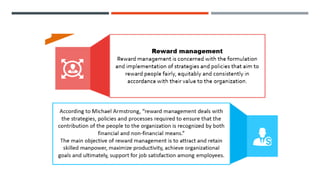
 Reward Management is concerned with the formulation and implementation of
strategies and policies that aim to reward people fairly, equitably and consistently in
accordance with their value to the organization.
REWARD MANAGEMENT
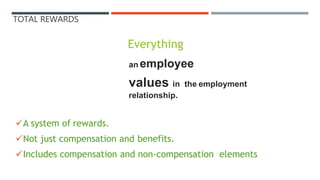
Everything
an employee
values in the employment
relationship.
A system of rewards.
Not just compensation and benefits.
Includes compensation and non-compensation elements
TOTAL REWARDS
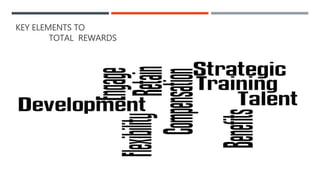
KEY ELEMENTS TO
TOTAL REWARDS
COMPENSATION
• Fixed Pay - base wages
• Variable Pay – pay at risk
– Short term Incentive Pay
– Long-term Incentive Pay
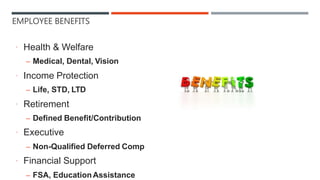
EMPLOYEE BENEFITS
 Health & Welfare
– Medical, Dental, Vision
 Income Protection
– Life, STD, LTD
 Retirement
– Defined Benefit/Contribution
 Executive
– Non-Qualified Deferred Comp
 Financial Support
– FSA, EducationAssistance
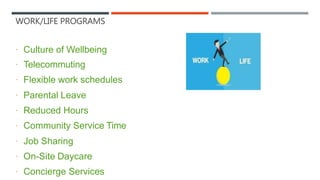
WORK/LIFE PROGRAMS
 Culture of Wellbeing
 Telecommuting
 Flexible work schedules
 Parental Leave
 Reduced Hours
 Community Service Time
 Job Sharing
 On-Site Daycare
 Concierge Services
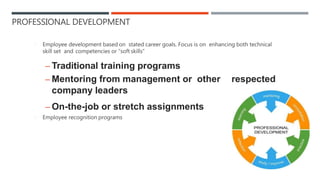
PROFESSIONAL DEVELOPMENT
 Employee development based on stated career goals. Focus is on enhancing both technical
skill set and competencies or “soft skills”
– Traditional training programs
– Mentoring from management or other respected
company leaders
– On-the-job or stretch assignments
 Employee recognition programs
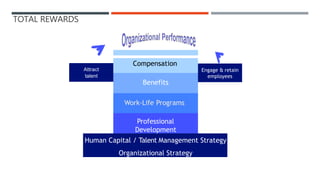
TOTAL REWARDS
Attract
talent
Engage & retain
employees
Compensation
Benefits
Work-Life Programs
Professional
Development
Human Capital / Talent Management Strategy
Organizational Strategy
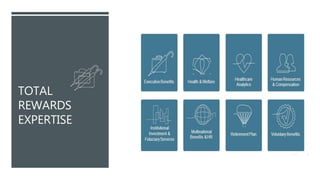
TOTAL
REWARDS
EXPERTISE
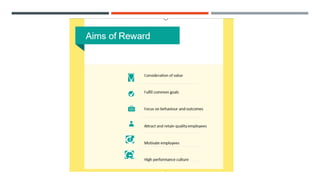
AIM OF REWARD MANAGEMENT
 Reward employees according to what the organization values and wants to pay for.
 Reward employees for the value they create.
 Reward the right things to convey the right message about what is
 important in terms of behaviors and outcomes.
 Develop a performance culture.
 Motivate employees and obtain their commitment and engagement.
 Operate fairly – employees feel that they are treated justly in accordance with what is
due to them because of their value to the organization.
 Function consistently – decisions on pay do not vary arbitrarily and without due cause
between different people or at different times.
 Operate transparently – employees understand how reward processes operate and
how they are affected by them.
AIM OF REWARD MANAGEMENT
PURPOSE OF REWARD SYSTEM
It is the way by which companies can encourage employees to work harder and
increase their effort while doing their job.
 Some of the organizational aims are motivation, development of high performance
and rewarding the right behavior.
 The promise of a bonus or a pay rise is intended to encourage employees to
motivate themselves to reap the rewards.
 Employees will increase their effort while doing their job, will create high
performance that will result in having a high percentage of productivity.
PURPOSE OF REWARD SYSTEM
 Companies can show the message they try to send to the employees. Rewarding an
employee for a behavior he/she has done is a way to show other employees what is
asked from them to do in terms of behavior or performance.
 Rewards can be used to send a message showing the outcomes that the company is
expecting form its employees.
 Competitive hiring and reducing attrition rate.
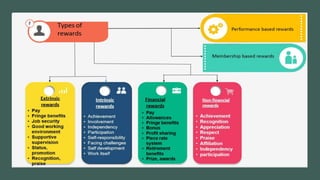
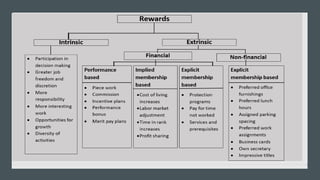
CLASSIFICATION OF REWARDS
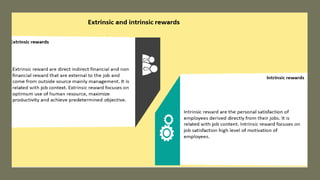
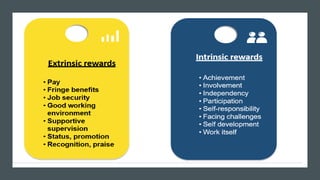
 Intrinsic rewards:
 The satisfaction one gets from the job itself. These include pride in one’s work, feeling
of accomplishment, being a part of team job enrichment, shorter work-weeks, job
rotation etc.
 Extrinsic rewards :
 Includes money, promotions and fringe benefits or a write up in the company
magazine.
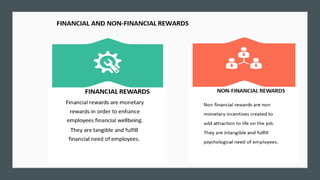
 Financial rewards :
 Direct-through wages, bonuses, profit sharing etc., or indirect- through
supportive benefits like pension schemes, leave encashment, purchase discounts
etc.
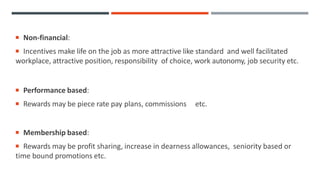
 Non-financial:
 Incentives make life on the job as more attractive like standard and well facilitated
workplace, attractive position, responsibility of choice, work autonomy, job security etc.
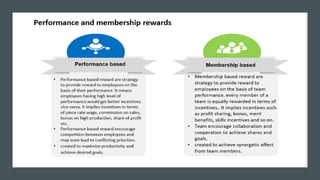
 Performance based:
 Rewards may be piece rate pay plans, commissions etc.
 Membership based:
 Rewards may be profit sharing, increase in dearness allowances, seniority based or
time bound promotions etc.
QUALITIES OF A GOOD REWARD SYSTEM
 Performance based:
 Better performer must receive better reward than the average and
 poor performer.
 Transparent and predictive:
 Employees must be familiar with the reward system and the
 reward must be distributed transparently.
 Employees should be able to calculate and predict their reward in an advance.
 Employees become enthusiastic and motivated if they are aware
 about the type, size and quality of reward.
 Cost effective:
 Reward must have the quality of balancing the cost benefit ratio. The reward received
by the employee should not exceed the benefit received by the organization.
 Need based:
 The reward system must match with the need or requirement of
 the employees.
 If reward system doesn't meet the need of employees, it will not motivate the
employees to perform better in the future.
 Unbiased:
 Reward must be unbiased and fair. Employees identical to their job performance
should be rewarded equally.
 Competitive:
 Reward system must be competitive to other organization's
 provision.
 Reward must be revised timely.
 Good reward system will attract and retain the competent employees.
DETERMINANTS OF REWARD
 Performance
 Efforts
 Seniority
 Skill held
 Job difficulty
 Punctuality
 Adhering to rules and guidelines
 Market competition
METHODS OF REWARD EVALUATION
 Merit rating:
 Can be defined as a systematic evaluation of an employee’s
 performance on the job in terms of requirements of the job.
 The merit rating enables the manager to differentiate among his subordinates through
systematic approach for the purpose of their recommendation for promotion, wage
increase or of special training etc.
 Essay Type Merit Rating:
 Generally this type of merit rating is used for the persons of supervisory cadre. In
this, the incharge writes an essay on his subordinates.
 Forced choice method:
 Characteristics are printed on a sheet of paper and the incharge is asked to tick them.
The marks for the rating can be given on the basis of these characteristics.
 Graphic rating plan:
 In this system, points in numerical values are given for various characteristics. The
total of these points in them is used to compare the workers.
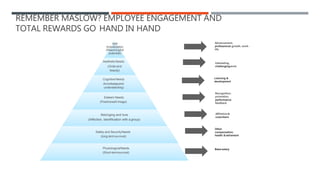
REMEMBER MASLOW? EMPLOYEE ENGAGEMENT AND
TOTAL REWARDS GO HAND IN HAND
Self
Actualization
(Reachingfull
potential)
AestheticNeeds
(Orderand
beauty)
CognitiveNeeds
(knowledgeand
understanding)
Esteem Needs
(Positiveself-image)
Belonging and love
(Affection, identification with a group)
Safety and SecurityNeeds
(long-term survival)
PhysiologicalNeeds
(Short-termsurvival)
Advancement,
professional growth, work-
life
Interesting,
challengingwork
Learning &
development
Recognition,
promotion,
performance
feedback
Affiliation&
coworkers
Other
compensation,
health &retirement
Base salary
EFFECTIVENESS (ADVANTAGE OF REWARD)
 Worth:
 Creates an increased sense of worth and improved morale in the workplace.
 Colleagues see that exceptional performance is appreciated by upper management
and may step up their own productivity levels with the understanding that their work
could be noticed as well.
 Loyalty:
 When employees are treated like family, they’re far less likely to
 betray the company for personal gain.
 This reduces the likelihood of issues like office theft, the release of proprietary
information and instances of fudging time sheets and expense reports.
 Employees are more likely to talk positively about their company
 in the community thus enhancing the business’s reputation.
 Longevity:
 When employees feel valued and appreciated and see they have room for
advancement, they are less likely to look for other employment, even if the salary is
higher.
 A company that has seasoned, long-term professionals on staff reduces the costs of
continually hiring and training new employees.
 Quality:
 Recognizing employees for innovative ideas and concepts can lead
 to increased quality of a company’s products and services.
Employees who feel their ideas are welcomed and credit is given where it is due may
reject complacency and continually strive to perform at top levels.
• Service Benefits
oPersonal Service, Family service
• Other job related Benefits
oFlexible work schedule, Cafeteria Benefits

Reward -Construction Personnel Management

  • 1.
  • 2.
     Reward isan incentive plan to reinforce the desirable behavior of workers or employers and in return for their service to the organization.  Compensation and Reward system plays vital role in a business organization.  Reward Management is concerned with the formulation and implementation of strategies and policies that aim to reward people fairly, equitably and consistently in accordance with their value to the organization. REWARD MANAGEMENT
  • 4.
    Everything an employee values inthe employment relationship. A system of rewards. Not just compensation and benefits. Includes compensation and non-compensation elements TOTAL REWARDS
  • 5.
  • 6.
    COMPENSATION • Fixed Pay- base wages • Variable Pay – pay at risk – Short term Incentive Pay – Long-term Incentive Pay
  • 7.
    EMPLOYEE BENEFITS  Health& Welfare – Medical, Dental, Vision  Income Protection – Life, STD, LTD  Retirement – Defined Benefit/Contribution  Executive – Non-Qualified Deferred Comp  Financial Support – FSA, EducationAssistance
  • 8.
    WORK/LIFE PROGRAMS  Cultureof Wellbeing  Telecommuting  Flexible work schedules  Parental Leave  Reduced Hours  Community Service Time  Job Sharing  On-Site Daycare  Concierge Services
  • 9.
    PROFESSIONAL DEVELOPMENT  Employeedevelopment based on stated career goals. Focus is on enhancing both technical skill set and competencies or “soft skills” – Traditional training programs – Mentoring from management or other respected company leaders – On-the-job or stretch assignments  Employee recognition programs
  • 10.
    TOTAL REWARDS Attract talent Engage &retain employees Compensation Benefits Work-Life Programs Professional Development Human Capital / Talent Management Strategy Organizational Strategy
  • 11.
  • 12.
    AIM OF REWARDMANAGEMENT  Reward employees according to what the organization values and wants to pay for.  Reward employees for the value they create.  Reward the right things to convey the right message about what is  important in terms of behaviors and outcomes.  Develop a performance culture.  Motivate employees and obtain their commitment and engagement.
  • 13.
     Operate fairly– employees feel that they are treated justly in accordance with what is due to them because of their value to the organization.  Function consistently – decisions on pay do not vary arbitrarily and without due cause between different people or at different times.  Operate transparently – employees understand how reward processes operate and how they are affected by them. AIM OF REWARD MANAGEMENT
  • 15.
    PURPOSE OF REWARDSYSTEM It is the way by which companies can encourage employees to work harder and increase their effort while doing their job.  Some of the organizational aims are motivation, development of high performance and rewarding the right behavior.  The promise of a bonus or a pay rise is intended to encourage employees to motivate themselves to reap the rewards.  Employees will increase their effort while doing their job, will create high performance that will result in having a high percentage of productivity.
  • 16.
    PURPOSE OF REWARDSYSTEM  Companies can show the message they try to send to the employees. Rewarding an employee for a behavior he/she has done is a way to show other employees what is asked from them to do in terms of behavior or performance.  Rewards can be used to send a message showing the outcomes that the company is expecting form its employees.  Competitive hiring and reducing attrition rate.
  • 17.
    CLASSIFICATION OF REWARDS Intrinsic rewards:  The satisfaction one gets from the job itself. These include pride in one’s work, feeling of accomplishment, being a part of team job enrichment, shorter work-weeks, job rotation etc.  Extrinsic rewards :  Includes money, promotions and fringe benefits or a write up in the company magazine.  Financial rewards :  Direct-through wages, bonuses, profit sharing etc., or indirect- through supportive benefits like pension schemes, leave encashment, purchase discounts etc.
  • 18.
     Non-financial:  Incentivesmake life on the job as more attractive like standard and well facilitated workplace, attractive position, responsibility of choice, work autonomy, job security etc.  Performance based:  Rewards may be piece rate pay plans, commissions etc.  Membership based:  Rewards may be profit sharing, increase in dearness allowances, seniority based or time bound promotions etc.
  • 25.
    QUALITIES OF AGOOD REWARD SYSTEM  Performance based:  Better performer must receive better reward than the average and  poor performer.  Transparent and predictive:  Employees must be familiar with the reward system and the  reward must be distributed transparently.  Employees should be able to calculate and predict their reward in an advance.  Employees become enthusiastic and motivated if they are aware  about the type, size and quality of reward.
  • 26.
     Cost effective: Reward must have the quality of balancing the cost benefit ratio. The reward received by the employee should not exceed the benefit received by the organization.  Need based:  The reward system must match with the need or requirement of  the employees.  If reward system doesn't meet the need of employees, it will not motivate the employees to perform better in the future.  Unbiased:  Reward must be unbiased and fair. Employees identical to their job performance should be rewarded equally.
  • 27.
     Competitive:  Rewardsystem must be competitive to other organization's  provision.  Reward must be revised timely.  Good reward system will attract and retain the competent employees.
  • 28.
    DETERMINANTS OF REWARD Performance  Efforts  Seniority  Skill held  Job difficulty  Punctuality  Adhering to rules and guidelines  Market competition
  • 29.
    METHODS OF REWARDEVALUATION  Merit rating:  Can be defined as a systematic evaluation of an employee’s  performance on the job in terms of requirements of the job.  The merit rating enables the manager to differentiate among his subordinates through systematic approach for the purpose of their recommendation for promotion, wage increase or of special training etc.  Essay Type Merit Rating:  Generally this type of merit rating is used for the persons of supervisory cadre. In this, the incharge writes an essay on his subordinates.
  • 30.
     Forced choicemethod:  Characteristics are printed on a sheet of paper and the incharge is asked to tick them. The marks for the rating can be given on the basis of these characteristics.  Graphic rating plan:  In this system, points in numerical values are given for various characteristics. The total of these points in them is used to compare the workers.
  • 31.
    REMEMBER MASLOW? EMPLOYEEENGAGEMENT AND TOTAL REWARDS GO HAND IN HAND Self Actualization (Reachingfull potential) AestheticNeeds (Orderand beauty) CognitiveNeeds (knowledgeand understanding) Esteem Needs (Positiveself-image) Belonging and love (Affection, identification with a group) Safety and SecurityNeeds (long-term survival) PhysiologicalNeeds (Short-termsurvival) Advancement, professional growth, work- life Interesting, challengingwork Learning & development Recognition, promotion, performance feedback Affiliation& coworkers Other compensation, health &retirement Base salary
  • 32.
    EFFECTIVENESS (ADVANTAGE OFREWARD)  Worth:  Creates an increased sense of worth and improved morale in the workplace.  Colleagues see that exceptional performance is appreciated by upper management and may step up their own productivity levels with the understanding that their work could be noticed as well.  Loyalty:  When employees are treated like family, they’re far less likely to  betray the company for personal gain.
  • 33.
     This reducesthe likelihood of issues like office theft, the release of proprietary information and instances of fudging time sheets and expense reports.  Employees are more likely to talk positively about their company  in the community thus enhancing the business’s reputation.  Longevity:  When employees feel valued and appreciated and see they have room for advancement, they are less likely to look for other employment, even if the salary is higher.  A company that has seasoned, long-term professionals on staff reduces the costs of continually hiring and training new employees.
  • 34.
     Quality:  Recognizingemployees for innovative ideas and concepts can lead  to increased quality of a company’s products and services. Employees who feel their ideas are welcomed and credit is given where it is due may reject complacency and continually strive to perform at top levels.
  • 35.
    • Service Benefits oPersonalService, Family service • Other job related Benefits oFlexible work schedule, Cafeteria Benefits