2. Procurement and Contract
management
General Description
Procurement:
 Procurement can be defined as the purchase of
goods or services or works, at the best possible
prices, delivery dates and legal terms.
 It can also understood as a process used to select
the lowest competitive and qualified bidder for
procuring services or works or goods from
potential competitors based on reasonable
relevant criteria.
 That is competitive procurement which in turn
implies a contractual acquisition/procuring of
goods or services or works. 2
• Why Procurement & Contract management is to be
discussed?
It ensures:
– Fair competition and
– Fair distributions of obligations and rights among
stakeholders
Fair competition helps
– To acquire the rights the owner is entitled to
– To value market principles & effective utilization of
finance
– To get impartial and neutral opportunity for business
3
Contd..
Fair distributions of obligations and rights helps:
– To allocate appropriate risks among contractual
parties
– To entitle remedial rights to contractual parties
In general the following things determine the
construction process involved and the
relationships and roles of stakeholders along the
process.
– The delivery system chosen
– the procurement method adopted
– the contract types decided
4
5
Contract and procurement management basics:
Procurement and Contract Management involves three
major processes:
• Contract Planning,
• Procurement Management and,
• Contract Management which in turn consists of the
following
I) Contract Planning
The approved contract provisions can only be
changed following the change process stated in
the contract planning document and if and only
if:
–The environment and context considered are not
correctly analyzed or changed,
–Their application can remarkably affect the
objective of the project, and
–Procurement management process justifies change
of the contract types.
6
II) Procurement Management
Procurement Management is a process of
selecting individuals or organizations to carry out
the intended services and / or works. It is based
on provisions made on contract planning phase.
 More likely covered in Chapter 3.
It involves
– The preparation of procurement documents
– Invitation and submission of tender proposals
– Opening and evaluation of tenders
7
Procurement Management, contd…
The following issues are necessary for a successful
Procurement Management phase:
– Knowing and ensuring the implementation of
procurement related national and international
laws, rules and regulations,
– Adherence to the provisions made during the
contract planning phase including their change
processes,
– Establishment of a flexible procurement team,
and
– Adhering to the principles of proof of
competition, impartiality, neutrality, accessibility
and formality.
8
III) Contract Management
Contract Management: is a process of reaching
contractual agreement for implementation, its
administration and finally concluding the
contract.
It based on provisions made on contract planning
phase.
9
Contract Management, contd…
The following issues are necessary for a successful
Contract Management phase:
– Knowing and ensuring contract related national
and international laws, rules and regulations,
– Adherence to the provisions made during the
contract planning phase including their change
processes,
– Identifying, recognizing and involving all
potential or key stakeholders to form a contract
team,
– Understanding, mapping and monitoring all
contract conditions agreed upon, and
– Ability to administer changes, claims and
disputes.
10
Types of Procurement and Contract Delivery system
• Procurement and Contract Delivery system is the way
Project Owners, Project Regulators and Financiers
determine the assignment of responsibilities to Project
Stakeholders along the Construction Process.
• Project Delivery method is an organizational concept
which assigns specific responsibilities and authorities to
people and organizations and which defines relationship
of the various elements in construction of a project.
11
Definition & Development
– Procurement and Contract Delivery system is the
way Project Owners together with Project
Regulators and Financiers determine the
assignment of responsibilities to Project
Stakeholders along the Construction Process.
– A formalized contractual approach which allows an
owner to secure planning and design services and
build a project, assuring effective management
throughout.
– Procurement and Contract Delivery system is often
determined during the Basic Planning phase of
Construction Project.
12
Types & Development
• Generally, there are six types of Procurement
and Contract Delivery systems:
1. Force Account
2. Design Bid Build (DBB)
3. Design Build (DB) or Turnkey
4. Finance/Build Operate System (BOT)
5. Construction/Facility Management Consultancy &
6. Alliances and Outsourcing.
13
I) Force Account
When the Project Owners engage themselves to
undertake the project, it is called a force account
delivery system. This system is promoted for: -
• Comparative advantage of cost, quality and
time
• Scale of projects and technology (large, small)
• Remote projects
• spatially scattered and maintenance projects
• These days this type of delivery system is often
used when projects are small and places are
remote such that reaching them is difficult and in
general they are not attractive enough to call the
attention of Bidders.
14
Owner
Architect/Engineer
Responsible for
Costs & Schedule
Responsible for Design
General
Contractor
II) Design-Bid-Build
• This is the most practiced type of delivery
system in the Construction Industry of Ethiopia
since the 1987.
• Two Separate Contracts for Design &
Construction
• This makes employer difficulty of dealing with
different contracts,
15
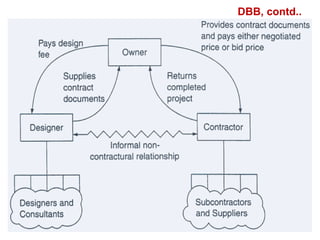
(DBB), contd..
• After project owners did prepare the Basic Planning
that identifies construction project programs, they
call upon the participation of Design and/or
Supervision Consultants either by tender or by
negotiated contracts.
• This consultant will carry out the design together
with the necessary tender documents which will be
the bases for tendering to select contractors.
• Contractors are responsible to construct works
with due care and diligence and complete them in
accordance with the contract,
• But contractors are not held responsible for
design deficiencies.
16
DBB, contd..
17
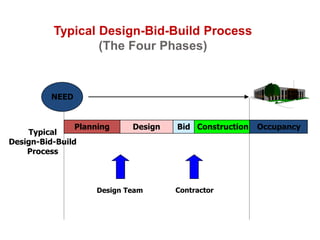
Design
Planning Bid Construction Occupancy
NEED
Typical
Design-Bid-Build
Process
Typical Design-Bid-Build Process
(The Four Phases)
Design Team Contractor
18
Current status of DBB
• Since the 1980s, this traditional approach becomes
less popular due to the following factors:
– Severe Adversarial relations between the design
and contract administration consultant and the
contractor
– Fragmented contract for the project owner
– Project owner responsibility for risks associated
with the design and contract administration
– Non-Impartiality of the Design and Contract
Administration services
– The inability of design and contract administration
consultants to cope up with new construction
technologies and constructability issues of their
designs
19
Merits of DBB
• Contractors bid competitively ,based on complete
design documents to maximize the built product
for the price
• The owner selects the Designer on the basis of
qualifications or ability
• The Designer is active in construction
administration, so design intentions are followed.
• Design and construction roles are clearly defined,
and responsibilities and liabilities clear.
• Owner is an active participant in design process.
20
Demerits of DBB
• Fragmented contract for the project owner ( The indirect
contractual obligation assigned for the Design and
Contract Administration consultants)
• Severe Adversarial relations between the contracting
parties, rather than foster a cooperative atmosphere
• Non - Impartiality of the Design and Contract
Administration services
• Project owner responsibility for risks associated with the
design and contract administration
• Design-Bid-Build construction phases are sequential and
may require more time
• No built-in incentives for contractors to provide enhanced
performance (cost, time, quality, or combination thereof)
21
Demerits of DBB, contd..
• Owner is at risk for final construction cost.
• Actual construction costs are not known until
design and bidding are complete.
• The inability of design and contract administration
consultants to cope up with new construction
technologies and constructability issues of their
designs.
• The indirect contractual obligation assigned for the
Design and Contract Administration consultants.
• Often prone to adversarial positions that lead to
disputes and claims
22
III) Design Build (DB)/Turnkey
DB approaches
– Enhance the Force Account System
– Reducing fragmentation, adversarial relations
and Project Owners’ risk
– Employ only one procurement process
– Single contractor to provide the entire
Construction Process (Design and Construction
Implementations)
23
Design-Build
Firm
Owner
Subcontractors and Suppliers
Designers and Consultants
Design-Build (Turnkey)
24
Design-Build
OWNER
DESIGN-BUILD
FIRM
design
subcontractors
suppliers
construction
subcontractors
design
subconsultants
25
NEED
Typical Design/Build Process
(The Four Phases)
Design
Planning
Occupancy
Construction
Typical
Design/Bu
ild Process
Design/Build
Team
26
Design Build/Turnkey
A design-build contract may also include
responsibilities that extend beyond the design
and construction phases of a project, shifting
more performance risk to the private sector.
These have include
»Design-Build-Warranty
»Design-Build-Maintain
»Design-Build-Operate
27
Design Build (DB) / Turnkey, contd…
• DB Delivery system is a response to problems associated to
the last two types of delivery systems.
• These were promoting privatization and its business like
approach to enhance the Force Account System and
reducing fragmentation, adversarial relations and
Project Owners’ risk.
• The project concept should clearly define the performance
criteria such as output, input, waste and any other
performances the employer may desire.
– This makes an additional responsibility to the
contractor which is ¨fitness to purpose¨ according to
the Orange Book of FIDIC.
– Fitness to purpose is beyond the professional duty of care
and places liability on the contractor for any failure of
the design to perform the standards required. 28
Advantages of DB
– Reducing fragmentation and adversarial relations
between designers and constructors;
– Minimizing project owners’ risk transferable due to
designers’ faults;
– Accountability and entire responsibility for both design
and construction which entitle the employer to receive
completed project is onto a single contractor;
– Employers’ responsibility to co-ordinate interfaces
between different project elements is avoided;
– Single point responsibility minimizes the opportunity to
claims by the contractor due to design related issues;
– Coordination between design and construction processes
will also be enhanced (both in communication for
constructability as well as in fast tracking); and
– The client budget or financial requirement is defined
early enough in the development process,
– Earlier schedule and cost certainty. 29
Advantage of DB, contd…
Accelerated project delivery by:
• Fast-tracking design and construction
• Close coordination between designer and contractor
• Early contractor involvement to enhance
constructability of plans
Innovation and quality improvements through:
• Alternative designs and construction methods suited
to the contractor’s capabilities
• Flexibility in the selection of design, materials, and
construction methods
30
Disadvantage of DB
The disadvantage of this delivery system is
–loss of control,
–cost of tender and
–cost of risks.
Accelerated construction can potentially
overextend the workforce.
Traditional funding may not support fast-tracking
construction or may require accelerated cash
flow.
31
Disadvantages of DB, contd…
• Since limited supervisory role by the employer
representative is practiced; the employer:
– distanced from the whole process  has little
chance to understand what is developed and
entertain variations in requirements  loss of
control.
• Contractors in order to provide reasonable offer,
their tender cost is higher than in the case for
DBB delivery system.
• The increase in risk transferred onto the
contractor will be counterbalanced by the increase
in contract prices which can be taken to include
these costs of risks. 32
IV) Build Operate Transfer-BOT
• BOT- is a form of procurement and contract delivery
system that promotes Public Private Partnership
(PPP) in which a private company is contracted to
finance, design, construct, and operate for a certain
period (usually 10 years) and transfer.
• The project owner is not responsible for any liability
other than force majeure and agreed upon claim
adjustments.
• The Operation period between completion and
transfer gives the contractor an opportunity to verify
the quality of the output of the services and works
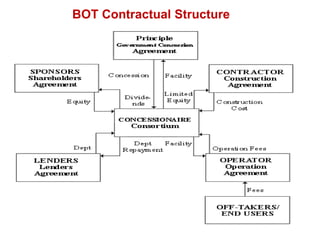
• BOT project involves a potentially complex
contractual structure. 33
BOT, contd..,
• The Typical BOT contract is the process whereby a
government grants a concession to a project
development company to develop and operate
what would normally be a public sector project, for
a given period of time known as the concession
period.
Characteristics of BOT
– Most BOT projects failed because of their built up and
engagement in very large projects which is an extremely
risky business for contractors (BOT-entities).
– The increasing popularity of the BOT project is largely
due to a shortage of public funding and the opinion that
the facility will be more efficiently managed by a private
entity.
34
BOT Contractual Structure
35
Advantages of BOT
This delivery system is advantageous because of
– It minimizes owners’ scarcity of financial
resources;
– It devoid of considerable risks from the project
owners
– the facility is well operated and transferred with
free of charge or minimum compensations to
project owners.
– Integrates the process of design, construction,
operation, and maintenance.
– Projects completed faster
36
Disadvantage of BOT
Disadvantages of BOT are:
– Cost more in the long run
– Longer tendering process
– Costly tendering
– Future political change may disrupt prior agreement
– No capable local contractors
– Contractors not interested in all works
37
V) Construction/Facility Management (CM/FM)
Consultancy
• CMC Delivery System is a response to problems
associated with DB and BOT where the Project Owner
was not well represented for its benefit.
• Construction management consultancy firm is used to
coordinate all activities from concept inception through
acceptance of the facility.
• Facility management consultancy adds operation of
facility during operation to construction management
consultancy.
• CM is involved in the whole construction processes
where as all the others involve only during the
implementation phase after major decisions was made
during the Basic planning phase 38
Construction Management:
“Agency” Form
ARCHITECT
OWNER
Architect’s
design
consultants
subcontractors
LIMITED
CONSTRUCTION
ADMINISTRATION
CMa
DETAILED
CONSTRUCTION
COORDINATION
FEASIBILITY
+COST DATA
materials suppliers
GENERAL
CONTRACTOR
DESIGN
DATA
Source: Modified AL( 1998)
39
• CM/FM-consultancy
CM/FM-consultancy, contd..
Construction Management Consultants then
represents Project Owners to carry out the
following services:
– Feasibility studies of Construction related services
– Plan and Monitor the Triple Constraints of Project
Performances
– Lead and Organize regulatory systems of the
Construction Industry
– Valuation, Quantity Surveying and Procurement
and Contract Management Services
40
• The main difference of this delivery system is that, while all
the others involve only during the implementation phase
after major decisions was made during the Basic planning
phase of the construction process, CMC, is involved in the
whole construction processes.
• Construction Management Consultants then represents
Project Owners to carry out the following services:
– Feasibility studies of Construction related services
– Plan and Monitor the Triple Constraints (time, cost,
quality) of Project Performances
– Lead and Organize regulatory systems of the
Construction Industry
– Valuation, Quantity Surveying and Procurement and
Contract Management Services
CM/FM-consultancy, contd..
41
Construction management is a broad term
covering a variety of project delivery scenarios in
which a construction manager becomes an
integral part of the team, at early stages in the
project, to oversee such elements as schedule,
cost, and construction methodologies and
procurement strategies.
The general Construction Management variations
are
a) Construction Management-at-Fee (CM at-Fee), &
b) Construction Management-at-Risk (CM-at-Risk),
42
CM/FM-consultancy, contd..
i) CM/FM at-Fee
CM-at-fee is a delivery method similar to the DBB
In CM-at-fee method,
– The construction manager is responsible for project and
site management, but is not involved in actual
construction work.
– The construction manager monitors cost, time, quality
and safety, but does not take responsibility for them.
• The construction manager is paid a fixed or time based for
services provided.
• The construction management organization takes an
advisory role or role of an agent to the client
• The CM has limited risk because construction contracts are
between the owner and individual contractors.
43
Construction Management-at-Fee
(CM at-Fee)
Owner
Agency
CM
Designers and Consultants
GC
Subcontractors and Suppliers
44
Architect/Engineer
A/E
General
Contractor
Advantages/disadvantages of CM at-Fee
Advantages of CM at-Fee:
– Managing and administering all phases of a project.
– Treats Planning, Construction and Design, as an Integral
Task.
– Cost and Schedule Control
– Constructability input at design stage
Disadvantages of CM at-Fee
– No contractual relationships with trade contractors
– No contractual responsibility for outcomes of a
project
– Client retains the risks
– Additional cost for the Construction Manager
45
ii) CM at-Risk
• In CM-at-risk, the construction manager, apart from
providing constructability inputs at the design stage,
is also responsible for construction means and
methods and delivery of the completed work,
including quality and performance of the asset
• All procurement in the project is done by the
construction manager,
• Owner contracts with the designer and the
construction manager-at-risk,
• Construction manager-at-risk contracts with the
subcontractors.
–But, still, the client retains the final decision
in project delivery 46
Advantages of CM at-Risk
– Good for clients with insufficient staff
– Owner flexibility
– Responsible for cost and time overruns
– Holds and manages trade contractors
– Constructability design review
– Legal position as a General Contractor
–Works closely as a teaming effort and
encouraging trust and partnering
–Phased construction (fast tracking) possible
47
Disadvantages of CM at-Risk
–Lack of capable construction managers
–Demanding work organization
–Lack of cost certainty for each work packages
–Lack of contractors who can provide both
construction management and construction
services
–Fragmentation, as compared to DB& BOT
–No exactly defined work packages (bill
quantities)
48
VI) Partnering, Alliances, and Outsourcing
which focuses most on management of
relationships and value adding to ensure quicker,
cheaper and quality services and products with
less disputes are recent developments.
This is a method where an owner/developer and
a contractor agree to work together by freely
sharing resources, risks and knowledge during
the course of the project
These systems require to overcome cultural and
behavioral barriers among interest groups and
control motivated performance based
management
49
contd…
• Single staged procurement systems, involving less
competitive and comparative advantage for services and
works and existing stakeholders relationships.
• As a result,
– Running delivery system using Partnering and
Alliances
– Specialized delivery system using Outsourcing
– Fast tracking, parallel and coordinated
implementations using Concurrent Engineering and
Just in Time principles
• Alliances and partnerships are not types of contract but
a relationship between contracting parties with aligned
objectives. 50
Characteristics
• It focuses most on
– management of relationships and
– value adding to ensure quicker, cheaper and quality
services and products
– less disputes are recent developments.
• These systems require overcoming cultural and
behavioral barriers among interest groups and
control motivated performance based management.
• These types of delivery systems are often the bases
behind DB, BOT, FMCM consultancy delivery
systems but their at most and recent developments.
51
Outsourcing
• Outsourcing to others what they do more efficiently is a
successful management strategy.
• Outsourcing is not 100% guaranteed and have some
drawbacks
• Outsourcing is the practice of handing over the planning,
management and operation of certain functions to an
independent third party.
• Outsourcing on the other hand, entails a long-term
relationship between supplier and beneficiary, with a
high degree of risk-sharing
• More variables are brought into play when management
considers outsourcing.
Partnering, Alliances, contd..
This type of project procurement can be distinguished
from others by:
–Collective performance of obligations by the
owner/developer and contractor,
–Decision-making by consensus,
–Commitment to resolve disputes without
resort to litigation
53
The advantages of partnering and alliances;
– Increased opportunities for cost saving by continual
improvement,
– Lack of an adversarial atmosphere,
– Cultivation of good public relations and increased
prospects of repeat business,
– Incentives for innovations and improved cost, time
and quality outcomes.
– However, partnering is not an easy solution.
– It requires commitment, discipline and trust and can
demand significant adjustments in the relative,
traditional positions of an owner/developer and a
contractor. 54
Choice of Project Delivery Methods:
Considerations.
Choice of project delivery methods can be pictured in a
different context, which displays the project delivery
methods viewed by means of two criteria.
This is based on whether the project delivery methods
are based on:
–approach (segmented or integrated), and
–Source of finance (direct or indirect funding)
If the goal is to seek traditional or segmented delivery
methods, then the client would consider the following
delivery methods.
–Design-Bid-Build (DBB)
–Construction Management (CM) at fee.55
Considerations, contd…
If the goal is to seek integrated delivery methods, then the client
would consider the following delivery methods.
– Design-Build (DB)
– Construction Management (CM at-Risk)
– Design-Build-Operate-Transfer (BOT)
And if the intention is to seek direct project funding, the owner
may consider the following options:
– Design-Bid-Build (DBB)
– D-B (Design-Build)
– Construction Management (CM) at fee and at risk.
If the goal is to seek external financing (indirect funding), then
the client would consider the build-operate-transfer (BOT ).
Note: It is worth mentioning that the above division is
based on the normal procedure or the usual practice. It
may vary as agreed up on. 56
Summary
Contract Types (Classification) - Contracts may be classified in several ways:
Award point of view
• a. Competitive: - Open (proposal bids open in public)
• - Closed (negotiation)
• b. Negotiated contracts (common in housing, industrial)
Multiplicity view point
• No contract (Force account)
• Single contract (General/Prime)
• Separate Contracts
Design & Construction relation
• Only construction
• Design & Construction (Turnkey)
• Overlapping Design & Construction is called Fast Tracking or Phase Construction.
Cost point of view (revise-cost engineering course materials)
 Lump sum Or
combination
 Unit price
 Cost plus – can be as follows:
 Cost plus percentage of cost
 Cost plus fixed free
 Cost plus with guaranteed max, cost
 Cost plus incentive fee. 57
I thank you !
58

Chapter_2-Procurement and Contract management.pptx

  • 1.
    2. Procurement andContract management
  • 2.
    General Description Procurement:  Procurementcan be defined as the purchase of goods or services or works, at the best possible prices, delivery dates and legal terms.  It can also understood as a process used to select the lowest competitive and qualified bidder for procuring services or works or goods from potential competitors based on reasonable relevant criteria.  That is competitive procurement which in turn implies a contractual acquisition/procuring of goods or services or works. 2
  • 3.
    • Why Procurement& Contract management is to be discussed? It ensures: – Fair competition and – Fair distributions of obligations and rights among stakeholders Fair competition helps – To acquire the rights the owner is entitled to – To value market principles & effective utilization of finance – To get impartial and neutral opportunity for business 3
  • 4.
    Contd.. Fair distributions ofobligations and rights helps: – To allocate appropriate risks among contractual parties – To entitle remedial rights to contractual parties In general the following things determine the construction process involved and the relationships and roles of stakeholders along the process. – The delivery system chosen – the procurement method adopted – the contract types decided 4
  • 5.
    5 Contract and procurementmanagement basics: Procurement and Contract Management involves three major processes: • Contract Planning, • Procurement Management and, • Contract Management which in turn consists of the following
  • 6.
    I) Contract Planning Theapproved contract provisions can only be changed following the change process stated in the contract planning document and if and only if: –The environment and context considered are not correctly analyzed or changed, –Their application can remarkably affect the objective of the project, and –Procurement management process justifies change of the contract types. 6
  • 7.
    II) Procurement Management ProcurementManagement is a process of selecting individuals or organizations to carry out the intended services and / or works. It is based on provisions made on contract planning phase.  More likely covered in Chapter 3. It involves – The preparation of procurement documents – Invitation and submission of tender proposals – Opening and evaluation of tenders 7
  • 8.
    Procurement Management, contd… Thefollowing issues are necessary for a successful Procurement Management phase: – Knowing and ensuring the implementation of procurement related national and international laws, rules and regulations, – Adherence to the provisions made during the contract planning phase including their change processes, – Establishment of a flexible procurement team, and – Adhering to the principles of proof of competition, impartiality, neutrality, accessibility and formality. 8
  • 9.
    III) Contract Management ContractManagement: is a process of reaching contractual agreement for implementation, its administration and finally concluding the contract. It based on provisions made on contract planning phase. 9
  • 10.
    Contract Management, contd… Thefollowing issues are necessary for a successful Contract Management phase: – Knowing and ensuring contract related national and international laws, rules and regulations, – Adherence to the provisions made during the contract planning phase including their change processes, – Identifying, recognizing and involving all potential or key stakeholders to form a contract team, – Understanding, mapping and monitoring all contract conditions agreed upon, and – Ability to administer changes, claims and disputes. 10
  • 11.
    Types of Procurementand Contract Delivery system • Procurement and Contract Delivery system is the way Project Owners, Project Regulators and Financiers determine the assignment of responsibilities to Project Stakeholders along the Construction Process. • Project Delivery method is an organizational concept which assigns specific responsibilities and authorities to people and organizations and which defines relationship of the various elements in construction of a project. 11
  • 12.
    Definition & Development –Procurement and Contract Delivery system is the way Project Owners together with Project Regulators and Financiers determine the assignment of responsibilities to Project Stakeholders along the Construction Process. – A formalized contractual approach which allows an owner to secure planning and design services and build a project, assuring effective management throughout. – Procurement and Contract Delivery system is often determined during the Basic Planning phase of Construction Project. 12
  • 13.
    Types & Development •Generally, there are six types of Procurement and Contract Delivery systems: 1. Force Account 2. Design Bid Build (DBB) 3. Design Build (DB) or Turnkey 4. Finance/Build Operate System (BOT) 5. Construction/Facility Management Consultancy & 6. Alliances and Outsourcing. 13
  • 14.
    I) Force Account Whenthe Project Owners engage themselves to undertake the project, it is called a force account delivery system. This system is promoted for: - • Comparative advantage of cost, quality and time • Scale of projects and technology (large, small) • Remote projects • spatially scattered and maintenance projects • These days this type of delivery system is often used when projects are small and places are remote such that reaching them is difficult and in general they are not attractive enough to call the attention of Bidders. 14
  • 15.
    Owner Architect/Engineer Responsible for Costs &Schedule Responsible for Design General Contractor II) Design-Bid-Build • This is the most practiced type of delivery system in the Construction Industry of Ethiopia since the 1987. • Two Separate Contracts for Design & Construction • This makes employer difficulty of dealing with different contracts, 15
  • 16.
    (DBB), contd.. • Afterproject owners did prepare the Basic Planning that identifies construction project programs, they call upon the participation of Design and/or Supervision Consultants either by tender or by negotiated contracts. • This consultant will carry out the design together with the necessary tender documents which will be the bases for tendering to select contractors. • Contractors are responsible to construct works with due care and diligence and complete them in accordance with the contract, • But contractors are not held responsible for design deficiencies. 16
  • 17.
  • 18.
    Design Planning Bid ConstructionOccupancy NEED Typical Design-Bid-Build Process Typical Design-Bid-Build Process (The Four Phases) Design Team Contractor 18
  • 19.
    Current status ofDBB • Since the 1980s, this traditional approach becomes less popular due to the following factors: – Severe Adversarial relations between the design and contract administration consultant and the contractor – Fragmented contract for the project owner – Project owner responsibility for risks associated with the design and contract administration – Non-Impartiality of the Design and Contract Administration services – The inability of design and contract administration consultants to cope up with new construction technologies and constructability issues of their designs 19
  • 20.
    Merits of DBB •Contractors bid competitively ,based on complete design documents to maximize the built product for the price • The owner selects the Designer on the basis of qualifications or ability • The Designer is active in construction administration, so design intentions are followed. • Design and construction roles are clearly defined, and responsibilities and liabilities clear. • Owner is an active participant in design process. 20
  • 21.
    Demerits of DBB •Fragmented contract for the project owner ( The indirect contractual obligation assigned for the Design and Contract Administration consultants) • Severe Adversarial relations between the contracting parties, rather than foster a cooperative atmosphere • Non - Impartiality of the Design and Contract Administration services • Project owner responsibility for risks associated with the design and contract administration • Design-Bid-Build construction phases are sequential and may require more time • No built-in incentives for contractors to provide enhanced performance (cost, time, quality, or combination thereof) 21
  • 22.
    Demerits of DBB,contd.. • Owner is at risk for final construction cost. • Actual construction costs are not known until design and bidding are complete. • The inability of design and contract administration consultants to cope up with new construction technologies and constructability issues of their designs. • The indirect contractual obligation assigned for the Design and Contract Administration consultants. • Often prone to adversarial positions that lead to disputes and claims 22
  • 23.
    III) Design Build(DB)/Turnkey DB approaches – Enhance the Force Account System – Reducing fragmentation, adversarial relations and Project Owners’ risk – Employ only one procurement process – Single contractor to provide the entire Construction Process (Design and Construction Implementations) 23
  • 24.
    Design-Build Firm Owner Subcontractors and Suppliers Designersand Consultants Design-Build (Turnkey) 24
  • 25.
  • 26.
    NEED Typical Design/Build Process (TheFour Phases) Design Planning Occupancy Construction Typical Design/Bu ild Process Design/Build Team 26
  • 27.
    Design Build/Turnkey A design-buildcontract may also include responsibilities that extend beyond the design and construction phases of a project, shifting more performance risk to the private sector. These have include »Design-Build-Warranty »Design-Build-Maintain »Design-Build-Operate 27
  • 28.
    Design Build (DB)/ Turnkey, contd… • DB Delivery system is a response to problems associated to the last two types of delivery systems. • These were promoting privatization and its business like approach to enhance the Force Account System and reducing fragmentation, adversarial relations and Project Owners’ risk. • The project concept should clearly define the performance criteria such as output, input, waste and any other performances the employer may desire. – This makes an additional responsibility to the contractor which is ¨fitness to purpose¨ according to the Orange Book of FIDIC. – Fitness to purpose is beyond the professional duty of care and places liability on the contractor for any failure of the design to perform the standards required. 28
  • 29.
    Advantages of DB –Reducing fragmentation and adversarial relations between designers and constructors; – Minimizing project owners’ risk transferable due to designers’ faults; – Accountability and entire responsibility for both design and construction which entitle the employer to receive completed project is onto a single contractor; – Employers’ responsibility to co-ordinate interfaces between different project elements is avoided; – Single point responsibility minimizes the opportunity to claims by the contractor due to design related issues; – Coordination between design and construction processes will also be enhanced (both in communication for constructability as well as in fast tracking); and – The client budget or financial requirement is defined early enough in the development process, – Earlier schedule and cost certainty. 29
  • 30.
    Advantage of DB,contd… Accelerated project delivery by: • Fast-tracking design and construction • Close coordination between designer and contractor • Early contractor involvement to enhance constructability of plans Innovation and quality improvements through: • Alternative designs and construction methods suited to the contractor’s capabilities • Flexibility in the selection of design, materials, and construction methods 30
  • 31.
    Disadvantage of DB Thedisadvantage of this delivery system is –loss of control, –cost of tender and –cost of risks. Accelerated construction can potentially overextend the workforce. Traditional funding may not support fast-tracking construction or may require accelerated cash flow. 31
  • 32.
    Disadvantages of DB,contd… • Since limited supervisory role by the employer representative is practiced; the employer: – distanced from the whole process  has little chance to understand what is developed and entertain variations in requirements  loss of control. • Contractors in order to provide reasonable offer, their tender cost is higher than in the case for DBB delivery system. • The increase in risk transferred onto the contractor will be counterbalanced by the increase in contract prices which can be taken to include these costs of risks. 32
  • 33.
    IV) Build OperateTransfer-BOT • BOT- is a form of procurement and contract delivery system that promotes Public Private Partnership (PPP) in which a private company is contracted to finance, design, construct, and operate for a certain period (usually 10 years) and transfer. • The project owner is not responsible for any liability other than force majeure and agreed upon claim adjustments. • The Operation period between completion and transfer gives the contractor an opportunity to verify the quality of the output of the services and works • BOT project involves a potentially complex contractual structure. 33
  • 34.
    BOT, contd.., • TheTypical BOT contract is the process whereby a government grants a concession to a project development company to develop and operate what would normally be a public sector project, for a given period of time known as the concession period. Characteristics of BOT – Most BOT projects failed because of their built up and engagement in very large projects which is an extremely risky business for contractors (BOT-entities). – The increasing popularity of the BOT project is largely due to a shortage of public funding and the opinion that the facility will be more efficiently managed by a private entity. 34
  • 35.
  • 36.
    Advantages of BOT Thisdelivery system is advantageous because of – It minimizes owners’ scarcity of financial resources; – It devoid of considerable risks from the project owners – the facility is well operated and transferred with free of charge or minimum compensations to project owners. – Integrates the process of design, construction, operation, and maintenance. – Projects completed faster 36
  • 37.
    Disadvantage of BOT Disadvantagesof BOT are: – Cost more in the long run – Longer tendering process – Costly tendering – Future political change may disrupt prior agreement – No capable local contractors – Contractors not interested in all works 37
  • 38.
    V) Construction/Facility Management(CM/FM) Consultancy • CMC Delivery System is a response to problems associated with DB and BOT where the Project Owner was not well represented for its benefit. • Construction management consultancy firm is used to coordinate all activities from concept inception through acceptance of the facility. • Facility management consultancy adds operation of facility during operation to construction management consultancy. • CM is involved in the whole construction processes where as all the others involve only during the implementation phase after major decisions was made during the Basic planning phase 38
  • 39.
  • 40.
    CM/FM-consultancy, contd.. Construction ManagementConsultants then represents Project Owners to carry out the following services: – Feasibility studies of Construction related services – Plan and Monitor the Triple Constraints of Project Performances – Lead and Organize regulatory systems of the Construction Industry – Valuation, Quantity Surveying and Procurement and Contract Management Services 40
  • 41.
    • The maindifference of this delivery system is that, while all the others involve only during the implementation phase after major decisions was made during the Basic planning phase of the construction process, CMC, is involved in the whole construction processes. • Construction Management Consultants then represents Project Owners to carry out the following services: – Feasibility studies of Construction related services – Plan and Monitor the Triple Constraints (time, cost, quality) of Project Performances – Lead and Organize regulatory systems of the Construction Industry – Valuation, Quantity Surveying and Procurement and Contract Management Services CM/FM-consultancy, contd.. 41
  • 42.
    Construction management isa broad term covering a variety of project delivery scenarios in which a construction manager becomes an integral part of the team, at early stages in the project, to oversee such elements as schedule, cost, and construction methodologies and procurement strategies. The general Construction Management variations are a) Construction Management-at-Fee (CM at-Fee), & b) Construction Management-at-Risk (CM-at-Risk), 42 CM/FM-consultancy, contd..
  • 43.
    i) CM/FM at-Fee CM-at-feeis a delivery method similar to the DBB In CM-at-fee method, – The construction manager is responsible for project and site management, but is not involved in actual construction work. – The construction manager monitors cost, time, quality and safety, but does not take responsibility for them. • The construction manager is paid a fixed or time based for services provided. • The construction management organization takes an advisory role or role of an agent to the client • The CM has limited risk because construction contracts are between the owner and individual contractors. 43
  • 44.
    Construction Management-at-Fee (CM at-Fee) Owner Agency CM Designersand Consultants GC Subcontractors and Suppliers 44 Architect/Engineer A/E General Contractor
  • 45.
    Advantages/disadvantages of CMat-Fee Advantages of CM at-Fee: – Managing and administering all phases of a project. – Treats Planning, Construction and Design, as an Integral Task. – Cost and Schedule Control – Constructability input at design stage Disadvantages of CM at-Fee – No contractual relationships with trade contractors – No contractual responsibility for outcomes of a project – Client retains the risks – Additional cost for the Construction Manager 45
  • 46.
    ii) CM at-Risk •In CM-at-risk, the construction manager, apart from providing constructability inputs at the design stage, is also responsible for construction means and methods and delivery of the completed work, including quality and performance of the asset • All procurement in the project is done by the construction manager, • Owner contracts with the designer and the construction manager-at-risk, • Construction manager-at-risk contracts with the subcontractors. –But, still, the client retains the final decision in project delivery 46
  • 47.
    Advantages of CMat-Risk – Good for clients with insufficient staff – Owner flexibility – Responsible for cost and time overruns – Holds and manages trade contractors – Constructability design review – Legal position as a General Contractor –Works closely as a teaming effort and encouraging trust and partnering –Phased construction (fast tracking) possible 47
  • 48.
    Disadvantages of CMat-Risk –Lack of capable construction managers –Demanding work organization –Lack of cost certainty for each work packages –Lack of contractors who can provide both construction management and construction services –Fragmentation, as compared to DB& BOT –No exactly defined work packages (bill quantities) 48
  • 49.
    VI) Partnering, Alliances,and Outsourcing which focuses most on management of relationships and value adding to ensure quicker, cheaper and quality services and products with less disputes are recent developments. This is a method where an owner/developer and a contractor agree to work together by freely sharing resources, risks and knowledge during the course of the project These systems require to overcome cultural and behavioral barriers among interest groups and control motivated performance based management 49
  • 50.
    contd… • Single stagedprocurement systems, involving less competitive and comparative advantage for services and works and existing stakeholders relationships. • As a result, – Running delivery system using Partnering and Alliances – Specialized delivery system using Outsourcing – Fast tracking, parallel and coordinated implementations using Concurrent Engineering and Just in Time principles • Alliances and partnerships are not types of contract but a relationship between contracting parties with aligned objectives. 50
  • 51.
    Characteristics • It focusesmost on – management of relationships and – value adding to ensure quicker, cheaper and quality services and products – less disputes are recent developments. • These systems require overcoming cultural and behavioral barriers among interest groups and control motivated performance based management. • These types of delivery systems are often the bases behind DB, BOT, FMCM consultancy delivery systems but their at most and recent developments. 51
  • 52.
    Outsourcing • Outsourcing toothers what they do more efficiently is a successful management strategy. • Outsourcing is not 100% guaranteed and have some drawbacks • Outsourcing is the practice of handing over the planning, management and operation of certain functions to an independent third party. • Outsourcing on the other hand, entails a long-term relationship between supplier and beneficiary, with a high degree of risk-sharing • More variables are brought into play when management considers outsourcing.
  • 53.
    Partnering, Alliances, contd.. Thistype of project procurement can be distinguished from others by: –Collective performance of obligations by the owner/developer and contractor, –Decision-making by consensus, –Commitment to resolve disputes without resort to litigation 53
  • 54.
    The advantages ofpartnering and alliances; – Increased opportunities for cost saving by continual improvement, – Lack of an adversarial atmosphere, – Cultivation of good public relations and increased prospects of repeat business, – Incentives for innovations and improved cost, time and quality outcomes. – However, partnering is not an easy solution. – It requires commitment, discipline and trust and can demand significant adjustments in the relative, traditional positions of an owner/developer and a contractor. 54
  • 55.
    Choice of ProjectDelivery Methods: Considerations. Choice of project delivery methods can be pictured in a different context, which displays the project delivery methods viewed by means of two criteria. This is based on whether the project delivery methods are based on: –approach (segmented or integrated), and –Source of finance (direct or indirect funding) If the goal is to seek traditional or segmented delivery methods, then the client would consider the following delivery methods. –Design-Bid-Build (DBB) –Construction Management (CM) at fee.55
  • 56.
    Considerations, contd… If thegoal is to seek integrated delivery methods, then the client would consider the following delivery methods. – Design-Build (DB) – Construction Management (CM at-Risk) – Design-Build-Operate-Transfer (BOT) And if the intention is to seek direct project funding, the owner may consider the following options: – Design-Bid-Build (DBB) – D-B (Design-Build) – Construction Management (CM) at fee and at risk. If the goal is to seek external financing (indirect funding), then the client would consider the build-operate-transfer (BOT ). Note: It is worth mentioning that the above division is based on the normal procedure or the usual practice. It may vary as agreed up on. 56
  • 57.
    Summary Contract Types (Classification)- Contracts may be classified in several ways: Award point of view • a. Competitive: - Open (proposal bids open in public) • - Closed (negotiation) • b. Negotiated contracts (common in housing, industrial) Multiplicity view point • No contract (Force account) • Single contract (General/Prime) • Separate Contracts Design & Construction relation • Only construction • Design & Construction (Turnkey) • Overlapping Design & Construction is called Fast Tracking or Phase Construction. Cost point of view (revise-cost engineering course materials)  Lump sum Or combination  Unit price  Cost plus – can be as follows:  Cost plus percentage of cost  Cost plus fixed free  Cost plus with guaranteed max, cost  Cost plus incentive fee. 57
  • 58.