

1
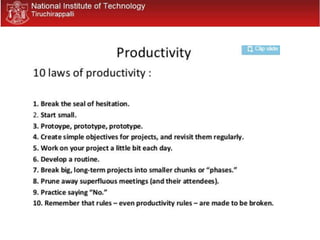
Productivity
13 October 2020
2
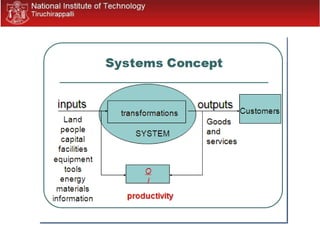
• Productivity is one measure of the effective use of resources withinan
organization, industry, ornation.
• The classical productivity definition measures outputs relative to the
inputs needed to produce them. That is, productivity is defined as the
number of output units per unit ofinput
productivity = output/input.
Productivity Definition
The amount of output per unit of input (labor, equipment, and capital).
There are many different ways of measuring productivity. For example, in
a factory productivity might be measured based on the number of hours it
takes to produce a good, while in the service sector productivity might be
measured based on the revenue generated by an employee divided by
his/her salary.
Productivity Concepts and Definitions
According to Fabricant productivity in the following words, “always a ratio
of output and input”.
According to Kendrick and Creamer “a-Functional definitions for partial,
total factor and total productivity, b-Loose description of relationship
usually in ratio form, between outputs and all of the associated inputs in
real terms”
Productivity Definition
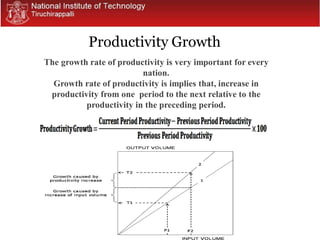
Productivity Growth
The growth rate of productivity is very important for every
nation.
Growth rate of productivity is implies that, increase in
productivity from one period to the next relative to the
productivity in the preceding period.
3
• Sometimes, an inverse calculation is used that measures inputs per unitof
output. Care must be taken to interpret this inverse calculation
appropriately; the greater the number of units of input per unit ofoutput,
the lower the productivity.
• For example, traditionally productivity in hospital nursing units has been
measured by hours per patient day (HPPD). That requires an inversion of
the typical calculations: meaning total hours are divided by total patient
days.
Productivity Definition
HPPD = Total Hours/Total days
Productivity Definition
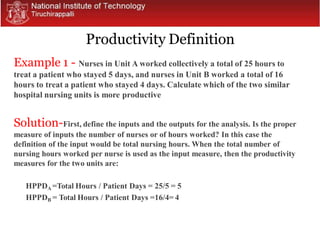
Example 1 - Nurses in Unit A worked collectively a total of 25 hours to
treat a patient who stayed 5 days, and nurses in Unit B worked a total of 16
hours to treat a patient who stayed 4 days. Calculate which of the two similar
hospital nursing units is more productive
Solution-First, define the inputs and the outputs for the analysis. Is the proper
measure of inputs the number of nurses or of hours worked? In this case the
definition of the input would be total nursing hours. When the total number of
nursing hours worked per nurse is used as the input measure, then the productivity
measures for the two units are:
HPPDA =Total Hours / Patient Days = 25/5 = 5
HPPDB = Total Hours / Patient Days =16/4= 4
8
Productivity Measurements
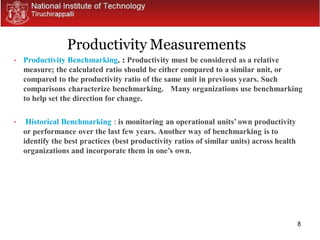
• Productivity Benchmarking. : Productivity must be considered as a relative
measure; the calculated ratio should be either compared to a similar unit, or
compared to the productivity ratio of the same unit in previous years. Such
comparisons characterize benchmarking. Many organizations use benchmarking
to help set the direction for change.
• Historical Benchmarking : is monitoring an operational units’ own productivity
or performance over the last few years. Another way of benchmarking is to
identify the best practices (best productivity ratios of similar units) across health
organizations and incorporate them in one’s own.
4
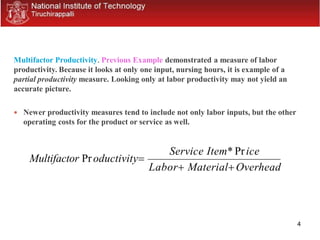
Multifactor Productivity. Previous Example demonstrated a measure of labor
productivity. Because it looks at only one input, nursing hours, it is example of a
partial productivity measure. Looking only at labor productivity may not yield an
accurate picture.
 Newer productivity measures tend to include not only labor inputs, but the other
operating costs for the product or service as well.
Multifactor Productivity
Service Item* Price
Labor MaterialOverhead
1
0
Productivity Measurements
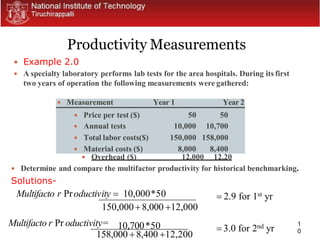
 Example 2.0
 A specialty laboratory performs lab tests for the area hospitals. During its first
two years of operation the following measurements were gathered:
 Measurement Year 1 Year 2
 Price per test ($) 50 50
 Annual tests 10,000 10,700
 Total labor costs($) 150,000 158,000
 Material costs ($) 8,000 8,400
 Overhead ($) 12,000 12,20
 Determine and compare the multifactor productivity for historical benchmarking.
Solutions-
Multifacto r Productivity 
Multifacto r Pr oductivity=
10,000*50
150,0008,000 12,000
10,700*50
158,000 8,400 12,200
 2.9 for 1st yr
 3.0 for 2nd yr
1
1
Productivity Improvement Indices
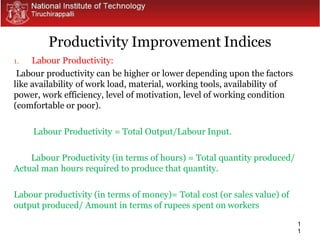
1. Labour Productivity:
Labour productivity can be higher or lower depending upon the factors
like availability of work load, material, working tools, availability of
power, work efficiency, level of motivation, level of working condition
(comfortable or poor).
Labour Productivity = Total Output/Labour Input.
Labour Productivity (in terms of hours) = Total quantity produced/
Actual man hours required to produce that quantity.
Labour productivity (in terms of money)= Total cost (or sales value) of
output produced/ Amount in terms of rupees spent on workers
1
2
 2. Material productivity:
Material productivity depends upon how material is effectively utilized in its
conversion into finished product. Material productivity depends upon percentage
of rejection, creation of scrap, level of spoilage, obsolescence, work wastage etc.
Material productivity = Total output / Material input.
or
Material productivity = Number of units produced / Total material cost.
Productivity Improvement Indices
1
3
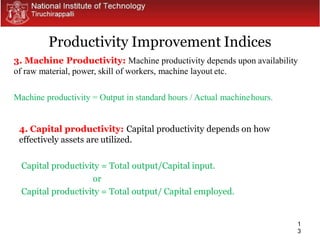
3. Machine Productivity: Machine productivity depends upon availability
of raw material, power, skill of workers, machine layout etc.
Machine productivity = Output in standard hours / Actual machinehours.
4. Capital productivity: Capital productivity depends on how
effectively assets are utilized.
Capital productivity = Total output/Capital input.
or
Capital productivity = Total output/ Capital employed.
Productivity Improvement Indices
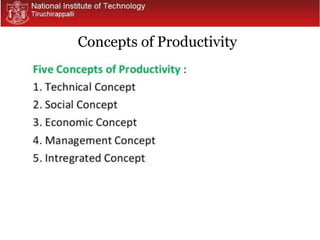
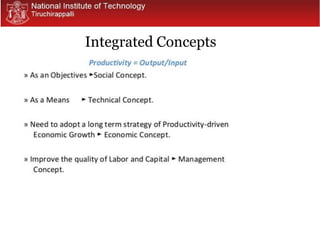
Concepts of Productivity
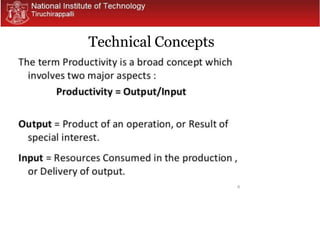
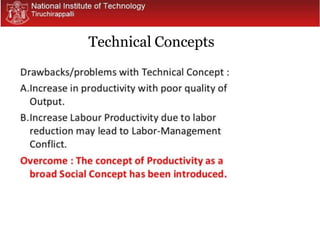
Technical Concepts
Technical Concepts
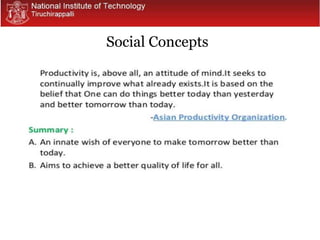
Social Concepts
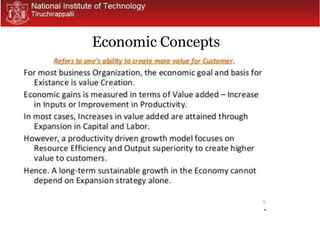
Economic Concepts
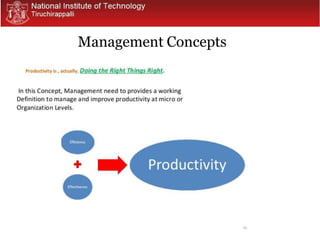
Management Concepts
Integrated Concepts
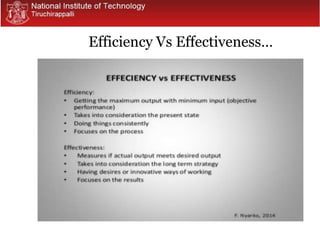
Efficiency Vs Effectiveness…
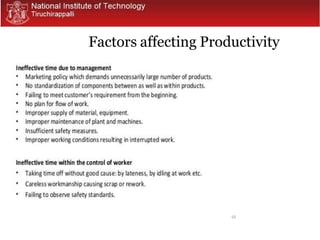
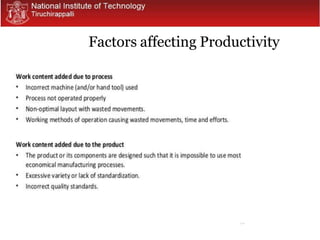
Factors affecting Productivity
24
Productivity Improvement Technique
A) JIDOKA: Jidoka is a Toyota concept aimed at describing the man-machine
interface such that people remain free to exercise judgment while machines serve
their purpose. The jidoka system shows faith in the worker as a thinker and
allows all workers the right to stop the line on which they are working. Jidoka is
often referred to as automation with a human mind. The jidoka way of working
consists of following three principles-
Do not make defects, Do not pass on defects, Do not accept defects.
25
B) HEIJUNKA: Heijunka focuses on achieving consistent levels of
production. It is defined as ‘distributing the production of different [bodytypes]
evenly over the course of a day’. It incorporates
1) The principles of line balancing by attempting to equate workloads
2) Leveling demand out by creating an inventory buffer and replenishing that
buffer.
It believes in providing even work load for all employees. Heijunka has the
capability of reducing lead times by minimizing time losses due to frequent
process changeovers.
26
C)KAIZEN Techniques: Kaizen (Continuous improvement) is a
management supported employee driven process where, employees make a great
number of continuous improvement efforts.
i)Five Ss of Housekeeping: A structured approach to achieve clean andorderly
work place by fixing place for everything. Five Ss is an abbreviation for the Japanese
words: Seiri, Seiton, Seiso, Seiketsu and Shitsuke. It means:
 Seiri- getting rid of unnecessary items
 Seiton- Arranging items (materials, tools, gauges) systematically for easy
 retrievability.
 Seiso- Keeping work place scrupulously clean.
 Seiketsu - Scheduling regular cleaning and clearing out operations.
 Shitsuke - Making all the above task meet agreed standards at agreed intervals.
27
(ii) Muda elimination: Muda means ‘Waste’. Here muda elimination
implies an ‘on going’ and systematic reduction or elimination of waste.
There are seven kinds of major waste:
Overproduction Muda, Stock Muda, Transport Muda, Defects Muda, Delay
Muda, Motion Muda, Over processing Muda.
(iii) Poka-Yoke: It is powerful and comprehensive method of ‘error
proofing’.A work process to eliminate inadvertent errors to ensure quality
products and services. It helps in defect prevention and defect detection.
28
(iv) SMED: Single Minute Exchange of Die (SMED) is a technique of
performing a set up operation in lesser amount of time .It affects a machinery
setup for change over from job to another in less than 10 minutes expressed asa
single digit. It helps in reduced Work-in-progress, better average daily
production, increased capacity and faster delivery to customers.
(v) Total Productive maintenance (TPM): TPM is keeping machines
in good working condition through systematic maintenance of equipment so that
they fail less frequently and production process continues without interruption.
(vi) Just-In-Time: JIT is a management philosophy aimed at eliminating
waste from every aspect of manufacturing and its related activities. The aim of
JIT in a factory is to reduce lead times, minimize inventory, reduce the defect rate
to zero and accomplish all of the above at minimum cost.
29
(vii) Kanban: Kanban is a manual production scheduling technique
controlled by a process or machine operator. Kanban means card in Japanese, is
attached to given number of parts or products in the production line instructing
the delivery of given quantity.
The kanban card after all parts/products have been used up is returned by the
operator to its origin. Production is controlled through demand originatingfrom
external customer.
(viii) Process Oriented Management (POM): Traditional management
focuses mainly on results and individuals on their ultimate achievement. Kaizen
management emphasis on process of achieving the results.
Managers in POM are judged by people centered skills as time management,
education and training, inter-team participation, communication and morale
boosting.
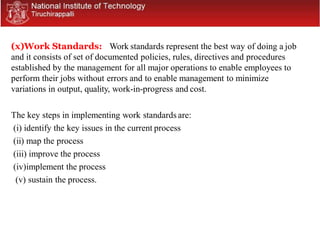
(x)Work Standards: Work standards represent the best way of doing a job
and it consists of set of documented policies, rules, directives and procedures
established by the management for all major operations to enable employees to
perform their jobs without errors and to enable management to minimize
variations in output, quality, work-in-progress and cost.
The key steps in implementing work standards are:
(i) identify the key issues in the current process
(ii) map the process
(iii) improve the process
(iv)implement the process
(v) sustain the process.
31
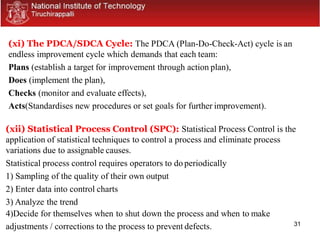
(xi) The PDCA/SDCA Cycle: The PDCA (Plan-Do-Check-Act) cycle is an
endless improvement cycle which demands that each team:
Plans (establish a target for improvement through action plan),
Does (implement the plan),
Checks (monitor and evaluate effects),
Acts(Standardises new procedures or set goals for further improvement).
(xii) Statistical Process Control (SPC): Statistical Process Control is the
application of statistical techniques to control a process and eliminate process
variations due to assignable causes.
Statistical process control requires operators to do periodically
1) Sampling of the quality of their own output
2) Enter data into control charts
3) Analyze the trend
4)Decide for themselves when to shut down the process and when to make
adjustments / corrections to the process to prevent defects.
32
xiii) Suggestion Systems: Suggestion Systems- the fundamental to the
Kaizen philosophy is the process owned by employees through designed to
benefit the company, inviting employees to suggest / implement any idea, large or
small, novel or mundane concerning any aspect of the company life.
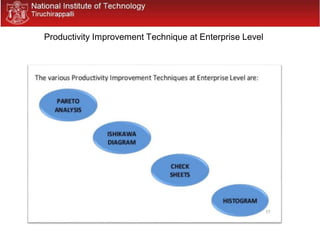
Productivity Improvement Technique at Enterprise Level
Pareto Analysis
Pareto Analysis
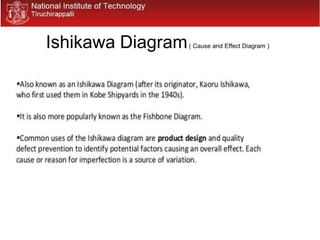
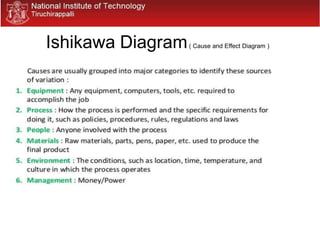
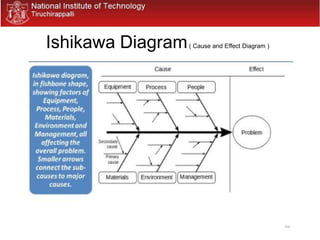
Ishikawa Diagram( Cause and Effect Diagram )
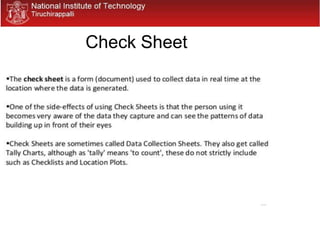
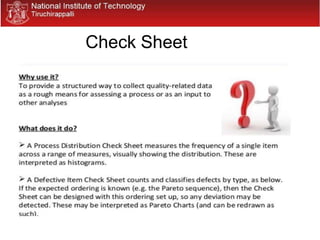
Check Sheet
Check Sheet
Check Sheet
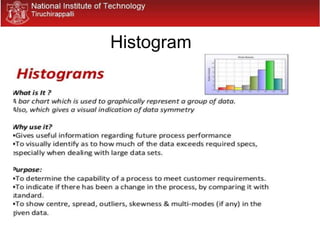
Histogram
43
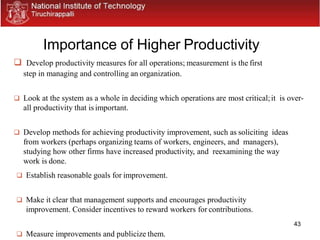
Importance of Higher Productivity
 Develop productivity measures for all operations; measurement is the first
step in managing and controlling an organization.
 Look at the system as a whole in deciding which operations are most critical;it is over-
all productivity that is important.
 Develop methods for achieving productivity improvement, such as soliciting ideas
from workers (perhaps organizing teams of workers, engineers, and managers),
studying how other firms have increased productivity, and reexamining the way
work is done.
 Establish reasonable goals for improvement.
 Make it clear that management supports and encourages productivity
improvement. Consider incentives to reward workers for contributions.
 Measure improvements and publicize them.
45
Thank you

Productivity - Personnel Management

  • 1.
  • 2.
    2 • Productivity isone measure of the effective use of resources withinan organization, industry, ornation. • The classical productivity definition measures outputs relative to the inputs needed to produce them. That is, productivity is defined as the number of output units per unit ofinput productivity = output/input. Productivity Definition
  • 3.
    The amount ofoutput per unit of input (labor, equipment, and capital). There are many different ways of measuring productivity. For example, in a factory productivity might be measured based on the number of hours it takes to produce a good, while in the service sector productivity might be measured based on the revenue generated by an employee divided by his/her salary. Productivity Concepts and Definitions According to Fabricant productivity in the following words, “always a ratio of output and input”. According to Kendrick and Creamer “a-Functional definitions for partial, total factor and total productivity, b-Loose description of relationship usually in ratio form, between outputs and all of the associated inputs in real terms” Productivity Definition
  • 5.
    Productivity Growth The growthrate of productivity is very important for every nation. Growth rate of productivity is implies that, increase in productivity from one period to the next relative to the productivity in the preceding period.
  • 6.
    3 • Sometimes, aninverse calculation is used that measures inputs per unitof output. Care must be taken to interpret this inverse calculation appropriately; the greater the number of units of input per unit ofoutput, the lower the productivity. • For example, traditionally productivity in hospital nursing units has been measured by hours per patient day (HPPD). That requires an inversion of the typical calculations: meaning total hours are divided by total patient days. Productivity Definition HPPD = Total Hours/Total days
  • 7.
    Productivity Definition Example 1- Nurses in Unit A worked collectively a total of 25 hours to treat a patient who stayed 5 days, and nurses in Unit B worked a total of 16 hours to treat a patient who stayed 4 days. Calculate which of the two similar hospital nursing units is more productive Solution-First, define the inputs and the outputs for the analysis. Is the proper measure of inputs the number of nurses or of hours worked? In this case the definition of the input would be total nursing hours. When the total number of nursing hours worked per nurse is used as the input measure, then the productivity measures for the two units are: HPPDA =Total Hours / Patient Days = 25/5 = 5 HPPDB = Total Hours / Patient Days =16/4= 4
  • 8.
    8 Productivity Measurements • ProductivityBenchmarking. : Productivity must be considered as a relative measure; the calculated ratio should be either compared to a similar unit, or compared to the productivity ratio of the same unit in previous years. Such comparisons characterize benchmarking. Many organizations use benchmarking to help set the direction for change. • Historical Benchmarking : is monitoring an operational units’ own productivity or performance over the last few years. Another way of benchmarking is to identify the best practices (best productivity ratios of similar units) across health organizations and incorporate them in one’s own.
  • 9.
    4 Multifactor Productivity. PreviousExample demonstrated a measure of labor productivity. Because it looks at only one input, nursing hours, it is example of a partial productivity measure. Looking only at labor productivity may not yield an accurate picture.  Newer productivity measures tend to include not only labor inputs, but the other operating costs for the product or service as well. Multifactor Productivity Service Item* Price Labor MaterialOverhead
  • 10.
    1 0 Productivity Measurements  Example2.0  A specialty laboratory performs lab tests for the area hospitals. During its first two years of operation the following measurements were gathered:  Measurement Year 1 Year 2  Price per test ($) 50 50  Annual tests 10,000 10,700  Total labor costs($) 150,000 158,000  Material costs ($) 8,000 8,400  Overhead ($) 12,000 12,20  Determine and compare the multifactor productivity for historical benchmarking. Solutions- Multifacto r Productivity  Multifacto r Pr oductivity= 10,000*50 150,0008,000 12,000 10,700*50 158,000 8,400 12,200  2.9 for 1st yr  3.0 for 2nd yr
  • 11.
    1 1 Productivity Improvement Indices 1.Labour Productivity: Labour productivity can be higher or lower depending upon the factors like availability of work load, material, working tools, availability of power, work efficiency, level of motivation, level of working condition (comfortable or poor). Labour Productivity = Total Output/Labour Input. Labour Productivity (in terms of hours) = Total quantity produced/ Actual man hours required to produce that quantity. Labour productivity (in terms of money)= Total cost (or sales value) of output produced/ Amount in terms of rupees spent on workers
  • 12.
    1 2  2. Materialproductivity: Material productivity depends upon how material is effectively utilized in its conversion into finished product. Material productivity depends upon percentage of rejection, creation of scrap, level of spoilage, obsolescence, work wastage etc. Material productivity = Total output / Material input. or Material productivity = Number of units produced / Total material cost. Productivity Improvement Indices
  • 13.
    1 3 3. Machine Productivity:Machine productivity depends upon availability of raw material, power, skill of workers, machine layout etc. Machine productivity = Output in standard hours / Actual machinehours. 4. Capital productivity: Capital productivity depends on how effectively assets are utilized. Capital productivity = Total output/Capital input. or Capital productivity = Total output/ Capital employed. Productivity Improvement Indices
  • 14.
  • 15.
  • 16.
  • 17.
  • 18.
  • 19.
  • 20.
  • 21.
  • 22.
  • 23.
  • 24.
    24 Productivity Improvement Technique A)JIDOKA: Jidoka is a Toyota concept aimed at describing the man-machine interface such that people remain free to exercise judgment while machines serve their purpose. The jidoka system shows faith in the worker as a thinker and allows all workers the right to stop the line on which they are working. Jidoka is often referred to as automation with a human mind. The jidoka way of working consists of following three principles- Do not make defects, Do not pass on defects, Do not accept defects.
  • 25.
    25 B) HEIJUNKA: Heijunkafocuses on achieving consistent levels of production. It is defined as ‘distributing the production of different [bodytypes] evenly over the course of a day’. It incorporates 1) The principles of line balancing by attempting to equate workloads 2) Leveling demand out by creating an inventory buffer and replenishing that buffer. It believes in providing even work load for all employees. Heijunka has the capability of reducing lead times by minimizing time losses due to frequent process changeovers.
  • 26.
    26 C)KAIZEN Techniques: Kaizen(Continuous improvement) is a management supported employee driven process where, employees make a great number of continuous improvement efforts. i)Five Ss of Housekeeping: A structured approach to achieve clean andorderly work place by fixing place for everything. Five Ss is an abbreviation for the Japanese words: Seiri, Seiton, Seiso, Seiketsu and Shitsuke. It means:  Seiri- getting rid of unnecessary items  Seiton- Arranging items (materials, tools, gauges) systematically for easy  retrievability.  Seiso- Keeping work place scrupulously clean.  Seiketsu - Scheduling regular cleaning and clearing out operations.  Shitsuke - Making all the above task meet agreed standards at agreed intervals.
  • 27.
    27 (ii) Muda elimination:Muda means ‘Waste’. Here muda elimination implies an ‘on going’ and systematic reduction or elimination of waste. There are seven kinds of major waste: Overproduction Muda, Stock Muda, Transport Muda, Defects Muda, Delay Muda, Motion Muda, Over processing Muda. (iii) Poka-Yoke: It is powerful and comprehensive method of ‘error proofing’.A work process to eliminate inadvertent errors to ensure quality products and services. It helps in defect prevention and defect detection.
  • 28.
    28 (iv) SMED: SingleMinute Exchange of Die (SMED) is a technique of performing a set up operation in lesser amount of time .It affects a machinery setup for change over from job to another in less than 10 minutes expressed asa single digit. It helps in reduced Work-in-progress, better average daily production, increased capacity and faster delivery to customers. (v) Total Productive maintenance (TPM): TPM is keeping machines in good working condition through systematic maintenance of equipment so that they fail less frequently and production process continues without interruption. (vi) Just-In-Time: JIT is a management philosophy aimed at eliminating waste from every aspect of manufacturing and its related activities. The aim of JIT in a factory is to reduce lead times, minimize inventory, reduce the defect rate to zero and accomplish all of the above at minimum cost.
  • 29.
    29 (vii) Kanban: Kanbanis a manual production scheduling technique controlled by a process or machine operator. Kanban means card in Japanese, is attached to given number of parts or products in the production line instructing the delivery of given quantity. The kanban card after all parts/products have been used up is returned by the operator to its origin. Production is controlled through demand originatingfrom external customer. (viii) Process Oriented Management (POM): Traditional management focuses mainly on results and individuals on their ultimate achievement. Kaizen management emphasis on process of achieving the results. Managers in POM are judged by people centered skills as time management, education and training, inter-team participation, communication and morale boosting.
  • 30.
    (x)Work Standards: Workstandards represent the best way of doing a job and it consists of set of documented policies, rules, directives and procedures established by the management for all major operations to enable employees to perform their jobs without errors and to enable management to minimize variations in output, quality, work-in-progress and cost. The key steps in implementing work standards are: (i) identify the key issues in the current process (ii) map the process (iii) improve the process (iv)implement the process (v) sustain the process.
  • 31.
    31 (xi) The PDCA/SDCACycle: The PDCA (Plan-Do-Check-Act) cycle is an endless improvement cycle which demands that each team: Plans (establish a target for improvement through action plan), Does (implement the plan), Checks (monitor and evaluate effects), Acts(Standardises new procedures or set goals for further improvement). (xii) Statistical Process Control (SPC): Statistical Process Control is the application of statistical techniques to control a process and eliminate process variations due to assignable causes. Statistical process control requires operators to do periodically 1) Sampling of the quality of their own output 2) Enter data into control charts 3) Analyze the trend 4)Decide for themselves when to shut down the process and when to make adjustments / corrections to the process to prevent defects.
  • 32.
    32 xiii) Suggestion Systems:Suggestion Systems- the fundamental to the Kaizen philosophy is the process owned by employees through designed to benefit the company, inviting employees to suggest / implement any idea, large or small, novel or mundane concerning any aspect of the company life.
  • 33.
  • 34.
  • 35.
  • 36.
    Ishikawa Diagram( Causeand Effect Diagram )
  • 37.
    Ishikawa Diagram( Causeand Effect Diagram )
  • 38.
    Ishikawa Diagram( Causeand Effect Diagram )
  • 39.
  • 40.
  • 41.
  • 42.
  • 43.
    43 Importance of HigherProductivity  Develop productivity measures for all operations; measurement is the first step in managing and controlling an organization.  Look at the system as a whole in deciding which operations are most critical;it is over- all productivity that is important.  Develop methods for achieving productivity improvement, such as soliciting ideas from workers (perhaps organizing teams of workers, engineers, and managers), studying how other firms have increased productivity, and reexamining the way work is done.  Establish reasonable goals for improvement.  Make it clear that management supports and encourages productivity improvement. Consider incentives to reward workers for contributions.  Measure improvements and publicize them.
  • 45.