CONTRACTS AND
PAYMENT STRUCTURES
EMCM5103 TOPIC 2
TYPES OF CONTRACT STRUCTURE
• CONVENTIONAL / TRADITIONAL CONTRACT
• TURNKEY CONTRACT
• DESIGN AND BUILD CONTRACT
• CONSTRUCTION MANAGEMENT AND MANAGEMENT
CONTRACTING
• GUARANTEED MAXIMUM PRICE
CONVENTIONAL/TRADITIONAL CONTRACT
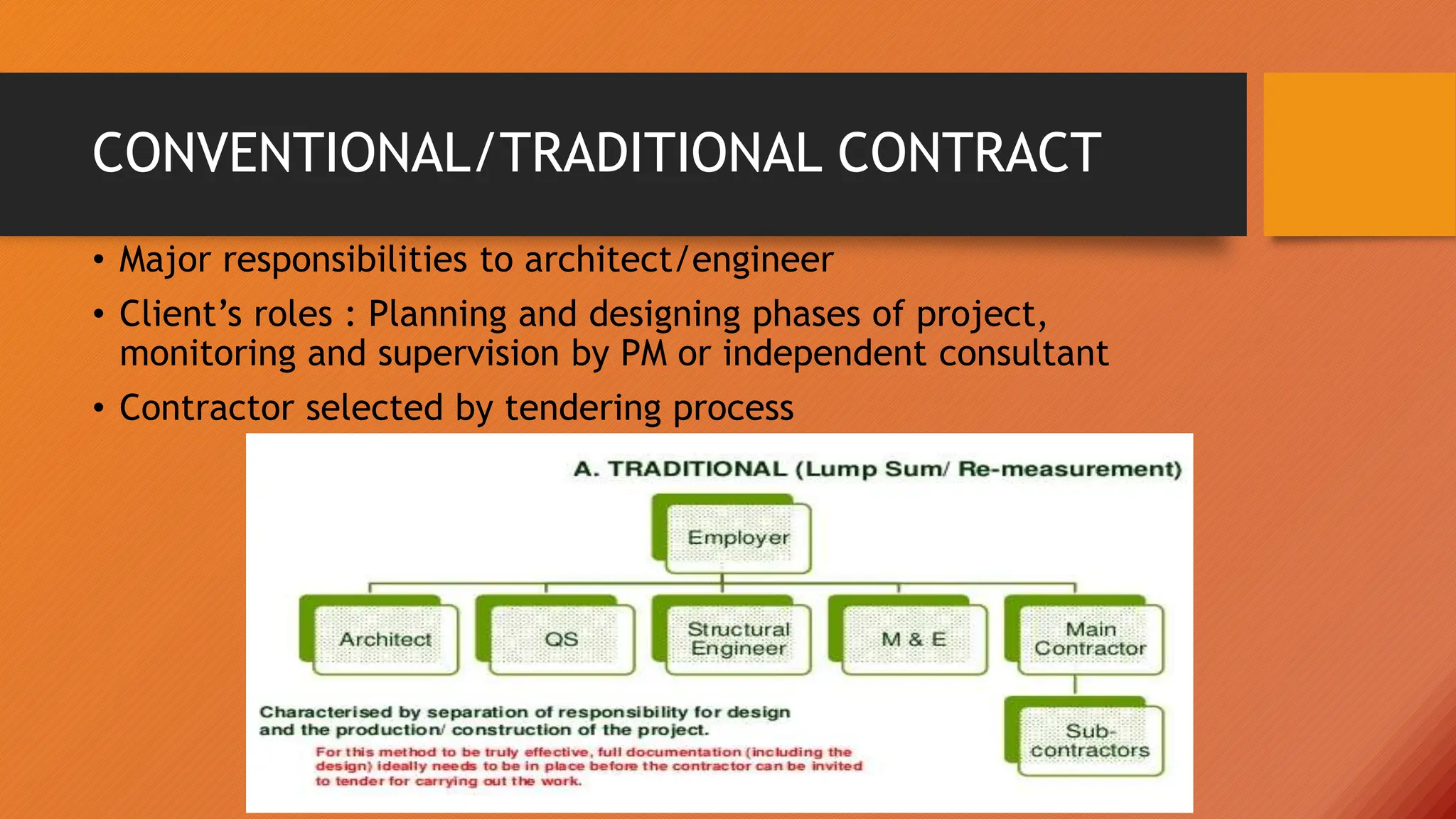
• Major responsibilities to architect/engineer
• Client’s roles : Planning and designing phases of project,
monitoring and supervision by PM or independent consultant
• Contractor selected by tendering process
CONVENTIONAL/TRADITIONAL CONTRACT
• Under this contract, the design responsibility primarily falls on the
architect or engineer employed by the client and the contractor.
• In the Malaysian context, the client’s organisation usually does all the
planning and designing phases of a project. The construction phase of the
project is done by the contractor who is selected and appointed through
the tender process.
• The Client’s organisation may carry out monitoring and supervision of the
project through the appointed project manager or may engage an
independent consultant to carry out monitoring of the project.
TURNKEY CONTRACT
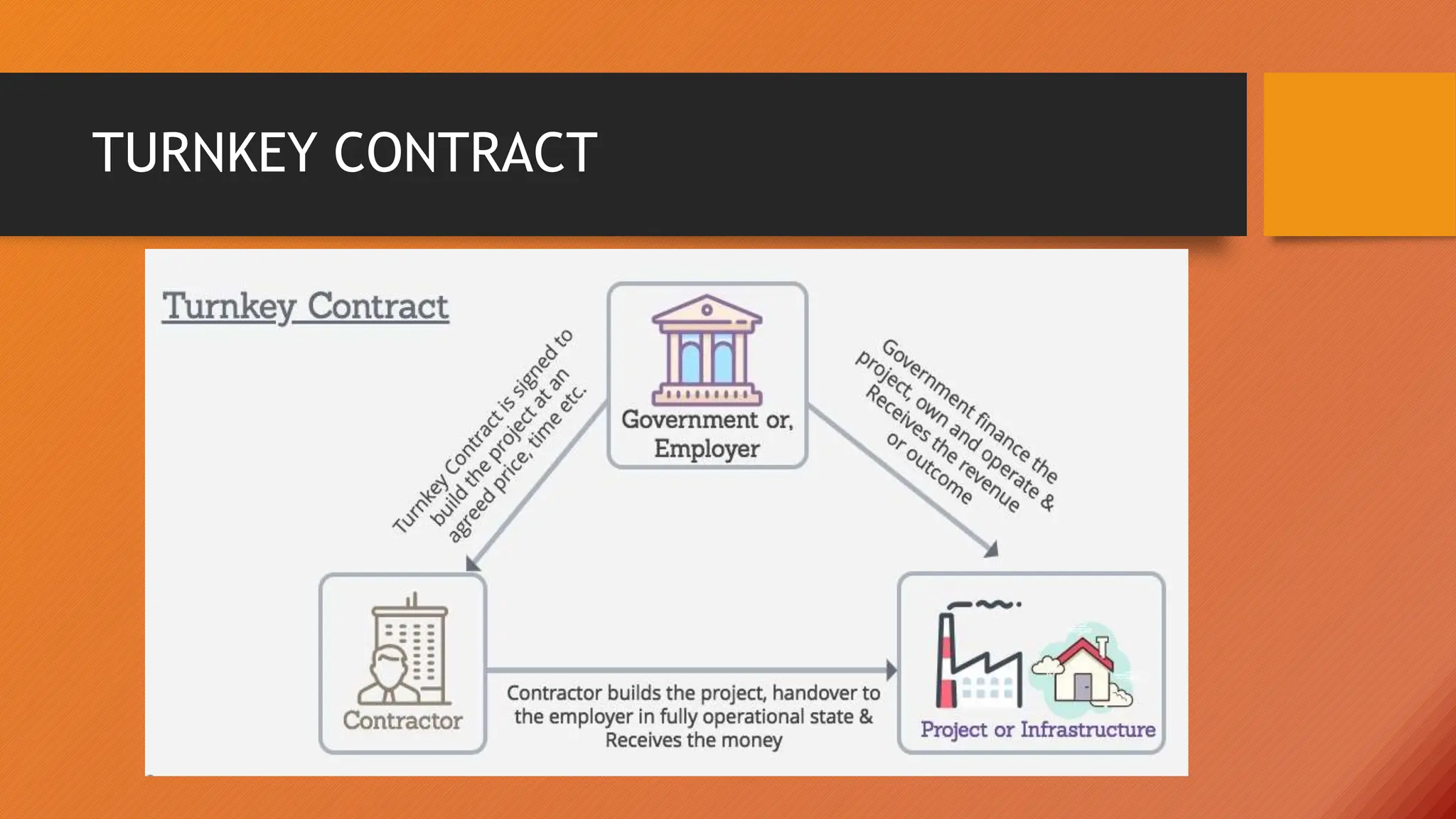
- Contractor employed by client shall take major responsibilities in
design, procurement, construction and commissioning of entire works
including the management of project.
- Also known as Engineering, Procurement and Construction (EPC).
Commonly adopted for the design and construction under Private
Finance Initiative.
- Similar to Design and Build
- Used for government big project and clients roles limited to
inspection, payment and performance target.
- In Malaysia, normally JKR will provide the standards guidelines for
writing the need statement, format, requirements for contractor’s
proposal , contract sum analysis and other related contractual terms
for turnkey project.
TURNKEY CONTRACT
DESIGN AND BUILD CONTRACT
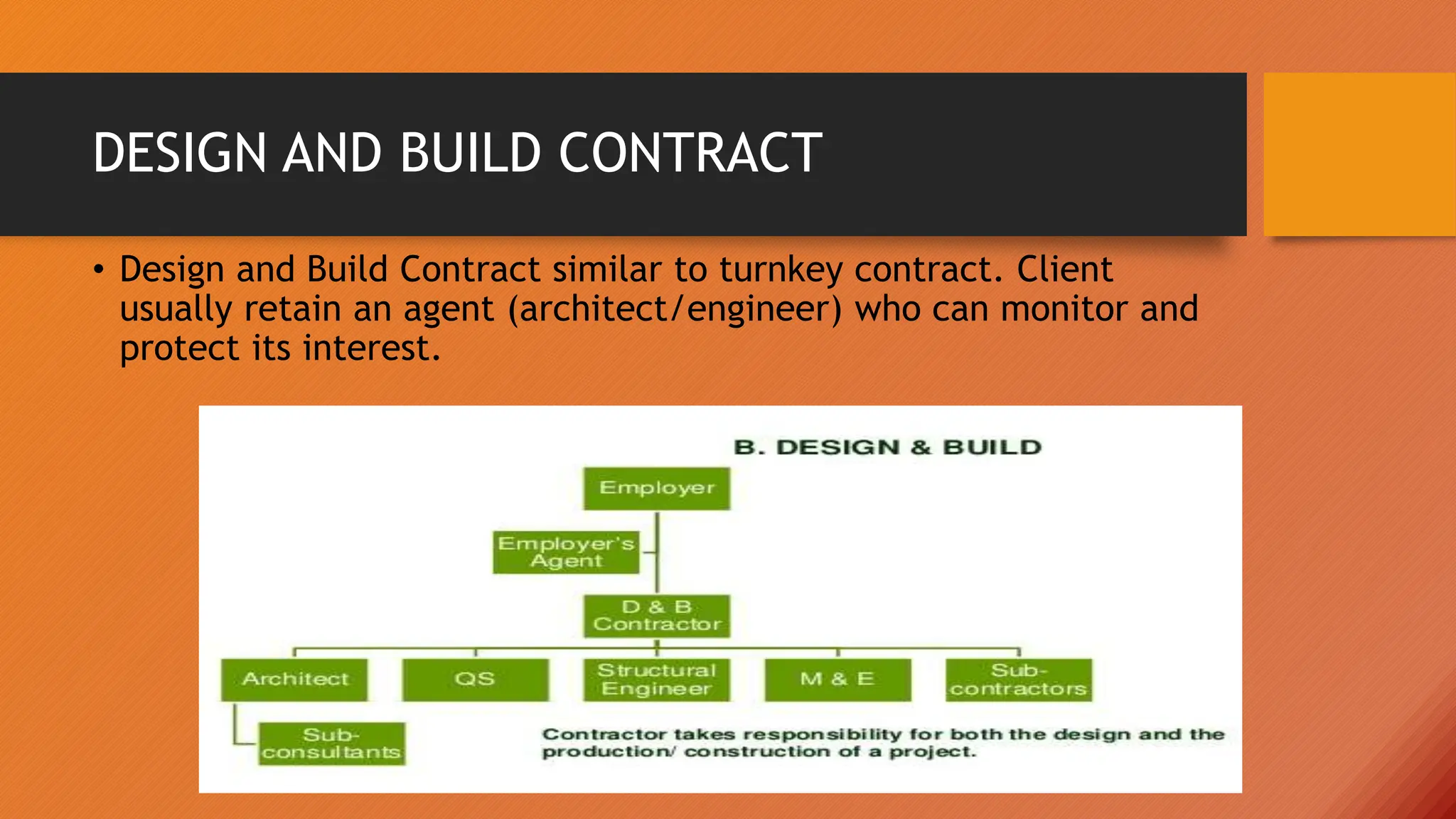
• Design and Build Contract similar to turnkey contract. Client
usually retain an agent (architect/engineer) who can monitor and
protect its interest.
CONSTRUCTION MANAGEMENT AND
MANAGEMENT CONTRACTING
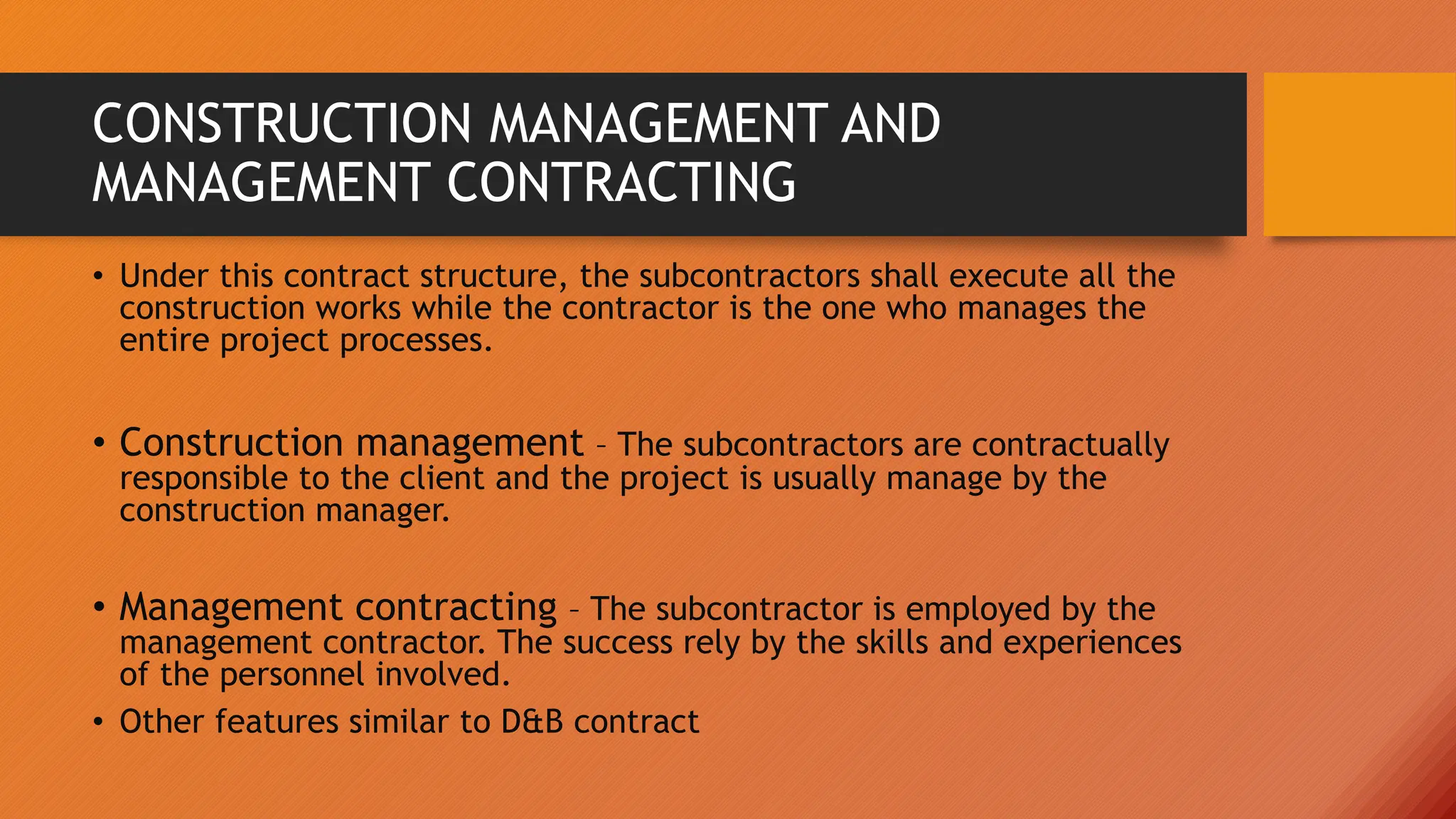
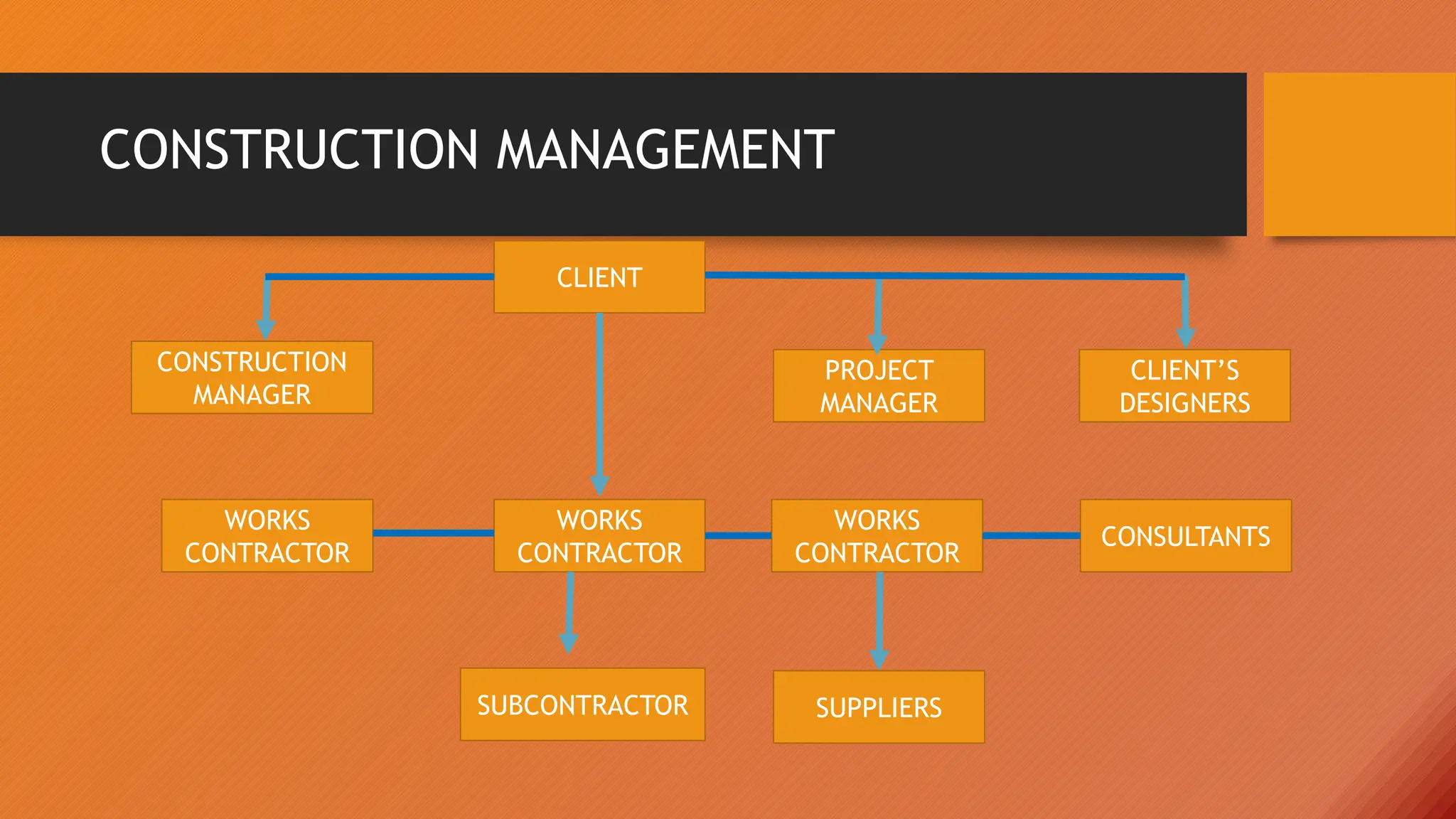
• Under this contract structure, the subcontractors shall execute all the
construction works while the contractor is the one who manages the
entire project processes.
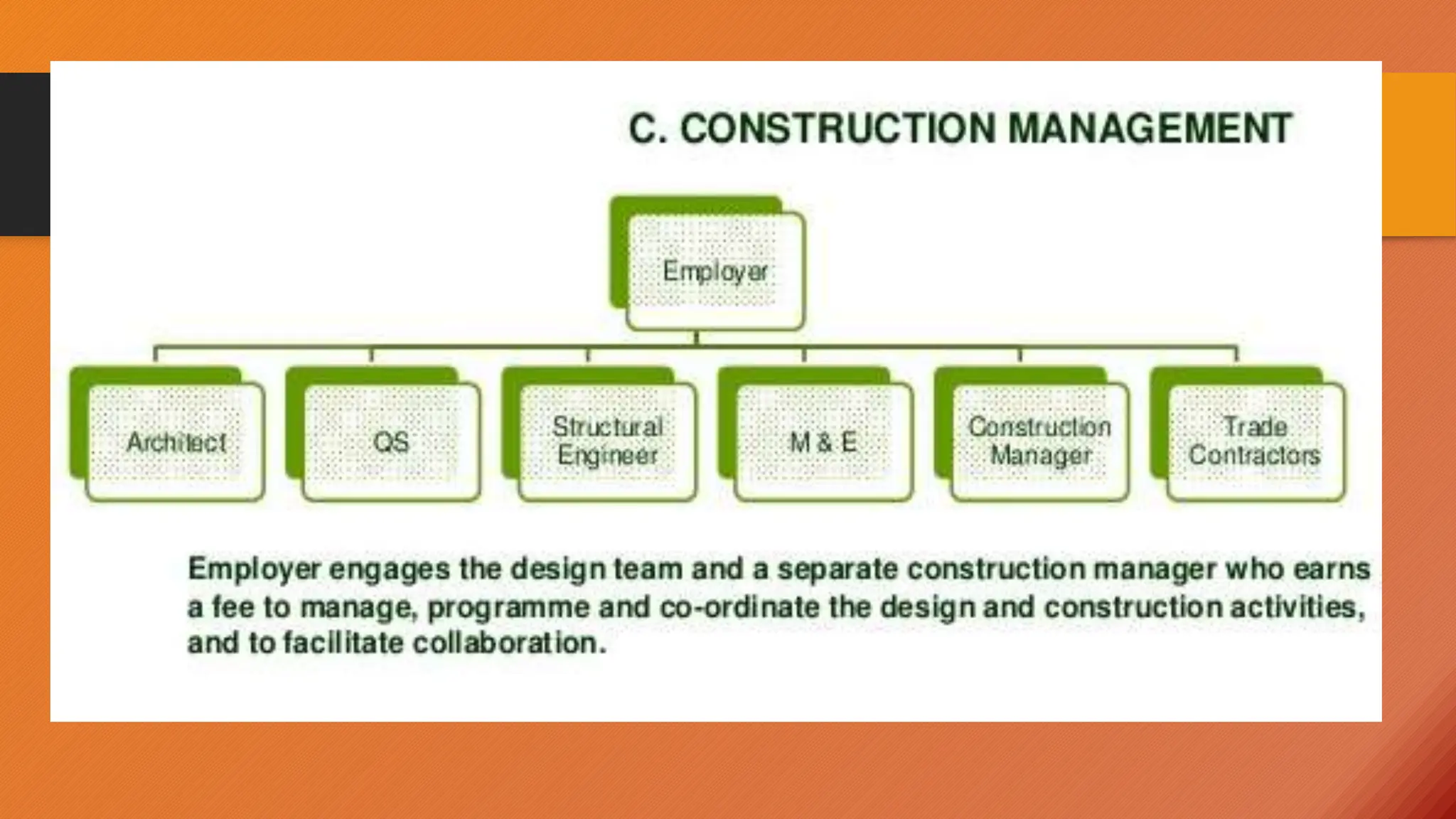
• Construction management – The subcontractors are contractually
responsible to the client and the project is usually manage by the
construction manager.
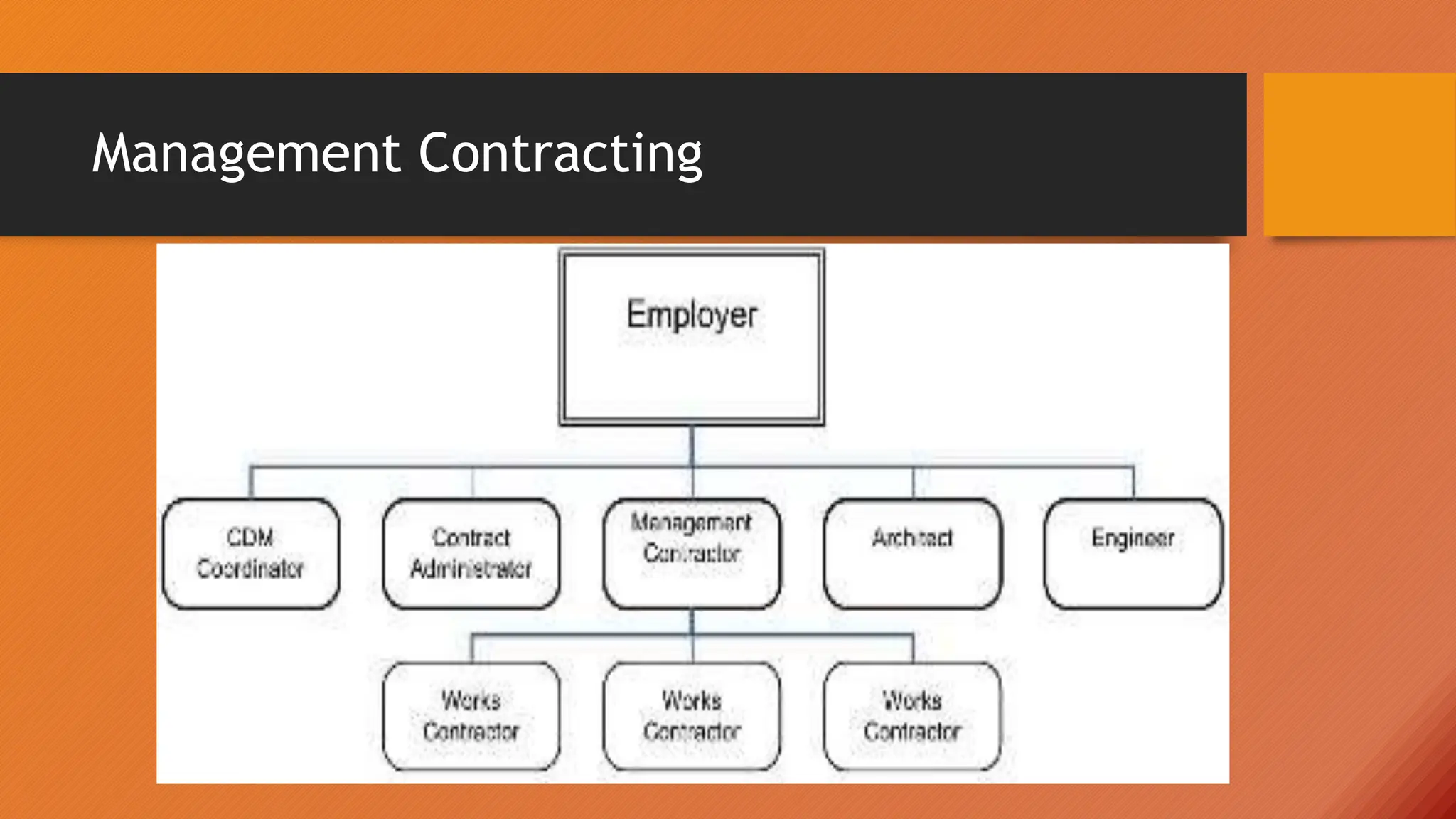
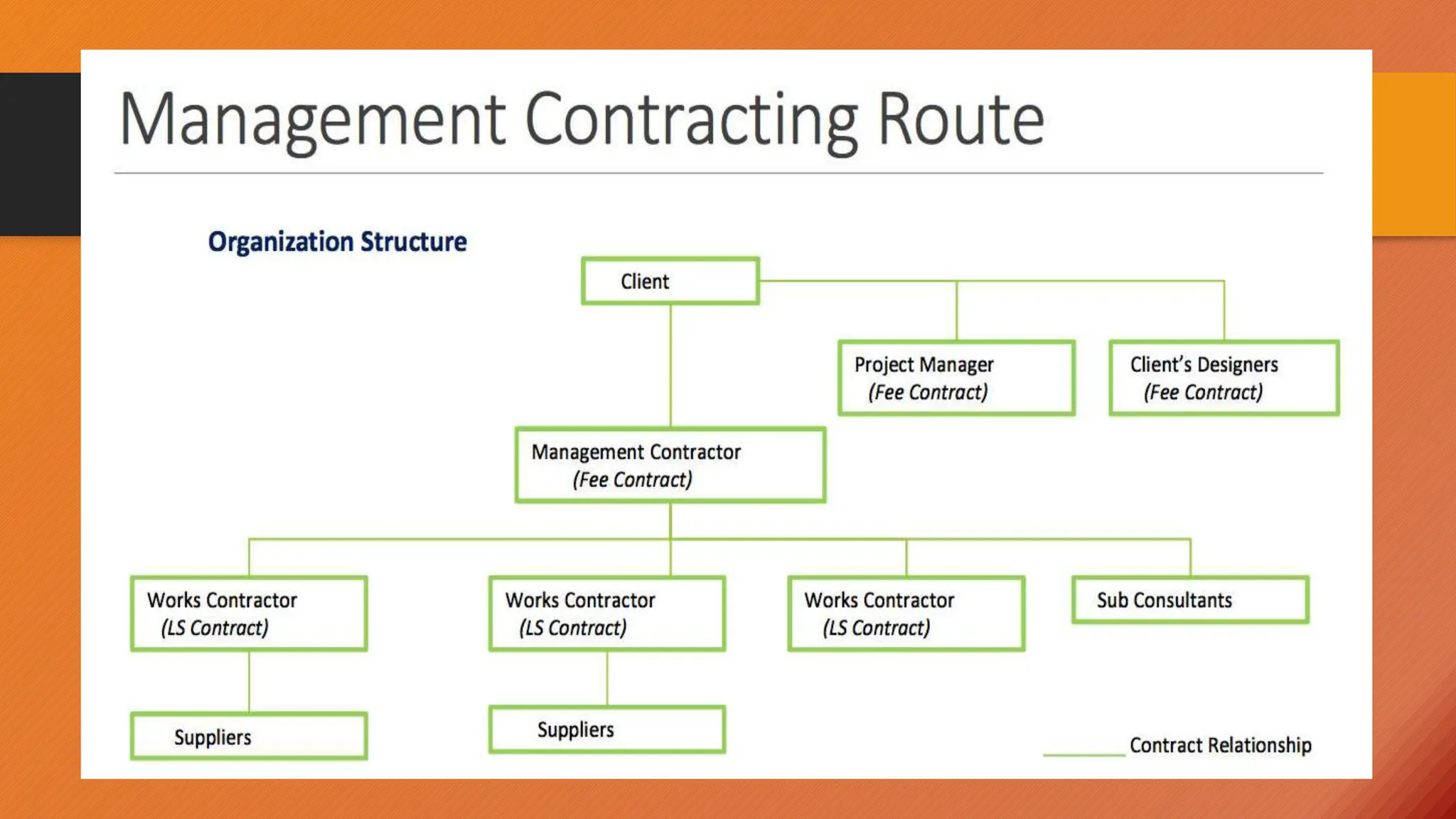
• Management contracting – The subcontractor is employed by the
management contractor. The success rely by the skills and experiences
of the personnel involved.
• Other features similar to D&B contract
CLIENT
CONSTRUCTION
MANAGER
PROJECT
MANAGER
CLIENT’S
DESIGNERS
WORKS
CONTRACTOR
WORKS
CONTRACTOR
WORKS
CONTRACTOR
CONSULTANTS
SUBCONTRACTOR SUPPLIERS
CONSTRUCTION MANAGEMENT
Management Contracting
GUARANTEED MAXIMUM PRICE CONTRACT
• Combination of construction mgmt. and D&B contract.
• The contractor/construction manager agrees to perform work within a price
ceiling. Contractor guarantees a max price for the work to be completed
according to the design.
• Contractor responsible for the design and tendering phases.
• Contractor fees for overhead and profit are contractually decided and agreed
upon once appointed by client.
• The price will not change except there is authorised modification.
• If the ceiling is exceeded, without change in scope, then the excess cost is
borne by the contractor.
• If the work is accomplished under the ceiling then the owner pays no more than
the actual cost and the profit is shared between the contractor and the owner.
• This method gives greater flexibility to the owner.
FACTORS DETERMINING THE ADOPTION OF
CONTRACT STRUCTURE
• PROJECT COMPLEXITY
• SPEED OF THE PROJECT
• CLIENT’S EXPERIENCE
• CONTRACT SUBJECT TO LOCAL REGULATIONS
• LIKELIHOOD OF PROJECT CHANGES
• NATURE OF THE PROJECT
• ALLOCATION OF RISKS
1. PROJECT COMPLEXITY
• The design of the building is complex and have high engineering content.
Complexity interrelated with issues such as expert and skills of consultant,
duration and cost of the project.
• More complex – more tedious – more difficult to handle the cost and longer
duration of project.
• For example, the lump-sum type of contract, is popular for the reason that the total cost
of the project is known in advance. But if the project is too complicated, it is not
possible to accurately determine the nature and quantity of the work prior to the start
of site activities, then lump sum type of contract pricing is not suitable.
2. SPEED OF THE PROJECT (Start to
Completion)
• The need to complete the project on time or earlier is a crucial issue
for projects especially those involving high traffic congestion or for low
cost projects where timing and costing are major challenges.
• The right choice of contract structure is crucial to ensure the success
of the project.
3. CLIENT’S EXPERIENCES
• The bigger or more experienced clients have their own preferred protocols which
involves specific choice of contract form. The credibility and commitment of the
client has always been an added value in project, thus client must be aware that
the contract structure has to fit well with the nature of project.
• For example, the client prefers competitive bidding to be able to compare and choose the most
suitable tender.
• The choice of contract form would therefore depend on the client’s experience.
4. CONTRACT SUBJECT TO LOCAL
REGULATIONS
• For international projects, legal conditions must be synchronised, the
commercial terms must be agreed on and the risk must be apportioned.
• Project will involve various legal systems and global organisation has to
deal with different practices in different countries, thus project team
need to select the right strategy of contract structure for the global
project.
5. LIKELIHOOD OF PROJECT CHANGES
• Some contractors/clients will allow the changes of the design when
construction stage start but some will not allow and every design must
follow the tender, and these two required different contract form.
• Each project is susceptible to change because of the complexities which
are unique to each project. The level of changes projection in a project
is to influence the type of contract structure selected.
6. NATURE OF THE PROJECT
• Different types of project will affect the choice of contract form.
• For example, the project can be build a new building, extension of
building, renovation works, industrial building and more.
• Different projects have different requirements therefore required
different type of contract form.
7. ALLOCATION OF RISK
• All sorts of risks arising from both the internal and external
environment of a project or organization and affecting the project
performance,
• In terms of successful delivery of project on of time, within budget
and of the specified performance.
• Important to know how much risk is shared in the project and how
much risk is allocated to the contractor and client.
CONTRACT PRICING
Contract Pricing consists of 3 types:
a.Lump Sum or Fixed Price
b.Re measurement or Bill of Quantities
c.Cost Reimbursement
- Possible to combine more than 1 type of pricing within a project.
- Pricing depend on information given to the contractor during tendering
phase, the level of risk involved and the conditions under which the
work will be carried out.
- The nature of contract structure also plays important role in
determining the pricing basis.
LUMP SUM , MEASUREMENT & COST
REIMBURSEMENT CONTRACT
• Lump sum contracts — where the contract sum is
determined before construction work is started.
• Measurement contracts — where the contract sum is
assessed on re-measurement to a previously agreed
basis.
• Cost reimbursement contracts — where the contract sum
is set based on the prime costs (of labour, plant and
materials) plus an agreed amount for overheads and
profit.
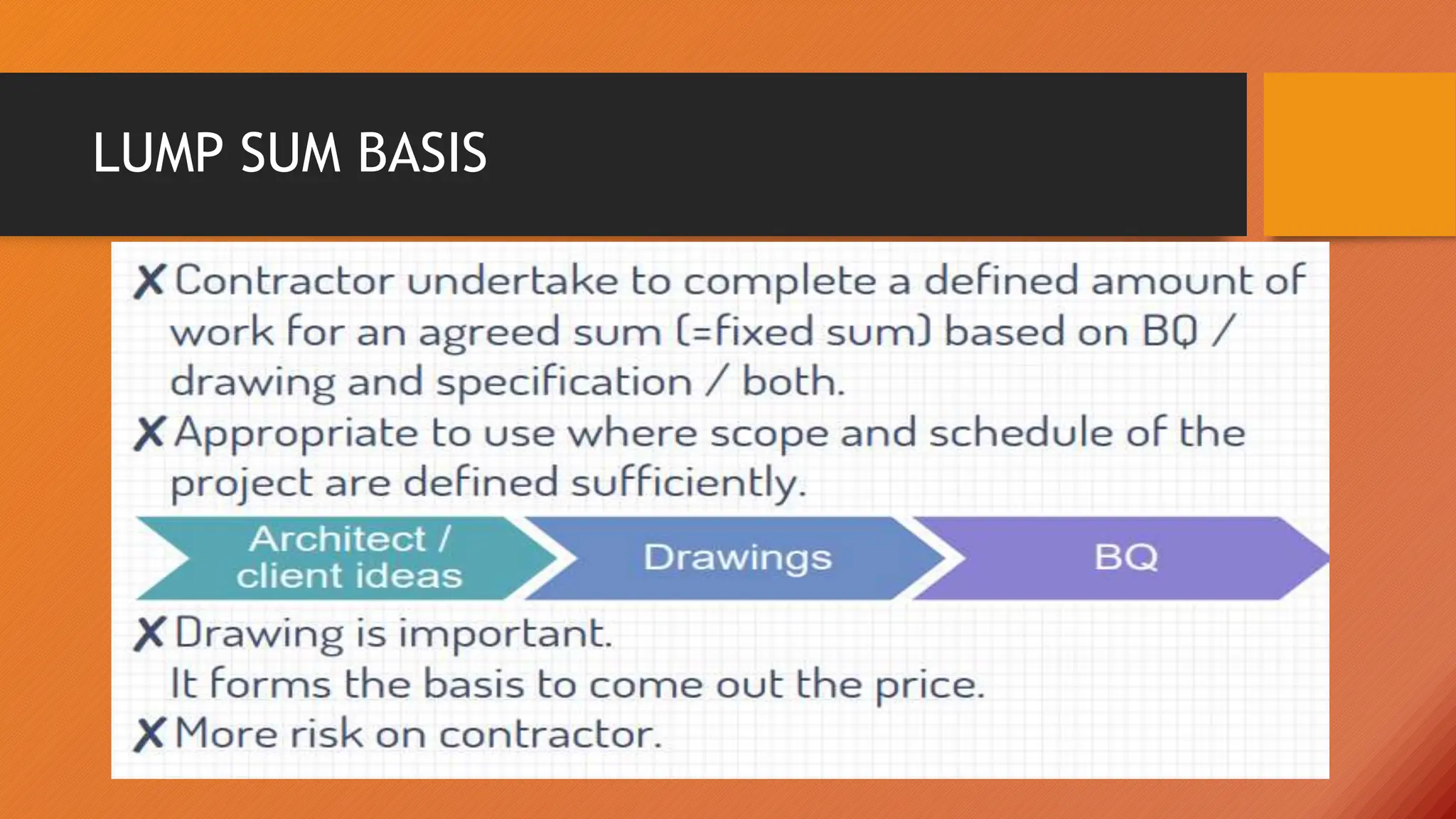
LUMP SUM BASIS (FIXED PRICE CONTRACT)
• Client-contractor agree on a price for the proposed work. Price remains
fixed unless both agree to any changes.
• Less risks to client (buyer) as they will no pay any extra cost incurred.
Contractor (seller) has to be very accurate in computing the cost
estimates and to include sufficient contingency cost. Bigger risk is borne
by contractor.
• Suit to low risk and well defined projects.
• High commitment needed in advance and reduces the amount of
administrative work after contract is in effect.
LUMP SUM BASIS
REMEASUREMENT / BILL OF QUANTITIES
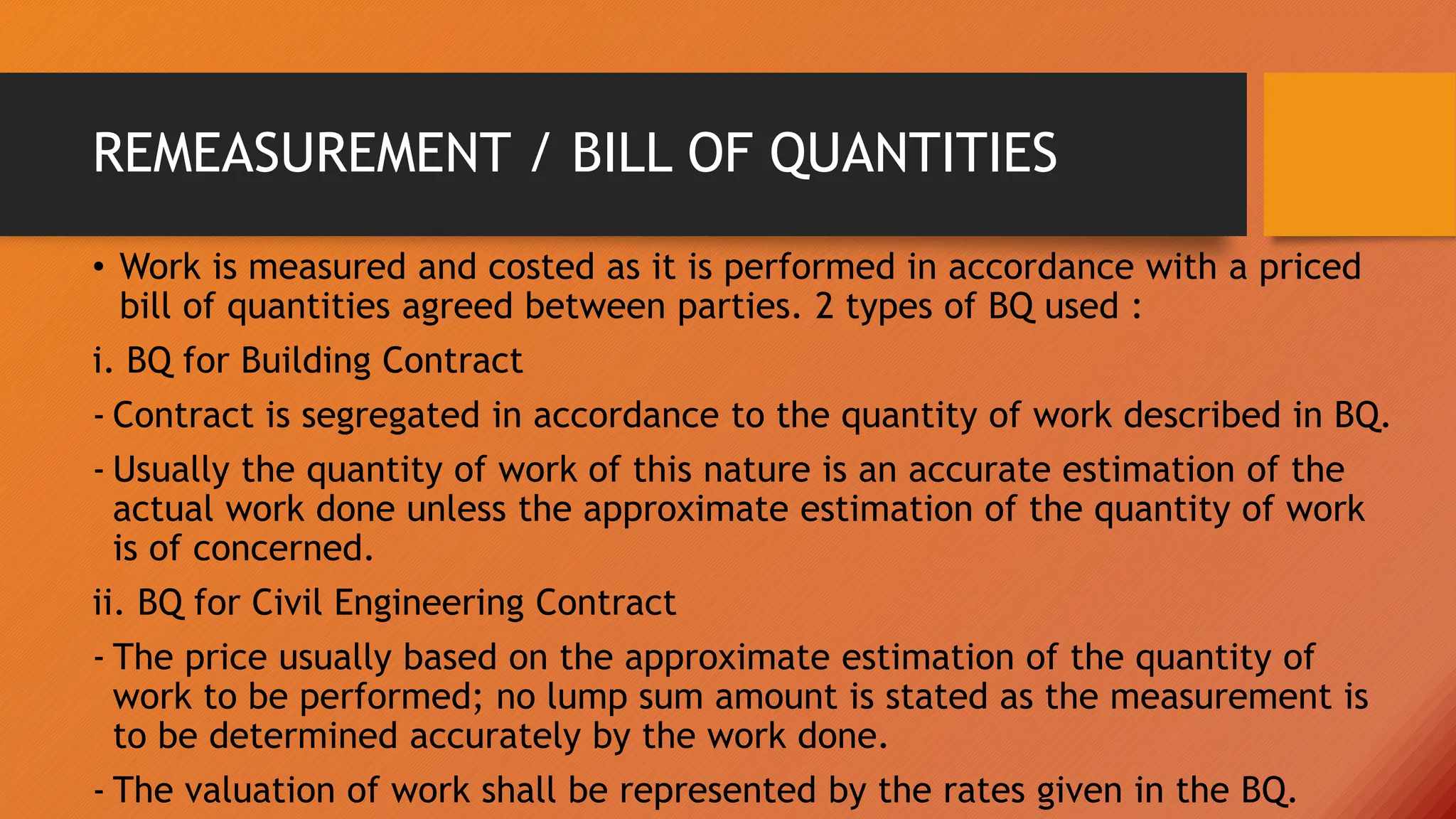
• Work is measured and costed as it is performed in accordance with a priced
bill of quantities agreed between parties. 2 types of BQ used :
i. BQ for Building Contract
- Contract is segregated in accordance to the quantity of work described in BQ.
- Usually the quantity of work of this nature is an accurate estimation of the
actual work done unless the approximate estimation of the quantity of work
is of concerned.
ii. BQ for Civil Engineering Contract
- The price usually based on the approximate estimation of the quantity of
work to be performed; no lump sum amount is stated as the measurement is
to be determined accurately by the work done.
- The valuation of work shall be represented by the rates given in the BQ.
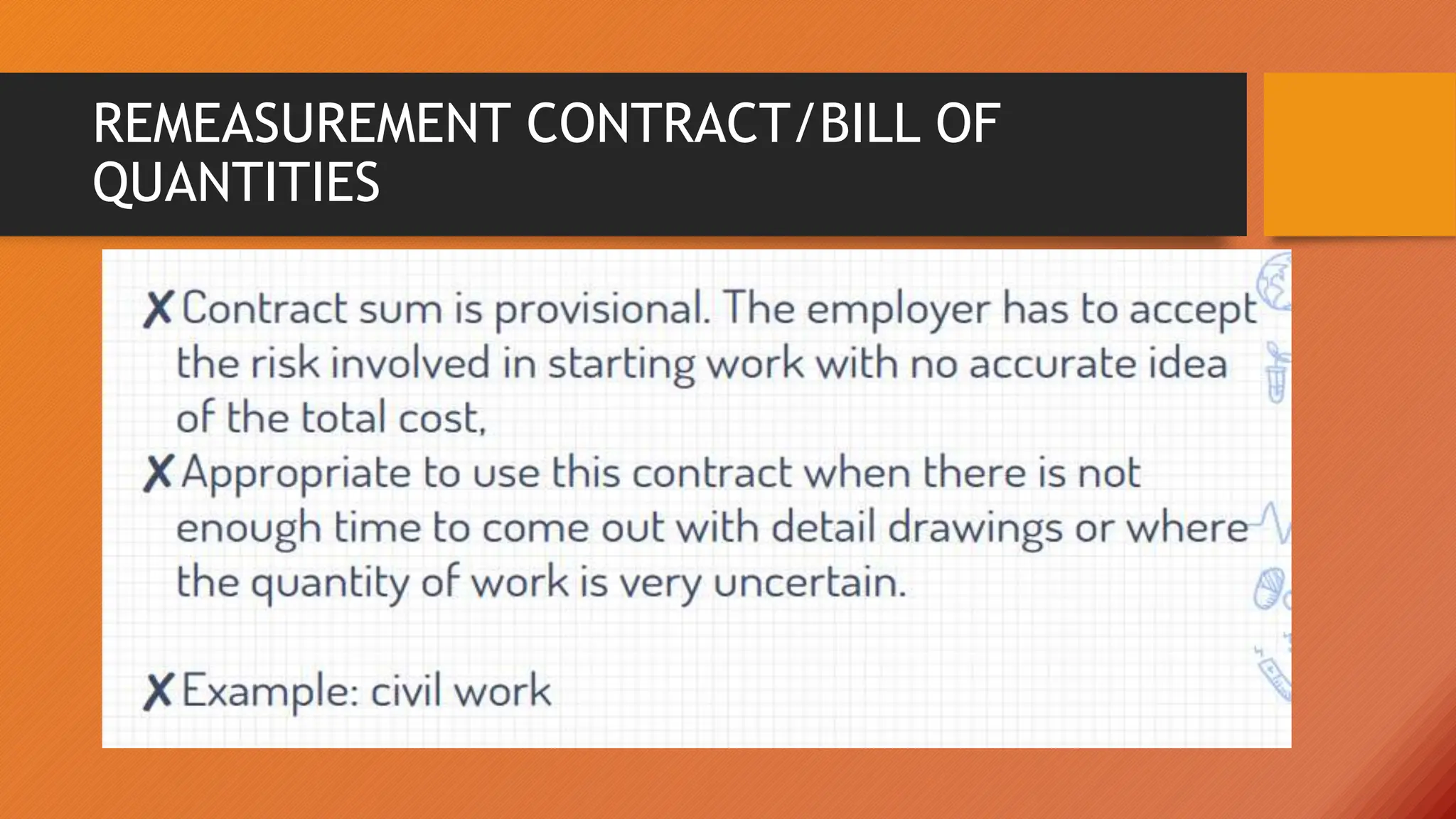
REMEASUREMENT CONTRACT/BILL OF
QUANTITIES
REMEASUREMENT CONTRACT/BILL OF
QUANTITIES
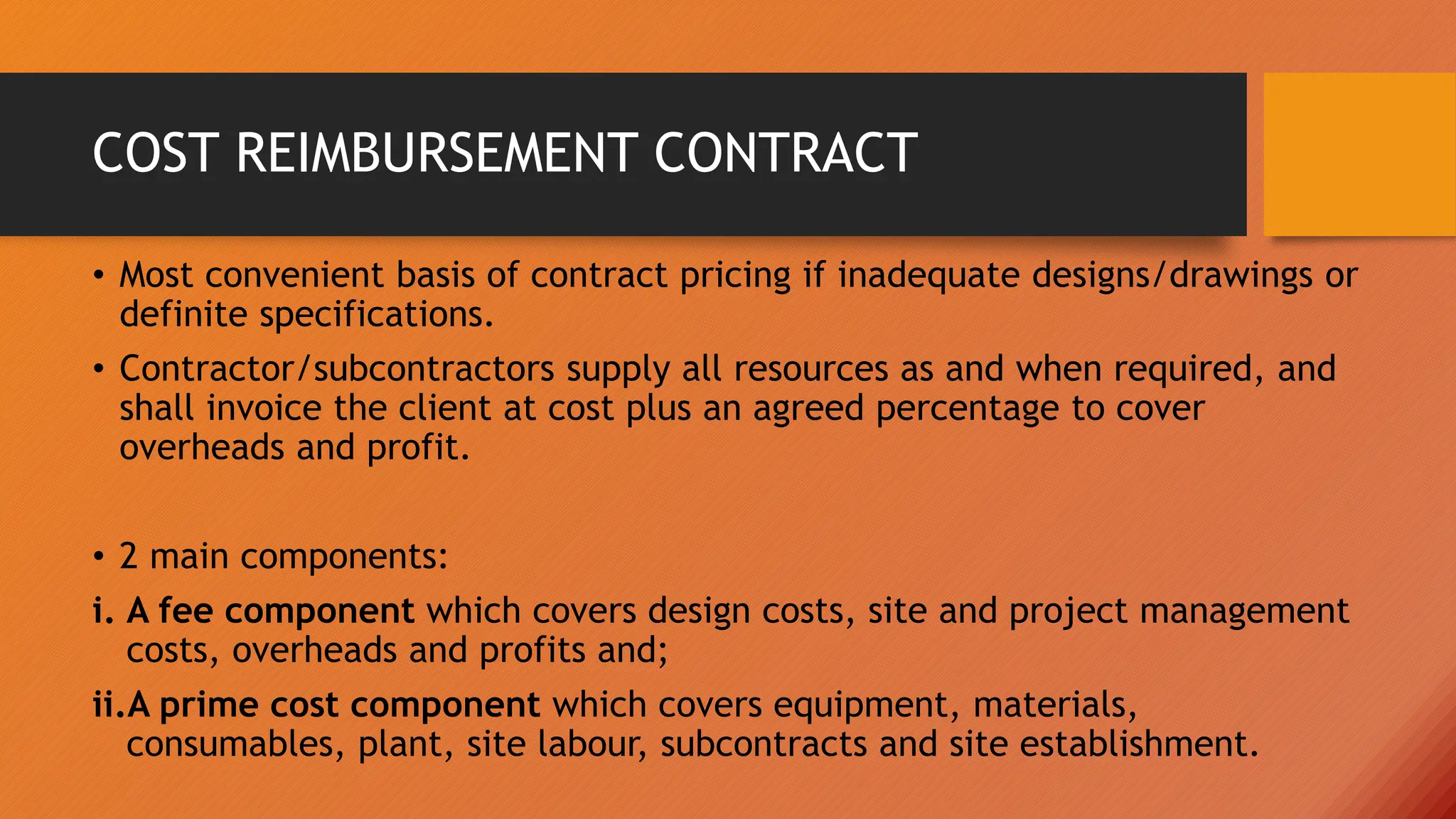
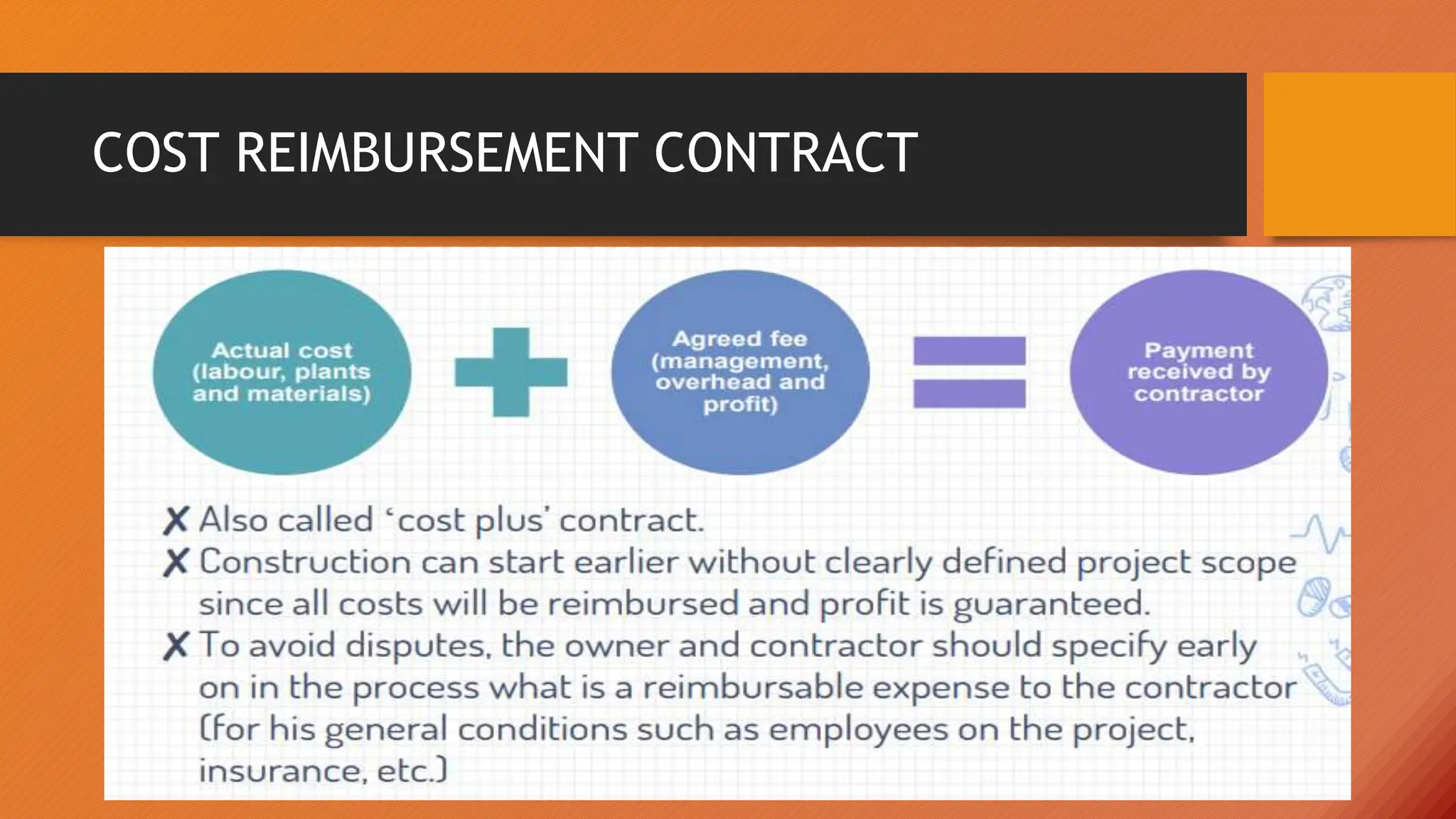
COST REIMBURSEMENT CONTRACT
• Most convenient basis of contract pricing if inadequate designs/drawings or
definite specifications.
• Contractor/subcontractors supply all resources as and when required, and
shall invoice the client at cost plus an agreed percentage to cover
overheads and profit.
• 2 main components:
i. A fee component which covers design costs, site and project management
costs, overheads and profits and;
ii.A prime cost component which covers equipment, materials,
consumables, plant, site labour, subcontracts and site establishment.
COST REIMBURSEMENT CONTRACT
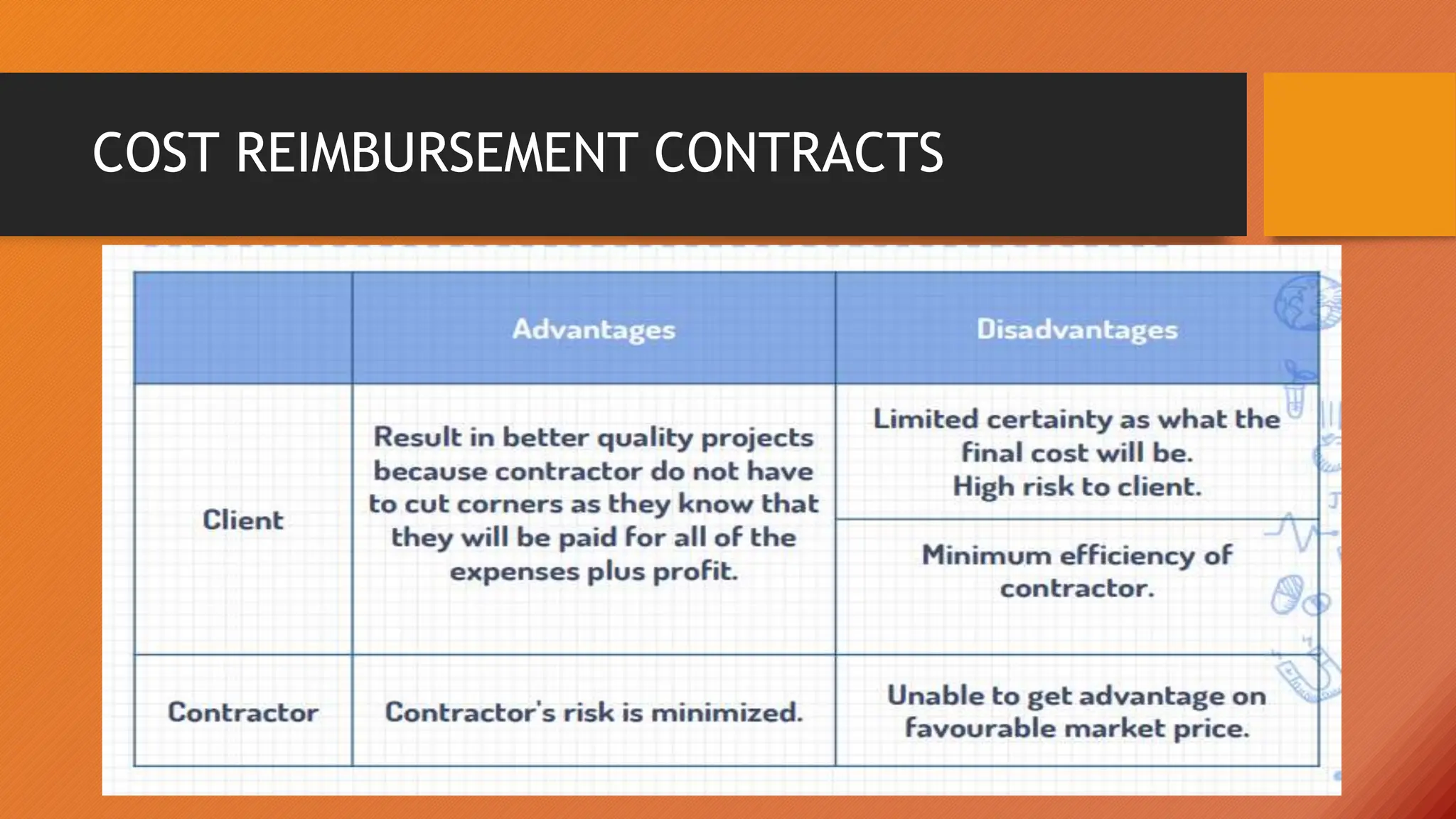
COST REIMBURSEMENT CONTRACTS
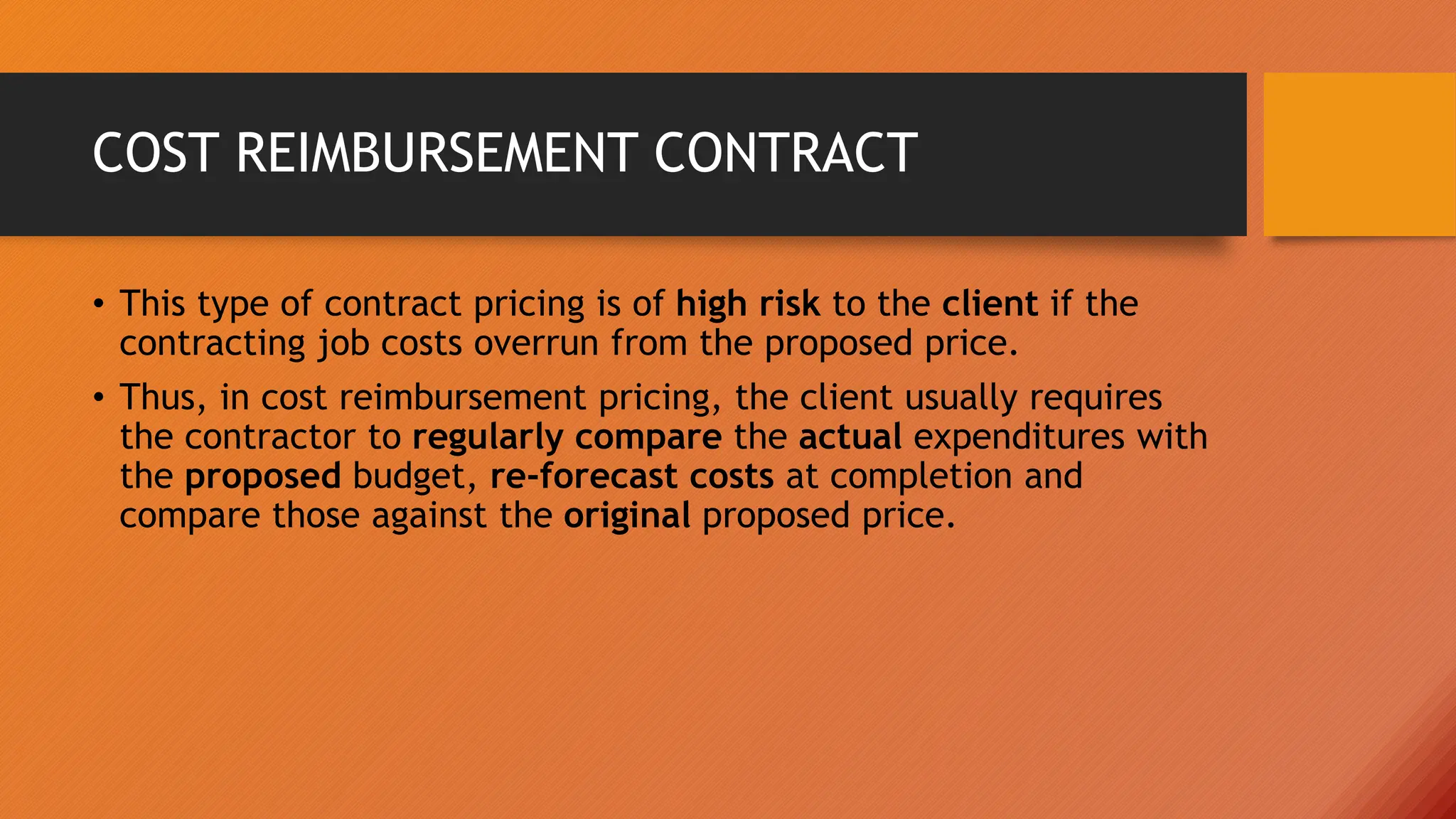
COST REIMBURSEMENT CONTRACT
• This type of contract pricing is of high risk to the client if the
contracting job costs overrun from the proposed price.
• Thus, in cost reimbursement pricing, the client usually requires
the contractor to regularly compare the actual expenditures with
the proposed budget, re-forecast costs at completion and
compare those against the original proposed price.
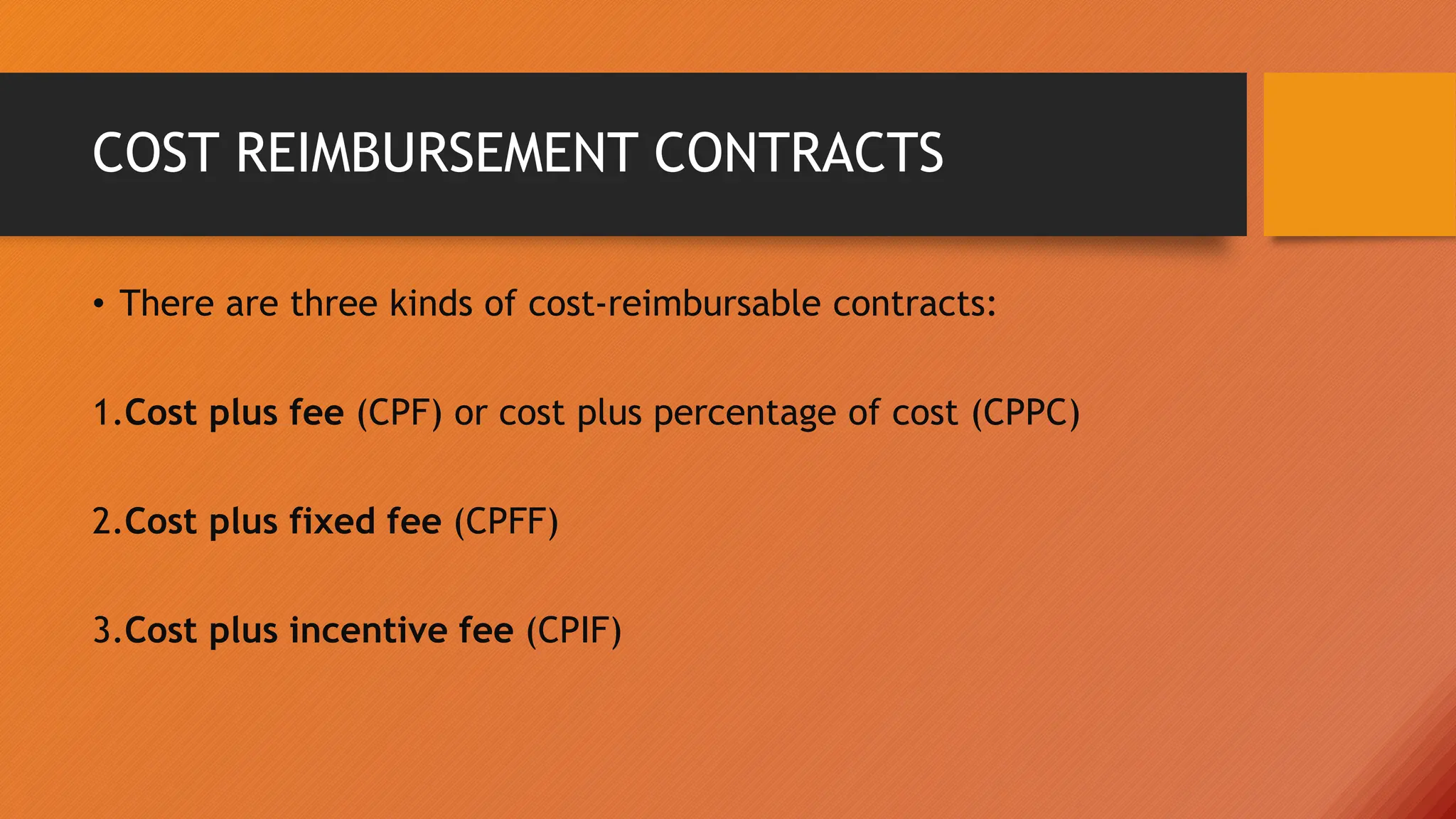
COST REIMBURSEMENT CONTRACTS
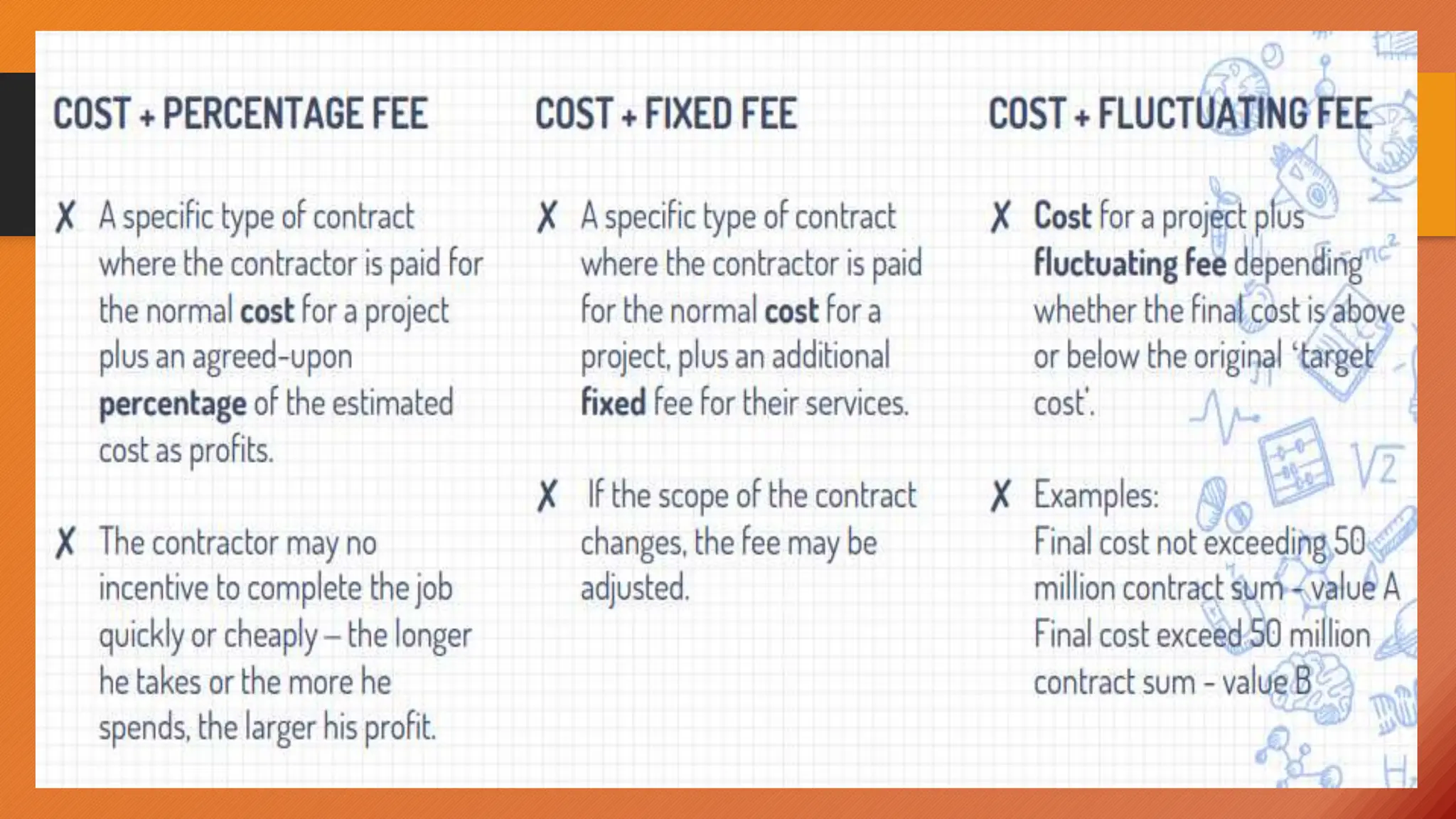
• There are three kinds of cost-reimbursable contracts:
1.Cost plus fee (CPF) or cost plus percentage of cost (CPPC)
2.Cost plus fixed fee (CPFF)
3.Cost plus incentive fee (CPIF)
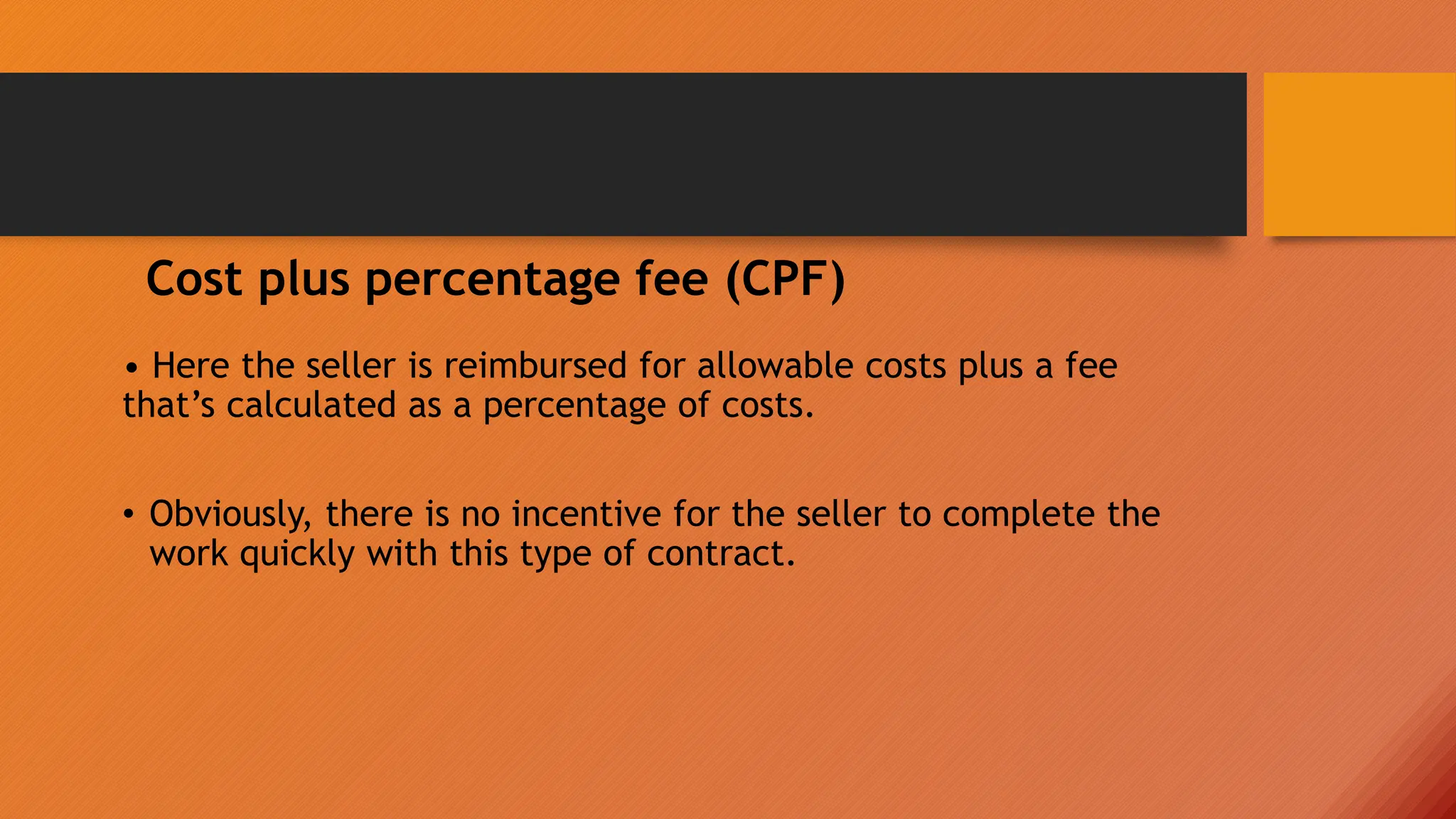
• Here the seller is reimbursed for allowable costs plus a fee
that’s calculated as a percentage of costs.
• Obviously, there is no incentive for the seller to complete the
work quickly with this type of contract.
Cost plus percentage fee (CPF)
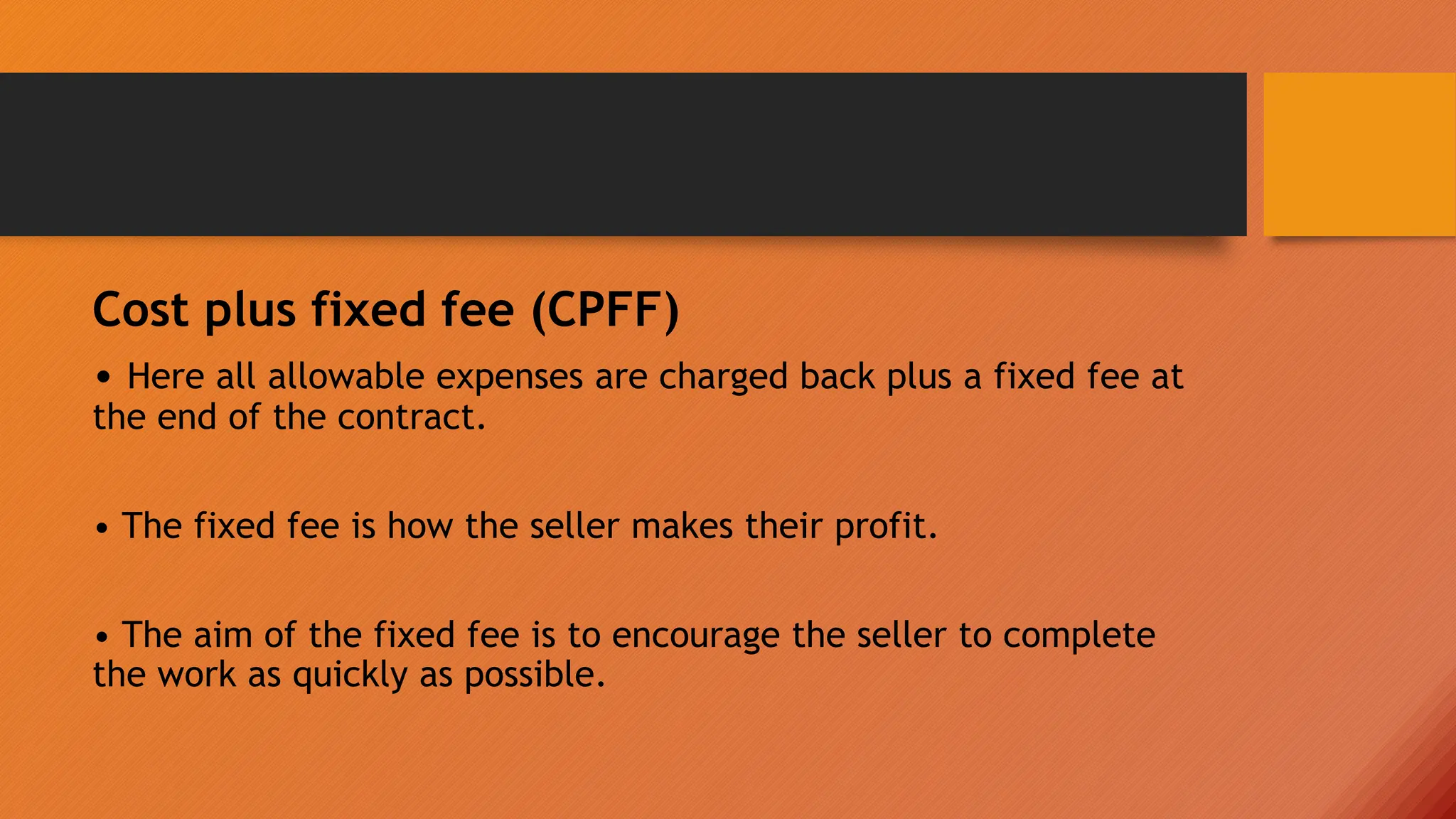
Cost plus fixed fee (CPFF)
• Here all allowable expenses are charged back plus a fixed fee at
the end of the contract.
• The fixed fee is how the seller makes their profit.
• The aim of the fixed fee is to encourage the seller to complete
the work as quickly as possible.
Cost plus incentive fee (CPIF)
• Here all allowable expenses are charged back and in addition an
incentive fee for exceeding the performance criteria specified in
the contract.
• The incentive fee is designed to encourage increased cost
performance by the seller. There is the potential of both buyer and
seller saving if the performance criteria is exceeded.
TERMS OF PAYMENT
• The best benefit to offer the tenderers who bid for the project is a term of
payment that is able to achieve both the commercial and technical results while
still able to provide the client with reasonable contractual safeguards. The
approach provides numerous benefits to the client such as :
a. Able to offer the project not to only to larger firm whose overheads and prices
are likely to be higher but also to the smaller but competent companies as well;
b.Tenderers who bid the project do not have to inflate their tender prices due to
financing charges as a result of having to pay the interest from having to take out
a loan for the project;
c.Enable the companies who possess technical expertise but lack liquid cash to also
bid along with other companies
d.Minimise the risk of having to straddle with the contractor who has insufficient
cash to carry out the project to completion phase and will save both parties
from terminating the contract before the project is completed.
TERMS OF PAYMENT
• In addition , not all payments can be tendered for lump sum basis due to prevalent
uncertainties especially when assessing the quantity of work that needs to have the
approximate valuation in their bill of quantities. It is more reasonable to pay them
on monthly basis for the value of work that already has been completed. It is also
good practice to tie the payment with the completion of certain milestones which
can be identified from the work program.
• However, to offer the terms of payment of such kind will also bring few
disadvantages to the client such as :
a.Client has to finance the work in progress which in a way might hold up their capital
for the respective short-term period;
b.Paying by term might encourage incompetent small contractors who do not possess
technical competencies to undertake the work that offers low price;
c.Monthly payment especially under remeasurement contract may have the tendency
to be over-measured during the early months of the contract.
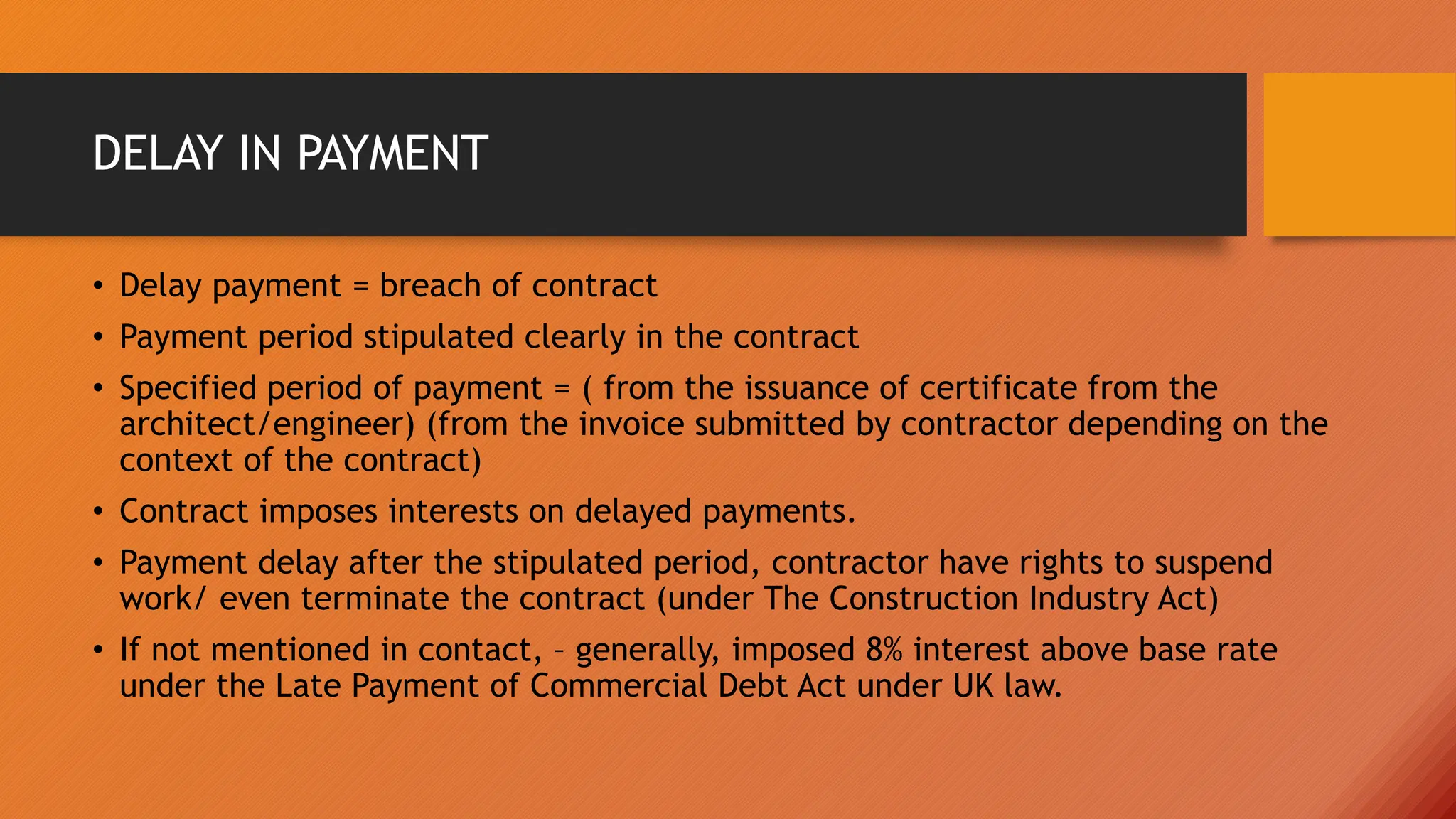
DELAY IN PAYMENT
• Delay payment = breach of contract
• Payment period stipulated clearly in the contract
• Specified period of payment = ( from the issuance of certificate from the
architect/engineer) (from the invoice submitted by contractor depending on the
context of the contract)
• Contract imposes interests on delayed payments.
• Payment delay after the stipulated period, contractor have rights to suspend
work/ even terminate the contract (under The Construction Industry Act)
• If not mentioned in contact, – generally, imposed 8% interest above base rate
under the Late Payment of Commercial Debt Act under UK law.
ADVANCE PAYMENT, PROGRESS PAYMENT AND
RETENTION MONEY
ADVANCE PAYMENT
-In general, payment cannot be made in advance
- but the practice is in the form of various types of bond
PROGRESS PAYMENTS DURING MANUFACTURE
- Stated in the contract that the plant, in accordance to the payments made, will
become the property of the purchaser accordingly.
- The manufacturer shall bear the risk up to completion phase and has been approved
and accepted by the purchaser.
RETENTION MONEY
- Under contract, client withhold 10%-20% from the contract price until work fully
completed and accepted by purchaser.
- Will be released in portion during defect liability period as security .
THANK YOU

Contract Management - Contracts Types and Payment Structure

  • 1.
  • 2.
    TYPES OF CONTRACTSTRUCTURE • CONVENTIONAL / TRADITIONAL CONTRACT • TURNKEY CONTRACT • DESIGN AND BUILD CONTRACT • CONSTRUCTION MANAGEMENT AND MANAGEMENT CONTRACTING • GUARANTEED MAXIMUM PRICE
  • 3.
    CONVENTIONAL/TRADITIONAL CONTRACT • Majorresponsibilities to architect/engineer • Client’s roles : Planning and designing phases of project, monitoring and supervision by PM or independent consultant • Contractor selected by tendering process
  • 4.
    CONVENTIONAL/TRADITIONAL CONTRACT • Underthis contract, the design responsibility primarily falls on the architect or engineer employed by the client and the contractor. • In the Malaysian context, the client’s organisation usually does all the planning and designing phases of a project. The construction phase of the project is done by the contractor who is selected and appointed through the tender process. • The Client’s organisation may carry out monitoring and supervision of the project through the appointed project manager or may engage an independent consultant to carry out monitoring of the project.
  • 5.
    TURNKEY CONTRACT - Contractoremployed by client shall take major responsibilities in design, procurement, construction and commissioning of entire works including the management of project. - Also known as Engineering, Procurement and Construction (EPC). Commonly adopted for the design and construction under Private Finance Initiative. - Similar to Design and Build - Used for government big project and clients roles limited to inspection, payment and performance target. - In Malaysia, normally JKR will provide the standards guidelines for writing the need statement, format, requirements for contractor’s proposal , contract sum analysis and other related contractual terms for turnkey project.
  • 6.
  • 7.
    DESIGN AND BUILDCONTRACT • Design and Build Contract similar to turnkey contract. Client usually retain an agent (architect/engineer) who can monitor and protect its interest.
  • 8.
    CONSTRUCTION MANAGEMENT AND MANAGEMENTCONTRACTING • Under this contract structure, the subcontractors shall execute all the construction works while the contractor is the one who manages the entire project processes. • Construction management – The subcontractors are contractually responsible to the client and the project is usually manage by the construction manager. • Management contracting – The subcontractor is employed by the management contractor. The success rely by the skills and experiences of the personnel involved. • Other features similar to D&B contract
  • 9.
  • 11.
  • 13.
    GUARANTEED MAXIMUM PRICECONTRACT • Combination of construction mgmt. and D&B contract. • The contractor/construction manager agrees to perform work within a price ceiling. Contractor guarantees a max price for the work to be completed according to the design. • Contractor responsible for the design and tendering phases. • Contractor fees for overhead and profit are contractually decided and agreed upon once appointed by client. • The price will not change except there is authorised modification. • If the ceiling is exceeded, without change in scope, then the excess cost is borne by the contractor. • If the work is accomplished under the ceiling then the owner pays no more than the actual cost and the profit is shared between the contractor and the owner. • This method gives greater flexibility to the owner.
  • 14.
    FACTORS DETERMINING THEADOPTION OF CONTRACT STRUCTURE • PROJECT COMPLEXITY • SPEED OF THE PROJECT • CLIENT’S EXPERIENCE • CONTRACT SUBJECT TO LOCAL REGULATIONS • LIKELIHOOD OF PROJECT CHANGES • NATURE OF THE PROJECT • ALLOCATION OF RISKS
  • 15.
    1. PROJECT COMPLEXITY •The design of the building is complex and have high engineering content. Complexity interrelated with issues such as expert and skills of consultant, duration and cost of the project. • More complex – more tedious – more difficult to handle the cost and longer duration of project. • For example, the lump-sum type of contract, is popular for the reason that the total cost of the project is known in advance. But if the project is too complicated, it is not possible to accurately determine the nature and quantity of the work prior to the start of site activities, then lump sum type of contract pricing is not suitable.
  • 16.
    2. SPEED OFTHE PROJECT (Start to Completion) • The need to complete the project on time or earlier is a crucial issue for projects especially those involving high traffic congestion or for low cost projects where timing and costing are major challenges. • The right choice of contract structure is crucial to ensure the success of the project.
  • 17.
    3. CLIENT’S EXPERIENCES •The bigger or more experienced clients have their own preferred protocols which involves specific choice of contract form. The credibility and commitment of the client has always been an added value in project, thus client must be aware that the contract structure has to fit well with the nature of project. • For example, the client prefers competitive bidding to be able to compare and choose the most suitable tender. • The choice of contract form would therefore depend on the client’s experience.
  • 18.
    4. CONTRACT SUBJECTTO LOCAL REGULATIONS • For international projects, legal conditions must be synchronised, the commercial terms must be agreed on and the risk must be apportioned. • Project will involve various legal systems and global organisation has to deal with different practices in different countries, thus project team need to select the right strategy of contract structure for the global project.
  • 19.
    5. LIKELIHOOD OFPROJECT CHANGES • Some contractors/clients will allow the changes of the design when construction stage start but some will not allow and every design must follow the tender, and these two required different contract form. • Each project is susceptible to change because of the complexities which are unique to each project. The level of changes projection in a project is to influence the type of contract structure selected.
  • 20.
    6. NATURE OFTHE PROJECT • Different types of project will affect the choice of contract form. • For example, the project can be build a new building, extension of building, renovation works, industrial building and more. • Different projects have different requirements therefore required different type of contract form.
  • 21.
    7. ALLOCATION OFRISK • All sorts of risks arising from both the internal and external environment of a project or organization and affecting the project performance, • In terms of successful delivery of project on of time, within budget and of the specified performance. • Important to know how much risk is shared in the project and how much risk is allocated to the contractor and client.
  • 22.
    CONTRACT PRICING Contract Pricingconsists of 3 types: a.Lump Sum or Fixed Price b.Re measurement or Bill of Quantities c.Cost Reimbursement - Possible to combine more than 1 type of pricing within a project. - Pricing depend on information given to the contractor during tendering phase, the level of risk involved and the conditions under which the work will be carried out. - The nature of contract structure also plays important role in determining the pricing basis.
  • 23.
    LUMP SUM ,MEASUREMENT & COST REIMBURSEMENT CONTRACT • Lump sum contracts — where the contract sum is determined before construction work is started. • Measurement contracts — where the contract sum is assessed on re-measurement to a previously agreed basis. • Cost reimbursement contracts — where the contract sum is set based on the prime costs (of labour, plant and materials) plus an agreed amount for overheads and profit.
  • 24.
    LUMP SUM BASIS(FIXED PRICE CONTRACT) • Client-contractor agree on a price for the proposed work. Price remains fixed unless both agree to any changes. • Less risks to client (buyer) as they will no pay any extra cost incurred. Contractor (seller) has to be very accurate in computing the cost estimates and to include sufficient contingency cost. Bigger risk is borne by contractor. • Suit to low risk and well defined projects. • High commitment needed in advance and reduces the amount of administrative work after contract is in effect.
  • 25.
  • 26.
    REMEASUREMENT / BILLOF QUANTITIES • Work is measured and costed as it is performed in accordance with a priced bill of quantities agreed between parties. 2 types of BQ used : i. BQ for Building Contract - Contract is segregated in accordance to the quantity of work described in BQ. - Usually the quantity of work of this nature is an accurate estimation of the actual work done unless the approximate estimation of the quantity of work is of concerned. ii. BQ for Civil Engineering Contract - The price usually based on the approximate estimation of the quantity of work to be performed; no lump sum amount is stated as the measurement is to be determined accurately by the work done. - The valuation of work shall be represented by the rates given in the BQ.
  • 27.
  • 28.
  • 29.
    COST REIMBURSEMENT CONTRACT •Most convenient basis of contract pricing if inadequate designs/drawings or definite specifications. • Contractor/subcontractors supply all resources as and when required, and shall invoice the client at cost plus an agreed percentage to cover overheads and profit. • 2 main components: i. A fee component which covers design costs, site and project management costs, overheads and profits and; ii.A prime cost component which covers equipment, materials, consumables, plant, site labour, subcontracts and site establishment.
  • 30.
  • 31.
  • 32.
    COST REIMBURSEMENT CONTRACT •This type of contract pricing is of high risk to the client if the contracting job costs overrun from the proposed price. • Thus, in cost reimbursement pricing, the client usually requires the contractor to regularly compare the actual expenditures with the proposed budget, re-forecast costs at completion and compare those against the original proposed price.
  • 33.
    COST REIMBURSEMENT CONTRACTS •There are three kinds of cost-reimbursable contracts: 1.Cost plus fee (CPF) or cost plus percentage of cost (CPPC) 2.Cost plus fixed fee (CPFF) 3.Cost plus incentive fee (CPIF)
  • 35.
    • Here theseller is reimbursed for allowable costs plus a fee that’s calculated as a percentage of costs. • Obviously, there is no incentive for the seller to complete the work quickly with this type of contract. Cost plus percentage fee (CPF)
  • 36.
    Cost plus fixedfee (CPFF) • Here all allowable expenses are charged back plus a fixed fee at the end of the contract. • The fixed fee is how the seller makes their profit. • The aim of the fixed fee is to encourage the seller to complete the work as quickly as possible.
  • 37.
    Cost plus incentivefee (CPIF) • Here all allowable expenses are charged back and in addition an incentive fee for exceeding the performance criteria specified in the contract. • The incentive fee is designed to encourage increased cost performance by the seller. There is the potential of both buyer and seller saving if the performance criteria is exceeded.
  • 38.
    TERMS OF PAYMENT •The best benefit to offer the tenderers who bid for the project is a term of payment that is able to achieve both the commercial and technical results while still able to provide the client with reasonable contractual safeguards. The approach provides numerous benefits to the client such as : a. Able to offer the project not to only to larger firm whose overheads and prices are likely to be higher but also to the smaller but competent companies as well; b.Tenderers who bid the project do not have to inflate their tender prices due to financing charges as a result of having to pay the interest from having to take out a loan for the project; c.Enable the companies who possess technical expertise but lack liquid cash to also bid along with other companies d.Minimise the risk of having to straddle with the contractor who has insufficient cash to carry out the project to completion phase and will save both parties from terminating the contract before the project is completed.
  • 39.
    TERMS OF PAYMENT •In addition , not all payments can be tendered for lump sum basis due to prevalent uncertainties especially when assessing the quantity of work that needs to have the approximate valuation in their bill of quantities. It is more reasonable to pay them on monthly basis for the value of work that already has been completed. It is also good practice to tie the payment with the completion of certain milestones which can be identified from the work program. • However, to offer the terms of payment of such kind will also bring few disadvantages to the client such as : a.Client has to finance the work in progress which in a way might hold up their capital for the respective short-term period; b.Paying by term might encourage incompetent small contractors who do not possess technical competencies to undertake the work that offers low price; c.Monthly payment especially under remeasurement contract may have the tendency to be over-measured during the early months of the contract.
  • 40.
    DELAY IN PAYMENT •Delay payment = breach of contract • Payment period stipulated clearly in the contract • Specified period of payment = ( from the issuance of certificate from the architect/engineer) (from the invoice submitted by contractor depending on the context of the contract) • Contract imposes interests on delayed payments. • Payment delay after the stipulated period, contractor have rights to suspend work/ even terminate the contract (under The Construction Industry Act) • If not mentioned in contact, – generally, imposed 8% interest above base rate under the Late Payment of Commercial Debt Act under UK law.
  • 41.
    ADVANCE PAYMENT, PROGRESSPAYMENT AND RETENTION MONEY ADVANCE PAYMENT -In general, payment cannot be made in advance - but the practice is in the form of various types of bond PROGRESS PAYMENTS DURING MANUFACTURE - Stated in the contract that the plant, in accordance to the payments made, will become the property of the purchaser accordingly. - The manufacturer shall bear the risk up to completion phase and has been approved and accepted by the purchaser. RETENTION MONEY - Under contract, client withhold 10%-20% from the contract price until work fully completed and accepted by purchaser. - Will be released in portion during defect liability period as security .
  • 42.

Editor's Notes

  • #14 Guaranteed Max Price – combination of construction management and design and build contract. The contractor or construction manager guarantees a max price for the work to be completed according to the design. The price will not change except when there is authorised modification. Contractor responsible for the design and tendering phases. Contractor fees for overhead and profit are contractually decided and agreed upon once appointed by client.
  • #25 Fixed Price or Lump Sum Contracts • In this type of contract a specific price is agreed for the good or service being sold. In project terms, the buyer and seller will agree on a well-defined deliverable for a specific price. • In this type of contract the bigger risk is borne by the seller. They must make sure they make a profit even given some unknowns such as increasing costs or delays in creation of the deliverable. Fixed price contracts can be catastrophic for both buyer and seller if there isn’t a well defined deliverable. • Firstly, often the sellers profit is eroded as they compromise to meet the buyer’s demands. • Secondly, the buyer may have to pay more for change requests when the supplier is no longer willing to compromise around what, in their eyes, appear to be changing requirements. Another type of contract you might encounter is the fixed-price plus incentive contract. • Here the contract includes an incentive or bonus, typically for the early or on-time completion of the deliverable
  • #27 REMEASUREMENT / BILL OF QUANTITIES Work is measured and costed as it is performed in accordance with a priced bill of quantities agreed between parties. 2 types of BQ used : BQ for Building Contract BQ for Civil Engineering Contract Contract is segregated in accordance to the quantity of work described in BQ. Usually the quantity of work of this nature is an acuurate estimation of the actual work done unless the approximate estimation of the quantity of work is of concerned. The price usually based on the approximate estimation of the quantity of work to be performed; no lump sum amount is stated as the measurement is to be determined accurately by the work done. The valuation of work shall be represented by the rates given in the BQ.
  • #30 -Most convenient basis of contract pricing if inadequate designs/drawings or definite specifications. Contractor/subcontractors supply all resources as and when required, and shall invoice the client at cost plus an agreed percentage to cover overheads and profit. 2 main components: A fee component which covers design costs, site and project management costs, overheads and profits and; A prime cost component which covers equipment, materials, consumables, plant, site labour, subcontracts and site establishment.
  • #31 Cost-Reimbursable Contracts • In this type of contract all the costs that the seller incurs during the project are charged back to the buyer, and thus the seller is reimbursed costs. The costs which are allowable will be defined in the contract. • In this type of contract more risk is carried by the buyer as the final cost is uncertain. If problems arise during the execution of the project then the buyer will have to spend more. The advantage of this type of contract to the buyer is that obviously scope changes can be easily made to the work being done. • One problem with this type of contract is that the seller has very little incentive to be efficient and productive and complete the work quickly. • It should come as no surprise that this type of contract is most often used when there is a lot of uncertainty associated with the final deliverable.
  • #40 d. Minimise the risk of having to straddle with the contractor who has insufficient cash to carry out the project u to completion phase and will save both parties from terminating the contract before the project is completed. In addition , not all payments can be tendered for lump sum basis due to prevalent uncertainties especially when assessing the quantity of work that needs to have the approximate valuation in their bill of quantities. It is more reasonable to pay them on monthly basis for the value of work that already has been completed. It is also good practice to tie the payment with the completion of certain milestones which can be identified from the work program. However, to offer the terms of payment of such kind will also bring few disadvantages to the client such as : Client has to finance the work in progress which in a way might hold up their capital for the respective short-term period; Paying by term might encourage incompetent small contractors who do not possess technical competencies to undertake the work that offers low price; Monthly payment especially under remeasurement contract may have the tendency to be over-measured during the early months of the contract.