Sourav Sarkar
Assistant Professor
Department of ECE
Tunnel Diode
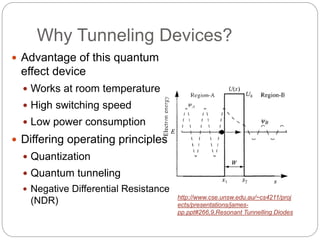
Why Tunneling Devices?
 Advantage of this quantum
effect device
 Works at room temperature
 High switching speed
 Low power consumption
 Differing operating principles
 Quantization
 Quantum tunneling
 Negative Differential Resistance
(NDR) http://www.cse.unsw.edu.au/~cs4211/proj
ects/presentations/james-
pp.ppt#266,9,Resonant Tunnelling Diodes
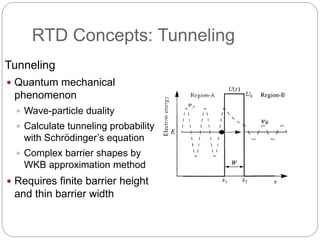
RTD Concepts: Tunneling
 Tunneling
 Quantum mechanical
phenomenon
 Wave-particle duality
 Calculate tunneling probability
with Schrödinger’s equation
 Complex barrier shapes by
WKB approximation method
 Requires finite barrier height
and thin barrier width
Obligatory Moore’s Law Referencehuman brain in 2012?
 As mentioned earlier, heavily-doped, abrupt
junctions are needed
 Can be obtained using several different
methods
◦ Ion implantation
◦ Rapid thermal diffusion
◦ Molecular beam epitaxy
◦ Laser diffusion
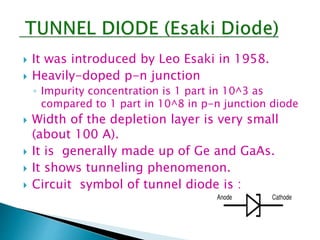
 It was introduced by Leo Esaki in 1958.
 Heavily-doped p-n junction
◦ Impurity concentration is 1 part in 10^3 as
compared to 1 part in 10^8 in p-n junction diode
 Width of the depletion layer is very small
(about 100 A).
 It is generally made up of Ge and GaAs.
 It shows tunneling phenomenon.
 Circuit symbol of tunnel diode is :
EV
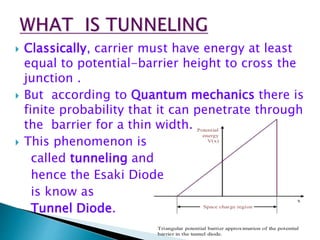
 Classically, carrier must have energy at least
equal to potential-barrier height to cross the
junction .
 But according to Quantum mechanics there is
finite probability that it can penetrate through
the barrier for a thin width.
 This phenomenon is
called tunneling and
hence the Esaki Diode
is know as
Tunnel Diode.
 Lower sub-threshold swing can allow for
lower operating voltages to be used
 Negative differential resistance (NDR)
properties can be exploited to create simpler
designs for bi-stable circuits, differential
comparators, oscillators, etc.
 Leads to chips that consume less power
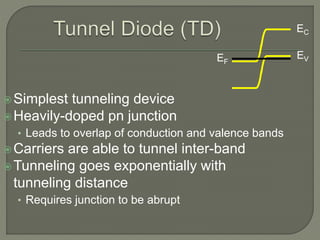
Simplest tunneling device
Heavily-doped pn junction
• Leads to overlap of conduction and valence bands
Carriers are able to tunnel inter-band
Tunneling goes exponentially with
tunneling distance
• Requires junction to be abrupt
EC
EVEF
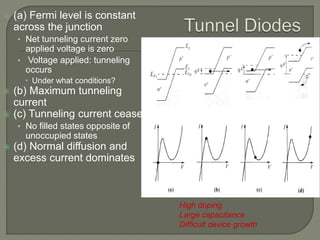
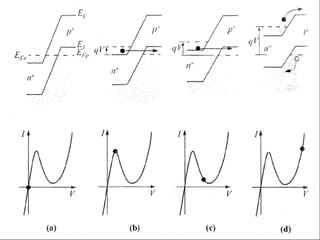
 (a) Fermi level is constant
across the junction
• Net tunneling current zero
applied voltage is zero
• Voltage applied: tunneling
occurs
 Under what conditions?
 (b) Maximum tunneling
current
 (c) Tunneling current ceases
• No filled states opposite of
unoccupied states
 (d) Normal diffusion and
excess current dominates
High doping
Large capacitance
Difficult device growth
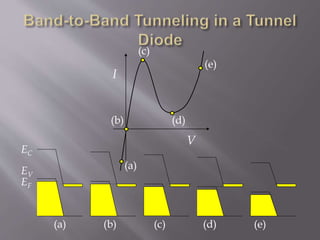
EC
EV
EF
I
V
(a)
(b)
(c)
(d)
(e)
(a) (b) (c) (d) (e)
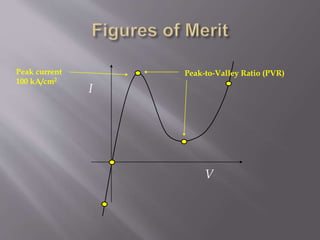
I
V
Peak current
100 kA/cm2
Peak-to-Valley Ratio (PVR)
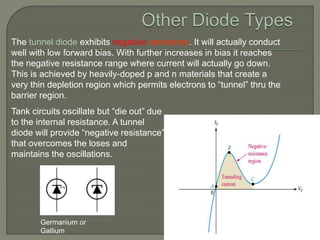
The tunnel diode exhibits negative resistance. It will actually conduct
well with low forward bias. With further increases in bias it reaches
the negative resistance range where current will actually go down.
This is achieved by heavily-doped p and n materials that create a
very thin depletion region which permits electrons to “tunnel” thru the
barrier region.
Germanium or
Gallium
Tank circuits oscillate but “die out” due
to the internal resistance. A tunnel
diode will provide “negative resistance”
that overcomes the loses and
maintains the oscillations.
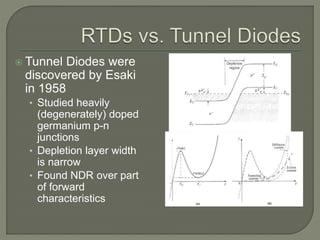
 Tunnel Diodes were
discovered by Esaki
in 1958
• Studied heavily
(degenerately) doped
germanium p-n
junctions
• Depletion layer width
is narrow
• Found NDR over part
of forward
characteristics
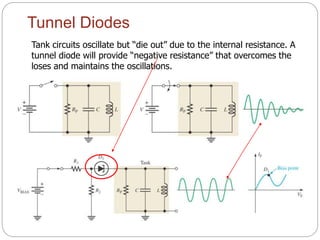
Tunnel Diodes
Tank circuits oscillate but “die out” due to the internal resistance. A
tunnel diode will provide “negative resistance” that overcomes the
loses and maintains the oscillations.
Summary
 HFETs use heterostructures to separate doped
region from the electron channel
 Adds flexibility and design based on doping and
material variations in various layers that
controls the flow and distribution of charge
carriers
 Scattering effects are reduced especially at low
temperatures resulting in high mobilities, high
gm, and high fT operating at low power
 Typical materials being used include
GaAs/AlGaAs InGaAs/AlGaAs and AlGaN/GaN
Diode Transient /switching
The diodes are used as switches in many
applications. Of prime concern is the speed
at which the pn junction diode can be made
to switch from “off” to “on” state and vice
versa.
20
• Diodes can be used as switching devices
• Need to change from conducting to non-conducting
at high speed
• Storage time or turn-off transients should be small
• Add recombination centers to reduce minority carrier
lifetimes
For example adding 1015cm–3 gold (Au) to Si reduces hole lifetime to
0.01 s from 1 s!
• Use narrow-base diodes
Amount of charge stored in the neutral region of the diode will be
small.
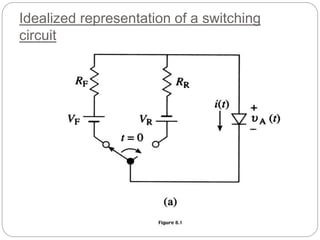
Idealized representation of a switching
circuit
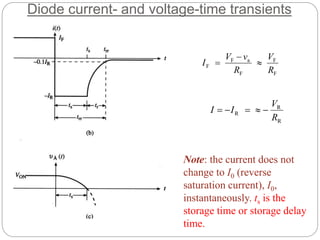
Diode current- and voltage-time transients
F
F
F
aF
F
R
V
R
vV
I 


R
R
R
R
V
II 
Note: the current does not
change to I0 (reverse
saturation current), I0,
instantaneously. ts is the
storage time or storage delay
time.
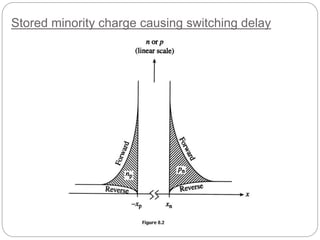
Stored minority charge causing switching delay
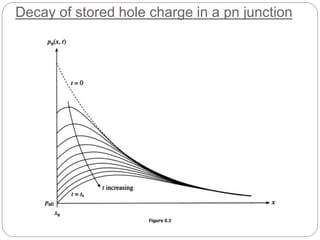
Decay of stored hole charge in a pn junction
erf(x) is known as error function and an approximate
solution for storage time can be obtained as
]1ln[
F
p0
F
F
p0
s
R
s
R
I
I
t
II
It
erf





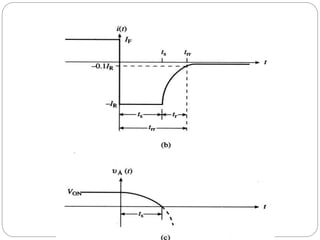
The recovery time t>ts is the time required for the junction
its steady state reverse condition. The reminder of the ex
is being removed and the space charge width is increasin
Bias value .
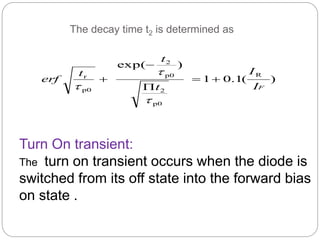
The decay time t2 is determined as
)(1.01
)exp(
R
p0
2
p0
2
p0
r
FI
I
t
t
t
erf 






Turn On transient:
The turn on transient occurs when the diode is
switched from its off state into the forward bias
on state .

Tunnel diode

  • 1.
  • 2.
    Why Tunneling Devices? Advantage of this quantum effect device  Works at room temperature  High switching speed  Low power consumption  Differing operating principles  Quantization  Quantum tunneling  Negative Differential Resistance (NDR) http://www.cse.unsw.edu.au/~cs4211/proj ects/presentations/james- pp.ppt#266,9,Resonant Tunnelling Diodes
  • 3.
    RTD Concepts: Tunneling Tunneling  Quantum mechanical phenomenon  Wave-particle duality  Calculate tunneling probability with Schrödinger’s equation  Complex barrier shapes by WKB approximation method  Requires finite barrier height and thin barrier width
  • 4.
    Obligatory Moore’s LawReferencehuman brain in 2012?
  • 5.
     As mentionedearlier, heavily-doped, abrupt junctions are needed  Can be obtained using several different methods ◦ Ion implantation ◦ Rapid thermal diffusion ◦ Molecular beam epitaxy ◦ Laser diffusion
  • 6.
     It wasintroduced by Leo Esaki in 1958.  Heavily-doped p-n junction ◦ Impurity concentration is 1 part in 10^3 as compared to 1 part in 10^8 in p-n junction diode  Width of the depletion layer is very small (about 100 A).  It is generally made up of Ge and GaAs.  It shows tunneling phenomenon.  Circuit symbol of tunnel diode is : EV
  • 7.
     Classically, carriermust have energy at least equal to potential-barrier height to cross the junction .  But according to Quantum mechanics there is finite probability that it can penetrate through the barrier for a thin width.  This phenomenon is called tunneling and hence the Esaki Diode is know as Tunnel Diode.
  • 8.
     Lower sub-thresholdswing can allow for lower operating voltages to be used  Negative differential resistance (NDR) properties can be exploited to create simpler designs for bi-stable circuits, differential comparators, oscillators, etc.  Leads to chips that consume less power
  • 9.
    Simplest tunneling device Heavily-dopedpn junction • Leads to overlap of conduction and valence bands Carriers are able to tunnel inter-band Tunneling goes exponentially with tunneling distance • Requires junction to be abrupt EC EVEF
  • 10.
     (a) Fermilevel is constant across the junction • Net tunneling current zero applied voltage is zero • Voltage applied: tunneling occurs  Under what conditions?  (b) Maximum tunneling current  (c) Tunneling current ceases • No filled states opposite of unoccupied states  (d) Normal diffusion and excess current dominates High doping Large capacitance Difficult device growth
  • 12.
  • 13.
  • 14.
    The tunnel diodeexhibits negative resistance. It will actually conduct well with low forward bias. With further increases in bias it reaches the negative resistance range where current will actually go down. This is achieved by heavily-doped p and n materials that create a very thin depletion region which permits electrons to “tunnel” thru the barrier region. Germanium or Gallium Tank circuits oscillate but “die out” due to the internal resistance. A tunnel diode will provide “negative resistance” that overcomes the loses and maintains the oscillations.
  • 15.
     Tunnel Diodeswere discovered by Esaki in 1958 • Studied heavily (degenerately) doped germanium p-n junctions • Depletion layer width is narrow • Found NDR over part of forward characteristics
  • 16.
    Tunnel Diodes Tank circuitsoscillate but “die out” due to the internal resistance. A tunnel diode will provide “negative resistance” that overcomes the loses and maintains the oscillations.
  • 17.
    Summary  HFETs useheterostructures to separate doped region from the electron channel  Adds flexibility and design based on doping and material variations in various layers that controls the flow and distribution of charge carriers  Scattering effects are reduced especially at low temperatures resulting in high mobilities, high gm, and high fT operating at low power  Typical materials being used include GaAs/AlGaAs InGaAs/AlGaAs and AlGaN/GaN
  • 18.
  • 19.
    The diodes areused as switches in many applications. Of prime concern is the speed at which the pn junction diode can be made to switch from “off” to “on” state and vice versa.
  • 20.
    20 • Diodes canbe used as switching devices • Need to change from conducting to non-conducting at high speed • Storage time or turn-off transients should be small • Add recombination centers to reduce minority carrier lifetimes For example adding 1015cm–3 gold (Au) to Si reduces hole lifetime to 0.01 s from 1 s! • Use narrow-base diodes Amount of charge stored in the neutral region of the diode will be small.
  • 21.
    Idealized representation ofa switching circuit
  • 22.
    Diode current- andvoltage-time transients F F F aF F R V R vV I    R R R R V II  Note: the current does not change to I0 (reverse saturation current), I0, instantaneously. ts is the storage time or storage delay time.
  • 23.
    Stored minority chargecausing switching delay
  • 24.
    Decay of storedhole charge in a pn junction
  • 26.
    erf(x) is knownas error function and an approximate solution for storage time can be obtained as ]1ln[ F p0 F F p0 s R s R I I t II It erf      The recovery time t>ts is the time required for the junction its steady state reverse condition. The reminder of the ex is being removed and the space charge width is increasin Bias value .
  • 27.
    The decay timet2 is determined as )(1.01 )exp( R p0 2 p0 2 p0 r FI I t t t erf        Turn On transient: The turn on transient occurs when the diode is switched from its off state into the forward bias on state .