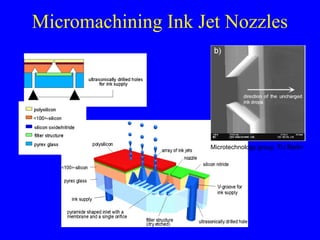
Micromachining Ink Jet Nozzles
Microtechnology group, TU Berlin
CNT Based Gas Sensor
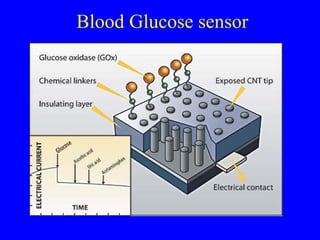
Blood Glucose sensor
Microfluidic Chips
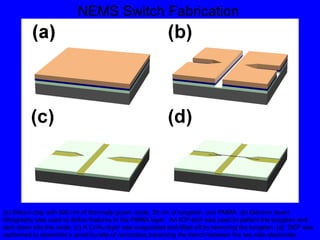
NEMS Switch Fabrication
(a) Silicon chip with 500 nm of thermally grown oxide, 20 nm of tungsten, and PMMA. (b) Electron beam
lithography was used to define features in the PMMA layer. An ICP etch was used to pattern the tungsten and
etch down into the oxide. (c) A Cr/Au layer was evaporated and lifted off by removing the tungsten. (d) DEP was
performed to assemble a small bundle of nanotubes traversing the trench between the two side electrodes.

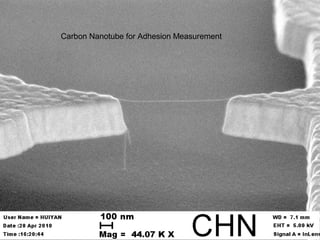
Carbon Nanotube for Adhesion Measurement
Accelerometers
Sensors
Accelerometers
 Types of Accelerometers
 How Surface Micromachined Capacitive
Accelerometers Work
 Tilt Sensing with Accelerometers
Accelerometer
• An accelerometer measures proper acceleration, which is the
acceleration it experiences relative to freefall and is the
acceleration felt by people and objects.
• Conceptually, an accelerometer behaves as a damped mass on
a spring. When the accelerometer experiences an acceleration,
the mass is displaced to the point that the spring is able to
accelerate the mass at the same rate as the casing. The
displacement is then measured to give the acceleration.
• In commercial devices, piezoelectric, piezoresistive
and capacitive components are commonly used to convert the
mechanical motion into an electrical signal.
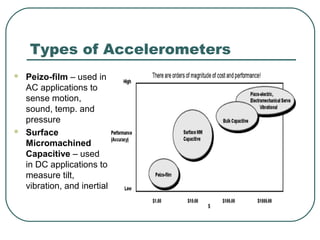
Types of Accelerometers
 Peizo-film – used in
AC applications to
sense motion,
sound, temp. and
pressure
 Surface
Micromachined
Capacitive – used
in DC applications to
measure tilt,
vibration, and inertial
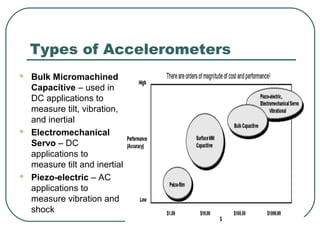
Types of Accelerometers
 Bulk Micromachined
Capacitive – used in
DC applications to
measure tilt, vibration,
and inertial
 Electromechanical
Servo – DC
applications to
measure tilt and inertial
 Piezo-electric – AC
applications to
measure vibration and
shock
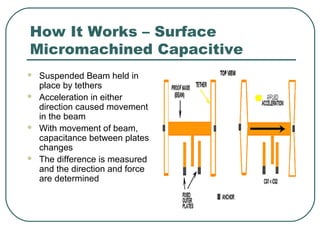
How It Works – Surface
Micromachined Capacitive
 Suspended Beam held in
place by tethers
 Acceleration in either
direction caused movement
in the beam
 With movement of beam,
capacitance between plates
changes
 The difference is measured
and the direction and force
are determined
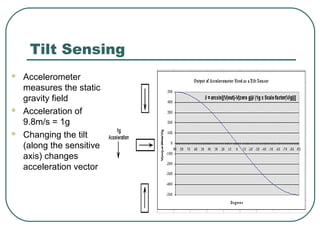
Tilt Sensing
 Accelerometer
measures the static
gravity field
 Acceleration of
9.8m/s = 1g
 Changing the tilt
(along the sensitive
axis) changes
acceleration vector
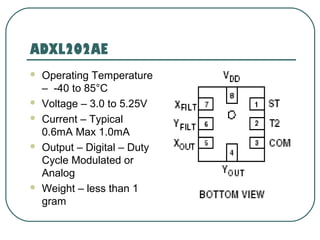
ADXL202AE
 Operating Temperature
– -40 to 85°C
 Voltage – 3.0 to 5.25V
 Current – Typical
0.6mA Max 1.0mA
 Output – Digital – Duty
Cycle Modulated or
Analog
 Weight – less than 1
gram
Accelerometers are used to measure the motion
and vibration of a structure that is exposed to
dynamic loads
 Human activities – walking, running, dancing or skipping
 Working machines – inside a building or in the surrounding area
 Construction work – driving piles, demolition, drilling and excavating
 Moving loads on bridges
 Vehicle collisions
 Impact loads – falling debris
 Concussion loads – internal and external explosions
 Collapse of structural elements
 Wind loads and wind gusts
 Air blast pressure
 Loss of support because of ground failure
 Earthquakes and aftershocks
Pressure Sensor
Presentation Overview
1. Pressure Sensor Theory Overview
2. Pressure Sensor Process Overview
and Fabrication Theory Review
18
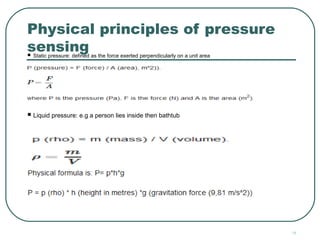
Physical principles of pressure
sensing Static pressure: defined as the force exerted perpendicularly on a unit area
 Volume pressure: defined as mass per unit volume
 Liquid pressure: e.g a person lies inside then bathtub
19
Typical characteristics of
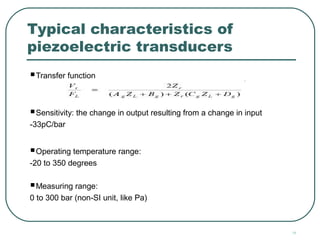
piezoelectric transducers
Transfer function
Sensitivity: the change in output resulting from a change in input
-33pC/bar
Operating temperature range:
-20 to 350 degrees
Measuring range:
0 to 300 bar (non-SI unit, like Pa)
Pressure Sensors
•Absolute – A Sensor That Measures Input Pressure in
Relation to a Zero Pressure.
•Differential – A Sensor That Is Designed to Accept
Simultaneously Two Independent Pressure Sources. The
Output Is Proportional to the Difference Between the Two
Sources.
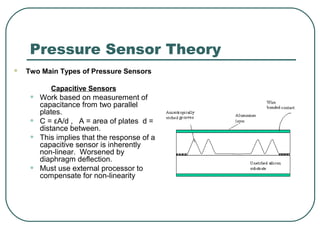
Pressure Sensor Theory
 Two Main Types of Pressure Sensors
Capacitive Sensors
• Work based on measurement of
capacitance from two parallel
plates.
• C = εA/d , A = area of plates d =
distance between.
• This implies that the response of a
capacitive sensor is inherently
non-linear. Worsened by
diaphragm deflection.
• Must use external processor to
compensate for non-linearity
Pressure Sensor Theory
Piezoresistive Sensors
 Work based on the
piezoresistive properties of
silicon and other materials.
 Piezoresistivity is a response to
stress.
 Some piezoresistive materials
are Si, Ge, metals.
 In semiconductors,
piezoresistivity is caused by 2
factors: geometry deformation
and resistivity changes.
Reference: http://en.wikipedia.org/wiki/Piezoresistance_Effect
Pressure Sensor Theory
 Our Sensor is a
Piezoresistive
Sensor based on a
Wheatstone Bridge
Configuration.
 Resistors are made
with Boron Diffusion.
Pressure Sensor Theory
 Vout =Iin*∆R
 Why use a Constant
Source Bridge?
 Produces Linear
Output
 Neglects Lead
Resistance
R + ∆R R - ∆R
R - ∆R R + ∆R
Pressure Sensor Process
Overview
 Initial Wafer is 525
µm thick, n-type,
<100> double-side
polished (DSP).
Pressure Sensor Process
Overview – Step 1
 What should ALWAYS be step 1?
 Wafer Cleaning (RCA Clean)
 Steps
1. TCE (Tetrachloroethylene) Immersion, Acetone, Methanol
2. Base Clean - H2O/H2O2/NH4OH (5 parts,1 part,1 part) @
70 C to Remove Organic Contaminants
3. Dilute HF Immersion (2.5%) Why?
4. Acid Clean - H2O/H2O2/HCl (4 parts, 1 part, 1 part) @ 70 C
to remove metallic and ionic contaminants.
Pressure Sensor Process
Overview – Step 2
 Any guesses?
 Thermal Oxidation
 Wet Oxidation
Followed by Dry
Oxidation
Si + O2 → SiO2 (Dry Oxidation)
Si + 2H2O2 → SiO2 (Wet Oxidation)
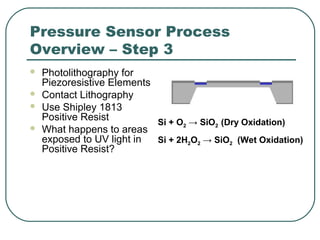
Pressure Sensor Process
Overview – Step 3
 Photolithography for
Piezoresistive Elements
 Contact Lithography
 Use Shipley 1813
Positive Resist
 What happens to areas
exposed to UV light in
Positive Resist?
Si + O2 → SiO2 (Dry Oxidation)
Si + 2H2O2 → SiO2 (Wet Oxidation)
Pressure Sensor Process
Overview – Step 3 Cont.
 DNQ Method using
Mercury Lamp
 Diazonap. Changes to
carboxylic acid via Wolf
re-arrangement
 Carboxylic Acid is more
soluble in a base than
Novolak. So exposed
areas dissolve.
 Use TMAH (a base)
mixture to develop
Ref: http://chem.chem.rochester.edu/~chem421/polymod2.htm
Pressure Sensor Process
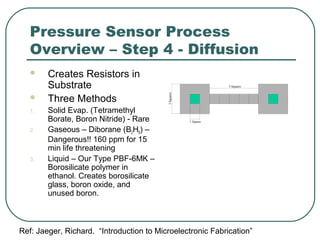
Overview – Step 4 - Diffusion
 Creates Resistors in
Substrate
 Three Methods
1. Solid Evap. (Tetramethyl
Borate, Boron Nitride) - Rare
2. Gaseous – Diborane (B2H6) –
Dangerous!! 160 ppm for 15
min life threatening
3. Liquid – Our Type PBF-6MK –
Borosilicate polymer in
ethanol. Creates borosilicate
glass, boron oxide, and
unused boron.
5 Squares
1 Square
3Squares
Ref: Jaeger, Richard. “Introduction to Microelectronic Fabrication”
Pressure Sensor Process Overview –
Step 5 – Backside Photlithography
 Windows Must Be
Opened in New Oxide
For Backside Etch.
 Use Front to Backside
Alignment
 Etch Silicon Dioxide
w/BOE (HF 6:1)
 Finished when wafer is
hydrophobic (water rolls
off)
Pressure Sensor Process Overview –
Step 6 – Backside Etch
 Need 20 µm Thick
Diaphragm, therefore
must etch approx. 500
µm.
TMAH/IPA KOH
25% wt.
TMAH
45% wt KOH
17% vol IPA
70o
C 75o
C
{100} 12 µm/hr 21 µm/hr
{111} 0.7 µm/hr < 0.05 µm/hr
SiO2 <0.01 µm/hr < 0.20 µm/hr
Ref: Crain, Mark. “Powerpoint Thesis Defense”
Pressure Sensor Process Overview –
Step 8 Metal Deposition and Pattern
 Several Methods, we
use Sputtering
 2 Types (Magnetron)
-RF Sputter
-DC Sputter
http://en.wikipedia.org/wiki/Sputtering
Pressure Sensor Process Overview –
Photolithography and Aluminum Etch
 First Photoresist is
deposited on metal
and patterned for
desired traces
 Uses Aluminum
Etch, 85-95%
Phosphoric Acid, 2-
8% Nitric Acid, and
Water.
Pressure Sensor Process Overview –
Wire Bonding and Packaging
 Several Types – Ball, Wedge, etc.
 Heated gold wire is pressed onto surface, melted,
and then cooled.
37
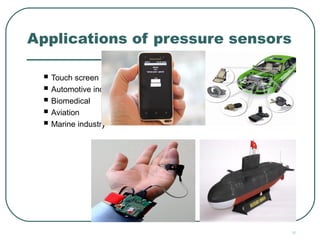
Applications of pressure sensors
 Touch screen devices
 Automotive industry
 Biomedical
 Aviation
 Marine industry
Thank You

Ink Jet Nozzels

  • 1.
    Micromachining Ink JetNozzles Microtechnology group, TU Berlin
  • 2.
  • 3.
  • 4.
  • 5.
    NEMS Switch Fabrication (a)Silicon chip with 500 nm of thermally grown oxide, 20 nm of tungsten, and PMMA. (b) Electron beam lithography was used to define features in the PMMA layer. An ICP etch was used to pattern the tungsten and etch down into the oxide. (c) A Cr/Au layer was evaporated and lifted off by removing the tungsten. (d) DEP was performed to assemble a small bundle of nanotubes traversing the trench between the two side electrodes.
  • 6.
    Carbon Nanotube forAdhesion Measurement
  • 7.
  • 8.
    Accelerometers  Types ofAccelerometers  How Surface Micromachined Capacitive Accelerometers Work  Tilt Sensing with Accelerometers
  • 9.
    Accelerometer • An accelerometermeasures proper acceleration, which is the acceleration it experiences relative to freefall and is the acceleration felt by people and objects. • Conceptually, an accelerometer behaves as a damped mass on a spring. When the accelerometer experiences an acceleration, the mass is displaced to the point that the spring is able to accelerate the mass at the same rate as the casing. The displacement is then measured to give the acceleration. • In commercial devices, piezoelectric, piezoresistive and capacitive components are commonly used to convert the mechanical motion into an electrical signal.
  • 10.
    Types of Accelerometers Peizo-film – used in AC applications to sense motion, sound, temp. and pressure  Surface Micromachined Capacitive – used in DC applications to measure tilt, vibration, and inertial
  • 11.
    Types of Accelerometers Bulk Micromachined Capacitive – used in DC applications to measure tilt, vibration, and inertial  Electromechanical Servo – DC applications to measure tilt and inertial  Piezo-electric – AC applications to measure vibration and shock
  • 12.
    How It Works– Surface Micromachined Capacitive  Suspended Beam held in place by tethers  Acceleration in either direction caused movement in the beam  With movement of beam, capacitance between plates changes  The difference is measured and the direction and force are determined
  • 13.
    Tilt Sensing  Accelerometer measuresthe static gravity field  Acceleration of 9.8m/s = 1g  Changing the tilt (along the sensitive axis) changes acceleration vector
  • 14.
    ADXL202AE  Operating Temperature –-40 to 85°C  Voltage – 3.0 to 5.25V  Current – Typical 0.6mA Max 1.0mA  Output – Digital – Duty Cycle Modulated or Analog  Weight – less than 1 gram
  • 15.
    Accelerometers are usedto measure the motion and vibration of a structure that is exposed to dynamic loads  Human activities – walking, running, dancing or skipping  Working machines – inside a building or in the surrounding area  Construction work – driving piles, demolition, drilling and excavating  Moving loads on bridges  Vehicle collisions  Impact loads – falling debris  Concussion loads – internal and external explosions  Collapse of structural elements  Wind loads and wind gusts  Air blast pressure  Loss of support because of ground failure  Earthquakes and aftershocks
  • 16.
  • 17.
    Presentation Overview 1. PressureSensor Theory Overview 2. Pressure Sensor Process Overview and Fabrication Theory Review
  • 18.
    18 Physical principles ofpressure sensing Static pressure: defined as the force exerted perpendicularly on a unit area  Volume pressure: defined as mass per unit volume  Liquid pressure: e.g a person lies inside then bathtub
  • 19.
    19 Typical characteristics of piezoelectrictransducers Transfer function Sensitivity: the change in output resulting from a change in input -33pC/bar Operating temperature range: -20 to 350 degrees Measuring range: 0 to 300 bar (non-SI unit, like Pa)
  • 20.
    Pressure Sensors •Absolute –A Sensor That Measures Input Pressure in Relation to a Zero Pressure. •Differential – A Sensor That Is Designed to Accept Simultaneously Two Independent Pressure Sources. The Output Is Proportional to the Difference Between the Two Sources.
  • 21.
    Pressure Sensor Theory Two Main Types of Pressure Sensors Capacitive Sensors • Work based on measurement of capacitance from two parallel plates. • C = εA/d , A = area of plates d = distance between. • This implies that the response of a capacitive sensor is inherently non-linear. Worsened by diaphragm deflection. • Must use external processor to compensate for non-linearity
  • 22.
    Pressure Sensor Theory PiezoresistiveSensors  Work based on the piezoresistive properties of silicon and other materials.  Piezoresistivity is a response to stress.  Some piezoresistive materials are Si, Ge, metals.  In semiconductors, piezoresistivity is caused by 2 factors: geometry deformation and resistivity changes. Reference: http://en.wikipedia.org/wiki/Piezoresistance_Effect
  • 23.
    Pressure Sensor Theory Our Sensor is a Piezoresistive Sensor based on a Wheatstone Bridge Configuration.  Resistors are made with Boron Diffusion.
  • 24.
    Pressure Sensor Theory Vout =Iin*∆R  Why use a Constant Source Bridge?  Produces Linear Output  Neglects Lead Resistance R + ∆R R - ∆R R - ∆R R + ∆R
  • 25.
    Pressure Sensor Process Overview Initial Wafer is 525 µm thick, n-type, <100> double-side polished (DSP).
  • 26.
    Pressure Sensor Process Overview– Step 1  What should ALWAYS be step 1?  Wafer Cleaning (RCA Clean)  Steps 1. TCE (Tetrachloroethylene) Immersion, Acetone, Methanol 2. Base Clean - H2O/H2O2/NH4OH (5 parts,1 part,1 part) @ 70 C to Remove Organic Contaminants 3. Dilute HF Immersion (2.5%) Why? 4. Acid Clean - H2O/H2O2/HCl (4 parts, 1 part, 1 part) @ 70 C to remove metallic and ionic contaminants.
  • 27.
    Pressure Sensor Process Overview– Step 2  Any guesses?  Thermal Oxidation  Wet Oxidation Followed by Dry Oxidation Si + O2 → SiO2 (Dry Oxidation) Si + 2H2O2 → SiO2 (Wet Oxidation)
  • 28.
    Pressure Sensor Process Overview– Step 3  Photolithography for Piezoresistive Elements  Contact Lithography  Use Shipley 1813 Positive Resist  What happens to areas exposed to UV light in Positive Resist? Si + O2 → SiO2 (Dry Oxidation) Si + 2H2O2 → SiO2 (Wet Oxidation)
  • 29.
    Pressure Sensor Process Overview– Step 3 Cont.  DNQ Method using Mercury Lamp  Diazonap. Changes to carboxylic acid via Wolf re-arrangement  Carboxylic Acid is more soluble in a base than Novolak. So exposed areas dissolve.  Use TMAH (a base) mixture to develop Ref: http://chem.chem.rochester.edu/~chem421/polymod2.htm
  • 30.
    Pressure Sensor Process Overview– Step 4 - Diffusion  Creates Resistors in Substrate  Three Methods 1. Solid Evap. (Tetramethyl Borate, Boron Nitride) - Rare 2. Gaseous – Diborane (B2H6) – Dangerous!! 160 ppm for 15 min life threatening 3. Liquid – Our Type PBF-6MK – Borosilicate polymer in ethanol. Creates borosilicate glass, boron oxide, and unused boron. 5 Squares 1 Square 3Squares Ref: Jaeger, Richard. “Introduction to Microelectronic Fabrication”
  • 31.
    Pressure Sensor ProcessOverview – Step 5 – Backside Photlithography  Windows Must Be Opened in New Oxide For Backside Etch.  Use Front to Backside Alignment  Etch Silicon Dioxide w/BOE (HF 6:1)  Finished when wafer is hydrophobic (water rolls off)
  • 32.
    Pressure Sensor ProcessOverview – Step 6 – Backside Etch  Need 20 µm Thick Diaphragm, therefore must etch approx. 500 µm. TMAH/IPA KOH 25% wt. TMAH 45% wt KOH 17% vol IPA 70o C 75o C {100} 12 µm/hr 21 µm/hr {111} 0.7 µm/hr < 0.05 µm/hr SiO2 <0.01 µm/hr < 0.20 µm/hr Ref: Crain, Mark. “Powerpoint Thesis Defense”
  • 33.
    Pressure Sensor ProcessOverview – Step 8 Metal Deposition and Pattern  Several Methods, we use Sputtering  2 Types (Magnetron) -RF Sputter -DC Sputter http://en.wikipedia.org/wiki/Sputtering
  • 34.
    Pressure Sensor ProcessOverview – Photolithography and Aluminum Etch  First Photoresist is deposited on metal and patterned for desired traces  Uses Aluminum Etch, 85-95% Phosphoric Acid, 2- 8% Nitric Acid, and Water.
  • 36.
    Pressure Sensor ProcessOverview – Wire Bonding and Packaging  Several Types – Ball, Wedge, etc.  Heated gold wire is pressed onto surface, melted, and then cooled.
  • 37.
    37 Applications of pressuresensors  Touch screen devices  Automotive industry  Biomedical  Aviation  Marine industry
  • 38.