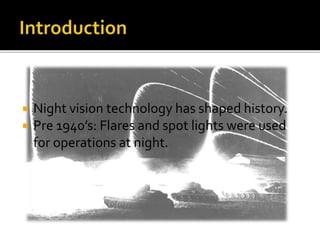
 Night vision technology has shaped history.
 Pre 1940’s: Flares and spot lights were used
for operations at night.
 Due to the nature of these early night vision
devices (NVD), they gave away tactical
positions.
 Military scientists began to think of ways to
improve night vision to gain a strategic
advantage.
Introduction Cont.
A tank fromWorld
War II equipped
with a search light
used for night
combat.
5
NIGHT VISION GOGGLE DRIVING OPERATIONS
Night Operations
Depth Perception Height and Distance
Visual Acuity Terrain Features &
Obstacles
Night Vision Techniques Effective Night
Operations
6
NIGHT VISION GOGGLE DRIVING OPERATIONS
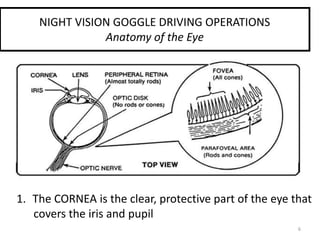
Anatomy of the Eye
1. The CORNEA is the clear, protective part of the eye that
covers the iris and pupil
7
NIGHT VISION GOGGLE DRIVING OPERATIONS
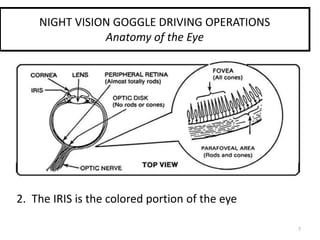
Anatomy of the Eye
2. The IRIS is the colored portion of the eye
8
NIGHT VISION GOGGLE DRIVING OPERATIONS
Anatomy of the Eye
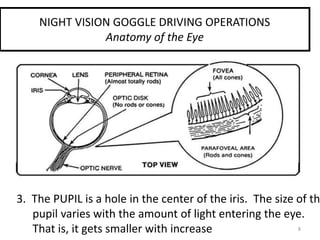
3. The PUPIL is a hole in the center of the iris. The size of th
pupil varies with the amount of light entering the eye.
That is, it gets smaller with increase
9
NIGHT VISION GOGGLE DRIVING OPERATIONS
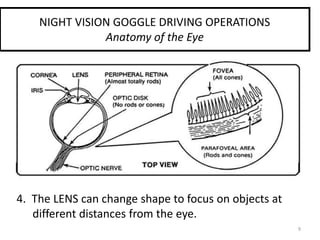
Anatomy of the Eye
4. The LENS can change shape to focus on objects at
different distances from the eye.
10
NIGHT VISION GOGGLE DRIVING OPERATIONS
Anatomy of the Eye
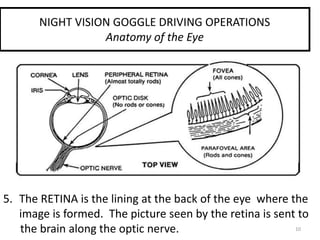
5. The RETINA is the lining at the back of the eye where the
image is formed. The picture seen by the retina is sent to
the brain along the optic nerve.
NVD FUN POP
QUIZ!
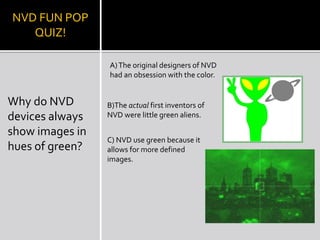
Why do NVD
devices always
show images in
hues of green?
A)The original designers of NVD
had an obsession with the color.
B)The actual first inventors of
NVD were little green aliens.
C) NVD use green because it
allows for more defined
images.
C
The screen was purposefully colored
green due to the scientific fact that the
human eye can differentiate more
shades of green that any other color.
 A night vision device (NVD), also known as night optical/observation
device (NOD) and night vision goggles (NVG), is an optoelectronic
device that allows images to be produced in levels of light approaching total
darkness.
 The image may be a conversion to visible light of both visible light and near-
infrared, while by convention detection of thermal infrared is denoted thermal
imaging.
 The image produced is typically monochrome, e.g. shades of green.The
devices are classified into the following generations
 1.1.1Generation 0
 1.1.2Generation 1 (GEN I)
 1.1.3Generation 2 (GEN II)
 1.1.4Generation 3 (GEN III)
 1.1.5Generation 3+ (GEN III OMNI IV -VII)
Night Vision Devices
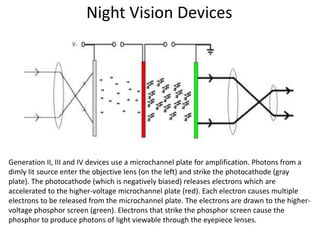
Generation II, III and IV devices use a microchannel plate for amplification. Photons from a
dimly lit source enter the objective lens (on the left) and strike the photocathode (gray
plate). The photocathode (which is negatively biased) releases electrons which are
accelerated to the higher-voltage microchannel plate (red). Each electron causes multiple
electrons to be released from the microchannel plate. The electrons are drawn to the higher-
voltage phosphor screen (green). Electrons that strike the phosphor screen cause the
phosphor to produce photons of light viewable through the eyepiece lenses.
Night Vision Technology

Night Vision Technology

  • 2.
     Night visiontechnology has shaped history.  Pre 1940’s: Flares and spot lights were used for operations at night.
  • 3.
     Due tothe nature of these early night vision devices (NVD), they gave away tactical positions.  Military scientists began to think of ways to improve night vision to gain a strategic advantage.
  • 4.
    Introduction Cont. A tankfromWorld War II equipped with a search light used for night combat.
  • 5.
    5 NIGHT VISION GOGGLEDRIVING OPERATIONS Night Operations Depth Perception Height and Distance Visual Acuity Terrain Features & Obstacles Night Vision Techniques Effective Night Operations
  • 6.
    6 NIGHT VISION GOGGLEDRIVING OPERATIONS Anatomy of the Eye 1. The CORNEA is the clear, protective part of the eye that covers the iris and pupil
  • 7.
    7 NIGHT VISION GOGGLEDRIVING OPERATIONS Anatomy of the Eye 2. The IRIS is the colored portion of the eye
  • 8.
    8 NIGHT VISION GOGGLEDRIVING OPERATIONS Anatomy of the Eye 3. The PUPIL is a hole in the center of the iris. The size of th pupil varies with the amount of light entering the eye. That is, it gets smaller with increase
  • 9.
    9 NIGHT VISION GOGGLEDRIVING OPERATIONS Anatomy of the Eye 4. The LENS can change shape to focus on objects at different distances from the eye.
  • 10.
    10 NIGHT VISION GOGGLEDRIVING OPERATIONS Anatomy of the Eye 5. The RETINA is the lining at the back of the eye where the image is formed. The picture seen by the retina is sent to the brain along the optic nerve.
  • 11.
    NVD FUN POP QUIZ! Whydo NVD devices always show images in hues of green? A)The original designers of NVD had an obsession with the color. B)The actual first inventors of NVD were little green aliens. C) NVD use green because it allows for more defined images.
  • 12.
    C The screen waspurposefully colored green due to the scientific fact that the human eye can differentiate more shades of green that any other color.
  • 13.
     A nightvision device (NVD), also known as night optical/observation device (NOD) and night vision goggles (NVG), is an optoelectronic device that allows images to be produced in levels of light approaching total darkness.  The image may be a conversion to visible light of both visible light and near- infrared, while by convention detection of thermal infrared is denoted thermal imaging.  The image produced is typically monochrome, e.g. shades of green.The devices are classified into the following generations  1.1.1Generation 0  1.1.2Generation 1 (GEN I)  1.1.3Generation 2 (GEN II)  1.1.4Generation 3 (GEN III)  1.1.5Generation 3+ (GEN III OMNI IV -VII)
  • 14.
    Night Vision Devices GenerationII, III and IV devices use a microchannel plate for amplification. Photons from a dimly lit source enter the objective lens (on the left) and strike the photocathode (gray plate). The photocathode (which is negatively biased) releases electrons which are accelerated to the higher-voltage microchannel plate (red). Each electron causes multiple electrons to be released from the microchannel plate. The electrons are drawn to the higher- voltage phosphor screen (green). Electrons that strike the phosphor screen cause the phosphor to produce photons of light viewable through the eyepiece lenses.

Editor's Notes