
Tuning systemd for Embedded
Alison Chaiken
alison_chaiken@mentor.com
Mar. 23, 2015
Latest version: http://she-devel.com/ELC_systemd.pdf
Auxiliary files: http://she-devel.com/ELC_auxiliary.tar.bz2
Text in blue is hyperlinked.
Quiz: 
what is the most widely 
used
Linux init system?
?
?
?
?
?? ??
?
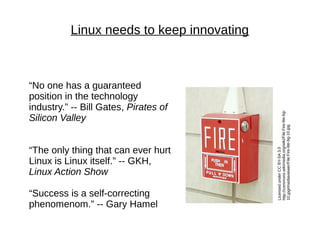
Linux needs to keep innovating
LicensedunderCCBY-SA3.0
http://commons.wikimedia.org/wiki/File:Fire-lite-bg-
10.jpg#mediaviewer/File:Fire-lite-bg-10.jpg
“No one has a guaranteed
position in the technology
industry.” -- Bill Gates, Pirates of
Silicon Valley
“The only thing that can ever hurt
Linux is Linux itself.” -- GKH,
Linux Action Show
“Success is a self-correcting
phenomenom.” -- Gary Hamel
Philosophy of systemd
Extract duplicate functionality from daemons and move 
it to systemd core or kernel.
Replace /etc scripts with declarative config files.
Expose newer kernel APIs to userspace via a simple 
interface.
● modular;
● asynchronous and concurrent;
● described by declarative sets of properties;
● bundled with analysis tools and tests;
● features a fully language-agnostic API.
systemd is:
One daemon to rule them all
xinetd: a daemon to lazily launch internet
services when activity is detected on an
AF_INET socket
systemd: a daemon to lazily launch any
system service when activity is detected on
an AF_UNIX socket (oversimplification)
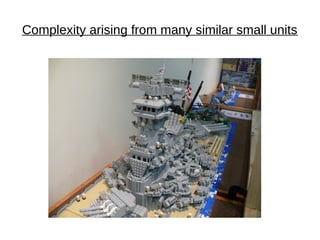
Complexity arising from many similar small units
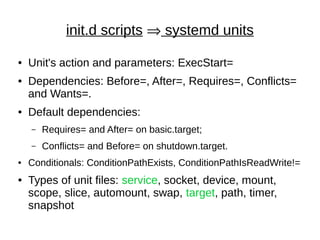
init.d scripts  systemd units
● Unit's action and parameters: ExecStart=
● Dependencies: Before=, After=, Requires=, Conflicts=
and Wants=.
● Default dependencies:
– Requires= and After= on basic.target;
– Conflicts= and Before= on shutdown.target.
● Conditionals: ConditionPathExists, ConditionPathIsReadWrite!=
● Types of unit files: service, socket, device, mount,
scope, slice, automount, swap, target, path, timer,
snapshot
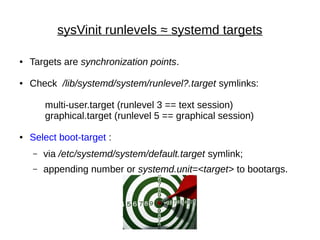
sysVinit runlevels ≈ systemd targets
● Targets are synchronization points.
● Check /lib/systemd/system/runlevel?.target symlinks:
multi-user.target (runlevel 3 == text session)
graphical.target (runlevel 5 == graphical session)
● Select boot-target :
– via /etc/systemd/system/default.target symlink;
– appending number or systemd.unit=<target> to bootargs.
plus: intuitively exposes kernel interfaces
● Including Capabilities, Watchdog, Cgroups and kdbus
('coming attraction')
● Kernel features configurable via simple ASCII options
in unit files.
● Encourages creation of system policies via unit
templates.
systemd and cgroups
● cgroups are a kernel-level mechanism for allocating resources:
storage, memory, CPU and network.
● slices are groups of daemons whose resources are managed
jointly.
● systemd scopes are resultant groups of user processes.
● Can set BlockIOWeight, IOSchedulingPriority, OOMScoreAdjust,
CPUShares, MemoryLimit …
Demo Example: limiting memory usage of Firefox.
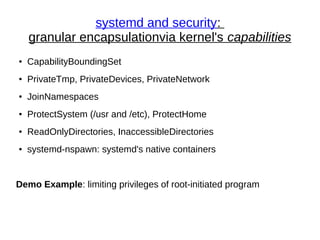
systemd and security:
granular encapsulationvia kernel's capabilities
● CapabilityBoundingSet
● PrivateTmp, PrivateDevices, PrivateNetwork
● JoinNamespaces
● ProtectSystem (/usr and /etc), ProtectHome
● ReadOnlyDirectories, InaccessibleDirectories
● systemd-nspawn: systemd's native containers
Demo Example: limiting privileges of root-initiated program
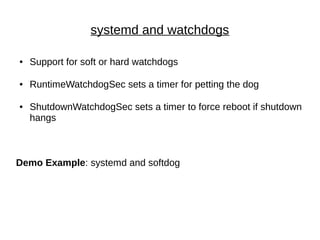
systemd and watchdogs
● Support for soft or hard watchdogs
● RuntimeWatchdogSec sets a timer for petting the dog
● ShutdownWatchdogSec sets a timer to force reboot if shutdown
hangs
Demo Example: systemd and softdog
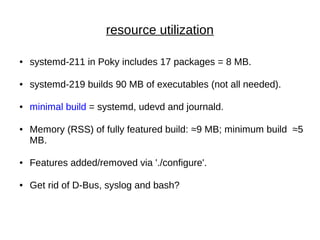
resource utilization
● systemd-211 in Poky includes 17 packages = 8 MB.
● systemd-219 builds 90 MB of executables (not all needed).
● minimal build = systemd, udevd and journald.
● Memory (RSS) of fully featured build: ≈9 MB; minimum build ≈5
MB.
● Features added/removed via './configure'.
● Get rid of D-Bus, syslog and bash?
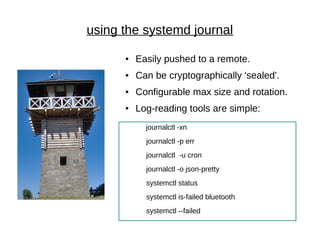
using the systemd journal
● Easily pushed to a remote.
● Can be cryptographically 'sealed'.
● Configurable max size and rotation.
● Log-reading tools are simple:
journalctl -xn
journalctl -p err
journalctl -u cron
journalctl -o json-pretty
systemctl status
systemctl is-failed bluetooth
systemctl --failed
Other embedded-relevant features
● Support for read-only rootfs
● Remote journaling via HTTP requests
● Coredumpctl:
– read last core file
– read stack trace automatically written to journal
● Timesyncd: lightweight network-time daemon
● 'systemctl snapshot' captures state to which the system can be
restored
systemd prevents self-injury!
● Test out new units by trying them:
– in /run
– in *.conf.d directory
– via bootargs
● No need ever to modify files in /lib/systemd.
● Services linked into basic.target.wants (≈runlevel 1) that won't
work until graphical.target (runlevel 5) will start properly if their
dependencies are correctly stated.
systemd and backwards compatibility
system updates
Ye Good Olde Days:
-- update kernel and modules
-- separately update root fs
Newfangled:
-- update kernel and modules
-- update device-tree
-- separately update root fs
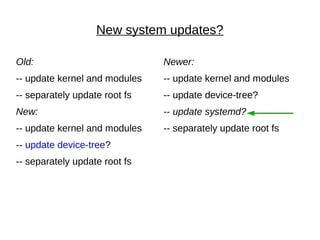
New system updates?
Old:
-- update kernel and modules
-- separately update root fs
New:
-- update kernel and modules
-- update device-tree?
-- separately update root fs
Newer:
-- update kernel and modules
-- update device-tree?
-- update systemd?
-- separately update root fs
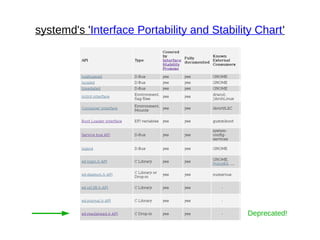
systemd's 'Interface Portability and Stability Chart'
Deprecated!
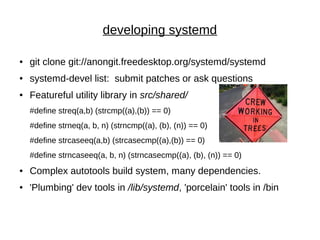
developing systemd
● git clone git://anongit.freedesktop.org/systemd/systemd
● systemd-devel list: submit patches or ask questions
● Featureful utility library in src/shared/
#define streq(a,b) (strcmp((a),(b)) == 0)
#define strneq(a, b, n) (strncmp((a), (b), (n)) == 0)
#define strcaseeq(a,b) (strcasecmp((a),(b)) == 0)
#define strncaseeq(a, b, n) (strncasecmp((a), (b), (n)) == 0)
● Complex autotools build system, many dependencies.
● 'Plumbing' dev tools in /lib/systemd, 'porcelain' tools in /bin
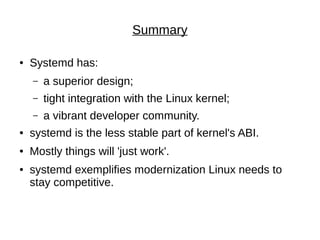
Summary
● Systemd has:
– a superior design;
– tight integration with the Linux kernel;
– a vibrant developer community.
● systemd is the less stable part of kernel's ABI.
● Mostly things will 'just work'.
● systemd exemplifies modernization Linux needs to
stay competitive.
photo
courtesy
Jym
Dyer
Thanks
● Vladimir Pantelic, Tom Gundersen, Lennart Poettering, Jeff
Waugh, Ivan Shapovalov, Mantas Mikulènas, Stephanie
Lockwood-Childs and Jon Stanley for corrections and advice.
● Bill Ward, Jym Dyer and Janet Lafleur for use of their images.
Resources
● Man pages are part of systemd git repo.
●
freedesktop.org: systemd mailing list archives and wiki
● Poettering's 0pointer.de blog
● ➟At wayback machine: “Booting up” articles
●
Neil Brown series at LWN
● ➟Fedora's SysVinit to systemd cheatsheet
● Poettering's 'What's new' talk from FOSDEM 2015
●
Josh Triplett's Debconf talk video
● Linux Action Show interviews with Mark Shuttleworth and Lennart Poettering
Leftover
Materials
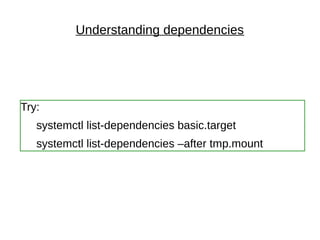
Understanding dependencies
Try:
systemctl list-dependencies basic.target
systemctl list-dependencies –after tmp.mount
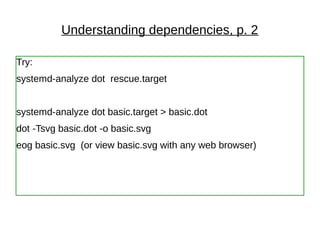
Try:
systemd-analyze dot rescue.target
systemd-analyze dot basic.target > basic.dot
dot -Tsvg basic.dot -o basic.svg
eog basic.svg (or view basic.svg with any web browser)
Understanding dependencies, p. 2
SysV already has a big service manager: bash
[user@localhost]$ ls -l /sbin/init
26k
[user@localhost]$ ls -lh /bin/bash
1008K
[user@localhost]$ ls -lh /lib/systemd/systemd
1.3M
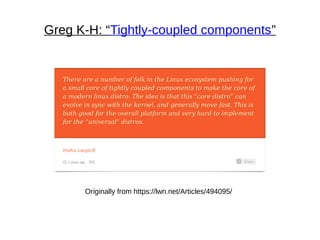
Greg K-H: “Tightly-coupled components”
Originally from https://lwn.net/Articles/494095/
[Socket activation demo with cups and ncat]
systemd and udev
● udev is a kernel facility that handles device events.
– merged into the systemd project.
● Rules are enabled by placement in /lib/udev/rules.d,
unlike systemd unit enablement.
● Rule loading is ordered by numeric filename prefix,
like old sysVinit scripts.
udev is still old-school
Try:
ls /lib/udev/rules.d
cat /lib/udev/rules.d/99-systemd.rules
Hierarchy of unit files for
system and user sessions
● Organized into system and user units
● /lib/systemd/system: systemd upstream defaults for
system-wide services
● /etc/systemd/system: local customizations by override
and extension
● /lib/systemd/user/: systemd's upstream defaults for per-
user services
● $HOME/.local/share/systemd/user/ for user-installed
units
● 'drop-ins' are run-time extensions
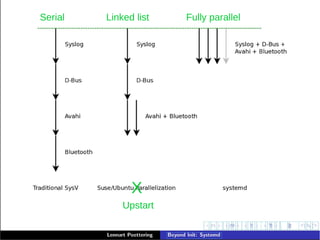
X
Upstart
Serial Linked list Fully parallel
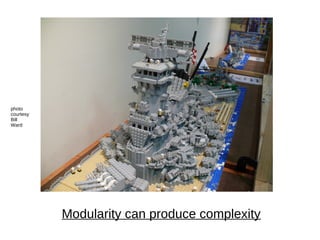
Modularity can produce complexity
photo
courtesy
Bill
Ward
systemd and outside projects: CoreOS
● networkd was initially contributed by CoreOS developers.
● CoreOS's fleet “tool that presents your entire cluster as a single init system”
is based on systemd.
– Spin up new containers due to events on sockets.
● CoreOS devs are outside systemd inner circle.
● systemd has many patches from Arch, Intel, Debian . . .
systemd in embedded systems
● systemd is widely adopted in embedded systems
because
– proper allocation of resources is critical;
– fastboot is required;
– customization of boot sequence is common.
● Lack of backward compatibility for older kernels (due
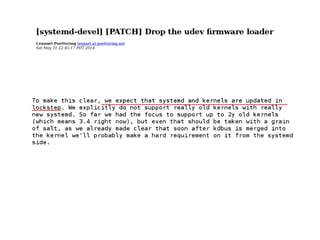
to firmware loading) is a pain point.
● Embedded use cases are not always understood by
systemd devs.
[runlevel demo with Fedora Qemu and Firefox]
Try: 'systemctl isolate multi-user.target'
[warning: KILLS X11]
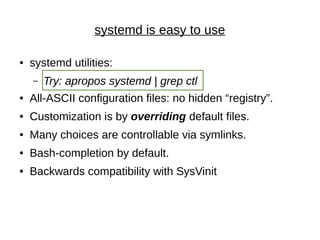
systemd is easy to use
● systemd utilities:
– Try: apropos systemd | grep ctl
● All-ASCII configuration files: no hidden “registry”.
● Customization is by overriding default files.
● Many choices are controllable via symlinks.
● Bash-completion by default.
● Backwards compatibility with SysVinit
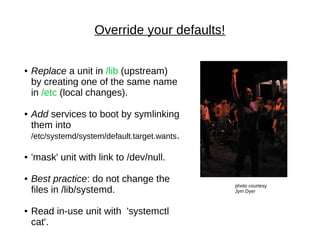
Override your defaults!
photo courtesy
Jym Dyer
● Replace a unit in /lib (upstream)
by creating one of the same name
in /etc (local changes).
● Add services to boot by symlinking
them into
/etc/systemd/system/default.target.wants.
● 'mask' unit with link to /dev/null.
● Best practice: do not change the
files in /lib/systemd.
● Read in-use unit with 'systemctl
cat'.
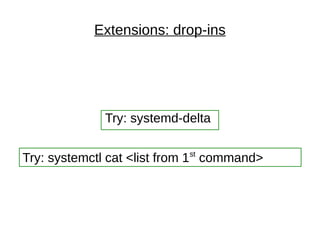
Extensions: drop-ins
Try: systemd-delta
Try: systemctl cat <list from 1st
command>
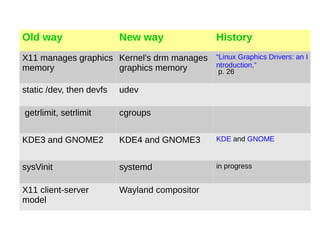
Old way New way History
X11 manages graphics
memory
Kernel's drm manages
graphics memory
“Linux Graphics Drivers: an I
ntroduction,”
p. 26
static /dev, then devfs udev
getrlimit, setrlimit cgroups
KDE3 and GNOME2 KDE4 and GNOME3 KDE and GNOME
sysVinit systemd in progress
X11 client-server
model
Wayland compositor
Crux of the problem: Dave Neary
“There is no freedesktop.org process for
proposing standards, identifying those which are
proposals and those which are de facto
implemented, and perhaps more importantly,
there is no process for building consensus around
a specification . . .”
(comment regarding GNOME3)
systemd is . . .
● the basis of Fedora, RHEL, CentOS, OpenSUSE,
Ubuntu, Debian and much embedded.
● praised by Jordan Hubbard of FreeBSD.
● tightly integrated with Linux kernel cgroups.
● the reference implementation for udev and for kdbus
userspace access.
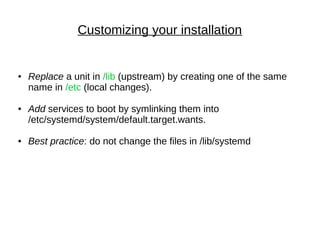
Customizing your installation
● Replace a unit in /lib (upstream) by creating one of the same
name in /etc (local changes).
● Add services to boot by symlinking them into
/etc/systemd/system/default.target.wants.
● Best practice: do not change the files in /lib/systemd
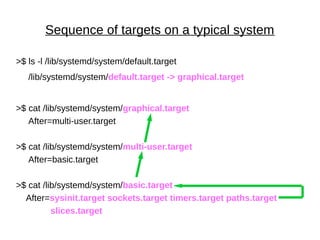
Sequence of targets on a typical system
>$ ls -l /lib/systemd/system/default.target
/lib/systemd/system/default.target -> graphical.target
>$ cat /lib/systemd/system/graphical.target
After=multi-user.target
>$ cat /lib/systemd/system/multi-user.target
After=basic.target
>$ cat /lib/systemd/system/basic.target
After=sysinit.target sockets.target timers.target paths.target
slices.target
Example: set display manager
[user@localhost ~]$ ls -l `locate display-manager.service`
lrwxrwxrwx. 1 root root 35 Dec 11 2013
/etc/systemd/system/display-manager.service ->
/usr/lib/systemd/system/gdm.service
[user@localhost ~]$ cat /usr/lib/systemd/system/gdm.service
[Unit]
Description=GNOME Display Manager
[ . . . ]
[Install]
Alias=display-manager.service
or
WantedBy=graphical.target
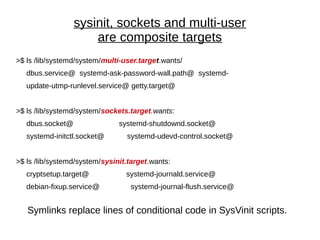
sysinit, sockets and multi-user
are composite targets
>$ ls /lib/systemd/system/multi-user.target.wants/
dbus.service@ systemd-ask-password-wall.path@ systemd-
update-utmp-runlevel.service@ getty.target@
>$ ls /lib/systemd/system/sockets.target.wants:
dbus.socket@ systemd-shutdownd.socket@
systemd-initctl.socket@ systemd-udevd-control.socket@
>$ ls /lib/systemd/system/sysinit.target.wants:
cryptsetup.target@ systemd-journald.service@
debian-fixup.service@ systemd-journal-flush.service@
Symlinks replace lines of conditional code in SysVinit scripts.
Example: change the default target
[alison@localhost ~]$ ls /etc/systemd/system/default.target
/etc/systemd/system/default.target ->
/lib/systemd/system/graphical.target
[alison@localhost ~]$ sudo rm /etc/systemd/system/default.target
[alison@localhost ~]$ sudo ln -s /lib/systemd/system/multi-user.target
/etc/systemd/system/default.target
[alison@localhost ~]$ ~/bin/systemd-delta
[ . . . ]
[REDIRECTED] /etc/systemd/system/default.target →
/usr/lib/systemd/system/default.target
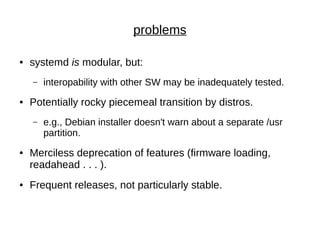
problems
● systemd is modular, but:
– interopability with other SW may be inadequately tested.
● Potentially rocky piecemeal transition by distros.
– e.g., Debian installer doesn't warn about a separate /usr
partition.
● Merciless deprecation of features (firmware loading,
readahead . . . ).
● Frequent releases, not particularly stable.
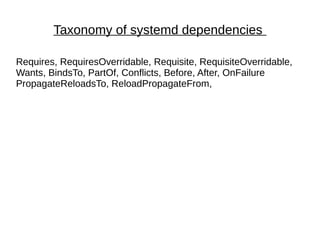
Taxonomy of systemd dependencies
Requires, RequiresOverridable, Requisite, RequisiteOverridable,
Wants, BindsTo, PartOf, Conflicts, Before, After, OnFailure
PropagateReloadsTo, ReloadPropagateFrom,
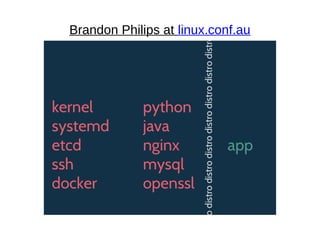
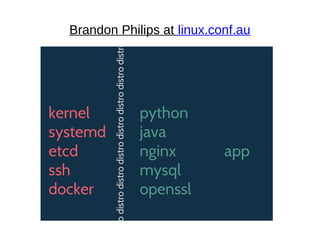
Brandon Philips at linux.conf.au
Design

Tuning systemd for embedded

  • 1.
    Tuning systemd forEmbedded Alison Chaiken alison_chaiken@mentor.com Mar. 23, 2015 Latest version: http://she-devel.com/ELC_systemd.pdf Auxiliary files: http://she-devel.com/ELC_auxiliary.tar.bz2 Text in blue is hyperlinked.
  • 2.
  • 3.
    Linux needs tokeep innovating LicensedunderCCBY-SA3.0 http://commons.wikimedia.org/wiki/File:Fire-lite-bg- 10.jpg#mediaviewer/File:Fire-lite-bg-10.jpg “No one has a guaranteed position in the technology industry.” -- Bill Gates, Pirates of Silicon Valley “The only thing that can ever hurt Linux is Linux itself.” -- GKH, Linux Action Show “Success is a self-correcting phenomenom.” -- Gary Hamel
  • 4.
  • 5.
    ● modular; ● asynchronousand concurrent; ● described by declarative sets of properties; ● bundled with analysis tools and tests; ● features a fully language-agnostic API. systemd is:
  • 6.
    One daemon torule them all xinetd: a daemon to lazily launch internet services when activity is detected on an AF_INET socket systemd: a daemon to lazily launch any system service when activity is detected on an AF_UNIX socket (oversimplification)
  • 7.
    Complexity arising frommany similar small units
  • 8.
    init.d scripts systemd units ● Unit's action and parameters: ExecStart= ● Dependencies: Before=, After=, Requires=, Conflicts= and Wants=. ● Default dependencies: – Requires= and After= on basic.target; – Conflicts= and Before= on shutdown.target. ● Conditionals: ConditionPathExists, ConditionPathIsReadWrite!= ● Types of unit files: service, socket, device, mount, scope, slice, automount, swap, target, path, timer, snapshot
  • 9.
    sysVinit runlevels ≈systemd targets ● Targets are synchronization points. ● Check /lib/systemd/system/runlevel?.target symlinks: multi-user.target (runlevel 3 == text session) graphical.target (runlevel 5 == graphical session) ● Select boot-target : – via /etc/systemd/system/default.target symlink; – appending number or systemd.unit=<target> to bootargs.
  • 10.
    plus: intuitively exposeskernel interfaces ● Including Capabilities, Watchdog, Cgroups and kdbus ('coming attraction') ● Kernel features configurable via simple ASCII options in unit files. ● Encourages creation of system policies via unit templates.
  • 11.
    systemd and cgroups ●cgroups are a kernel-level mechanism for allocating resources: storage, memory, CPU and network. ● slices are groups of daemons whose resources are managed jointly. ● systemd scopes are resultant groups of user processes. ● Can set BlockIOWeight, IOSchedulingPriority, OOMScoreAdjust, CPUShares, MemoryLimit … Demo Example: limiting memory usage of Firefox.
  • 12.
    systemd and security: granularencapsulationvia kernel's capabilities ● CapabilityBoundingSet ● PrivateTmp, PrivateDevices, PrivateNetwork ● JoinNamespaces ● ProtectSystem (/usr and /etc), ProtectHome ● ReadOnlyDirectories, InaccessibleDirectories ● systemd-nspawn: systemd's native containers Demo Example: limiting privileges of root-initiated program
  • 13.
    systemd and watchdogs ●Support for soft or hard watchdogs ● RuntimeWatchdogSec sets a timer for petting the dog ● ShutdownWatchdogSec sets a timer to force reboot if shutdown hangs Demo Example: systemd and softdog
  • 14.
    resource utilization ● systemd-211in Poky includes 17 packages = 8 MB. ● systemd-219 builds 90 MB of executables (not all needed). ● minimal build = systemd, udevd and journald. ● Memory (RSS) of fully featured build: ≈9 MB; minimum build ≈5 MB. ● Features added/removed via './configure'. ● Get rid of D-Bus, syslog and bash?
  • 15.
    using the systemdjournal ● Easily pushed to a remote. ● Can be cryptographically 'sealed'. ● Configurable max size and rotation. ● Log-reading tools are simple: journalctl -xn journalctl -p err journalctl -u cron journalctl -o json-pretty systemctl status systemctl is-failed bluetooth systemctl --failed
  • 16.
    Other embedded-relevant features ●Support for read-only rootfs ● Remote journaling via HTTP requests ● Coredumpctl: – read last core file – read stack trace automatically written to journal ● Timesyncd: lightweight network-time daemon ● 'systemctl snapshot' captures state to which the system can be restored
  • 17.
    systemd prevents self-injury! ●Test out new units by trying them: – in /run – in *.conf.d directory – via bootargs ● No need ever to modify files in /lib/systemd. ● Services linked into basic.target.wants (≈runlevel 1) that won't work until graphical.target (runlevel 5) will start properly if their dependencies are correctly stated.
  • 18.
    systemd and backwardscompatibility
  • 19.
    system updates Ye GoodOlde Days: -- update kernel and modules -- separately update root fs Newfangled: -- update kernel and modules -- update device-tree -- separately update root fs
  • 21.
    New system updates? Old: --update kernel and modules -- separately update root fs New: -- update kernel and modules -- update device-tree? -- separately update root fs Newer: -- update kernel and modules -- update device-tree? -- update systemd? -- separately update root fs
  • 22.
    systemd's 'Interface Portabilityand Stability Chart' Deprecated!
  • 23.
    developing systemd ● gitclone git://anongit.freedesktop.org/systemd/systemd ● systemd-devel list: submit patches or ask questions ● Featureful utility library in src/shared/ #define streq(a,b) (strcmp((a),(b)) == 0) #define strneq(a, b, n) (strncmp((a), (b), (n)) == 0) #define strcaseeq(a,b) (strcasecmp((a),(b)) == 0) #define strncaseeq(a, b, n) (strncasecmp((a), (b), (n)) == 0) ● Complex autotools build system, many dependencies. ● 'Plumbing' dev tools in /lib/systemd, 'porcelain' tools in /bin
  • 24.
    Summary ● Systemd has: –a superior design; – tight integration with the Linux kernel; – a vibrant developer community. ● systemd is the less stable part of kernel's ABI. ● Mostly things will 'just work'. ● systemd exemplifies modernization Linux needs to stay competitive.
  • 25.
  • 26.
    Thanks ● Vladimir Pantelic,Tom Gundersen, Lennart Poettering, Jeff Waugh, Ivan Shapovalov, Mantas Mikulènas, Stephanie Lockwood-Childs and Jon Stanley for corrections and advice. ● Bill Ward, Jym Dyer and Janet Lafleur for use of their images.
  • 27.
    Resources ● Man pagesare part of systemd git repo. ● freedesktop.org: systemd mailing list archives and wiki ● Poettering's 0pointer.de blog ● ➟At wayback machine: “Booting up” articles ● Neil Brown series at LWN ● ➟Fedora's SysVinit to systemd cheatsheet ● Poettering's 'What's new' talk from FOSDEM 2015 ● Josh Triplett's Debconf talk video ● Linux Action Show interviews with Mark Shuttleworth and Lennart Poettering
  • 28.
  • 29.
    Understanding dependencies Try: systemctl list-dependenciesbasic.target systemctl list-dependencies –after tmp.mount
  • 30.
    Try: systemd-analyze dot rescue.target systemd-analyzedot basic.target > basic.dot dot -Tsvg basic.dot -o basic.svg eog basic.svg (or view basic.svg with any web browser) Understanding dependencies, p. 2
  • 31.
    SysV already hasa big service manager: bash [user@localhost]$ ls -l /sbin/init 26k [user@localhost]$ ls -lh /bin/bash 1008K [user@localhost]$ ls -lh /lib/systemd/systemd 1.3M
  • 33.
    Greg K-H: “Tightly-coupledcomponents” Originally from https://lwn.net/Articles/494095/
  • 34.
    [Socket activation demowith cups and ncat]
  • 35.
    systemd and udev ●udev is a kernel facility that handles device events. – merged into the systemd project. ● Rules are enabled by placement in /lib/udev/rules.d, unlike systemd unit enablement. ● Rule loading is ordered by numeric filename prefix, like old sysVinit scripts.
  • 36.
    udev is stillold-school Try: ls /lib/udev/rules.d cat /lib/udev/rules.d/99-systemd.rules
  • 37.
    Hierarchy of unitfiles for system and user sessions ● Organized into system and user units ● /lib/systemd/system: systemd upstream defaults for system-wide services ● /etc/systemd/system: local customizations by override and extension ● /lib/systemd/user/: systemd's upstream defaults for per- user services ● $HOME/.local/share/systemd/user/ for user-installed units ● 'drop-ins' are run-time extensions
  • 38.
  • 39.
    Modularity can producecomplexity photo courtesy Bill Ward
  • 40.
    systemd and outsideprojects: CoreOS ● networkd was initially contributed by CoreOS developers. ● CoreOS's fleet “tool that presents your entire cluster as a single init system” is based on systemd. – Spin up new containers due to events on sockets. ● CoreOS devs are outside systemd inner circle. ● systemd has many patches from Arch, Intel, Debian . . .
  • 41.
    systemd in embeddedsystems ● systemd is widely adopted in embedded systems because – proper allocation of resources is critical; – fastboot is required; – customization of boot sequence is common. ● Lack of backward compatibility for older kernels (due to firmware loading) is a pain point. ● Embedded use cases are not always understood by systemd devs.
  • 42.
    [runlevel demo withFedora Qemu and Firefox] Try: 'systemctl isolate multi-user.target' [warning: KILLS X11]
  • 43.
    systemd is easyto use ● systemd utilities: – Try: apropos systemd | grep ctl ● All-ASCII configuration files: no hidden “registry”. ● Customization is by overriding default files. ● Many choices are controllable via symlinks. ● Bash-completion by default. ● Backwards compatibility with SysVinit
  • 44.
    Override your defaults! photocourtesy Jym Dyer ● Replace a unit in /lib (upstream) by creating one of the same name in /etc (local changes). ● Add services to boot by symlinking them into /etc/systemd/system/default.target.wants. ● 'mask' unit with link to /dev/null. ● Best practice: do not change the files in /lib/systemd. ● Read in-use unit with 'systemctl cat'.
  • 45.
    Extensions: drop-ins Try: systemd-delta Try:systemctl cat <list from 1st command>
  • 46.
    Old way Newway History X11 manages graphics memory Kernel's drm manages graphics memory “Linux Graphics Drivers: an I ntroduction,” p. 26 static /dev, then devfs udev getrlimit, setrlimit cgroups KDE3 and GNOME2 KDE4 and GNOME3 KDE and GNOME sysVinit systemd in progress X11 client-server model Wayland compositor
  • 47.
    Crux of theproblem: Dave Neary “There is no freedesktop.org process for proposing standards, identifying those which are proposals and those which are de facto implemented, and perhaps more importantly, there is no process for building consensus around a specification . . .” (comment regarding GNOME3)
  • 48.
    systemd is .. . ● the basis of Fedora, RHEL, CentOS, OpenSUSE, Ubuntu, Debian and much embedded. ● praised by Jordan Hubbard of FreeBSD. ● tightly integrated with Linux kernel cgroups. ● the reference implementation for udev and for kdbus userspace access.
  • 49.
    Customizing your installation ●Replace a unit in /lib (upstream) by creating one of the same name in /etc (local changes). ● Add services to boot by symlinking them into /etc/systemd/system/default.target.wants. ● Best practice: do not change the files in /lib/systemd
  • 50.
    Sequence of targetson a typical system >$ ls -l /lib/systemd/system/default.target /lib/systemd/system/default.target -> graphical.target >$ cat /lib/systemd/system/graphical.target After=multi-user.target >$ cat /lib/systemd/system/multi-user.target After=basic.target >$ cat /lib/systemd/system/basic.target After=sysinit.target sockets.target timers.target paths.target slices.target
  • 51.
    Example: set displaymanager [user@localhost ~]$ ls -l `locate display-manager.service` lrwxrwxrwx. 1 root root 35 Dec 11 2013 /etc/systemd/system/display-manager.service -> /usr/lib/systemd/system/gdm.service [user@localhost ~]$ cat /usr/lib/systemd/system/gdm.service [Unit] Description=GNOME Display Manager [ . . . ] [Install] Alias=display-manager.service or WantedBy=graphical.target
  • 52.
    sysinit, sockets andmulti-user are composite targets >$ ls /lib/systemd/system/multi-user.target.wants/ dbus.service@ systemd-ask-password-wall.path@ systemd- update-utmp-runlevel.service@ getty.target@ >$ ls /lib/systemd/system/sockets.target.wants: dbus.socket@ systemd-shutdownd.socket@ systemd-initctl.socket@ systemd-udevd-control.socket@ >$ ls /lib/systemd/system/sysinit.target.wants: cryptsetup.target@ systemd-journald.service@ debian-fixup.service@ systemd-journal-flush.service@ Symlinks replace lines of conditional code in SysVinit scripts.
  • 53.
    Example: change thedefault target [alison@localhost ~]$ ls /etc/systemd/system/default.target /etc/systemd/system/default.target -> /lib/systemd/system/graphical.target [alison@localhost ~]$ sudo rm /etc/systemd/system/default.target [alison@localhost ~]$ sudo ln -s /lib/systemd/system/multi-user.target /etc/systemd/system/default.target [alison@localhost ~]$ ~/bin/systemd-delta [ . . . ] [REDIRECTED] /etc/systemd/system/default.target → /usr/lib/systemd/system/default.target
  • 54.
    problems ● systemd ismodular, but: – interopability with other SW may be inadequately tested. ● Potentially rocky piecemeal transition by distros. – e.g., Debian installer doesn't warn about a separate /usr partition. ● Merciless deprecation of features (firmware loading, readahead . . . ). ● Frequent releases, not particularly stable.
  • 55.
    Taxonomy of systemddependencies Requires, RequiresOverridable, Requisite, RequisiteOverridable, Wants, BindsTo, PartOf, Conflicts, Before, After, OnFailure PropagateReloadsTo, ReloadPropagateFrom,
  • 56.
    Brandon Philips atlinux.conf.au
  • 57.
    Brandon Philips atlinux.conf.au
  • 58.