Android is a trademark of Google Inc. Use of this trademark is subject to Google Permissions.
Linux is the registered trademark of Linus Torvalds in the U.S. and other countries.
Qt is a registered trade mark of Digia Plc and/or its subsidiaries. All other trademarks mentioned in this document are
trademarks of their respective owners.
mentor.com/automo
tive
Alison Chaiken
Sept. 8, 2015
systemd, the modern Linux
service and resource manager
2
Philosophy of systemd
●
Extract duplicate functionality from daemons and 
move it to systemd core or kernel.
●
Replace /etc scripts with declarative config files.
●
Expose newer kernel APIs to userspace via a simple 
interface.
2
3
systemd is:
●
modular;
●
asynchronous and concurrent;
●
described by declarative sets of
properties;
●
bundled with analysis tools and tests;
●
supplied with a fully language-agnostic
API.
3
4
init.d scripts  systemd unit properties
●
Unit's action and parameters: ExecStart= 
●
Dependencies: Before=, After=, Requires=,
Conflicts= and Wants=.
●
Default dependencies:
– Requires= and After= on basic.target;
– Conflicts= and Before= on
shutdown.target.
●
Types of unit files: service, socket, device,
mount, scope, slice, automount, swap,
target, path, timer, snapshot
4
5
Example: Automotive Message Broker
From /lib/systemd/system/ambd.service:
# ambd systemd service unit file
[Unit]
Description=Automotive Message Broker
After=syslog.target
[Service]
Type=dbus
BusName=org.automotive.message.broker
ExecStart=/usr/bin/ambd
[Install]
WantedBy=multi-user.target
5
6
Example: Make the gdp-hmi-controller only start when weston
is ready
From: Jonathan Maw <jonathan.maw@codethink.co.uk>
[ . . . ]
--- /dev/null
+++ b/recipes-demo-hmi/genivi-demo-platform-hmi/gdp-hmi-
launcher2/StartLauncher.path
+[Unit]
+Description=GENIVI Start Launcher when weston is ready
+Requires=weston.service
+After=weston.service
+[Path]
+PathExists=/var/run/user/0/wayland-0
6
7
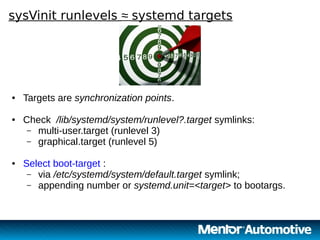
sysVinit runlevels ≈ systemd targets
7
● Targets are synchronization points.
● Check /lib/systemd/system/runlevel?.target symlinks:
– multi-user.target (runlevel 3)
– graphical.target (runlevel 5)
● Select boot-target :
– via /etc/systemd/system/default.target symlink;
– appending number or systemd.unit=<target> to bootargs.
8
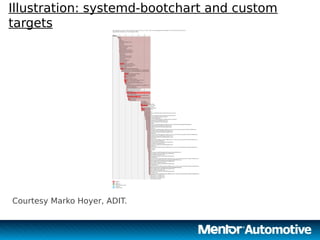
Illustration: systemd-bootchart and custom
targets
Courtesy Marko Hoyer, ADIT.
8
9
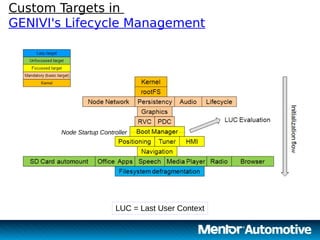
Custom Targets in
GENIVI's Lifecycle Management
9
LUC = Last User Context
Node Startup Controller
10 10
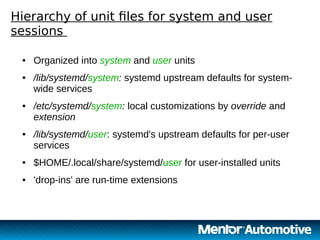
● Organized into system and user units
● /lib/systemd/system: systemd upstream defaults for system-
wide services
● /etc/systemd/system: local customizations by override and
extension
● /lib/systemd/user: systemd's upstream defaults for per-user
services
● $HOME/.local/share/systemd/user for user-installed units
● 'drop-ins' are run-time extensions
Hierarchy of unit files for system and user
sessions
11
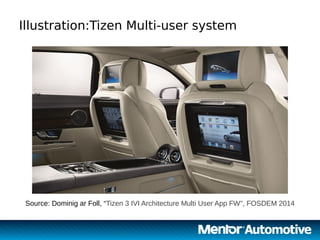
Illustration:Tizen Multi-user system
Source: Dominig ar Foll, “Tizen 3 IVI Architecture Multi User App FW”, FOSDEM 2014
12
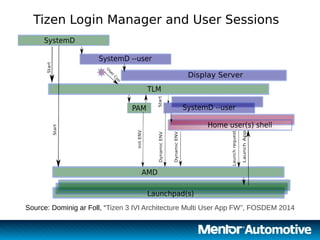
Tizen Login Manager and User Sessions
Source: Dominig ar Foll, “Tizen 3 IVI Architecture Multi User App FW”, FOSDEM 2014
13
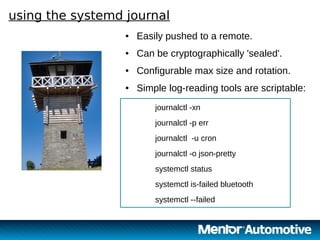
using the systemd journal
13
● Easily pushed to a remote.
● Can be cryptographically 'sealed'.
● Configurable max size and rotation.
● Simple log-reading tools are scriptable:
journalctl -xn
journalctl -p err
journalctl -u cron
journalctl -o json-pretty
systemctl status
systemctl is-failed bluetooth
systemctl --failed
14
Both systemd journal and DLT:
14
● are modular and extensible.
● support pushing data to AF_INET socket.
● can share data with legacy syslog.
● natively output binary formats.
→ Linking systemd and DLT involves:
– translating binary formats;
– handshaking;
– synchronization.
● Performed by remote?
15
simplifies access to kernel's security, resource and
watchdog controls
●
Including Capabilities, Watchdog, Cgroups and
kdbus (still a 'coming attraction')
●
Kernel features configurable via simple ASCII
options in unit files.
●
Encourages creation of system policies via unit
templates.
15
16
granular resource control: systemd and cgroups
16
● cgroups: a kernel-level mechanism for allocating
storage, memory, CPU and network.
● slices are groups of daemons whose resources are
managed jointly.
● systemd scopes are resultant groups of user
processes.
● Can set BlockIOWeight, IOSchedulingPriority,
OOMScoreAdjust, CPUShares, MemoryLimit …
Tomorrow: “An introduction to Control Groups”
17
systemd and security:
granular encapsulation via kernel's capabilities
17
● CapabilityBoundingSet
● PrivateTmp, PrivateDevices, PrivateNetwork
● JoinNamespaces
● ProtectSystem (/usr and /etc), ProtectHome
● ReadOnlyDirectories, InaccessibleDirectories
● systemd-nspawn: systemd's native containers
18
systemd's watchdog support
●
Provides simple configuration of soft or hard
watchdogs.
●
RuntimeWatchdogSec sets a timer for petting the
dog.
●
ShutdownWatchdogSec sets a timer to force
reboot if shutdown hangs.
18
19
Summary
●
Adaptation to systemd requires considerable
thought.
●
Uniform dependency language is attractive.
●
Managing resources, security and and watchdogs
is potentially simplified.
●
Backwards compatibility eases transition, but
project moves quickly.
19
20 20
● Man pages are part of systemd git repo.
● freedesktop.org: systemd mailing list archives and wiki
● Poettering's 0pointer.de blog
● ➟At wayback machine: “Booting up” articles
● Neil Brown series at LWN
● ➟Fedora's SysVinit to systemd cheatsheet
● Poettering's 'What's new' talk from FOSDEM 2015
● Josh Triplett's Debconf talk video
● Linux Action Show interviews with Mark Shuttleworth and
Lennart Poettering
● A bunch of videos and slides linked at my website
Resources
21
resource utilization of systemd itself
21
● systemd-211 in Poky includes 17 packages = 8 MB.
● systemd-219 builds 90 MB of executables (not all needed).
● minimal build = systemd, udevd and journald.
● Memory (RSS) of fully featured build: ≈9 MB; minimum build ≈5 MB.
● Features added/removed via './configure'.

Automotive Grade Linux and systemd

  • 1.
    Android is atrademark of Google Inc. Use of this trademark is subject to Google Permissions. Linux is the registered trademark of Linus Torvalds in the U.S. and other countries. Qt is a registered trade mark of Digia Plc and/or its subsidiaries. All other trademarks mentioned in this document are trademarks of their respective owners. mentor.com/automo tive Alison Chaiken Sept. 8, 2015 systemd, the modern Linux service and resource manager
  • 2.
  • 3.
    3 systemd is: ● modular; ● asynchronous andconcurrent; ● described by declarative sets of properties; ● bundled with analysis tools and tests; ● supplied with a fully language-agnostic API. 3
  • 4.
    4 init.d scripts systemd unit properties ● Unit's action and parameters: ExecStart=  ● Dependencies: Before=, After=, Requires=, Conflicts= and Wants=. ● Default dependencies: – Requires= and After= on basic.target; – Conflicts= and Before= on shutdown.target. ● Types of unit files: service, socket, device, mount, scope, slice, automount, swap, target, path, timer, snapshot 4
  • 5.
    5 Example: Automotive MessageBroker From /lib/systemd/system/ambd.service: # ambd systemd service unit file [Unit] Description=Automotive Message Broker After=syslog.target [Service] Type=dbus BusName=org.automotive.message.broker ExecStart=/usr/bin/ambd [Install] WantedBy=multi-user.target 5
  • 6.
    6 Example: Make thegdp-hmi-controller only start when weston is ready From: Jonathan Maw <jonathan.maw@codethink.co.uk> [ . . . ] --- /dev/null +++ b/recipes-demo-hmi/genivi-demo-platform-hmi/gdp-hmi- launcher2/StartLauncher.path +[Unit] +Description=GENIVI Start Launcher when weston is ready +Requires=weston.service +After=weston.service +[Path] +PathExists=/var/run/user/0/wayland-0 6
  • 7.
    7 sysVinit runlevels ≈systemd targets 7 ● Targets are synchronization points. ● Check /lib/systemd/system/runlevel?.target symlinks: – multi-user.target (runlevel 3) – graphical.target (runlevel 5) ● Select boot-target : – via /etc/systemd/system/default.target symlink; – appending number or systemd.unit=<target> to bootargs.
  • 8.
    8 Illustration: systemd-bootchart andcustom targets Courtesy Marko Hoyer, ADIT. 8
  • 9.
    9 Custom Targets in GENIVI'sLifecycle Management 9 LUC = Last User Context Node Startup Controller
  • 10.
    10 10 ● Organizedinto system and user units ● /lib/systemd/system: systemd upstream defaults for system- wide services ● /etc/systemd/system: local customizations by override and extension ● /lib/systemd/user: systemd's upstream defaults for per-user services ● $HOME/.local/share/systemd/user for user-installed units ● 'drop-ins' are run-time extensions Hierarchy of unit files for system and user sessions
  • 11.
    11 Illustration:Tizen Multi-user system Source:Dominig ar Foll, “Tizen 3 IVI Architecture Multi User App FW”, FOSDEM 2014
  • 12.
    12 Tizen Login Managerand User Sessions Source: Dominig ar Foll, “Tizen 3 IVI Architecture Multi User App FW”, FOSDEM 2014
  • 13.
    13 using the systemdjournal 13 ● Easily pushed to a remote. ● Can be cryptographically 'sealed'. ● Configurable max size and rotation. ● Simple log-reading tools are scriptable: journalctl -xn journalctl -p err journalctl -u cron journalctl -o json-pretty systemctl status systemctl is-failed bluetooth systemctl --failed
  • 14.
    14 Both systemd journaland DLT: 14 ● are modular and extensible. ● support pushing data to AF_INET socket. ● can share data with legacy syslog. ● natively output binary formats. → Linking systemd and DLT involves: – translating binary formats; – handshaking; – synchronization. ● Performed by remote?
  • 15.
    15 simplifies access tokernel's security, resource and watchdog controls ● Including Capabilities, Watchdog, Cgroups and kdbus (still a 'coming attraction') ● Kernel features configurable via simple ASCII options in unit files. ● Encourages creation of system policies via unit templates. 15
  • 16.
    16 granular resource control:systemd and cgroups 16 ● cgroups: a kernel-level mechanism for allocating storage, memory, CPU and network. ● slices are groups of daemons whose resources are managed jointly. ● systemd scopes are resultant groups of user processes. ● Can set BlockIOWeight, IOSchedulingPriority, OOMScoreAdjust, CPUShares, MemoryLimit … Tomorrow: “An introduction to Control Groups”
  • 17.
    17 systemd and security: granularencapsulation via kernel's capabilities 17 ● CapabilityBoundingSet ● PrivateTmp, PrivateDevices, PrivateNetwork ● JoinNamespaces ● ProtectSystem (/usr and /etc), ProtectHome ● ReadOnlyDirectories, InaccessibleDirectories ● systemd-nspawn: systemd's native containers
  • 18.
    18 systemd's watchdog support ● Providessimple configuration of soft or hard watchdogs. ● RuntimeWatchdogSec sets a timer for petting the dog. ● ShutdownWatchdogSec sets a timer to force reboot if shutdown hangs. 18
  • 19.
    19 Summary ● Adaptation to systemdrequires considerable thought. ● Uniform dependency language is attractive. ● Managing resources, security and and watchdogs is potentially simplified. ● Backwards compatibility eases transition, but project moves quickly. 19
  • 20.
    20 20 ● Manpages are part of systemd git repo. ● freedesktop.org: systemd mailing list archives and wiki ● Poettering's 0pointer.de blog ● ➟At wayback machine: “Booting up” articles ● Neil Brown series at LWN ● ➟Fedora's SysVinit to systemd cheatsheet ● Poettering's 'What's new' talk from FOSDEM 2015 ● Josh Triplett's Debconf talk video ● Linux Action Show interviews with Mark Shuttleworth and Lennart Poettering ● A bunch of videos and slides linked at my website Resources
  • 21.
    21 resource utilization ofsystemd itself 21 ● systemd-211 in Poky includes 17 packages = 8 MB. ● systemd-219 builds 90 MB of executables (not all needed). ● minimal build = systemd, udevd and journald. ● Memory (RSS) of fully featured build: ≈9 MB; minimum build ≈5 MB. ● Features added/removed via './configure'.