V.Sutha Jebakumari
AP/CSE
Kamaraj College of Engineering and Technology
September 4, 2019
 Software design is a process to transform user
requirements into some suitable form, which helps
the programmer in software coding and
implementation.
 The activity that leads from requirements to
implementation.
 Software design yields three levels of results:
 Architectural Design - The architectural design is the
highest abstract version of the system. It identifies
the software as a system with many components
interacting with each other. At this level, the
designers get the idea of proposed solution domain.
 High-level Design- High-level design focuses on
how the system along with all of its components can
be implemented in forms of modules. It recognizes
modular structure of each sub-system and their
relation and interaction among each other.
 Detailed Design- Detailed design deals with the
implementation part of what is seen as a system and
its sub-systems in the previous two designs. It is
more detailed towards modules and their
implementations.
 Modularization is a technique to divide a
software system into multiple discrete and
independent modules, which are expected to
be capable of carrying out task(s)
independently. Designers tend to design
modules such that they can be executed
and/or compiled separately and
independently.
 Smaller components are easier to
maintain
 Program can be divided based on
functional aspects
 Desired level of abstraction can be
brought in the program
 Components with high cohesion can
be re-used again
 Concurrent execution can be made
possible
 When a software program is modularized,
its tasks are divided into several modules
based on some characteristics. There are
measures by which the quality of a design
of modules and their interaction among
them can be measured. These measures
are called coupling and cohesion.
 Coupling – concerns relationships between
modules
 Cohesion – concerns relationships within a
module
• Goal: To have loosely coupled modules with
high internal cohesion
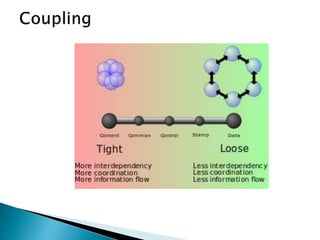
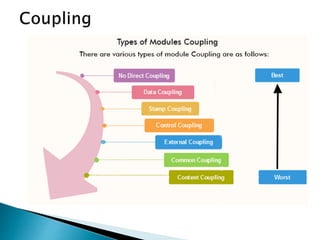
 Coupling is defined as the extent to which a
system, subsystem, method or module
connects with (depends on) others. In other
words, it measures interdependency. The
lower the coupling, the better the program.
 Coupling increases as the number of calls
between modules increase or the amount of
shared data is large
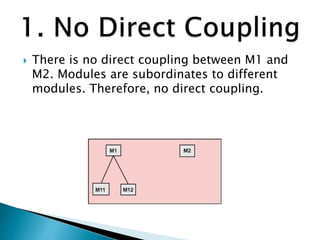
 There is no direct coupling between M1 and
M2. Modules are subordinates to different
modules. Therefore, no direct coupling.
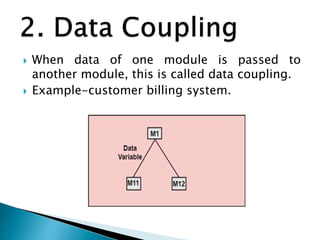
 When data of one module is passed to
another module, this is called data coupling.
 Example-customer billing system.
 Two modules are stamp coupled if they
communicate using composite data items
such as structure, objects, etc. When the
module passes non-global data structure or
entire structure to another module, they are
said to be stamp coupled. For example,
passing structure variable in C or object in
C++ language to a module.
 Control Coupling exists
among two modules if data
from one module is used to
direct the structure of
instruction execution in
another.
 External Coupling arises when two
modules share an externally imposed
data format, communication
protocols, or device interface. This is
related to communication to external
tools and devices.
 Ex- protocol, external file, device
format, etc.
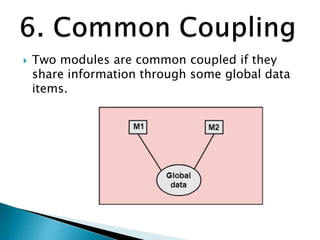
 Two modules are common coupled if they
share information through some global data
items.
 Content Coupling exists among two modules
if they share code, e.g., a branch from one
module into another module.
 Cohesion defines to the degree to
which the elements of a module
belong together. Thus, cohesion
measures the strength of relationships
between pieces of functionality within
a given module. For example, in
highly cohesive systems, functionality
is strongly related. A good software
design will have high cohesion.
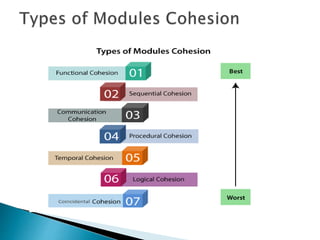
 Functional Cohesion is said to exist if the
different elements of a module, cooperate to
achieve a single function.
 A module is said to possess sequential
cohesion if the element of a module form the
components of the sequence, where the
output from one component of the sequence
is input to the next.
 A module is said to have communicational
cohesion, if all tasks of the module refer to or
update the same data structure, e.g., the set
of functions defined on an array or a stack.
 A module is said to be procedural cohesion if
the set of purpose of the module are all parts
of a procedure in which particular sequence
of steps has to be carried out for achieving a
goal, e.g., the algorithm for decoding a
message.
 When a module includes functions that are
associated by the fact that all the methods
must be executed in the same time, the
module is said to exhibit temporal cohesion.
 A module is said to be logically cohesive if all
the elements of the module perform a similar
operation. For example Error handling, data
input and data output, etc.
 A module is said to have coincidental
cohesion if it performs a set of tasks that are
associated with each other very loosely, if at
all.
S.No Coupling Cohesion
1
Cohesion is the concept of intra module. Coupling is the concept of inter module.
2
Cohesion represents the relationship within
module.
Coupling represents the relationships
between modules.
3
Increasing in cohesion is good for
software.
Increasing in coupling is avoided for
software.
4
Cohesion represents the functional
strength of modules.
Coupling represents the independence
among modules.
5
High cohesion gives the best software. Loose coupling gives the best software.
6
In cohesion, module focuses on the single
thing.
In coupling, modules are connected to
the other modules.

Coupling and cohesion

  • 1.
    V.Sutha Jebakumari AP/CSE Kamaraj Collegeof Engineering and Technology September 4, 2019
  • 2.
     Software designis a process to transform user requirements into some suitable form, which helps the programmer in software coding and implementation.  The activity that leads from requirements to implementation.
  • 3.
     Software designyields three levels of results:  Architectural Design - The architectural design is the highest abstract version of the system. It identifies the software as a system with many components interacting with each other. At this level, the designers get the idea of proposed solution domain.  High-level Design- High-level design focuses on how the system along with all of its components can be implemented in forms of modules. It recognizes modular structure of each sub-system and their relation and interaction among each other.  Detailed Design- Detailed design deals with the implementation part of what is seen as a system and its sub-systems in the previous two designs. It is more detailed towards modules and their implementations.
  • 4.
     Modularization isa technique to divide a software system into multiple discrete and independent modules, which are expected to be capable of carrying out task(s) independently. Designers tend to design modules such that they can be executed and/or compiled separately and independently.
  • 5.
     Smaller componentsare easier to maintain  Program can be divided based on functional aspects  Desired level of abstraction can be brought in the program  Components with high cohesion can be re-used again  Concurrent execution can be made possible
  • 6.
     When asoftware program is modularized, its tasks are divided into several modules based on some characteristics. There are measures by which the quality of a design of modules and their interaction among them can be measured. These measures are called coupling and cohesion.
  • 7.
     Coupling –concerns relationships between modules  Cohesion – concerns relationships within a module • Goal: To have loosely coupled modules with high internal cohesion
  • 8.
     Coupling isdefined as the extent to which a system, subsystem, method or module connects with (depends on) others. In other words, it measures interdependency. The lower the coupling, the better the program.  Coupling increases as the number of calls between modules increase or the amount of shared data is large
  • 11.
     There isno direct coupling between M1 and M2. Modules are subordinates to different modules. Therefore, no direct coupling.
  • 12.
     When dataof one module is passed to another module, this is called data coupling.  Example-customer billing system.
  • 13.
     Two modulesare stamp coupled if they communicate using composite data items such as structure, objects, etc. When the module passes non-global data structure or entire structure to another module, they are said to be stamp coupled. For example, passing structure variable in C or object in C++ language to a module.
  • 14.
     Control Couplingexists among two modules if data from one module is used to direct the structure of instruction execution in another.
  • 15.
     External Couplingarises when two modules share an externally imposed data format, communication protocols, or device interface. This is related to communication to external tools and devices.  Ex- protocol, external file, device format, etc.
  • 16.
     Two modulesare common coupled if they share information through some global data items.
  • 17.
     Content Couplingexists among two modules if they share code, e.g., a branch from one module into another module.
  • 18.
     Cohesion definesto the degree to which the elements of a module belong together. Thus, cohesion measures the strength of relationships between pieces of functionality within a given module. For example, in highly cohesive systems, functionality is strongly related. A good software design will have high cohesion.
  • 20.
     Functional Cohesionis said to exist if the different elements of a module, cooperate to achieve a single function.
  • 21.
     A moduleis said to possess sequential cohesion if the element of a module form the components of the sequence, where the output from one component of the sequence is input to the next.
  • 22.
     A moduleis said to have communicational cohesion, if all tasks of the module refer to or update the same data structure, e.g., the set of functions defined on an array or a stack.
  • 23.
     A moduleis said to be procedural cohesion if the set of purpose of the module are all parts of a procedure in which particular sequence of steps has to be carried out for achieving a goal, e.g., the algorithm for decoding a message.
  • 24.
     When amodule includes functions that are associated by the fact that all the methods must be executed in the same time, the module is said to exhibit temporal cohesion.
  • 25.
     A moduleis said to be logically cohesive if all the elements of the module perform a similar operation. For example Error handling, data input and data output, etc.
  • 26.
     A moduleis said to have coincidental cohesion if it performs a set of tasks that are associated with each other very loosely, if at all.
  • 27.
    S.No Coupling Cohesion 1 Cohesionis the concept of intra module. Coupling is the concept of inter module. 2 Cohesion represents the relationship within module. Coupling represents the relationships between modules. 3 Increasing in cohesion is good for software. Increasing in coupling is avoided for software. 4 Cohesion represents the functional strength of modules. Coupling represents the independence among modules. 5 High cohesion gives the best software. Loose coupling gives the best software. 6 In cohesion, module focuses on the single thing. In coupling, modules are connected to the other modules.

Editor's Notes

  • #2 October 12, 2001