
Early 
CHILDHOOD TUBERCULOSIS 
Gopakumar Hariharan 
Senior Registrar, NPICU 
Royal Hobart Hospital, 
Tasmania, Australia
Introduction 
• Case scenario 
• Mode of transmission 
• Pathophysiology 
• Investigations 
• Treatment 
• Complications
Case Scenario 
• 3 months old 
• Apnea and respiratory distress 
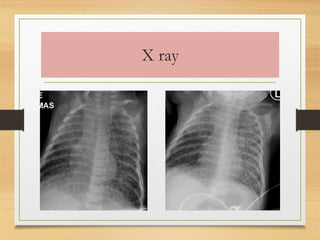
• CXR- Miliary patttern suggestive of TB 
• Mum- open case- cavitating lesion of lungs – AFB 
positive 
• Choroid Tubercles 
• On ATT ; Managed in Adult ICU
Tuberculosis 
• Chronic infection – Mycobacterium 
Tuberculosis 
• Major public health problem 
• Pulmonary and extrapulmonary
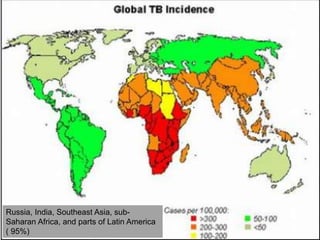
Russia, India, Southeast Asia, sub- 
Saharan Africa, and parts of Latin America 
( 95%)
Portal of entry for tuberculosis 
• Inhalation of Tubercle bacilli in >95% (M.TB) – Reservoir( 
infected person) 
• Ingestion of milk containing Bovine Tubercle bacilli (M. 
bovis) 
• Contamination of superficial skin or mucous membrane lesion 
with tubercle bacilli 
• Congenital infection when mother has 
lymphohematogenous spread during pregnancy OR 
tuberculous endometritis
Epidemiology 
• Host Factors 
• Age : all ages affected, congenital is rare 
• Malnutrition : more susceptible 
• Intercurrent infections : e.g. measles, whooping cough 
• Environment : overcrowding, inadequate ventilation, 
damp, insanitary and unhygienic conditions
Primary tuberculous infection 
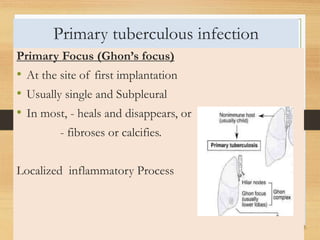
Primary Focus (Ghon’s focus) 
• At the site of first implantation 
• Usually single and Subpleural 
• In most, - heals and disappears, or 
- fibroses or calcifies. 
Localized inflammatory Process
Primary complex 
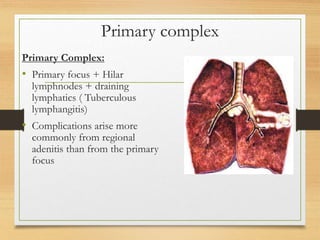
Primary Complex: 
• Primary focus + Hilar 
lymphnodes + draining 
lymphatics ( Tuberculous 
lymphangitis) 
• Complications arise more 
commonly from regional 
adenitis than from the primary 
focus
Progressive primary tuberculosis 
• Apparently healed focus or nodes may contain viable 
organisms for many years. 
• During 1st 4-8 weeks, organisms are disseminated in the blood 
stream directly or via lymphatic duct – involves multiple 
organs 
• Progression of TB depends on the age of the child, number of 
tubercle bacilli, and host resistance ( HIV )
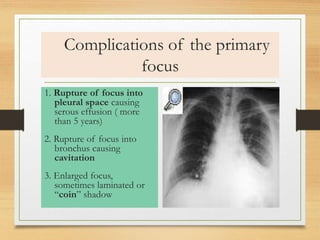
Complications of the primary 
focus 
1. Rupture of focus into 
pleural space causing 
serous effusion ( more 
than 5 years) 
2. Rupture of focus into 
bronchus causing 
cavitation 
3. Enlarged focus, 
sometimes laminated or 
“coin” shadow
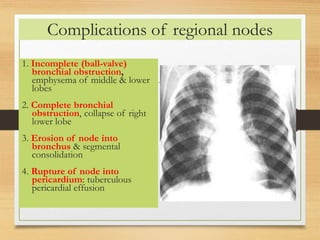
Complications of regional nodes 
1. Incomplete (ball-valve) 
bronchial obstruction, 
emphysema of middle & lower 
lobes 
2. Complete bronchial 
obstruction, collapse of right 
lower lobe 
3. Erosion of node into 
bronchus & segmental 
consolidation 
4. Rupture of node into 
pericardium: tuberculous 
pericardial effusion
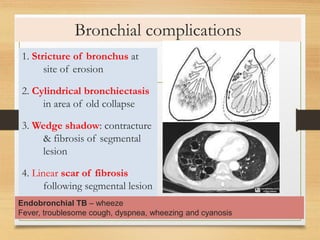
Bronchial complications 
1. Stricture of bronchus at 
site of erosion 
2. Cylindrical bronchiectasis 
in area of old collapse 
3. Wedge shadow: contracture 
& fibrosis of segmental 
lesion 
4. Linear scar of fibrosis 
following segmental lesion 
Endobronchial TB – wheeze 
Fever, troublesome cough, dyspnea, wheezing and cyanosis
Symptoms 
• Primary complex – mild fever, anorexia, weight 
loss, decreased activity, cough 
• Progressive primary complex – high grade fever, 
cough. 
• Expectoration and hemoptysis – usually associated 
with cavity and ulceration of bronchus. 
• Abnormal chest signs – decreased air entry, 
dullness, creps
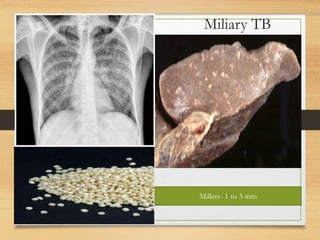
Miliary tuberculosis 
• Most common within 1st 3 to 6 months after 
infection 
• Due to heavy hematogenous spread of tubercle 
bacilli 
• Onset: Insidious, with 
Fever and weight loss 
Palpable liver and/or spleen 
Tachypnoea with normal chest findings
Miliary tuberculosis 
• Hematogenous dissemination - progressive 
development of small lesions throughout the body, 
with tubercles in the 
• lung, spleen, liver, 
• bone marrow, heart, pancreas 
• brain, choroid, skin 
Radiologic diagnosis: 
• “Snow storm” appearance (Multiple small lung 
nodules 1mm size and above in both lung fields).
Miliary TB 
Millets- 1 to 3 mm
X ray
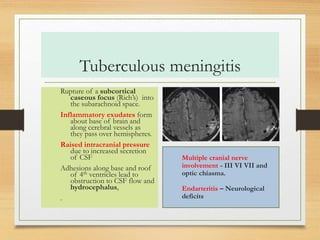
Tuberculous meningitis 
Rupture of a subcortical 
caseous focus (Rich’s) into 
the subarachnoid space. 
Inflammatory exudates form 
about base of brain and 
along cerebral vessels as 
they pass over hemispheres. 
Raised intracranial pressure 
due to increased secretion 
of CSF 
Adhesions along base and roof 
of 4th ventricles lead to 
obstruction to CSF flow and 
hydrocephalus, 
. 
Multiple cranial nerve 
involvement - III VI VII and 
optic chiasma. 
Endarteritis – Neurological 
deficits
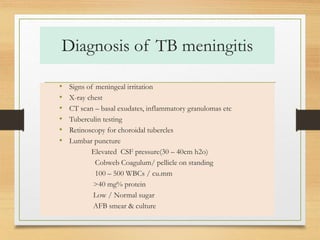
Diagnosis of TB meningitis 
• Signs of meningeal irritation 
• X-ray chest 
• CT scan – basal exudates, inflammatory granulomas etc 
• Tuberculin testing 
• Retinoscopy for choroidal tubercles 
• Lumbar puncture 
Elevated CSF pressure(30 – 40cm h2o) 
Cobweb Coagulum/ pellicle on standing 
100 – 500 WBCs / cu.mm 
>40 mg% protein 
Low / Normal sugar 
AFB smear & culture
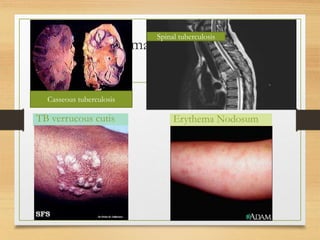
Spinal tuberculosis 
Skin manifestations 
Casseous tuberculosis 
TB verrucous cutis Erythema Nodosum
) 
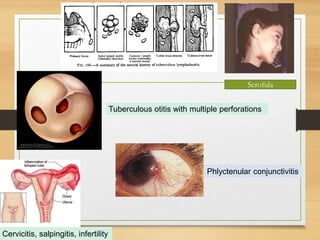
Scrofula 
Phlyctenular conjunctivitis 
Cervicitis, salpingitis, infertility 
Tuberculous otitis with multiple perforations
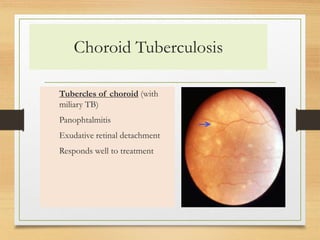
Choroid Tuberculosis 
Tubercles of choroid (with 
miliary TB) 
Panophtalmitis 
Exudative retinal detachment 
Responds well to treatment
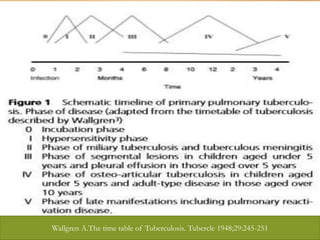
Wallgren A.The time table of Tuberculosis. Tubercle 1948;29:245-251
Direct tests for tuberculosis 
• Ziehl-Neelsen staining for AFB in 
clinical specimens (sputum, gastric juice, 
biopsy) 
• AFB culture on Lowenstein-Jensen solid 
medium (4 weeks) 
• PCR amplification of targeted 
mycobacterial DNA sequences 
• DNA probes: fluorescence in situ 
hybridization assays
Other tests 
• PCR – rapid results ( antigen/ antibodies) 
• Serodiagnosis – ELISA 
• QuantiFERON- TB test (QFT) – for diagnosing 
latent TB. Based on IFN-gamma released from 
sensitized lymphocytes. 
ELISPOT
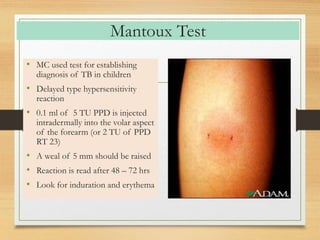
Mantoux Test 
• MC used test for establishing 
diagnosis of TB in children 
• Delayed type hypersensitivity 
reaction 
• 0.1 ml of 5 TU PPD is injected 
intradermally into the volar aspect 
of the forearm (or 2 TU of PPD 
RT 23) 
• A weal of 5 mm should be raised 
• Reaction is read after 48 – 72 hrs 
• Look for induration and erythema
Observation and Inference 
• 48-72 hours later  diameter of induration is measured 
transversely to the long axis of the forearm. 
• Induration > 10mm is suggestive of natural infection. 
• 5-10 mm  borderline; considered positive in 
immunocompromised host 
• <5mm  Negative mantoux test does not rule out TB
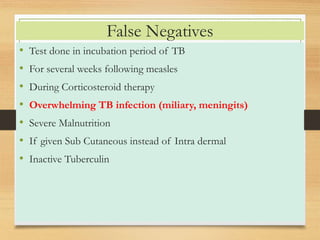
False Negatives 
• Test done in incubation period of TB 
• For several weeks following measles 
• During Corticosteroid therapy 
• Overwhelming TB infection (miliary, meningits) 
• Severe Malnutrition 
• If given Sub Cutaneous instead of Intra dermal 
• Inactive Tuberculin
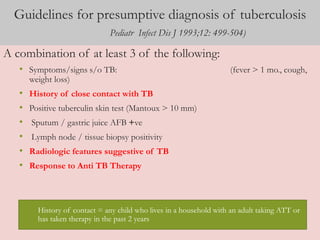
Guidelines for presumptive diagnosis of tuberculosis 
Pediatr Infect Dis J 1993;12: 499-504) 
A combination of at least 3 of the following: 
• Symptoms/signs s/o TB: (fever > 1 mo., cough, 
weight loss) 
• History of close contact with TB 
• Positive tuberculin skin test (Mantoux > 10 mm) 
• Sputum / gastric juice AFB +ve 
• Lymph node / tissue biopsy positivity 
• Radiologic features suggestive of TB 
• Response to Anti TB Therapy 
History of contact = any child who lives in a household with an adult taking ATT or 
has taken therapy in the past 2 years
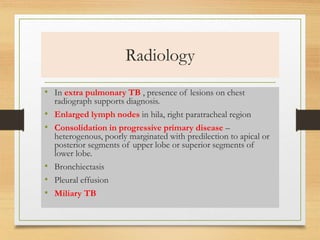
Radiology 
• In extra pulmonary TB , presence of lesions on chest 
radiograph supports diagnosis. 
• Enlarged lymph nodes in hila, right paratracheal region 
• Consolidation in progressive primary disease – 
heterogenous, poorly marginated with predilection to apical or 
posterior segments of upper lobe or superior segments of 
lower lobe. 
• Bronchiectasis 
• Pleural effusion 
• Miliary TB
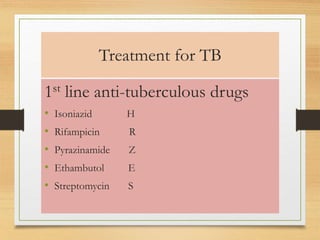
Treatment for TB 
1st line anti-tuberculous drugs 
• Isoniazid H 
• Rifampicin R 
• Pyrazinamide Z 
• Ethambutol E 
• Streptomycin S
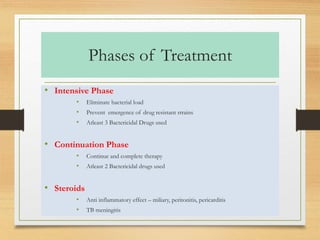
Phases of Treatment 
• Intensive Phase 
• Eliminate bacterial load 
• Prevent emergence of drug resistant strains 
• Atleast 3 Bactericidal Drugs used 
• Continuation Phase 
• Continue and complete therapy 
• Atleast 2 Bactericidal drugs used 
• Steroids 
• Anti inflammatory effect – miliary, peritonitis, pericarditis 
• TB meningitis
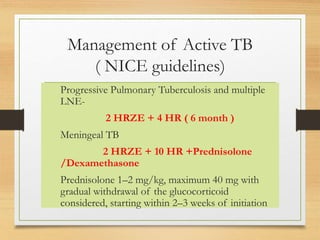
Management of Active TB 
( NICE guidelines) 
Progressive Pulmonary Tuberculosis and multiple 
LNE- 
2 HRZE + 4 HR ( 6 month ) 
Meningeal TB 
2 HRZE + 10 HR +Prednisolone 
/Dexamethasone 
Prednisolone 1–2 mg/kg, maximum 40 mg with 
gradual withdrawal of the glucocorticoid 
considered, starting within 2–3 weeks of initiation
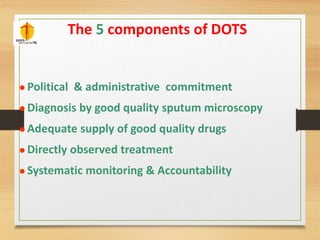
The 5 components of DOTS 
 Political & administrative commitment 
 Diagnosis by good quality sputum microscopy 
 Adequate supply of good quality drugs 
 Directly observed treatment 
 Systematic monitoring & Accountability
Prevention 
Children with pulmonary TB disease are 
rarely infectious due to 
• Their pattern of disease, 
• Low bacillary load and 
• Lack of coughing force
Diagnosing latent TB 
• Mantoux testing - household contacts (aged 5 years 
and older) of all people with active TB and non-household 
contacts (other close contacts for 
example, in workplaces and schools). 
• Consider Interferon-gamma testing - Mantoux 
testing shows positive results, or in people for whom 
Mantoux testing may be less reliable, for example 
BCG-vaccinated people. ( high specificity)
Contacts – outbreak situation 
• Active community surveillance 
• Large numbers of people may need to be screened, 
consider a single interferon-gamma test for people 
aged 5 years and older. 
• Preventive Therapy In Mantoux Positive : 6 HR
Healthcare workers 
• Offer a Mantoux test to new employees who will be 
in contact with patients or clinical materials if the 
employees: 
• Have not had BCG vaccination (for example, they 
are without scar, other documentation or reliable 
history). 
• Mantoux test is positive, offer an interferon-gamma 
test
BCG vaccination for 
healthcare workers 
• BCG vaccination should be offered to healthcare 
workers, irrespective of age, who: 
• are previously unvaccinated (that is, without adequate 
documentation or a characteristic scar), and 
• will have contact with patients or clinical 
materials, and 
• are Mantoux (or interferon-gamma) negative.
BCG vaccination for contacts 
of people with active TB 
• BCG vaccination should be offered to Mantoux-negative 
contacts of people with respiratory TB if 
they are previously unvaccinated and are: 
• Aged 35 or younger 
• aged 36 and older and a healthcare or laboratory 
worker who has contact with patients or clinical 
materials
Infection control 
Three levels of isolation for infection control in 
hospital settings: 
• Negative-pressure rooms 
• Single rooms - not negative pressure but are vented 
to the outside of the building 
• Beds on a ward
Isolation guidelines( NICE) 
• Should be given a single room. Preferably not 
admitted 
• Visitors to a child with TB in hospital - screened 
as part of contact tracing, and kept separate from 
other patients until they have been excluded as the 
source of infection 
• Isolation for 2 weeks of treatment
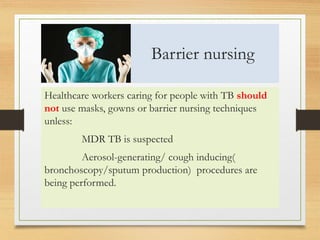
Barrier nursing 
Healthcare workers caring for people with TB should 
not use masks, gowns or barrier nursing techniques 
unless: 
MDR TB is suspected 
Aerosol-generating/ cough inducing( 
bronchoscopy/sputum production) procedures are 
being performed.
?Long term follow up 
Regular follow-up clinic visits after treatment 
completion were unnecessary. 
Patients should be advised to watch for symptoms of 
relapse and to contact the TB service rapidly if the 
symptoms occur.
Multidrug resistant Tuberculosis 
• A minority of cases, 6–8% in England and Wales, are 
resistant to one of the antibiotics. 
• Isoniazid and rifampicin are ineffective in 1% of 
cases. 
• These are said to be cases of multidrug-resistant 
(MDR) TB, which requires special treatment and 
careful monitoring.
Summary 
• Pathophysiology of childhood Tuberculosis 
• Various clinical manifestations 
• Management 
• Treatment 
• Preventive measures 
• Surveillance
“Nothing in life is to be feared, it is only to be 
understood. Now is the time to understand more, so that 
we may fear less.” 
― Marie Curie

Early childhood tuberculosis

  • 1.
    Early CHILDHOOD TUBERCULOSIS Gopakumar Hariharan Senior Registrar, NPICU Royal Hobart Hospital, Tasmania, Australia
  • 2.
    Introduction • Casescenario • Mode of transmission • Pathophysiology • Investigations • Treatment • Complications
  • 3.
    Case Scenario •3 months old • Apnea and respiratory distress • CXR- Miliary patttern suggestive of TB • Mum- open case- cavitating lesion of lungs – AFB positive • Choroid Tubercles • On ATT ; Managed in Adult ICU
  • 4.
    Tuberculosis • Chronicinfection – Mycobacterium Tuberculosis • Major public health problem • Pulmonary and extrapulmonary
  • 5.
    Russia, India, SoutheastAsia, sub- Saharan Africa, and parts of Latin America ( 95%)
  • 6.
    Portal of entryfor tuberculosis • Inhalation of Tubercle bacilli in >95% (M.TB) – Reservoir( infected person) • Ingestion of milk containing Bovine Tubercle bacilli (M. bovis) • Contamination of superficial skin or mucous membrane lesion with tubercle bacilli • Congenital infection when mother has lymphohematogenous spread during pregnancy OR tuberculous endometritis
  • 7.
    Epidemiology • HostFactors • Age : all ages affected, congenital is rare • Malnutrition : more susceptible • Intercurrent infections : e.g. measles, whooping cough • Environment : overcrowding, inadequate ventilation, damp, insanitary and unhygienic conditions
  • 8.
    Primary tuberculous infection Primary Focus (Ghon’s focus) • At the site of first implantation • Usually single and Subpleural • In most, - heals and disappears, or - fibroses or calcifies. Localized inflammatory Process
  • 9.
    Primary complex PrimaryComplex: • Primary focus + Hilar lymphnodes + draining lymphatics ( Tuberculous lymphangitis) • Complications arise more commonly from regional adenitis than from the primary focus
  • 10.
    Progressive primary tuberculosis • Apparently healed focus or nodes may contain viable organisms for many years. • During 1st 4-8 weeks, organisms are disseminated in the blood stream directly or via lymphatic duct – involves multiple organs • Progression of TB depends on the age of the child, number of tubercle bacilli, and host resistance ( HIV )
  • 11.
    Complications of theprimary focus 1. Rupture of focus into pleural space causing serous effusion ( more than 5 years) 2. Rupture of focus into bronchus causing cavitation 3. Enlarged focus, sometimes laminated or “coin” shadow
  • 12.
    Complications of regionalnodes 1. Incomplete (ball-valve) bronchial obstruction, emphysema of middle & lower lobes 2. Complete bronchial obstruction, collapse of right lower lobe 3. Erosion of node into bronchus & segmental consolidation 4. Rupture of node into pericardium: tuberculous pericardial effusion
  • 13.
    Bronchial complications 1.Stricture of bronchus at site of erosion 2. Cylindrical bronchiectasis in area of old collapse 3. Wedge shadow: contracture & fibrosis of segmental lesion 4. Linear scar of fibrosis following segmental lesion Endobronchial TB – wheeze Fever, troublesome cough, dyspnea, wheezing and cyanosis
  • 14.
    Symptoms • Primarycomplex – mild fever, anorexia, weight loss, decreased activity, cough • Progressive primary complex – high grade fever, cough. • Expectoration and hemoptysis – usually associated with cavity and ulceration of bronchus. • Abnormal chest signs – decreased air entry, dullness, creps
  • 15.
    Miliary tuberculosis •Most common within 1st 3 to 6 months after infection • Due to heavy hematogenous spread of tubercle bacilli • Onset: Insidious, with Fever and weight loss Palpable liver and/or spleen Tachypnoea with normal chest findings
  • 16.
    Miliary tuberculosis •Hematogenous dissemination - progressive development of small lesions throughout the body, with tubercles in the • lung, spleen, liver, • bone marrow, heart, pancreas • brain, choroid, skin Radiologic diagnosis: • “Snow storm” appearance (Multiple small lung nodules 1mm size and above in both lung fields).
  • 17.
  • 18.
  • 19.
    Tuberculous meningitis Ruptureof a subcortical caseous focus (Rich’s) into the subarachnoid space. Inflammatory exudates form about base of brain and along cerebral vessels as they pass over hemispheres. Raised intracranial pressure due to increased secretion of CSF Adhesions along base and roof of 4th ventricles lead to obstruction to CSF flow and hydrocephalus, . Multiple cranial nerve involvement - III VI VII and optic chiasma. Endarteritis – Neurological deficits
  • 20.
    Diagnosis of TBmeningitis • Signs of meningeal irritation • X-ray chest • CT scan – basal exudates, inflammatory granulomas etc • Tuberculin testing • Retinoscopy for choroidal tubercles • Lumbar puncture Elevated CSF pressure(30 – 40cm h2o) Cobweb Coagulum/ pellicle on standing 100 – 500 WBCs / cu.mm >40 mg% protein Low / Normal sugar AFB smear & culture
  • 21.
    Spinal tuberculosis Skinmanifestations Casseous tuberculosis TB verrucous cutis Erythema Nodosum
  • 22.
    ) Scrofula Phlyctenularconjunctivitis Cervicitis, salpingitis, infertility Tuberculous otitis with multiple perforations
  • 23.
    Choroid Tuberculosis Tuberclesof choroid (with miliary TB) Panophtalmitis Exudative retinal detachment Responds well to treatment
  • 24.
    Wallgren A.The timetable of Tuberculosis. Tubercle 1948;29:245-251
  • 25.
    Direct tests fortuberculosis • Ziehl-Neelsen staining for AFB in clinical specimens (sputum, gastric juice, biopsy) • AFB culture on Lowenstein-Jensen solid medium (4 weeks) • PCR amplification of targeted mycobacterial DNA sequences • DNA probes: fluorescence in situ hybridization assays
  • 26.
    Other tests •PCR – rapid results ( antigen/ antibodies) • Serodiagnosis – ELISA • QuantiFERON- TB test (QFT) – for diagnosing latent TB. Based on IFN-gamma released from sensitized lymphocytes. ELISPOT
  • 27.
    Mantoux Test •MC used test for establishing diagnosis of TB in children • Delayed type hypersensitivity reaction • 0.1 ml of 5 TU PPD is injected intradermally into the volar aspect of the forearm (or 2 TU of PPD RT 23) • A weal of 5 mm should be raised • Reaction is read after 48 – 72 hrs • Look for induration and erythema
  • 28.
    Observation and Inference • 48-72 hours later  diameter of induration is measured transversely to the long axis of the forearm. • Induration > 10mm is suggestive of natural infection. • 5-10 mm  borderline; considered positive in immunocompromised host • <5mm  Negative mantoux test does not rule out TB
  • 29.
    False Negatives •Test done in incubation period of TB • For several weeks following measles • During Corticosteroid therapy • Overwhelming TB infection (miliary, meningits) • Severe Malnutrition • If given Sub Cutaneous instead of Intra dermal • Inactive Tuberculin
  • 30.
    Guidelines for presumptivediagnosis of tuberculosis Pediatr Infect Dis J 1993;12: 499-504) A combination of at least 3 of the following: • Symptoms/signs s/o TB: (fever > 1 mo., cough, weight loss) • History of close contact with TB • Positive tuberculin skin test (Mantoux > 10 mm) • Sputum / gastric juice AFB +ve • Lymph node / tissue biopsy positivity • Radiologic features suggestive of TB • Response to Anti TB Therapy History of contact = any child who lives in a household with an adult taking ATT or has taken therapy in the past 2 years
  • 31.
    Radiology • Inextra pulmonary TB , presence of lesions on chest radiograph supports diagnosis. • Enlarged lymph nodes in hila, right paratracheal region • Consolidation in progressive primary disease – heterogenous, poorly marginated with predilection to apical or posterior segments of upper lobe or superior segments of lower lobe. • Bronchiectasis • Pleural effusion • Miliary TB
  • 32.
    Treatment for TB 1st line anti-tuberculous drugs • Isoniazid H • Rifampicin R • Pyrazinamide Z • Ethambutol E • Streptomycin S
  • 33.
    Phases of Treatment • Intensive Phase • Eliminate bacterial load • Prevent emergence of drug resistant strains • Atleast 3 Bactericidal Drugs used • Continuation Phase • Continue and complete therapy • Atleast 2 Bactericidal drugs used • Steroids • Anti inflammatory effect – miliary, peritonitis, pericarditis • TB meningitis
  • 34.
    Management of ActiveTB ( NICE guidelines) Progressive Pulmonary Tuberculosis and multiple LNE- 2 HRZE + 4 HR ( 6 month ) Meningeal TB 2 HRZE + 10 HR +Prednisolone /Dexamethasone Prednisolone 1–2 mg/kg, maximum 40 mg with gradual withdrawal of the glucocorticoid considered, starting within 2–3 weeks of initiation
  • 36.
    The 5 componentsof DOTS  Political & administrative commitment  Diagnosis by good quality sputum microscopy  Adequate supply of good quality drugs  Directly observed treatment  Systematic monitoring & Accountability
  • 37.
    Prevention Children withpulmonary TB disease are rarely infectious due to • Their pattern of disease, • Low bacillary load and • Lack of coughing force
  • 38.
    Diagnosing latent TB • Mantoux testing - household contacts (aged 5 years and older) of all people with active TB and non-household contacts (other close contacts for example, in workplaces and schools). • Consider Interferon-gamma testing - Mantoux testing shows positive results, or in people for whom Mantoux testing may be less reliable, for example BCG-vaccinated people. ( high specificity)
  • 39.
    Contacts – outbreaksituation • Active community surveillance • Large numbers of people may need to be screened, consider a single interferon-gamma test for people aged 5 years and older. • Preventive Therapy In Mantoux Positive : 6 HR
  • 40.
    Healthcare workers •Offer a Mantoux test to new employees who will be in contact with patients or clinical materials if the employees: • Have not had BCG vaccination (for example, they are without scar, other documentation or reliable history). • Mantoux test is positive, offer an interferon-gamma test
  • 41.
    BCG vaccination for healthcare workers • BCG vaccination should be offered to healthcare workers, irrespective of age, who: • are previously unvaccinated (that is, without adequate documentation or a characteristic scar), and • will have contact with patients or clinical materials, and • are Mantoux (or interferon-gamma) negative.
  • 42.
    BCG vaccination forcontacts of people with active TB • BCG vaccination should be offered to Mantoux-negative contacts of people with respiratory TB if they are previously unvaccinated and are: • Aged 35 or younger • aged 36 and older and a healthcare or laboratory worker who has contact with patients or clinical materials
  • 43.
    Infection control Threelevels of isolation for infection control in hospital settings: • Negative-pressure rooms • Single rooms - not negative pressure but are vented to the outside of the building • Beds on a ward
  • 44.
    Isolation guidelines( NICE) • Should be given a single room. Preferably not admitted • Visitors to a child with TB in hospital - screened as part of contact tracing, and kept separate from other patients until they have been excluded as the source of infection • Isolation for 2 weeks of treatment
  • 45.
    Barrier nursing Healthcareworkers caring for people with TB should not use masks, gowns or barrier nursing techniques unless: MDR TB is suspected Aerosol-generating/ cough inducing( bronchoscopy/sputum production) procedures are being performed.
  • 46.
    ?Long term followup Regular follow-up clinic visits after treatment completion were unnecessary. Patients should be advised to watch for symptoms of relapse and to contact the TB service rapidly if the symptoms occur.
  • 47.
    Multidrug resistant Tuberculosis • A minority of cases, 6–8% in England and Wales, are resistant to one of the antibiotics. • Isoniazid and rifampicin are ineffective in 1% of cases. • These are said to be cases of multidrug-resistant (MDR) TB, which requires special treatment and careful monitoring.
  • 48.
    Summary • Pathophysiologyof childhood Tuberculosis • Various clinical manifestations • Management • Treatment • Preventive measures • Surveillance
  • 49.
    “Nothing in lifeis to be feared, it is only to be understood. Now is the time to understand more, so that we may fear less.” ― Marie Curie

Editor's Notes