





Submitted to: Submitted by:
Resp. Pawan Sir Miss Abhilasha Verma
B. Sc. Nsg. Part-III
(2011-2012)
1. INTRODUCTION
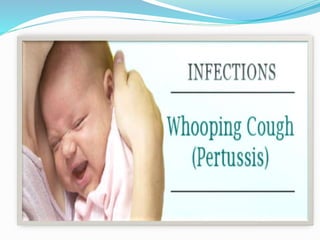
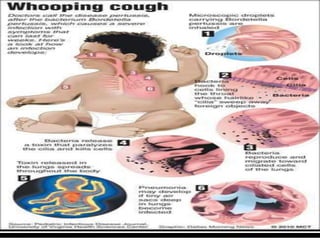
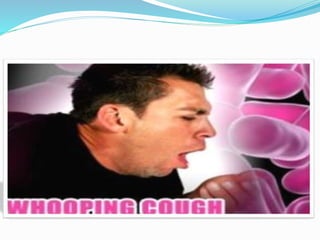
Pertussis, also known as whooping cough is a highly
contagious bacterial disease mainly caused by
Bordetella pertussis.
It's characterized by severe coughing spells, which can
sometimes end in a "whooping" sound when the
person breathes in.
Whooping cough is also known as 100 days cough.
Habbit pattern of coughing may longer or subscquent
weeks & month,so chiniese call it;
‘’’’100 DAYS COUGH’’’.
2. DEFINITION
Pertusis is acute highly contagious disease which cause
classic spasm (paroxyms) of uncontrollable coughing,
that is violent and persistence followed by a sharp,
high pitched intake of air which create characteristic
“WHOOP” sound.
Children who have typically illness of pertusis try to
take deep breath between cough result in whooping
sound.
3. AGENT
Agent of pertusis are-
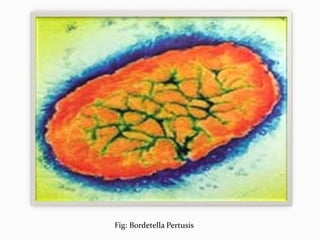
I. Bordetella Pertusis(gm +ve, rod shaped, non motile)
II. Bordetella Parapertusis
III. Haemophillus Haemolyticus
IV. Adeno Virus
V. Bronchi Septica
Fig: Bordetella Pertusis
4. INCUBATION PERIOD
The incubation period is typically seven to ten days in
infants or young children, after which there are usually
mild respiratory symptoms, mild coughing, sneezing,
or runny nose.
5. MODE OF TRANSMISSION
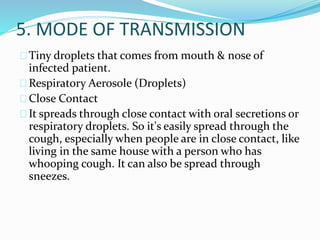
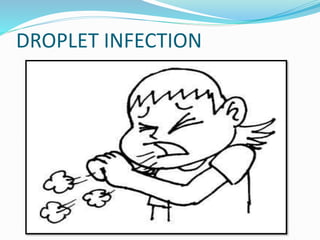
Tiny droplets that comes from mouth & nose of
infected patient.
Respiratory Aerosole (Droplets)
Close Contact
It spreads through close contact with oral secretions or
respiratory droplets. So it's easily spread through the
cough, especially when people are in close contact, like
living in the same house with a person who has
whooping cough. It can also be spread through
sneezes.
DROPLET INFECTION
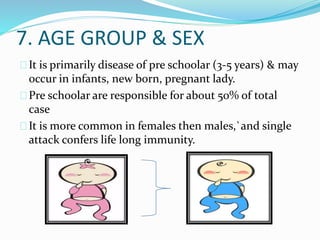
7. AGE GROUP & SEX
It is primarily disease of pre schoolar (3-5 years) & may
occur in infants, new born, pregnant lady.
Pre schoolar are responsible for about 50% of total
case
It is more common in females then males,`and single
attack confers life long immunity.
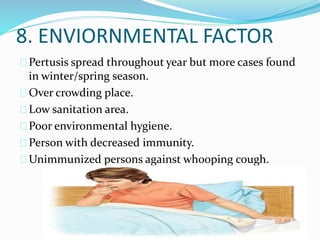
8. ENVIORNMENTAL FACTOR
Pertusis spread throughout year but more cases found
in winter/spring season.
Over crowding place.
Low sanitation area.
Poor environmental hygiene.
Person with decreased immunity.
Unimmunized persons against whooping cough.
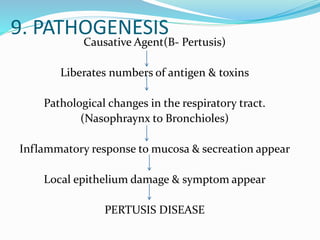
9. PATHOGENESIS
Causative Agent(B- Pertusis)
Liberates numbers of antigen & toxins
Pathological changes in the respiratory tract.
(Nasophraynx to Bronchioles)
Inflammatory response to mucosa & secreation appear
Local epithelium damage & symptom appear
PERTUSIS DISEASE
10. CLINICAL MENIFESTATION
Clinical menifestation include ‘3’ stages;
1. Catarrhal Stage (Pre paroxymal stage, 0-2 weeks)
2. Paroxymal Stage (Spasmodic stage, 2-4 weeks)
3. Convulscent Stage (Last 2 weeks)
STAGE-I CATARRHAL STAGE
Catarrhal symptoms appear that are:
 Fever
 Rhinitis
 Sneezing
 Anorexia
 Nausea & Vomiting
 Lacrimation
 Irritating cough at night (nocturnal but later become
diurnal)
STAGE-II PAROXYMAL STAGE
Cough means in paroxymus (repeatating) & is
accompanied by vomiting.
A typical attack consist of repeated series of many
cough in expiration followed by sudden deep, violent
inspiration with characterise crowing sound
“WHOOP” .
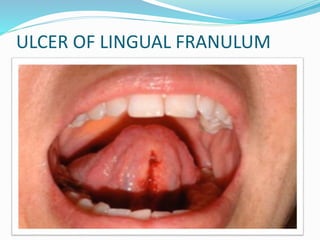
Ulcer of franulum of tounge.
Sweating
Congestion of neck & scalp vein.
Patient appears suffocated with congested (red) face
with or without cyanosis.
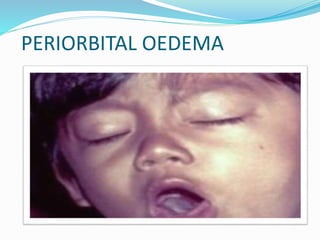
Mouth opened, periorbital oedema
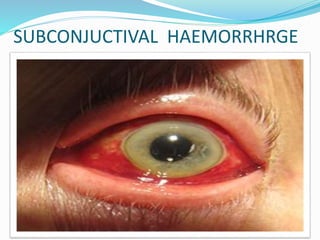
Sub conjuctional haemorrhage
Convulsion may be present.
SUBCONJUCTIVAL HAEMORRHRGE
ULCER OF LINGUAL FRANULUM
PERIORBITAL OEDEMA
STAGE-III CONVULSCENT STAGE
Disturbing cough & vomiting stops and apatite too
imprones.(start of hungerness)
Habit pattern of coughing may be longer to several
weeks & month.
11. COMPLICATIONS
Otitis media is quite frequent.
Respiratory complications are:
• Pneumonia (specially in infants)
• Atelectasis
• Bronchictaxis
• Emphysema
Neurological complication
• Intra cranial hage (Haemorrhage)
• Seizures (due to cerebral hypoxia)
• Paralysis
• Haemiplegia
• Encephalopathy (Encephalitis) (Due to cerebral anoxia)
Rupture of diaphragm.
Rectal prolapse, umblical & inguinal hernia over
whelming strain of violent cough.
Malnutrition due to vomiting.
12. DIAGNOSTIC EVALUATION
Pertusis is difficult to diagnose because coughing may
be due to common cold, bronchitis or chest infection.
For accurate diagnosis:-
1. CBC (Lymphocytosis increased)
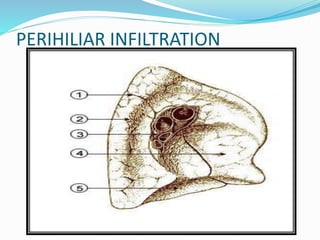
2. Chest X-Ray (Perihilar infiltration, atelectasis,
emphysema)
3. ELISA (To detect IgM, IgG, IgA)
4. Nasophrayngeal swab (Mainly in stage-I)
PERIHILIAR INFILTRATION
13. PREVENTION & CONTROL
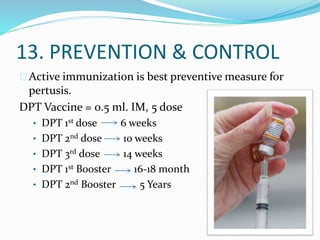
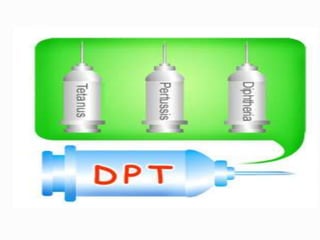
Active immunization is best preventive measure for
pertusis.
DPT Vaccine = 0.5 ml. IM, 5 dose
• DPT 1st dose 6 weeks
• DPT 2nd dose 10 weeks
• DPT 3rd dose 14 weeks
• DPT 1st Booster 16-18 month
• DPT 2nd Booster 5 Years
ANTIBIOTICS
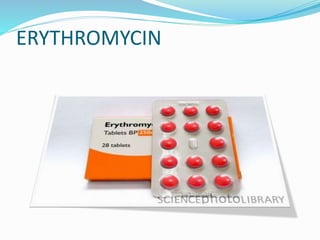
• Erythromycin
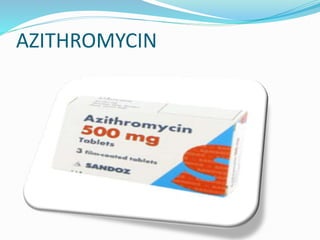
• Azithromycin
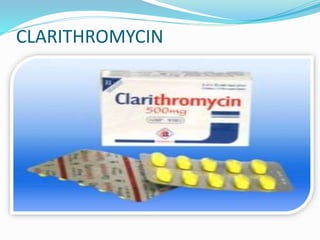
• Clarithromycin
ERYTHROMYCIN
AZITHROMYCIN
CLARITHROMYCIN
14. HEALTH EDUCATION
Emphasis should be placed on minimizing exposure to
susceptible person, specially infant.
Isolation & restriction of case, should be excluded
from work, school, preschool & child care centers.
Regular health check up.
Educate pregnant women to keep distance to such
cases.
Active immunization.
15. CONCLUSION
So by this project, we can say that pertusis or
whooping cough is a disease of respiratory mucus
membrane.
It is a bacterial and contageous disease which mainly
caused by Bordetella Pertusis.
It mainly occur in 3-5 year old children.
It can be prevented by active immunization.
It is treated by DPT Vaccines and Antibiotics.
Pertusis or  Whooping cough class presentation

Pertusis or Whooping cough class presentation

  • 1.
    Submitted to: Submittedby: Resp. Pawan Sir Miss Abhilasha Verma B. Sc. Nsg. Part-III (2011-2012)
  • 4.
    1. INTRODUCTION Pertussis, alsoknown as whooping cough is a highly contagious bacterial disease mainly caused by Bordetella pertussis. It's characterized by severe coughing spells, which can sometimes end in a "whooping" sound when the person breathes in. Whooping cough is also known as 100 days cough. Habbit pattern of coughing may longer or subscquent weeks & month,so chiniese call it; ‘’’’100 DAYS COUGH’’’.
  • 5.
    2. DEFINITION Pertusis isacute highly contagious disease which cause classic spasm (paroxyms) of uncontrollable coughing, that is violent and persistence followed by a sharp, high pitched intake of air which create characteristic “WHOOP” sound. Children who have typically illness of pertusis try to take deep breath between cough result in whooping sound.
  • 6.
    3. AGENT Agent ofpertusis are- I. Bordetella Pertusis(gm +ve, rod shaped, non motile) II. Bordetella Parapertusis III. Haemophillus Haemolyticus IV. Adeno Virus V. Bronchi Septica
  • 7.
  • 8.
    4. INCUBATION PERIOD Theincubation period is typically seven to ten days in infants or young children, after which there are usually mild respiratory symptoms, mild coughing, sneezing, or runny nose.
  • 9.
    5. MODE OFTRANSMISSION Tiny droplets that comes from mouth & nose of infected patient. Respiratory Aerosole (Droplets) Close Contact It spreads through close contact with oral secretions or respiratory droplets. So it's easily spread through the cough, especially when people are in close contact, like living in the same house with a person who has whooping cough. It can also be spread through sneezes.
  • 10.
  • 12.
    7. AGE GROUP& SEX It is primarily disease of pre schoolar (3-5 years) & may occur in infants, new born, pregnant lady. Pre schoolar are responsible for about 50% of total case It is more common in females then males,`and single attack confers life long immunity.
  • 13.
    8. ENVIORNMENTAL FACTOR Pertusisspread throughout year but more cases found in winter/spring season. Over crowding place. Low sanitation area. Poor environmental hygiene. Person with decreased immunity. Unimmunized persons against whooping cough.
  • 14.
    9. PATHOGENESIS Causative Agent(B-Pertusis) Liberates numbers of antigen & toxins Pathological changes in the respiratory tract. (Nasophraynx to Bronchioles) Inflammatory response to mucosa & secreation appear Local epithelium damage & symptom appear PERTUSIS DISEASE
  • 16.
    10. CLINICAL MENIFESTATION Clinicalmenifestation include ‘3’ stages; 1. Catarrhal Stage (Pre paroxymal stage, 0-2 weeks) 2. Paroxymal Stage (Spasmodic stage, 2-4 weeks) 3. Convulscent Stage (Last 2 weeks)
  • 17.
    STAGE-I CATARRHAL STAGE Catarrhalsymptoms appear that are:  Fever  Rhinitis  Sneezing  Anorexia  Nausea & Vomiting  Lacrimation  Irritating cough at night (nocturnal but later become diurnal)
  • 18.
    STAGE-II PAROXYMAL STAGE Coughmeans in paroxymus (repeatating) & is accompanied by vomiting. A typical attack consist of repeated series of many cough in expiration followed by sudden deep, violent inspiration with characterise crowing sound “WHOOP” . Ulcer of franulum of tounge. Sweating Congestion of neck & scalp vein. Patient appears suffocated with congested (red) face with or without cyanosis. Mouth opened, periorbital oedema Sub conjuctional haemorrhage Convulsion may be present.
  • 19.
  • 20.
  • 21.
  • 22.
    STAGE-III CONVULSCENT STAGE Disturbingcough & vomiting stops and apatite too imprones.(start of hungerness) Habit pattern of coughing may be longer to several weeks & month.
  • 24.
    11. COMPLICATIONS Otitis mediais quite frequent. Respiratory complications are: • Pneumonia (specially in infants) • Atelectasis • Bronchictaxis • Emphysema Neurological complication • Intra cranial hage (Haemorrhage) • Seizures (due to cerebral hypoxia) • Paralysis • Haemiplegia • Encephalopathy (Encephalitis) (Due to cerebral anoxia)
  • 25.
    Rupture of diaphragm. Rectalprolapse, umblical & inguinal hernia over whelming strain of violent cough. Malnutrition due to vomiting.
  • 26.
    12. DIAGNOSTIC EVALUATION Pertusisis difficult to diagnose because coughing may be due to common cold, bronchitis or chest infection. For accurate diagnosis:- 1. CBC (Lymphocytosis increased) 2. Chest X-Ray (Perihilar infiltration, atelectasis, emphysema) 3. ELISA (To detect IgM, IgG, IgA) 4. Nasophrayngeal swab (Mainly in stage-I)
  • 27.
  • 28.
    13. PREVENTION &CONTROL Active immunization is best preventive measure for pertusis. DPT Vaccine = 0.5 ml. IM, 5 dose • DPT 1st dose 6 weeks • DPT 2nd dose 10 weeks • DPT 3rd dose 14 weeks • DPT 1st Booster 16-18 month • DPT 2nd Booster 5 Years
  • 32.
  • 33.
  • 34.
  • 35.
  • 36.
    14. HEALTH EDUCATION Emphasisshould be placed on minimizing exposure to susceptible person, specially infant. Isolation & restriction of case, should be excluded from work, school, preschool & child care centers. Regular health check up. Educate pregnant women to keep distance to such cases. Active immunization.
  • 38.
    15. CONCLUSION So bythis project, we can say that pertusis or whooping cough is a disease of respiratory mucus membrane. It is a bacterial and contageous disease which mainly caused by Bordetella Pertusis. It mainly occur in 3-5 year old children. It can be prevented by active immunization. It is treated by DPT Vaccines and Antibiotics.