1
TUBERCULOSIS
Dr Kajoba Dickson
2
OUTLINE
 INTRODUCTION
 ETIOLOGY
 PATHOGENESIS
 CLINICAL PRESENTATION
 INVESTIGATIONS
 MANAGEMENT
 COMPLICATIONS
 PROGNOSIS
 REFERENCES
3
INTRODUCTION
 TB has caused human disease for more than 4,000 yr and is one of
the most important infectious diseases worldwide.
 TB was first recognized as a clinical entity in the early 19th
century by
Schönlein, who used the term TB in 1830, which was derived from the
English term “tubercle,” or lesion of consumption.
4
EPIDEMIOLOGY
 Peak incidence: 1 – 4 years
 Risk of infection depends on extent and duration of exposure
- mother to infant
- child on TB ward
- many sputum positives at home
 Majority of TB-exposed children do not get disease in childhood (latent infection)
 Likelihood of developing disease highest shortly after exposure, decreases
steadily with time
 In infants, time span between infection and disease is 6 – 8 weeks
5
EPIDEMIOLOGY
 estimated 1 million cases of childhood (0-14 years) TB worldwide
 In Uganda, 3316 (7.5%) in children were notified to the TB program
in 2014.
 However, this proportion falls short of the estimated 15% - 20%.
 TB may present at any age in children though the risk is highest below
the age of 2 years.
 When compared to adults, children are more prone to TB infection, TB
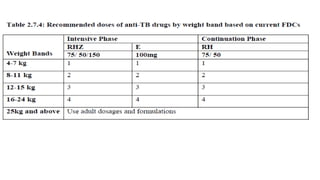
disease, and severe forms of TB disease. This is because their immune
system is not fully developed.
6
ETIOLOGY
 There are 5 closely related mycobacteria in the Mycobacterium TB
complex:
 M. tuberculosis,
 Mycobacterium bovis,
 Mycobacterium africanum,
 Mycobacterium microti,
 and Mycobacterium canetti.
 M. tuberculosis is the most important cause of TB disease in humans.
7
TRANSMISSION
 Usually by inhalation of airborne mucus droplet nuclei, particles 1-5
m in diameter that contain
μ M. tuberculosis.
 Rarely occurs by direct contact with an infected discharge or a
contaminated fomite.
 The chance of transmission increases when the patient has a positive
acid-fast smear of sputum, an extensive upper lobe infiltrate or cavity,
copious production of thin sputum, and severe and forceful cough.
 Environmental factors : poor air circulation enhance transmission.
8
TRANSMISSION Cont’d
 Young children with TB rarely infect other children or adults.
 Children and adolescents with adult-type cavitary or endobronchial
pulmonary TB can transmit the organism.
9
TRANSMISSION Cont’d
 Airborne transmission of M. bovis and M. africanum also occurs.
 M. bovis can penetrate the gastrointestinal mucosa or invade the
lymphatic tissue of the oropharynx when large numbers of the
organism are ingested.
 Human infection with M. bovis is rare in developed countries as a result
of the pasteurization of milk and effective TB control programs for
cattle.
10
PATHOGENESIS
 Transmission is via the respiratory tract:
1. direct droplet spread
2. dry sputum deposits
 Mycobacterium tuberculosis is an obligate aerobe, so organisms settle in alveoli
of the most oxygenated parts of the lungs
 There is an acute inflammatory response in lung tissue with many leucocytes and
monocytes surrounding the organisms
 Thus it can
 Clear the infection
 May fail to clear it thus multiply causing primary infection
 May contain it but still alive but not multiplying thus – latent disease
11
 Primary exposure to T.B bacilli result in formation of primary complex
at the site of entry of the bacilli.
 Composed of :
 Primary focus (Ghon's focus)
 Lymphangitis
 Hilar lymphadenitis
12
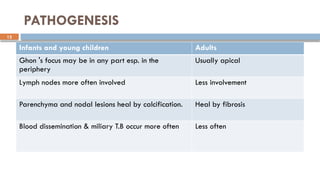
PATHOGENESIS
Infants and young children Adults
Ghon 's focus may be in any part esp. in the
periphery
Usually apical
Lymph nodes more often involved Less involvement
Parenchyma and nodal lesions heal by calcification. Heal by fibrosis
Blood dissemination & miliary T.B occur more often Less often
13
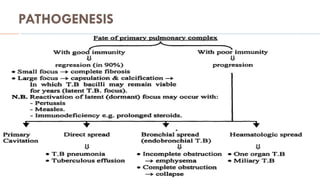
PATHOGENESIS
14
CLINICAL STAGES
3 major clinical stages of TB:
 Exposure,
 Infection, and
 Disease.
15
EXPOSURE
 child has had significant contact (“shared the air”) with an adult or
with infectious TB
 but lacks proof of infection.
 No clinical or paraclinical findings.
 However the child may be infected.
16
INFECTION
 occurs when the individual inhales droplet nuclei containing
Mycobacterium tuberculosis,
 which survive intracellularly within the lung and associated lymphoid
tissue.
 The hallmark of TB infection is a positive Tuberculin Skin Test
 In this stage, the child has no signs or symptoms, a normal physical
examination, and the chest radiograph is either normal or reveals only
granuloma or calcifications in the lung parenchyma.
17
Children at risk
1. Infants in close contact with sputum positive adults e.g. lactating
mother
2. HIV infected children
3. Post-measles or post-pertussis infection
4. Children with severe malnutrition
5. Children not immunized
6. Children exposed to high-risk adults
7. Homeless persons
18
DISEASE
 Signs or symptoms or radiographic manifestations caused by
Mycobacterium tuberculosis become apparent.
 Not all infected individuals have the same risk of developing disease.
 In an infected child younger than 1 yr of age has a 40% chance of
developing disease within 9 mo.
19
R. FACTORS FOR PROGRESSION OF LATENT TB
INFECTION TO TB DISEASE
 Infants and children ≤4 yr of age, especially those <2 yr of age
 Adolescents
 Persons co-infected with HIV
 Persons with skin test conversion in the past 1-2 yr
 Persons who are immunocompromised, especially in cases of
malignancy and solid organ transplantation, immunosuppressive
medical treatments including anti–tumor necrosis factor therapies,
diabetes mellitus, chronic renal failure, silicosis, and malnutrition
20
CLINICAL PRESENTATION
 I. PULMONARY TB
1. Chronic cough (≥ 2 weeks), not responding to conventional treatment
2. Fever
3. Excessive sweating
4. Weight loss or failure to thrive
5. Contact with proven PTB patient or chronically coughing adult
6. Wheeze
7. Lymphadenopathy
8. Poor appetite, vomiting, diarrhoea
 Lung collapse.
21
EXTRA PULMONARY TB
A. Miliary TB
 Common in: infants, malnourished & immunodeficient.
 Due to: Hematogenous spread of T.B bacilli from any focus (usually
pulmonary) with multiple organ involvement (lung, kidneys, liver,
spleen, mininges).
 Clinical picture:
 High spiking fever.
 Toxemia with bad general condition.
22
Miliary TB cont’d
 Hepatosplenomegaly
 Generalized lymphadenopathy
 May be fine crepitations all over the chest
 Fundus examination : choriod tubercles
 Chest xray: small miliary shadows (snow flake opacities).
 Definitive diagnosis: By liver or bone marrow biopsy & histologic
examination .
23
B. Tuberculous meningitis
 Due to Hematogenous spread either isolated or as a part of miliary T.B
 Clinical picture:
 In infancy and early childhood
 Insidious onset
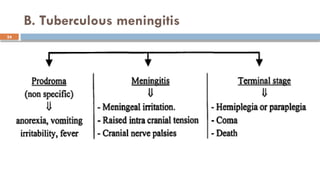
 Pass in 3 stages (each 1-2 weeks)
24
B. Tuberculous meningitis
25
C. Intestinal TB
Occur secondary to:
 Ingested T.B bacilli in milk
 Swallowed sputum from T.B lesions in the lungs.
Clinical picture:
 Coma
 Death
 Tabes mesentrica: - enlarged mesenteric lymph nodes.
 T.B enteritis : -chronic diarrhea failure to thrive.
 chronic abdominal pain.
26
D. Tuberculous peritonitis
 Occur 2ry to: Spread from intestinal or genitourinary T.B lesions
 Clinical picture: - Ascites
 - May be adhesions.
27
INVESTIGATION
 The Tuberculin Skin Test response to tuberculin antigen is a manifestation of a T
cell mediated delayed hypersensitivity.
−
 It is usually positive 2 to 6 weeks after onset of infection (occasionally 3 months) and
at the time of symptomatic illness.
 This test is preferred in children less than 5 years of age.
 It may also be used in other settings such as contact investigations or in older patients.
 Only persons at high risk should be offered a Mantoux test.
28
Tuberculin Skin Test
 Consider TST positive as below:
 5 mm or more is positive if the child is:
 HIV positive
 Severely malnourished
 Immunosuppressed
 Having a recent measles or whooping cough episode
 10 mm or more is positive in all children except the above listed
category
29
Culture
• The most specific confirmation of pulmonary TB is isolation
of M. Tuberculosis from a clinical sample.
• Induced sputum with a jet nebulizer, inhaled saline and
chest percussion followed by nasopharyngeal suctioning is
effective in children as young as 1 yr of age.
30
Culture
 Sputum induction provides samples for both culture and acid-fast
bacilli staining.
 The traditional culture specimen in young children is the early morning
gastric acid obtained before the child has arisen and peristalsis has
emptied the stomach of the pooled respiratory secretions that have
been swallowed overnight.
31
Culture
 Negative cultures never exclude the diagnosis of TB in a
child.
 Confirmation of extrapulmonary TB is best achieved with
a positive culture.
 However, for many forms of TB, the culture yield is only
25-50%.
32
Gene Xpert MTB/RIF
 is a real-time PCR assay for M. tuberculosis.
 Detects simulnateously rifampin resistance,
 it offers advantages in rapid detection (2 hours) of MDR TB
 Although cartridges for the Xpert system are expensive,
 Xpert should never replace mycobacterial cultures.
33
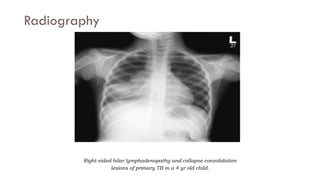
Radiography
Right-sided hilar lymphadenopathy and collapse consolidation
lesions of primary TB in a 4 yr old child.
34
DIFFERENTIAL DIAGNOSIS
 Bacterial pneumonias
 Long standing FB
 Chronic bronchiectasis
 Heart diseases
35
TB Case Definitions
Presumptive TB
 Any patient who presents with symptoms and signs suggestive of TB
 Previously called a TB suspect
Bacteriologically confirmed TB
 Patient in whom biological specimen is positive by smear microscopy,
culture, Xpert MTB/RIF.
 All such cases should be notified
36
TB Case Definitions
Clinically diagnosed TB
 Patient who does not fulfil the criteria for bacteriological confirmation,
but has been diagnosed with active TB by a clinician or other medical
practitioner on the basis of clinical symptoms and other investigations.
37
Classification of TB disease
Pulmonary TB
 Bacteriologically confirmed or clinically diagnosed case, affecting lung
parechyma or tracheobronchial tree.
 Isolated TB pleural effusion and mediastinal lymphadenopathy without
lung tissue involvement is considered extrapulmonary TB
38
Classification of TB disease cont’d
Extrapulmonary TB:
 Any other case of TB
 If the patient has pulmonary and extrapulmonary involvement, he/ she
will be classified as pulmonary
39
Classification of TB disease cont’d
New
 No previous TB treatment (or treatment less < 1 month)
Relapse
 Patient who completed a previous course of treatment, was declared
cured or treatment completed, and is now diagnosed with a recurrent
episode of TB
40
Classification of TB disease cont’d
Treatment after failure
 Those who have previously been treated for TB and whose treatment
failed at the end of their most recent course of treatment
Treatment after loss to follow up
 Have previously been treated for TB and were declared lost to
follow-up at the end of their most recent course of treatment. (These
were previously known as treatment after default patients)
41
Classification of TB disease cont’d
Other previously treated patients
 Are those who have previously been treated for TB but whose outcome
after their most recent course of treatment is unknown or
undocumented
42
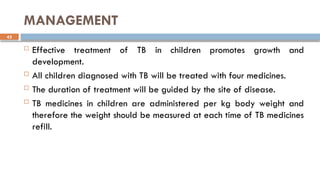
MANAGEMENT
 Effective treatment of TB in children promotes growth and
development.
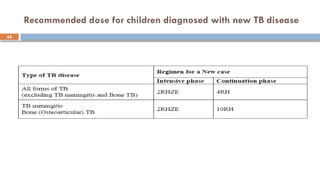
 All children diagnosed with TB will be treated with four medicines.
 The duration of treatment will be guided by the site of disease.
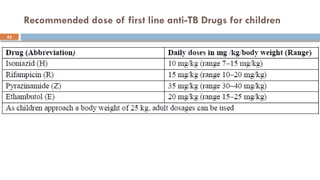
 TB medicines in children are administered per kg body weight and
therefore the weight should be measured at each time of TB medicines
refill.
43
Recommended dose of first line anti-TB Drugs for children
44
Recommended dose for children diagnosed with new TB disease
45
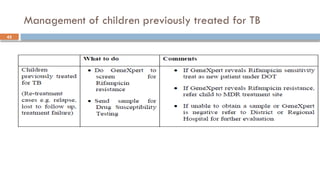
Management of children previously treated for TB
46
47
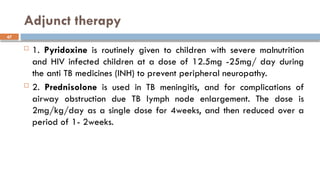
Adjunct therapy
 1. Pyridoxine is routinely given to children with severe malnutrition
and HIV infected children at a dose of 12.5mg -25mg/ day during
the anti TB medicines (INH) to prevent peripheral neuropathy.
 2. Prednisolone is used in TB meningitis, and for complications of
airway obstruction due TB lymph node enlargement. The dose is
2mg/kg/day as a single dose for 4weeks, and then reduced over a
period of 1- 2weeks.
48
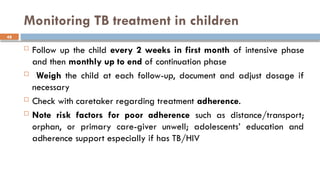
Monitoring TB treatment in children
 Follow up the child every 2 weeks in first month of intensive phase
and then monthly up to end of continuation phase
 Weigh the child at each follow-up, document and adjust dosage if
necessary
 Check with caretaker regarding treatment adherence.
 Note risk factors for poor adherence such as distance/transport;
orphan, or primary care-giver unwell; adolescents’ education and
adherence support especially if has TB/HIV
49
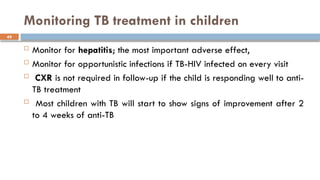
Monitoring TB treatment in children
 Monitor for hepatitis; the most important adverse effect,
 Monitor for opportunistic infections if TB-HIV infected on every visit
 CXR is not required in follow-up if the child is responding well to anti-
TB treatment
 Most children with TB will start to show signs of improvement after 2
to 4 weeks of anti-TB
50
Monitoring TB treatment in children
 Consider treatment failure if a child has:
 No symptom resolution or if symptoms are getting worse
 Continued weight loss
 Smear-positive at 2-month follow-up sputum
51
Prevention of TB in children
 BCG
 The vaccine is only effective in protecting against severe forms of TB
with an overall efficacy against TB of 50% and 80% efficacy in
preventing TB meningitis.
 BCG later than at birth, should not be administered to HIV
symptomatic children because of the associated BCG disease and its
related mortality in that population.
52
Prevention of TB in children
 IPT
 Isoniazid is effective in preventing TB disease among child contacts of individuals with
PTB and people living with HIV.
 Contacts of MDR PTB patients should NOT receive IPT.
 IPT is recommended for the following categories of patients for 6 months at a dose of
10mg/kg concurrently with pyridoxine upon exclusion of active TB.
a) All children <5 years with a positive history of contact with a patient with active TB
b) All HIV positive children in whom TB signs and symptoms have been excluded.
c) HIV positive children<12 months of age with a positive history of contact with a patient
with active TB.
53
Prevention
CONTACT SCREENING AND MANAGEMENT
 Contact screening (contact tracing) is a systematic process for
identifying TB contacts that have TB or are at risk of developing TB
54
Children with TB and HIV
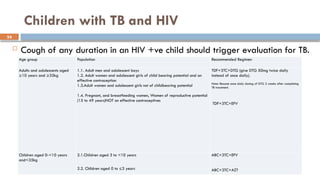
 Cough of any duration in an HIV +ve child should trigger evaluation for TB.
Age group Population Recommended Regimen
Adults and adolescents aged
≥10 years and ≥35kg
1.1. Adult men and adolescent boys
1.2. Adult women and adolescent girls of child bearing potential and on
effective contraception
1.3.Adult women and adolescent girls not of childbearing potential
1.4. Pregnant, and breastfeeding women, Women of reproductive potential
(15 to 49 years)NOT on effective contraceptives
TDF+3TC+DTG (give DTG 50mg twice daily
instead of once daily).
Note: Resume once daily dosing of DTG 2 weeks after completing
TB treatment.
TDF+3TC+EFV
Children aged 0-<10 years
and<35kg
2.1.Children aged 3 to <10 years
2.2. Children aged 0 to ≤3 years
ABC+3TC+EFV
ABC+3TC+AZT
55
REFERENCES
 Nelson textbook of Paediatrics, 20th
Edition, 2015
 Mohamed A, Baby Nelson and illustrated paediatrics, ?
 Uganda National TB And Leprosy Control Programme, Manual for
management and control of TB and leprosy, 3rd
edition 2017

Tuberculosis Dixon.pptx peadiatrics notes

  • 1.
  • 2.
    2 OUTLINE  INTRODUCTION  ETIOLOGY PATHOGENESIS  CLINICAL PRESENTATION  INVESTIGATIONS  MANAGEMENT  COMPLICATIONS  PROGNOSIS  REFERENCES
  • 3.
    3 INTRODUCTION  TB hascaused human disease for more than 4,000 yr and is one of the most important infectious diseases worldwide.  TB was first recognized as a clinical entity in the early 19th century by Schönlein, who used the term TB in 1830, which was derived from the English term “tubercle,” or lesion of consumption.
  • 4.
    4 EPIDEMIOLOGY  Peak incidence:1 – 4 years  Risk of infection depends on extent and duration of exposure - mother to infant - child on TB ward - many sputum positives at home  Majority of TB-exposed children do not get disease in childhood (latent infection)  Likelihood of developing disease highest shortly after exposure, decreases steadily with time  In infants, time span between infection and disease is 6 – 8 weeks
  • 5.
    5 EPIDEMIOLOGY  estimated 1million cases of childhood (0-14 years) TB worldwide  In Uganda, 3316 (7.5%) in children were notified to the TB program in 2014.  However, this proportion falls short of the estimated 15% - 20%.  TB may present at any age in children though the risk is highest below the age of 2 years.  When compared to adults, children are more prone to TB infection, TB disease, and severe forms of TB disease. This is because their immune system is not fully developed.
  • 6.
    6 ETIOLOGY  There are5 closely related mycobacteria in the Mycobacterium TB complex:  M. tuberculosis,  Mycobacterium bovis,  Mycobacterium africanum,  Mycobacterium microti,  and Mycobacterium canetti.  M. tuberculosis is the most important cause of TB disease in humans.
  • 7.
    7 TRANSMISSION  Usually byinhalation of airborne mucus droplet nuclei, particles 1-5 m in diameter that contain μ M. tuberculosis.  Rarely occurs by direct contact with an infected discharge or a contaminated fomite.  The chance of transmission increases when the patient has a positive acid-fast smear of sputum, an extensive upper lobe infiltrate or cavity, copious production of thin sputum, and severe and forceful cough.  Environmental factors : poor air circulation enhance transmission.
  • 8.
    8 TRANSMISSION Cont’d  Youngchildren with TB rarely infect other children or adults.  Children and adolescents with adult-type cavitary or endobronchial pulmonary TB can transmit the organism.
  • 9.
    9 TRANSMISSION Cont’d  Airbornetransmission of M. bovis and M. africanum also occurs.  M. bovis can penetrate the gastrointestinal mucosa or invade the lymphatic tissue of the oropharynx when large numbers of the organism are ingested.  Human infection with M. bovis is rare in developed countries as a result of the pasteurization of milk and effective TB control programs for cattle.
  • 10.
    10 PATHOGENESIS  Transmission isvia the respiratory tract: 1. direct droplet spread 2. dry sputum deposits  Mycobacterium tuberculosis is an obligate aerobe, so organisms settle in alveoli of the most oxygenated parts of the lungs  There is an acute inflammatory response in lung tissue with many leucocytes and monocytes surrounding the organisms  Thus it can  Clear the infection  May fail to clear it thus multiply causing primary infection  May contain it but still alive but not multiplying thus – latent disease
  • 11.
    11  Primary exposureto T.B bacilli result in formation of primary complex at the site of entry of the bacilli.  Composed of :  Primary focus (Ghon's focus)  Lymphangitis  Hilar lymphadenitis
  • 12.
    12 PATHOGENESIS Infants and youngchildren Adults Ghon 's focus may be in any part esp. in the periphery Usually apical Lymph nodes more often involved Less involvement Parenchyma and nodal lesions heal by calcification. Heal by fibrosis Blood dissemination & miliary T.B occur more often Less often
  • 13.
  • 14.
    14 CLINICAL STAGES 3 majorclinical stages of TB:  Exposure,  Infection, and  Disease.
  • 15.
    15 EXPOSURE  child hashad significant contact (“shared the air”) with an adult or with infectious TB  but lacks proof of infection.  No clinical or paraclinical findings.  However the child may be infected.
  • 16.
    16 INFECTION  occurs whenthe individual inhales droplet nuclei containing Mycobacterium tuberculosis,  which survive intracellularly within the lung and associated lymphoid tissue.  The hallmark of TB infection is a positive Tuberculin Skin Test  In this stage, the child has no signs or symptoms, a normal physical examination, and the chest radiograph is either normal or reveals only granuloma or calcifications in the lung parenchyma.
  • 17.
    17 Children at risk 1.Infants in close contact with sputum positive adults e.g. lactating mother 2. HIV infected children 3. Post-measles or post-pertussis infection 4. Children with severe malnutrition 5. Children not immunized 6. Children exposed to high-risk adults 7. Homeless persons
  • 18.
    18 DISEASE  Signs orsymptoms or radiographic manifestations caused by Mycobacterium tuberculosis become apparent.  Not all infected individuals have the same risk of developing disease.  In an infected child younger than 1 yr of age has a 40% chance of developing disease within 9 mo.
  • 19.
    19 R. FACTORS FORPROGRESSION OF LATENT TB INFECTION TO TB DISEASE  Infants and children ≤4 yr of age, especially those <2 yr of age  Adolescents  Persons co-infected with HIV  Persons with skin test conversion in the past 1-2 yr  Persons who are immunocompromised, especially in cases of malignancy and solid organ transplantation, immunosuppressive medical treatments including anti–tumor necrosis factor therapies, diabetes mellitus, chronic renal failure, silicosis, and malnutrition
  • 20.
    20 CLINICAL PRESENTATION  I.PULMONARY TB 1. Chronic cough (≥ 2 weeks), not responding to conventional treatment 2. Fever 3. Excessive sweating 4. Weight loss or failure to thrive 5. Contact with proven PTB patient or chronically coughing adult 6. Wheeze 7. Lymphadenopathy 8. Poor appetite, vomiting, diarrhoea  Lung collapse.
  • 21.
    21 EXTRA PULMONARY TB A.Miliary TB  Common in: infants, malnourished & immunodeficient.  Due to: Hematogenous spread of T.B bacilli from any focus (usually pulmonary) with multiple organ involvement (lung, kidneys, liver, spleen, mininges).  Clinical picture:  High spiking fever.  Toxemia with bad general condition.
  • 22.
    22 Miliary TB cont’d Hepatosplenomegaly  Generalized lymphadenopathy  May be fine crepitations all over the chest  Fundus examination : choriod tubercles  Chest xray: small miliary shadows (snow flake opacities).  Definitive diagnosis: By liver or bone marrow biopsy & histologic examination .
  • 23.
    23 B. Tuberculous meningitis Due to Hematogenous spread either isolated or as a part of miliary T.B  Clinical picture:  In infancy and early childhood  Insidious onset  Pass in 3 stages (each 1-2 weeks)
  • 24.
  • 25.
    25 C. Intestinal TB Occursecondary to:  Ingested T.B bacilli in milk  Swallowed sputum from T.B lesions in the lungs. Clinical picture:  Coma  Death  Tabes mesentrica: - enlarged mesenteric lymph nodes.  T.B enteritis : -chronic diarrhea failure to thrive.  chronic abdominal pain.
  • 26.
    26 D. Tuberculous peritonitis Occur 2ry to: Spread from intestinal or genitourinary T.B lesions  Clinical picture: - Ascites  - May be adhesions.
  • 27.
    27 INVESTIGATION  The TuberculinSkin Test response to tuberculin antigen is a manifestation of a T cell mediated delayed hypersensitivity. −  It is usually positive 2 to 6 weeks after onset of infection (occasionally 3 months) and at the time of symptomatic illness.  This test is preferred in children less than 5 years of age.  It may also be used in other settings such as contact investigations or in older patients.  Only persons at high risk should be offered a Mantoux test.
  • 28.
    28 Tuberculin Skin Test Consider TST positive as below:  5 mm or more is positive if the child is:  HIV positive  Severely malnourished  Immunosuppressed  Having a recent measles or whooping cough episode  10 mm or more is positive in all children except the above listed category
  • 29.
    29 Culture • The mostspecific confirmation of pulmonary TB is isolation of M. Tuberculosis from a clinical sample. • Induced sputum with a jet nebulizer, inhaled saline and chest percussion followed by nasopharyngeal suctioning is effective in children as young as 1 yr of age.
  • 30.
    30 Culture  Sputum inductionprovides samples for both culture and acid-fast bacilli staining.  The traditional culture specimen in young children is the early morning gastric acid obtained before the child has arisen and peristalsis has emptied the stomach of the pooled respiratory secretions that have been swallowed overnight.
  • 31.
    31 Culture  Negative culturesnever exclude the diagnosis of TB in a child.  Confirmation of extrapulmonary TB is best achieved with a positive culture.  However, for many forms of TB, the culture yield is only 25-50%.
  • 32.
    32 Gene Xpert MTB/RIF is a real-time PCR assay for M. tuberculosis.  Detects simulnateously rifampin resistance,  it offers advantages in rapid detection (2 hours) of MDR TB  Although cartridges for the Xpert system are expensive,  Xpert should never replace mycobacterial cultures.
  • 33.
    33 Radiography Right-sided hilar lymphadenopathyand collapse consolidation lesions of primary TB in a 4 yr old child.
  • 34.
    34 DIFFERENTIAL DIAGNOSIS  Bacterialpneumonias  Long standing FB  Chronic bronchiectasis  Heart diseases
  • 35.
    35 TB Case Definitions PresumptiveTB  Any patient who presents with symptoms and signs suggestive of TB  Previously called a TB suspect Bacteriologically confirmed TB  Patient in whom biological specimen is positive by smear microscopy, culture, Xpert MTB/RIF.  All such cases should be notified
  • 36.
    36 TB Case Definitions Clinicallydiagnosed TB  Patient who does not fulfil the criteria for bacteriological confirmation, but has been diagnosed with active TB by a clinician or other medical practitioner on the basis of clinical symptoms and other investigations.
  • 37.
    37 Classification of TBdisease Pulmonary TB  Bacteriologically confirmed or clinically diagnosed case, affecting lung parechyma or tracheobronchial tree.  Isolated TB pleural effusion and mediastinal lymphadenopathy without lung tissue involvement is considered extrapulmonary TB
  • 38.
    38 Classification of TBdisease cont’d Extrapulmonary TB:  Any other case of TB  If the patient has pulmonary and extrapulmonary involvement, he/ she will be classified as pulmonary
  • 39.
    39 Classification of TBdisease cont’d New  No previous TB treatment (or treatment less < 1 month) Relapse  Patient who completed a previous course of treatment, was declared cured or treatment completed, and is now diagnosed with a recurrent episode of TB
  • 40.
    40 Classification of TBdisease cont’d Treatment after failure  Those who have previously been treated for TB and whose treatment failed at the end of their most recent course of treatment Treatment after loss to follow up  Have previously been treated for TB and were declared lost to follow-up at the end of their most recent course of treatment. (These were previously known as treatment after default patients)
  • 41.
    41 Classification of TBdisease cont’d Other previously treated patients  Are those who have previously been treated for TB but whose outcome after their most recent course of treatment is unknown or undocumented
  • 42.
    42 MANAGEMENT  Effective treatmentof TB in children promotes growth and development.  All children diagnosed with TB will be treated with four medicines.  The duration of treatment will be guided by the site of disease.  TB medicines in children are administered per kg body weight and therefore the weight should be measured at each time of TB medicines refill.
  • 43.
    43 Recommended dose offirst line anti-TB Drugs for children
  • 44.
    44 Recommended dose forchildren diagnosed with new TB disease
  • 45.
    45 Management of childrenpreviously treated for TB
  • 46.
  • 47.
    47 Adjunct therapy  1.Pyridoxine is routinely given to children with severe malnutrition and HIV infected children at a dose of 12.5mg -25mg/ day during the anti TB medicines (INH) to prevent peripheral neuropathy.  2. Prednisolone is used in TB meningitis, and for complications of airway obstruction due TB lymph node enlargement. The dose is 2mg/kg/day as a single dose for 4weeks, and then reduced over a period of 1- 2weeks.
  • 48.
    48 Monitoring TB treatmentin children  Follow up the child every 2 weeks in first month of intensive phase and then monthly up to end of continuation phase  Weigh the child at each follow-up, document and adjust dosage if necessary  Check with caretaker regarding treatment adherence.  Note risk factors for poor adherence such as distance/transport; orphan, or primary care-giver unwell; adolescents’ education and adherence support especially if has TB/HIV
  • 49.
    49 Monitoring TB treatmentin children  Monitor for hepatitis; the most important adverse effect,  Monitor for opportunistic infections if TB-HIV infected on every visit  CXR is not required in follow-up if the child is responding well to anti- TB treatment  Most children with TB will start to show signs of improvement after 2 to 4 weeks of anti-TB
  • 50.
    50 Monitoring TB treatmentin children  Consider treatment failure if a child has:  No symptom resolution or if symptoms are getting worse  Continued weight loss  Smear-positive at 2-month follow-up sputum
  • 51.
    51 Prevention of TBin children  BCG  The vaccine is only effective in protecting against severe forms of TB with an overall efficacy against TB of 50% and 80% efficacy in preventing TB meningitis.  BCG later than at birth, should not be administered to HIV symptomatic children because of the associated BCG disease and its related mortality in that population.
  • 52.
    52 Prevention of TBin children  IPT  Isoniazid is effective in preventing TB disease among child contacts of individuals with PTB and people living with HIV.  Contacts of MDR PTB patients should NOT receive IPT.  IPT is recommended for the following categories of patients for 6 months at a dose of 10mg/kg concurrently with pyridoxine upon exclusion of active TB. a) All children <5 years with a positive history of contact with a patient with active TB b) All HIV positive children in whom TB signs and symptoms have been excluded. c) HIV positive children<12 months of age with a positive history of contact with a patient with active TB.
  • 53.
    53 Prevention CONTACT SCREENING ANDMANAGEMENT  Contact screening (contact tracing) is a systematic process for identifying TB contacts that have TB or are at risk of developing TB
  • 54.
    54 Children with TBand HIV  Cough of any duration in an HIV +ve child should trigger evaluation for TB. Age group Population Recommended Regimen Adults and adolescents aged ≥10 years and ≥35kg 1.1. Adult men and adolescent boys 1.2. Adult women and adolescent girls of child bearing potential and on effective contraception 1.3.Adult women and adolescent girls not of childbearing potential 1.4. Pregnant, and breastfeeding women, Women of reproductive potential (15 to 49 years)NOT on effective contraceptives TDF+3TC+DTG (give DTG 50mg twice daily instead of once daily). Note: Resume once daily dosing of DTG 2 weeks after completing TB treatment. TDF+3TC+EFV Children aged 0-<10 years and<35kg 2.1.Children aged 3 to <10 years 2.2. Children aged 0 to ≤3 years ABC+3TC+EFV ABC+3TC+AZT
  • 55.
    55 REFERENCES  Nelson textbookof Paediatrics, 20th Edition, 2015  Mohamed A, Baby Nelson and illustrated paediatrics, ?  Uganda National TB And Leprosy Control Programme, Manual for management and control of TB and leprosy, 3rd edition 2017

Editor's Notes

  • #27 The Mantoux test, an ID injection of 5 TU (tuberculin units) of purified protein derivative standard (PPD-S), usually on the volar surface of the forearm, is the standard TST.