TUBERCULOSIS
BY
OKEKE GLORIA O.,
KASULE STEVEN K.,
SENGOOBA DENNIS NYANZI
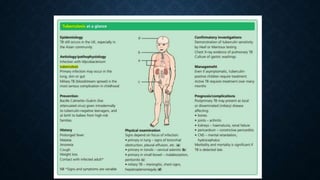
DEFINITION
A chronic infection caused by Mycobacterium tuberculosis complex (M. tuberculosis, M. bovis, M.
africanum and M. Microti). It commonly affects lungs but can affect any organ (lymph nodes, bones,
meninges, abdomen, kidney).
Mycobacterium tuberculosis is an acid fast gram positive rod (bacillus).
TB may present at any age in children though the risk is highest below the age of 2 years. When compared to
adults, children are more prone to TB infection, TB disease, and severe forms of TB disease.
EPIDEMIOLOGY
● Tuberculosis is the second leading infectious cause of death worldwide (after HIV).
● In 2019, an estimated 10 million people fell ill with tuberculosis(TB) worldwide. 5.6 million men, 3.2
million women and 1.2 million children. TB is present in all countries and age groups. But TB is
curable and preventable.
● In 2019, 1.2 million children fell ill with TB globally. Child and adolescent TB is often overlooked by
health providers and can be difficult to diagnose and treat.
● Ending the TB epidemic by 2030 is among the health targets of the United Nations Sustainable
Development Goals (SDGs).
● In uganda, there is an annual incidence of 330 cases of all forms and 136 new smear positive cases per
100000 people per year.
CHILDREN AT RISK
● Contact with infectious (pulmonary) case of TB (in adults).
● Age < 5 years
● Immunosuppression (HIV, malnutrition, diabetes, etc).
● Age < 1 year and lack of BCG vaccination are risk factors for severe disease.
● Foreign-born persons from areas with high TB rates (Asia, Africa, Latin America, Eastern Europe,
Russia)
PATHOGENESIS
● Tuberculosis (TB) is caused by bacteria (Mycobacterium tuberculosis) that most often affect the lungs.
● TB is spread from person to person through the air. When people with lung TB cough, sneeze or spit, they
propel the TB germs into the air. A person needs to inhale only a few of these germs to become infected.
● People infected with TB bacteria have a 5–10% lifetime risk of falling ill with TB. Those with compromised
immune systems, such as people living with HIV, malnutrition or diabetes, or people who use tobacco, have a
higher risk of falling ill.
● Acquisition of TB is usually by inhalation of the bacilli, and this gives rise to primary TB. The lung lesion is
usually subpleural and in any lobe.
● The initial polymorphonuclear leukocyte inflammatory response cannot contain the bacilli, at which point
monocyte-derived macrophages phagocytose them.
…
● Within hours, bacilli are carried in cells to the draining hilar lymph nodes and the characteristic
inflammatory reaction develops in both lung and nodes (the primary complex).
● There is necrosis of the lesions, which macroscopically are yellowish- ‘caseous (cheesy)
necrosis’.
● Formation of granuloma around the necrosis, which is a product of cell-mediated immunity
(CMI) where, after antigenic stimulation and co-presentation with MHC class II molecules, T-
helper cells secrete cytokines to activate macrophages. Activated macrophages – which are
epithelioid cells and other immune cells block the spread of the organism.
● The infection is then contained (latent TB) and can be reactivated later, e.g during
immunosuppression leading to secondary TB.
CLASSIFICATION
Pulmonary TB
● Chronic cough of >2 weeks (however, in HIV settings, cough of any duration)
● Chest pain, purulent sputum occasionally blood-stained,
● shortness of breath
Extrapulmonary TB
● Lymphnode TB: Localized enlargement of lymph nodes depending on the site affected
(commonly neck)
● Pleural or pericardial effusion
● Abdominal TB: ascites and abdominal pain
● TB meningitis: subacute meningitis (headache, alteration of consciousness)
● Bone or joint TB: swelling and deformity
PRESENTATIONS /CLINICAL FEATURES
● Cough
● Hemoptysis
● Back Pain
● Fever and Rash
● Lymphadenopathy
● Fever of Unknown Origin
● Night sweats
● Weight loss
Suspect TB in all children with – Fever > 2 weeks – Cough >2 weeks – Poor weight
gain for one month – Close (home) contact of pulmonary TB case
VACCINATION
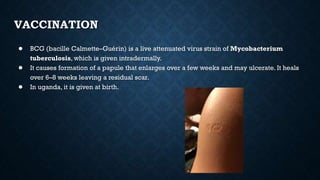
● BCG (bacille Calmette–Guérin) is a live attenuated virus strain of Mycobacterium
tuberculosis, which is given intradermally.
● It causes formation of a papule that enlarges over a few weeks and may ulcerate. It heals
over 6–8 weeks leaving a residual scar.
● In uganda, it is given at birth.
DIFFERENTIAL DIAGNOSIS
● Histoplasma pneumonia,
● Trypanosomiasis
● Brucellosis
● HIV/AIDS
● Malignancy
● COPD
● Asthma
● Bronchiectasis
● Emphysema
● Fungal infection of the lungs e.g. Aspergillosis
INVESTIGATIONS
● Sputum smear microscopy for acid fast bacilli (ZN stain).
● Bacteriological confirmation of TB is more difficult in children.The diagnosis of TB in
children is dependent on conducting a detailed clinical assessment combined with
available tests.
● Careful history including history of TB contact.
● Careful history of symptoms consistent with TB.
● Clinical examination including growth assessment.
● Tuberculin skin test (TST) is a good supportive test for TB diagnosis in children.
● Whenever possible, geneXpert (a PCR-based DNA testing) should be performed.
● Chest X-ray -will show pattern of infiltrate(s) or consolidation.
DIAGNOSIS OF EXTRAPULMONARY TB
● Biopsy or fine needle lymph node aspirate microscopy and culture, for superficially
enlarged lymph nodes.
● Body fluids such as ascitic, pleural or cerebrospinal can be subjected to microscopy,
biochemical analysis, Ziehl-Nielsen (ZN) staining and culture.
● Bone marrow aspirate and culture may be diagnostic in disseminated TB with persistent
fever and wasting.
MANAGEMENT AND TREATMENT
General principles;
It is recommended that all TB medicines are taken under direct observation by a treatment
supporter (DOT) .
Anti-TB drugs are given in fixed dose combination (FDC) regimens according to the patient’s
TB classification
Treatment is divided into 2 phases:
● An initial (intensive) phase of 2 months and
● A continuation phase of 4 months (longer in MDR-TB and severe forms of TB particularly
TB meningitis and osteoarticular TB ).
CONT’D
TB treatment regimens are expressed in a standard format, e.g. 2RHZE/4RH where:
–– Letters represent abbreviated drug names
–– Numbers show the duration in months
–– / shows the division between treatment phases
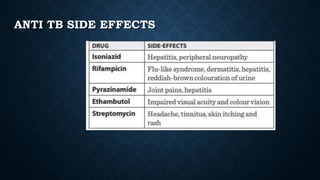
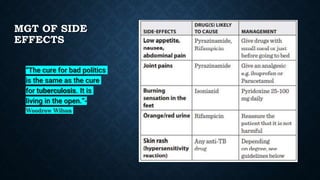
Anti-TB drugs have side effects and they should be managed appropriately
TB treatment monitoring should be done by clinical, sputum and where possible radiological.
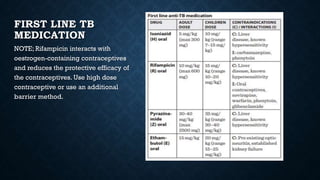
FIRST LINE TB
MEDICATION
NOTE; Rifampicin interacts with
oestrogen-containing contraceptives
and reduces the protective efficacy of
the contraceptives. Use high dose
contraceptive or use an additional
barrier method.
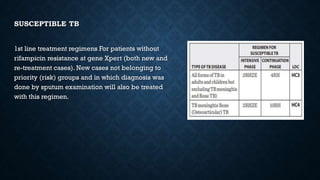
SUSCEPTIBLE TB
1st line treatment regimens For patients without
rifampicin resistance at gene Xpert (both new and
re-treatment cases). New cases not belonging to
priority (risk) groups and in which diagnosis was
done by sputum examination will also be treated
with this regimen.
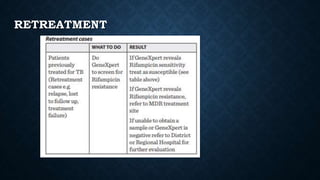
RETREATMENT
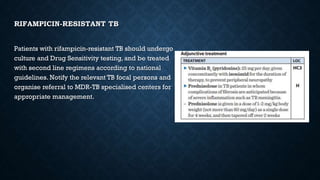
RIFAMPICIN-RESISTANT TB
Patients with rifampicin-resistant TB should undergo
culture and Drug Sensitivity testing, and be treated
with second line regimens according to national
guidelines. Notify the relevant TB focal persons and
organise referral to MDR-TB specialised centers for
appropriate management.
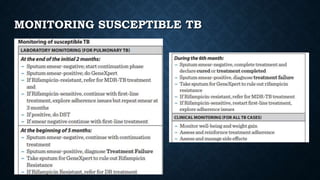
MONITORING SUSCEPTIBLE TB
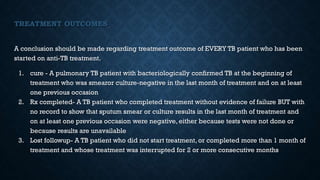
TREATMENT OUTCOMES
A conclusion should be made regarding treatment outcome of EVERY TB patient who has been
started on anti-TB treatment.
1. cure - A pulmonary TB patient with bacteriologically confirmed TB at the beginning of
treatment who was smearor culture-negative in the last month of treatment and on at least
one previous occasion
2. Rx completed- A TB patient who completed treatment without evidence of failure BUT with
no record to show that sputum smear or culture results in the last month of treatment and
on at least one previous occasion were negative, either because tests were not done or
because results are unavailable
3. Lost followup- A TB patient who did not start treatment, or completed more than 1 month of
treatment and whose treatment was interrupted for 2 or more consecutive months
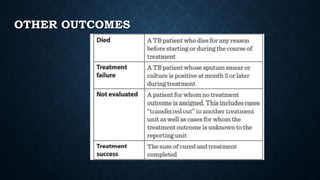
OTHER OUTCOMES
ANTI TB SIDE EFFECTS
MGT OF SIDE
EFFECTS
“The cure for bad politics
is the same as the cure
for tuberculosis. It is
living in the open.”-
Woodrow Wilson
TB AND HIV
● Children have an increased risk of developing primary progressive TB because of the
associated severe immune suppression resulting from a combination of their young age
and HIV
● Extrapulmonary TB is seen more often in HIV infected children.
● People living with HIV are 18 (15-21) times more likely to develop active TB disease than
people without HIV. HIV and TB form a lethal combination, each speeding the other's
progress. In 2019, about 208 000 people died of HIV-associated TB.
● WHO recommends a 12-component approach of collaborative TB-HIV activities, including
actions for prevention and treatment of infection and disease, to reduce deaths.
CONT’D
● HIV is now the major risk factor for reactivation of previous TB infection, instead of a lifetime risk of 5–
10% reactivation, there is a 10% per annum risk of disease.
● Primary infections in HIV-infected people are much more aggressive than in non-infected people.
● Patients present with fever, severe malaise, weight loss, and diarrhoea, and the tuberculous disease is
usually disseminated.
● Any organ can be affected, including the lung with miliary nodular disease, lymph nodes, intestine, and
meninges.
● If presentation is relatively early during the course of HIV disease, the pathology is granulomatous and
AFBs are relatively sparse.
● However, in the state of terminal immunosuppression, the lesions are non-reactive (‘anergic TB’): there
are no epithelioid cells, giant cells, or granulomas, just necrotic macrophages and huge numbers of
bacilli.
● Patients die in a state of toxic shock, probably related to the release of the cytokine tumour necrosis
factor α (TNFα).
● This pathology is not unique to those with HIV infection. It also occurs in people severely
immunosuppressed by other means (malnutrition, extremes of age, cancer, DM).
…
● In a child with suspected or proven HIV infection, a diagnosis of TB should always be
considered, although it is often difficult to confirm.
● Early in HIV infection, when immunity is not impaired, the signs of TB are similar to those
in a child without HIV infection.
● Pulmonary TB is still the commonest form of TB, even in HIV-infected children.
● As HIV infection progresses and immunity declines, dissemination of TB becomes more
common, and tuberculous meningitis, miliary TB and widespread tuberculous
lymphadenopathy occur.
…
● HIV-infected infants and children with active TB should begin TB treatment immediately.
● If they are not yet started on ART, this should be started as soon as it is tolerated, within the
first 8 weeks of TB therapy, irrespective of CD4 count and clinical stage.
● Treat TB in HIV-infected children with the same anti-TB drug regimen as for uninfected
children with TB.
COMPLICATIONS
● Massive haemoptysis - coughing up >250 mL blood per episode.
● Spontaneous pneumothorax and pleural effusion.
● TB pericarditis, TB meningitis,TB peritonitis.
● Bone TB: can be TB spine with gibbus,TB joints with deformity).
● Respiratory failure
PREVENTION AND CONTROL
Preventive measures
● BCG vaccination at birth to prevent severe forms of TB
● Preventive therapy for categories at risk
General hygiene
● Avoidance of overcrowding
● Cough hygiene (cover cough with pieces of cloth, washing hands with soap, proper
disposal of sputum)
● Avoid drinking unboiled milk
● Good nutrition
● Good housing condition with improved ventilation
CASE DIAGNOSIS AND MANAGEMENT
● Isolation of sputum-positive cases
● Early detection of cases and initiation of appropriate TB treatment
● Treatment under directly observed treatment (DOT) and follow up to ensure adherence
and cure
Contact tracing
● Tracing of contacts of pulmonary TB cases
● Routine screening of health workers for active TB
TUBERCULOSIS PREVENTIVE THERAPY
● Tuberculosis preventive therapy is recommended to prevent the development of active TB disease in
an individual who has latent TB infection (LTBI).
● Uganda NTLP (National Tuberculosis and Leprosy Program) National preventive guidelines recommend
preventive therapy using a six month regimen of Isoniazid as monotherapy (Isoniazid preventive
therapy, IPT) in the following categories: If
–– Persons living with HIV/AIDS
–– Child < 5 years, contacts of pulmonary TB patients
● HIV positive children less than 1year should receive IPT only if they have history of contact with TB case
and active TB has been ruled out.
Do not use IPT in cases of active TB
Do not use IPT in contacts of MDR-TB
HOW?
Give isoniazid for 6months
● Adults: 5 mg/kg/day (maximum 300 mg)
● Children: 10 mg/kg/day (maximum 300 mg)
Give vitamin B6 (pyridoxine)- 25 mg per day; given with isoniazid to prevent peripheral
neuropathy.
“The poison of skepticism becomes, like alcoholism, tuberculosis, and some other diseases, much
more virulent in a hitherto virgin soil.” — Simone Weil
REFERNCES
● Uganda clinical Guidelines, 2016
● Ministry of Health, Uganda
● World Health Organisation
● CDC

Tuberculosis

  • 1.
    TUBERCULOSIS BY OKEKE GLORIA O., KASULESTEVEN K., SENGOOBA DENNIS NYANZI
  • 2.
    DEFINITION A chronic infectioncaused by Mycobacterium tuberculosis complex (M. tuberculosis, M. bovis, M. africanum and M. Microti). It commonly affects lungs but can affect any organ (lymph nodes, bones, meninges, abdomen, kidney). Mycobacterium tuberculosis is an acid fast gram positive rod (bacillus). TB may present at any age in children though the risk is highest below the age of 2 years. When compared to adults, children are more prone to TB infection, TB disease, and severe forms of TB disease.
  • 3.
    EPIDEMIOLOGY ● Tuberculosis isthe second leading infectious cause of death worldwide (after HIV). ● In 2019, an estimated 10 million people fell ill with tuberculosis(TB) worldwide. 5.6 million men, 3.2 million women and 1.2 million children. TB is present in all countries and age groups. But TB is curable and preventable. ● In 2019, 1.2 million children fell ill with TB globally. Child and adolescent TB is often overlooked by health providers and can be difficult to diagnose and treat. ● Ending the TB epidemic by 2030 is among the health targets of the United Nations Sustainable Development Goals (SDGs). ● In uganda, there is an annual incidence of 330 cases of all forms and 136 new smear positive cases per 100000 people per year.
  • 4.
    CHILDREN AT RISK ●Contact with infectious (pulmonary) case of TB (in adults). ● Age < 5 years ● Immunosuppression (HIV, malnutrition, diabetes, etc). ● Age < 1 year and lack of BCG vaccination are risk factors for severe disease. ● Foreign-born persons from areas with high TB rates (Asia, Africa, Latin America, Eastern Europe, Russia)
  • 6.
    PATHOGENESIS ● Tuberculosis (TB)is caused by bacteria (Mycobacterium tuberculosis) that most often affect the lungs. ● TB is spread from person to person through the air. When people with lung TB cough, sneeze or spit, they propel the TB germs into the air. A person needs to inhale only a few of these germs to become infected. ● People infected with TB bacteria have a 5–10% lifetime risk of falling ill with TB. Those with compromised immune systems, such as people living with HIV, malnutrition or diabetes, or people who use tobacco, have a higher risk of falling ill. ● Acquisition of TB is usually by inhalation of the bacilli, and this gives rise to primary TB. The lung lesion is usually subpleural and in any lobe. ● The initial polymorphonuclear leukocyte inflammatory response cannot contain the bacilli, at which point monocyte-derived macrophages phagocytose them.
  • 7.
    … ● Within hours,bacilli are carried in cells to the draining hilar lymph nodes and the characteristic inflammatory reaction develops in both lung and nodes (the primary complex). ● There is necrosis of the lesions, which macroscopically are yellowish- ‘caseous (cheesy) necrosis’. ● Formation of granuloma around the necrosis, which is a product of cell-mediated immunity (CMI) where, after antigenic stimulation and co-presentation with MHC class II molecules, T- helper cells secrete cytokines to activate macrophages. Activated macrophages – which are epithelioid cells and other immune cells block the spread of the organism. ● The infection is then contained (latent TB) and can be reactivated later, e.g during immunosuppression leading to secondary TB.
  • 8.
    CLASSIFICATION Pulmonary TB ● Chroniccough of >2 weeks (however, in HIV settings, cough of any duration) ● Chest pain, purulent sputum occasionally blood-stained, ● shortness of breath Extrapulmonary TB ● Lymphnode TB: Localized enlargement of lymph nodes depending on the site affected (commonly neck) ● Pleural or pericardial effusion ● Abdominal TB: ascites and abdominal pain ● TB meningitis: subacute meningitis (headache, alteration of consciousness) ● Bone or joint TB: swelling and deformity
  • 9.
    PRESENTATIONS /CLINICAL FEATURES ●Cough ● Hemoptysis ● Back Pain ● Fever and Rash ● Lymphadenopathy ● Fever of Unknown Origin ● Night sweats ● Weight loss Suspect TB in all children with – Fever > 2 weeks – Cough >2 weeks – Poor weight gain for one month – Close (home) contact of pulmonary TB case
  • 10.
    VACCINATION ● BCG (bacilleCalmette–Guérin) is a live attenuated virus strain of Mycobacterium tuberculosis, which is given intradermally. ● It causes formation of a papule that enlarges over a few weeks and may ulcerate. It heals over 6–8 weeks leaving a residual scar. ● In uganda, it is given at birth.
  • 11.
    DIFFERENTIAL DIAGNOSIS ● Histoplasmapneumonia, ● Trypanosomiasis ● Brucellosis ● HIV/AIDS ● Malignancy ● COPD ● Asthma ● Bronchiectasis ● Emphysema ● Fungal infection of the lungs e.g. Aspergillosis
  • 12.
    INVESTIGATIONS ● Sputum smearmicroscopy for acid fast bacilli (ZN stain). ● Bacteriological confirmation of TB is more difficult in children.The diagnosis of TB in children is dependent on conducting a detailed clinical assessment combined with available tests. ● Careful history including history of TB contact. ● Careful history of symptoms consistent with TB. ● Clinical examination including growth assessment. ● Tuberculin skin test (TST) is a good supportive test for TB diagnosis in children. ● Whenever possible, geneXpert (a PCR-based DNA testing) should be performed. ● Chest X-ray -will show pattern of infiltrate(s) or consolidation.
  • 13.
    DIAGNOSIS OF EXTRAPULMONARYTB ● Biopsy or fine needle lymph node aspirate microscopy and culture, for superficially enlarged lymph nodes. ● Body fluids such as ascitic, pleural or cerebrospinal can be subjected to microscopy, biochemical analysis, Ziehl-Nielsen (ZN) staining and culture. ● Bone marrow aspirate and culture may be diagnostic in disseminated TB with persistent fever and wasting.
  • 14.
    MANAGEMENT AND TREATMENT Generalprinciples; It is recommended that all TB medicines are taken under direct observation by a treatment supporter (DOT) . Anti-TB drugs are given in fixed dose combination (FDC) regimens according to the patient’s TB classification Treatment is divided into 2 phases: ● An initial (intensive) phase of 2 months and ● A continuation phase of 4 months (longer in MDR-TB and severe forms of TB particularly TB meningitis and osteoarticular TB ).
  • 15.
    CONT’D TB treatment regimensare expressed in a standard format, e.g. 2RHZE/4RH where: –– Letters represent abbreviated drug names –– Numbers show the duration in months –– / shows the division between treatment phases Anti-TB drugs have side effects and they should be managed appropriately TB treatment monitoring should be done by clinical, sputum and where possible radiological.
  • 16.
    FIRST LINE TB MEDICATION NOTE;Rifampicin interacts with oestrogen-containing contraceptives and reduces the protective efficacy of the contraceptives. Use high dose contraceptive or use an additional barrier method.
  • 17.
    SUSCEPTIBLE TB 1st linetreatment regimens For patients without rifampicin resistance at gene Xpert (both new and re-treatment cases). New cases not belonging to priority (risk) groups and in which diagnosis was done by sputum examination will also be treated with this regimen.
  • 18.
  • 19.
    RIFAMPICIN-RESISTANT TB Patients withrifampicin-resistant TB should undergo culture and Drug Sensitivity testing, and be treated with second line regimens according to national guidelines. Notify the relevant TB focal persons and organise referral to MDR-TB specialised centers for appropriate management.
  • 20.
  • 21.
    TREATMENT OUTCOMES A conclusionshould be made regarding treatment outcome of EVERY TB patient who has been started on anti-TB treatment. 1. cure - A pulmonary TB patient with bacteriologically confirmed TB at the beginning of treatment who was smearor culture-negative in the last month of treatment and on at least one previous occasion 2. Rx completed- A TB patient who completed treatment without evidence of failure BUT with no record to show that sputum smear or culture results in the last month of treatment and on at least one previous occasion were negative, either because tests were not done or because results are unavailable 3. Lost followup- A TB patient who did not start treatment, or completed more than 1 month of treatment and whose treatment was interrupted for 2 or more consecutive months
  • 22.
  • 23.
    ANTI TB SIDEEFFECTS
  • 24.
    MGT OF SIDE EFFECTS “Thecure for bad politics is the same as the cure for tuberculosis. It is living in the open.”- Woodrow Wilson
  • 25.
    TB AND HIV ●Children have an increased risk of developing primary progressive TB because of the associated severe immune suppression resulting from a combination of their young age and HIV ● Extrapulmonary TB is seen more often in HIV infected children. ● People living with HIV are 18 (15-21) times more likely to develop active TB disease than people without HIV. HIV and TB form a lethal combination, each speeding the other's progress. In 2019, about 208 000 people died of HIV-associated TB. ● WHO recommends a 12-component approach of collaborative TB-HIV activities, including actions for prevention and treatment of infection and disease, to reduce deaths.
  • 26.
    CONT’D ● HIV isnow the major risk factor for reactivation of previous TB infection, instead of a lifetime risk of 5– 10% reactivation, there is a 10% per annum risk of disease. ● Primary infections in HIV-infected people are much more aggressive than in non-infected people. ● Patients present with fever, severe malaise, weight loss, and diarrhoea, and the tuberculous disease is usually disseminated. ● Any organ can be affected, including the lung with miliary nodular disease, lymph nodes, intestine, and meninges. ● If presentation is relatively early during the course of HIV disease, the pathology is granulomatous and AFBs are relatively sparse. ● However, in the state of terminal immunosuppression, the lesions are non-reactive (‘anergic TB’): there are no epithelioid cells, giant cells, or granulomas, just necrotic macrophages and huge numbers of bacilli. ● Patients die in a state of toxic shock, probably related to the release of the cytokine tumour necrosis factor α (TNFα). ● This pathology is not unique to those with HIV infection. It also occurs in people severely immunosuppressed by other means (malnutrition, extremes of age, cancer, DM).
  • 27.
    … ● In achild with suspected or proven HIV infection, a diagnosis of TB should always be considered, although it is often difficult to confirm. ● Early in HIV infection, when immunity is not impaired, the signs of TB are similar to those in a child without HIV infection. ● Pulmonary TB is still the commonest form of TB, even in HIV-infected children. ● As HIV infection progresses and immunity declines, dissemination of TB becomes more common, and tuberculous meningitis, miliary TB and widespread tuberculous lymphadenopathy occur.
  • 28.
    … ● HIV-infected infantsand children with active TB should begin TB treatment immediately. ● If they are not yet started on ART, this should be started as soon as it is tolerated, within the first 8 weeks of TB therapy, irrespective of CD4 count and clinical stage. ● Treat TB in HIV-infected children with the same anti-TB drug regimen as for uninfected children with TB.
  • 29.
    COMPLICATIONS ● Massive haemoptysis- coughing up >250 mL blood per episode. ● Spontaneous pneumothorax and pleural effusion. ● TB pericarditis, TB meningitis,TB peritonitis. ● Bone TB: can be TB spine with gibbus,TB joints with deformity). ● Respiratory failure
  • 30.
    PREVENTION AND CONTROL Preventivemeasures ● BCG vaccination at birth to prevent severe forms of TB ● Preventive therapy for categories at risk General hygiene ● Avoidance of overcrowding ● Cough hygiene (cover cough with pieces of cloth, washing hands with soap, proper disposal of sputum) ● Avoid drinking unboiled milk ● Good nutrition ● Good housing condition with improved ventilation
  • 31.
    CASE DIAGNOSIS ANDMANAGEMENT ● Isolation of sputum-positive cases ● Early detection of cases and initiation of appropriate TB treatment ● Treatment under directly observed treatment (DOT) and follow up to ensure adherence and cure Contact tracing ● Tracing of contacts of pulmonary TB cases ● Routine screening of health workers for active TB
  • 32.
    TUBERCULOSIS PREVENTIVE THERAPY ●Tuberculosis preventive therapy is recommended to prevent the development of active TB disease in an individual who has latent TB infection (LTBI). ● Uganda NTLP (National Tuberculosis and Leprosy Program) National preventive guidelines recommend preventive therapy using a six month regimen of Isoniazid as monotherapy (Isoniazid preventive therapy, IPT) in the following categories: If –– Persons living with HIV/AIDS –– Child < 5 years, contacts of pulmonary TB patients ● HIV positive children less than 1year should receive IPT only if they have history of contact with TB case and active TB has been ruled out. Do not use IPT in cases of active TB Do not use IPT in contacts of MDR-TB
  • 33.
    HOW? Give isoniazid for6months ● Adults: 5 mg/kg/day (maximum 300 mg) ● Children: 10 mg/kg/day (maximum 300 mg) Give vitamin B6 (pyridoxine)- 25 mg per day; given with isoniazid to prevent peripheral neuropathy. “The poison of skepticism becomes, like alcoholism, tuberculosis, and some other diseases, much more virulent in a hitherto virgin soil.” — Simone Weil
  • 34.
    REFERNCES ● Uganda clinicalGuidelines, 2016 ● Ministry of Health, Uganda ● World Health Organisation ● CDC

Editor's Notes

  • #17  The choice of regimen now depends on rifampicin sensitivity and not on the previous history of treatment: f All patients without rifampicin resistance (either new or re-treatments) are treated with 1st line regimen. f Patients with rifampicin resistance (either new or retreatments) are treated with second line medication in a designated MDR-TB treatment facility.