COMMUNICABLE
DISEASES
K. Udayasree
Assistant professor
Dept of MSN
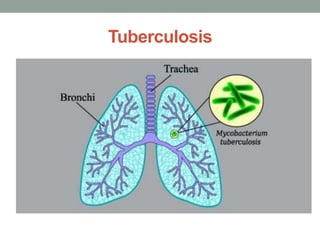
Tuberculosis
Introduction
• Tuberculosis (TB) is a contagious infection that usually
attacks your lungs. It can also spread to other parts of
your body, like your brain and spine. TB is spread through
the air when people with lung TB cough, sneeze or spit. A
person needs to inhale only a few germs to become
infected.
• Every year, 10 million people fall ill with tuberculosis (TB).
Despite being a preventable and curable disease, 1.5
million people die from TB each year – making it the
world’s top infectious killer.
DEFINITION
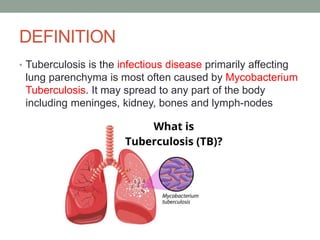
• Tuberculosis is the infectious disease primarily affecting
lung parenchyma is most often caused by Mycobacterium
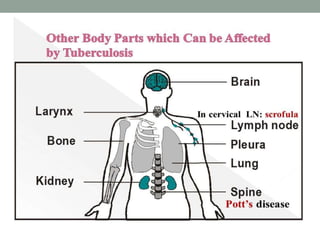
Tuberculosis. It may spread to any part of the body
including meninges, kidney, bones and lymph-nodes
INCIDENCE
• Over 9 million new cases and 2 million deaths per year
worldwide 1/3rd of the world’s population is infected with
M.tuberculosis, remains one of the top three killers In the
U.S
• India is the highest TB burden country in the world, home
to 20 percent of cases occurring globally.
TYPES
1. PULMONARY TUBERCULOSIS
2. AVIAN TUBERCULOSIS (Micobacterium avium; of
birds)
3. BOVINE TUBERCULOSIS (Mycobacterium bovis; of
cattle)
4. MILIARY TUBERCULOSIS /DISSEMINATED
TUBERCULOSIS (Invade the blood stream and spread
to all body organs.
Risk factors
Close contact with some one who have active TB.
Immune compromised status (elderly, cancer)
Drug abuse and alcoholism.
Malnutrition.
People lacking adequate health care.
Pre existing medical conditions (diabetes mellitus, chronic
renal failure).
Immigrants from countries with higher incidence of TB.
Institutionalization (long term care facilities)
Living in substandard conditions.
Occupation (health care workers)
MODE OF TRANSMISSION
Human beings acquire infection with tubercle bacilli by one
of the following routes:
Inhalation of organisms present in fresh cough droplets or
in dried sputum from an open case of pulmonary
tuberculosis.
Ingestion sputum of an open case of pulmonary
tuberculosis, or ingestion of bovine tubercle bacilli from
milk of diseased cows.
Inoculation of the organisms into the skin may rarely
occur from infected postmortem tissue.
Trans placental route results in development of congenital
tuberculosis in foetus from infected mother and is a rare
mode of transmission.
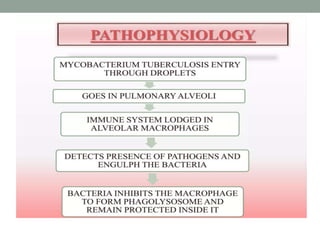
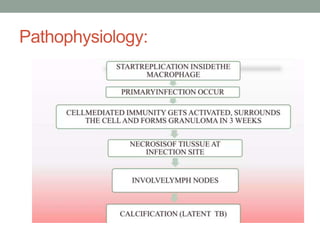
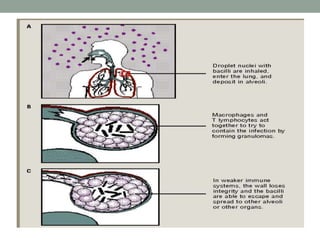
Pathophysiology:
CLINICAL MENIFESTATION
CONSTITUTIONAL SYMPTOMS
• Anorexia
• Low grade fever
• Night sweats
• Fatigue
• Weight los
Clinical manifestations(cont.,)
PULMONARY SYMPTOMS
• Dyspnea
• Non resolving bronchopneumonia
• Chest tightness
• Non productive cough
• Mucopurulent sputum with hemoptpysis
• Chest pain
EXTRA PULMONARY SYMPTOMS
• Pain
• Inflammation
Assessment and diagnostic findings
• Complete history
• Physical examination
• Tuberculin skin test (Mantoux test)
• Quantiform TB gold
• Sputum culture - Positive for Mycobacterium tuberculosis
• Drug susceptibility test
• Ziehl-Neelsen (acid-fast stain applied to a smear of body
fluid): Positive for acid-fast bacilli (AFB).
• Scans – X ray, CT, MRI etc.,
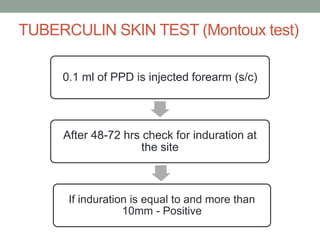
TUBERCULIN SKIN TEST (Montoux test)
0.1 ml of PPD is injected forearm (s/c)
After 48-72 hrs check for induration at
the site
If induration is equal to and more than
10mm - Positive
Montoux test
Quantiform TB gold
• This test is an ELISA test that detects the release of
interferon gamma by WBC when the blood of patient with
TB is incubated with peptides similar to those in M.
tuberculosis.
• Result is available within 24 hrs and are not affected by
prior vaccination with BCG.
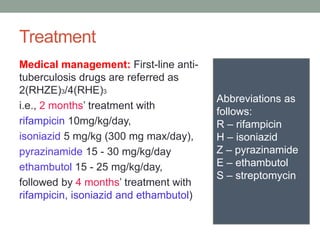
Treatment
Medical management: First-line anti-
tuberculosis drugs are referred as
2(RHZE)3/4(RHE)3
i.e., 2 months’ treatment with
rifampicin 10mg/kg/day,
isoniazid 5 mg/kg (300 mg max/day),
pyrazinamide 15 - 30 mg/kg/day
ethambutol 15 - 25 mg/kg/day,
followed by 4 months’ treatment with
rifampicin, isoniazid and ethambutol)
Abbreviations as
follows:
R – rifampicin
H – isoniazid
Z – pyrazinamide
E – ethambutol
S – streptomycin
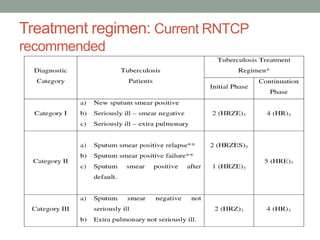
Treatment regimen: Current RNTCP
recommended
Dots therapy
Directly observed treatment, short-course has five
components:
1. Government commitment (including both political will at
all levels, and establishing a centralized and prioritized
system of TB monitoring, recording and training)
2. Case detection by sputum smear microscopy
3. Standardized treatment regimen directly observed by a
healthcare worker or community health worker for at
least the first two months
4. A regular drug supply
5. A standardized recording and reporting system that
allows assessment of treatment results
Nursing management:
• Assessment:
• Obtain history of exposure to TB
• Assess for symptoms of active disease
• Auscultate lungs for crackles
• During drug therapy assess for liver function
Nursing diagnosis:
1. Ineffective breathing pattern related to pulmonary
infection and potential for long term scarring with
decreased lung capacity
Interventions:
• Administer and teach self administration of medications
ordered
• Encourage rest and avoidance of exertion
• Monitor breath sounds respiratory rates , sputum
production and dyspnoea
• Provide supplemental oxygen as ordered
• Encourage increased fluid intake
• Instruct about best position to facilitate drainage
2. Risk for spreading infection related to nature of disease
and patients symptoms
Interventions:
• Be aware that TB is transmitted by respiratory droplets
• Use high efficiency particulate masks for high risk
procedures including endoscopy
• Educate patient to control the spread of infection by
covering mouth and nose while coughing and sneezing
• Isolation of patient
• Instruct about risk of drug resistance if drug regimen is not
strictly and continuously followed
• Carefully monitor vital signs and observe for temperature
changes
3. Imbalanced nutrition less than body requirement related
to poor appetite ,fatigue and productive cough
Interventions:
• Explain the importance of eating nutritious diet to promote
healing and defense against infection
• Encourage protein rich diet.
• Provide small frequent meals
• Monitor weight of the patient
• Administer vitamin supplements as ordered
Complications
• Pleural effusion
• Pneumonia
• Extra pulmonary tuberculosis
Prevention measures:
• ISOLATION
• No close contact with infected persons
• Ventilate the room/house
• Cover the mouth
• Wear mask
• Finish entire course of medication
• Vaccinations
• Eat healthy
• Maintain good nutritional status
• No not smoke or substance abuse
TUBERCULOSIS - communicable disease.pptx

TUBERCULOSIS - communicable disease.pptx

  • 1.
  • 2.
  • 3.
    Introduction • Tuberculosis (TB)is a contagious infection that usually attacks your lungs. It can also spread to other parts of your body, like your brain and spine. TB is spread through the air when people with lung TB cough, sneeze or spit. A person needs to inhale only a few germs to become infected. • Every year, 10 million people fall ill with tuberculosis (TB). Despite being a preventable and curable disease, 1.5 million people die from TB each year – making it the world’s top infectious killer.
  • 4.
    DEFINITION • Tuberculosis isthe infectious disease primarily affecting lung parenchyma is most often caused by Mycobacterium Tuberculosis. It may spread to any part of the body including meninges, kidney, bones and lymph-nodes
  • 5.
    INCIDENCE • Over 9million new cases and 2 million deaths per year worldwide 1/3rd of the world’s population is infected with M.tuberculosis, remains one of the top three killers In the U.S • India is the highest TB burden country in the world, home to 20 percent of cases occurring globally.
  • 6.
    TYPES 1. PULMONARY TUBERCULOSIS 2.AVIAN TUBERCULOSIS (Micobacterium avium; of birds) 3. BOVINE TUBERCULOSIS (Mycobacterium bovis; of cattle) 4. MILIARY TUBERCULOSIS /DISSEMINATED TUBERCULOSIS (Invade the blood stream and spread to all body organs.
  • 8.
    Risk factors Close contactwith some one who have active TB. Immune compromised status (elderly, cancer) Drug abuse and alcoholism. Malnutrition. People lacking adequate health care. Pre existing medical conditions (diabetes mellitus, chronic renal failure). Immigrants from countries with higher incidence of TB. Institutionalization (long term care facilities) Living in substandard conditions. Occupation (health care workers)
  • 9.
    MODE OF TRANSMISSION Humanbeings acquire infection with tubercle bacilli by one of the following routes: Inhalation of organisms present in fresh cough droplets or in dried sputum from an open case of pulmonary tuberculosis. Ingestion sputum of an open case of pulmonary tuberculosis, or ingestion of bovine tubercle bacilli from milk of diseased cows. Inoculation of the organisms into the skin may rarely occur from infected postmortem tissue. Trans placental route results in development of congenital tuberculosis in foetus from infected mother and is a rare mode of transmission.
  • 11.
  • 13.
    CLINICAL MENIFESTATION CONSTITUTIONAL SYMPTOMS •Anorexia • Low grade fever • Night sweats • Fatigue • Weight los
  • 14.
    Clinical manifestations(cont.,) PULMONARY SYMPTOMS •Dyspnea • Non resolving bronchopneumonia • Chest tightness • Non productive cough • Mucopurulent sputum with hemoptpysis • Chest pain EXTRA PULMONARY SYMPTOMS • Pain • Inflammation
  • 15.
    Assessment and diagnosticfindings • Complete history • Physical examination • Tuberculin skin test (Mantoux test) • Quantiform TB gold • Sputum culture - Positive for Mycobacterium tuberculosis • Drug susceptibility test • Ziehl-Neelsen (acid-fast stain applied to a smear of body fluid): Positive for acid-fast bacilli (AFB). • Scans – X ray, CT, MRI etc.,
  • 16.
    TUBERCULIN SKIN TEST(Montoux test) 0.1 ml of PPD is injected forearm (s/c) After 48-72 hrs check for induration at the site If induration is equal to and more than 10mm - Positive
  • 17.
  • 18.
    Quantiform TB gold •This test is an ELISA test that detects the release of interferon gamma by WBC when the blood of patient with TB is incubated with peptides similar to those in M. tuberculosis. • Result is available within 24 hrs and are not affected by prior vaccination with BCG.
  • 19.
    Treatment Medical management: First-lineanti- tuberculosis drugs are referred as 2(RHZE)3/4(RHE)3 i.e., 2 months’ treatment with rifampicin 10mg/kg/day, isoniazid 5 mg/kg (300 mg max/day), pyrazinamide 15 - 30 mg/kg/day ethambutol 15 - 25 mg/kg/day, followed by 4 months’ treatment with rifampicin, isoniazid and ethambutol) Abbreviations as follows: R – rifampicin H – isoniazid Z – pyrazinamide E – ethambutol S – streptomycin
  • 20.
    Treatment regimen: CurrentRNTCP recommended
  • 21.
    Dots therapy Directly observedtreatment, short-course has five components: 1. Government commitment (including both political will at all levels, and establishing a centralized and prioritized system of TB monitoring, recording and training) 2. Case detection by sputum smear microscopy 3. Standardized treatment regimen directly observed by a healthcare worker or community health worker for at least the first two months 4. A regular drug supply 5. A standardized recording and reporting system that allows assessment of treatment results
  • 22.
    Nursing management: • Assessment: •Obtain history of exposure to TB • Assess for symptoms of active disease • Auscultate lungs for crackles • During drug therapy assess for liver function
  • 23.
    Nursing diagnosis: 1. Ineffectivebreathing pattern related to pulmonary infection and potential for long term scarring with decreased lung capacity Interventions: • Administer and teach self administration of medications ordered • Encourage rest and avoidance of exertion • Monitor breath sounds respiratory rates , sputum production and dyspnoea • Provide supplemental oxygen as ordered • Encourage increased fluid intake • Instruct about best position to facilitate drainage
  • 24.
    2. Risk forspreading infection related to nature of disease and patients symptoms Interventions: • Be aware that TB is transmitted by respiratory droplets • Use high efficiency particulate masks for high risk procedures including endoscopy • Educate patient to control the spread of infection by covering mouth and nose while coughing and sneezing • Isolation of patient • Instruct about risk of drug resistance if drug regimen is not strictly and continuously followed • Carefully monitor vital signs and observe for temperature changes
  • 25.
    3. Imbalanced nutritionless than body requirement related to poor appetite ,fatigue and productive cough Interventions: • Explain the importance of eating nutritious diet to promote healing and defense against infection • Encourage protein rich diet. • Provide small frequent meals • Monitor weight of the patient • Administer vitamin supplements as ordered
  • 26.
    Complications • Pleural effusion •Pneumonia • Extra pulmonary tuberculosis
  • 27.
    Prevention measures: • ISOLATION •No close contact with infected persons • Ventilate the room/house • Cover the mouth • Wear mask • Finish entire course of medication • Vaccinations • Eat healthy • Maintain good nutritional status • No not smoke or substance abuse