SEMINAR ON PULMONARY
TUBERCULOSIS
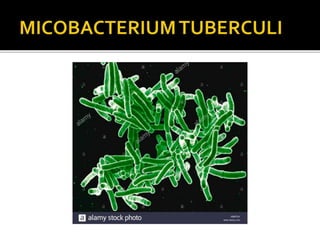
Tuberculosis (TB) is one of the most prevalent
infections of human beings and contributes
considerably to illness and death around the world. It
is spread by inhaling tiny droplets of saliva from the
coughs or sneezes of an infected person.it is a slowly
granulomatous spreading, bacterial chronic,
infection, characterized by gradual weight loss
Tuberculosis is the infectious disease primarily
affecting lung parenchyma is most often caused by
mycobacterium tuberculosis. It may spread to any
part of the body including meninges, kidney, bones
and lymphnodes.
 PULMONARYTUBERCULOSIS
 AVIANTUBERCULOSIS( MICROBACTERIUM
AVIUM, OF BIRDS)
 BOVINETUBERCULOSIS(MYCOBACTERIUM
BOVIS, OF CATTLE)
 MILIARYTUBERCULOSIS / DISSEMINATED
TUBERCULOSIS
 With the increased incidence of AIDS,TB has
become more a problem in the U.S., and the
world.
 It is currently estimated that 1/2 of the
world's population (3.1 billion) is infected with
Mycobacterium tuberculosis
 Global EmergencyTuberculosis kills 5,000
people a day
 2.3 million die each year
 Mycobacterium tuberculosis
 Droplet nuclei(coughing, sneezing, laughing)
 Exposure toTB
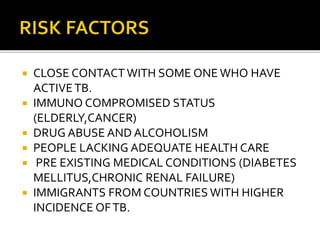
 CLOSE CONTACT WITH SOME ONE WHO HAVE
ACTIVETB.
 IMMUNO COMPROMISED STATUS
(ELDERLY,CANCER)
 DRUG ABUSE AND ALCOHOLISM
 PEOPLE LACKING ADEQUATE HEALTH CARE
 PRE EXISTING MEDICAL CONDITIONS (DIABETES
MELLITUS,CHRONIC RENAL FAILURE)
 IMMIGRANTS FROM COUNTRIES WITH HIGHER
INCIDENCE OFTB.
 INSTITUTIONALISATION(LONG TERM CARE
FACILITIES)
 LIVING IN SUBSTANDARD CONDITIONS
 OCCUPATION(HEALTH CAREWORKERS)
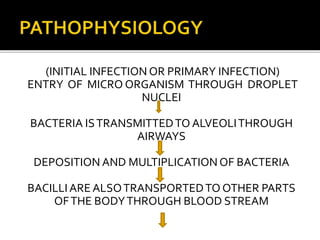
(INITIAL INFECTION OR PRIMARY INFECTION)
ENTRY OF MICRO ORGANISM THROUGH DROPLET
NUCLEI
BACTERIA ISTRANSMITTEDTO ALVEOLITHROUGH
AIRWAYS
DEPOSITION AND MULTIPLICATION OF BACTERIA
BACILLIARE ALSOTRANSPORTEDTO OTHER PARTS
OFTHE BODYTHROUGH BLOOD STREAM
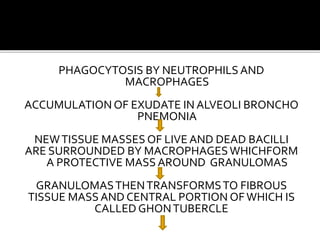
PHAGOCYTOSIS BY NEUTROPHILS AND
MACROPHAGES
ACCUMULATION OF EXUDATE IN ALVEOLI BRONCHO
PNEMONIA
NEWTISSUE MASSES OF LIVE AND DEAD BACILLI
ARE SURROUNDED BY MACROPHAGESWHICHFORM
A PROTECTIVE MASS AROUND GRANULOMAS
GRANULOMASTHENTRANSFORMSTO FIBROUS
TISSUE MASS AND CENTRAL PORTION OFWHICH IS
CALLED GHONTUBERCLE
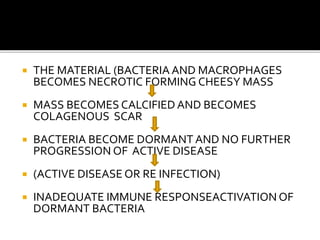
 THE MATERIAL (BACTERIA AND MACROPHAGES
BECOMES NECROTIC FORMING CHEESY MASS
 MASS BECOMES CALCIFIED AND BECOMES
COLAGENOUS SCAR
 BACTERIA BECOME DORMANT AND NO FURTHER
PROGRESSION OF ACTIVE DISEASE
 (ACTIVE DISEASE OR RE INFECTION)
 INADEQUATE IMMUNE RESPONSEACTIVATION OF
DORMANT BACTERIA
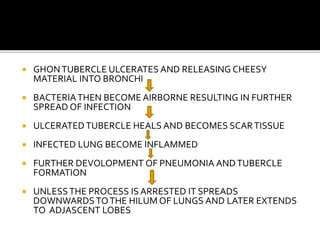
 GHONTUBERCLE ULCERATES AND RELEASING CHEESY
MATERIAL INTO BRONCHI
 BACTERIATHEN BECOME AIRBORNE RESULTING IN FURTHER
SPREAD OF INFECTION
 ULCERATEDTUBERCLE HEALS AND BECOMES SCARTISSUE
 INFECTED LUNG BECOME INFLAMMED
 FURTHER DEVOLOPMENT OF PNEUMONIA ANDTUBERCLE
FORMATION
 UNLESSTHE PROCESS IS ARRESTED IT SPREADS
DOWNWARDS TOTHE HILUM OF LUNGS AND LATER EXTENDS
TO ADJASCENT LOBES
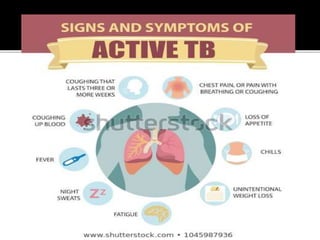
CONSTITUTIONAL SYMPTOMS
 Anorexia
 Low grade fever
 Night sweats
 Fatique
 Weight loss
PULMONARY SYMPTOMS
 Dyspnea
 Non resolving bronchopneumonia
 Chest tightness
 Non productive cough
 Mucopurulent sputum with hemoptpysis
 Chest pain
EXTRA PULMONARY SYMPTOMS
 Pain
 Inflammation
 HISTORY COLLECTION
 PHYSICAL EXAMINATION
 Clubbing of the fingers or toes (in people with
advanced disease)
 Swollen or tender lymph nodes in the neck or
other areas
 Fluid around a lung (pleural effusion)
 Unusual breath sounds (crackles)
IF MILIARYTB;A physical exam may show:
 Swollen liver
 Swollen lymph nodes
 Swollen spleen
Tests may include:
 Biopsy of the affected tissue (rare)
 Bronchoscopy
 Chest CT scan
 Chest x-ray
 Interferon-gamma release blood test such as the
QFT-Gold test to test forTB infection
 Sputum examination and cultures
 Thoracentesis
 Tuberculin skin test (also called a PPD test)
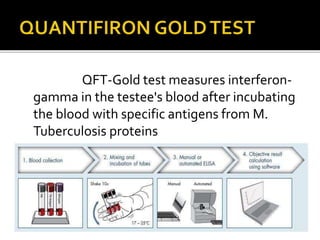
QFT-Gold test measures interferon-
gamma in the testee's blood after incubating
the blood with specific antigens from M.
Tuberculosis proteins
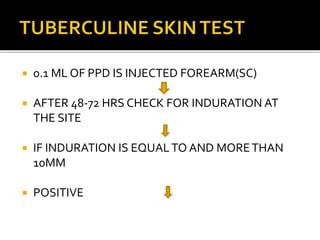
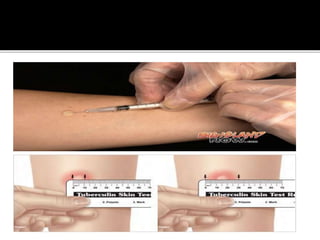
 0.1 ML OF PPD IS INJECTED FOREARM(SC)
 AFTER 48-72 HRS CHECK FOR INDURATION AT
THE SITE
 IF INDURATION IS EQUALTO AND MORETHAN
10MM
 POSITIVE
 Bones-Spinal pain and joint destruction may result
fromTB that infects your bones(TB spine or potss
spine)
 Brain(meningitis)
 Liver or kidneys
 Heart(cardiac tamponade)
 Pleural effusion Tb pneumonia
 Serious reactions to drug therapy(hepato toxicity,
hypersentivity)
PULMONARYTB is treated primarily with
antituberculosis agents for 6 to 12 months.
Pharmacological management
 First line antitubercular medications
 Streptomycin 15mg/kg
 Isoniazid or INH(Nydrazid) 5 mg/kg(300 mg max
perday)
 Rifampin 10 mg/kg
 Pyrazinamide 15 – 30 mg/kg
 Ethambutol(Myambutol) 15 -25 mg/kg daily for 8
weeks and continuing for up to 4 to 7 months
Second line medications
 Capreomycin 12 -15 mg/kg
 Ethionamide 15mg/kg
 Para aminosalycilate sodium 200 - 300 mg/kg
 Cycloserine 15 mg/kg
 Vitamin b(pyridoxine) usually adminstered with INH
THIRD LINE DRUGS
Other drugs that may be useful, but are not on the
WHO list of SLDs:
 Rifabutin
 Macrolides:e.g.,clarithromycin (CLR)
 Linezolid(LZD)
 Thioacetazone(T)
 Thioridazine
 Arginine
DOTS (directly observed treatment, short-course), is
the name given to theWorld Health Organization-
recommended tuberculosis control strategy that
combines five components:
1. Government commitment (including both political will at
all levels, and establishing a centralized and prioritized
system ofTB monitoring, recording and training)
2. Case detection by sputum smear microscopy
3. Standardized treatment regimen directly observed by a
healthcare worker or community health worker for at
least the first two months
4. A regular drug supply
5. A standardized recording and reporting system that
allows assessment of treatment results
DOT is especially critical for patients with drug
resistantTB, HIV-infected patients, and those on
intermittent treatment regimens (i.e., 2 or 3 times
weekly)DOT is especially critical for patients with
drug resistantTB, HIV-infected patients, and those
on intermittent treatment regimens (i.e., 2 or 3
times weekly)
MEDICATION:
 INTENSIVE PHASE (2-3 MONTHS)
UNDER DIRECT SUPERVISION OF HEALTH
WORKER ORTRIANED PROFFESSIONAL.
 CONTINUATION PHASE (4-6 MONTHS)
A MULTI BLISTER COMBI PACKWITH DRUGS IS
GIVEN OFWHICHTHE FIRST DOSE ISTAKEN
UNDER SUPERVISION.
 Multiple-drug therapy to treatTB means taking
several different anti tubercular drugs at the same
time.
 The standard treatment isoniazid, rifampin,
ethambutol, is to take and pyrazinamide for 2
months.Treatment is then continued for at least
4months with fewer medicines.
 MDR-TB is caused by strains of Micobacterium
Tuberculosis is resistant to both Refampicin and
Isoniazid with or without resistance to other drugs.
 Single isoniazid or refampicin resistnace is not
MDR-TB.
 MDR-TB is a laboratory diagnosis, not a clinical
assumption.
 Assessment
 Obtain history of exposure toTB
 Assess for symptoms of active disease
 Auscultate lungs for crackles
 During drug therapy assess for liver function
1.Ineffective breathing pattern related to
pulmonary infection and potential for long term
scarring with decreased lung capacity
Interventions
 Administer and teach self administration of
medications ordered
 Encourage rest and avoidance of exertion
 Moniter breath sounds respiratory rates ,sputum
production and dyspnoea
 Provide supplymental oxygen as ordered
 Encourage increased fluid intake
 Instruct about best position to facilitate drainage
2.Risk for spreading infection related to nature
of disease and patients symptoms
 Be aware thatTB is transmitted by respiratory
droplets
 Use high efficiency particulate masks for high risk
procedures including endoscopy
 Educate patient to control the spread of infection by
covering mouth and nose while coughing and
sneezing
 Isolation of patient
 Instruct about risk of drug resistance if drug
regimen is not strictly and continuosly followed
3.Imbalanced nutrition less than body
requirement related to poor appetite ,fatique and
productive cough
 Explain the importance of eating nutritious diet to
promote healing and defense against infection
 Provide small frequent meals
 Moniter weight of the patient
 Administer vitamin supplyments as ordered
4.Non compliance related to lack of motivation
and lack of treatment
 Educate patient about etiology transmission and
effects ofTB
 Review adverse effects of drug therapy
 Participate in observation of medicine
taking,weekly pill counts or programmes designed
to increase compliance with the treatment forTB
 Explain thatTB is a communicable disease and that
taking medications is most effective way of
preventing transmission
 Instruct about medications schecule and side effects
 ISOLATION
 Ventilate the room
 Cover the mouth
 Wear mask
 Finish entire course of medication
 vaccinations
 Despite all the national programmes and
efforts by the Govt. of IndiaTB still continues
to be a major socio economic burden of the
country.
 Still there is a need to awareness among the
health care workers and medical
proffessional and most importantly the
community.
 Brunner and Siddharth textbook of medical
surgical nursing 10th edition 2002.
 Lewi’s Medical and Surgical Nursing vol.
1,edition 2015.
 www.medscape.com
 www.wikipedia.com
Thank you

Seminar on Pulmonary Tuberculosis

  • 1.
  • 2.
    Tuberculosis (TB) isone of the most prevalent infections of human beings and contributes considerably to illness and death around the world. It is spread by inhaling tiny droplets of saliva from the coughs or sneezes of an infected person.it is a slowly granulomatous spreading, bacterial chronic, infection, characterized by gradual weight loss
  • 3.
    Tuberculosis is theinfectious disease primarily affecting lung parenchyma is most often caused by mycobacterium tuberculosis. It may spread to any part of the body including meninges, kidney, bones and lymphnodes.
  • 5.
     PULMONARYTUBERCULOSIS  AVIANTUBERCULOSIS(MICROBACTERIUM AVIUM, OF BIRDS)  BOVINETUBERCULOSIS(MYCOBACTERIUM BOVIS, OF CATTLE)  MILIARYTUBERCULOSIS / DISSEMINATED TUBERCULOSIS
  • 6.
     With theincreased incidence of AIDS,TB has become more a problem in the U.S., and the world.  It is currently estimated that 1/2 of the world's population (3.1 billion) is infected with Mycobacterium tuberculosis  Global EmergencyTuberculosis kills 5,000 people a day  2.3 million die each year
  • 7.
     Mycobacterium tuberculosis Droplet nuclei(coughing, sneezing, laughing)  Exposure toTB
  • 8.
     CLOSE CONTACTWITH SOME ONE WHO HAVE ACTIVETB.  IMMUNO COMPROMISED STATUS (ELDERLY,CANCER)  DRUG ABUSE AND ALCOHOLISM  PEOPLE LACKING ADEQUATE HEALTH CARE  PRE EXISTING MEDICAL CONDITIONS (DIABETES MELLITUS,CHRONIC RENAL FAILURE)  IMMIGRANTS FROM COUNTRIES WITH HIGHER INCIDENCE OFTB.
  • 9.
     INSTITUTIONALISATION(LONG TERMCARE FACILITIES)  LIVING IN SUBSTANDARD CONDITIONS  OCCUPATION(HEALTH CAREWORKERS)
  • 10.
    (INITIAL INFECTION ORPRIMARY INFECTION) ENTRY OF MICRO ORGANISM THROUGH DROPLET NUCLEI BACTERIA ISTRANSMITTEDTO ALVEOLITHROUGH AIRWAYS DEPOSITION AND MULTIPLICATION OF BACTERIA BACILLIARE ALSOTRANSPORTEDTO OTHER PARTS OFTHE BODYTHROUGH BLOOD STREAM
  • 11.
    PHAGOCYTOSIS BY NEUTROPHILSAND MACROPHAGES ACCUMULATION OF EXUDATE IN ALVEOLI BRONCHO PNEMONIA NEWTISSUE MASSES OF LIVE AND DEAD BACILLI ARE SURROUNDED BY MACROPHAGESWHICHFORM A PROTECTIVE MASS AROUND GRANULOMAS GRANULOMASTHENTRANSFORMSTO FIBROUS TISSUE MASS AND CENTRAL PORTION OFWHICH IS CALLED GHONTUBERCLE
  • 12.
     THE MATERIAL(BACTERIA AND MACROPHAGES BECOMES NECROTIC FORMING CHEESY MASS  MASS BECOMES CALCIFIED AND BECOMES COLAGENOUS SCAR  BACTERIA BECOME DORMANT AND NO FURTHER PROGRESSION OF ACTIVE DISEASE  (ACTIVE DISEASE OR RE INFECTION)  INADEQUATE IMMUNE RESPONSEACTIVATION OF DORMANT BACTERIA
  • 13.
     GHONTUBERCLE ULCERATESAND RELEASING CHEESY MATERIAL INTO BRONCHI  BACTERIATHEN BECOME AIRBORNE RESULTING IN FURTHER SPREAD OF INFECTION  ULCERATEDTUBERCLE HEALS AND BECOMES SCARTISSUE  INFECTED LUNG BECOME INFLAMMED  FURTHER DEVOLOPMENT OF PNEUMONIA ANDTUBERCLE FORMATION  UNLESSTHE PROCESS IS ARRESTED IT SPREADS DOWNWARDS TOTHE HILUM OF LUNGS AND LATER EXTENDS TO ADJASCENT LOBES
  • 14.
    CONSTITUTIONAL SYMPTOMS  Anorexia Low grade fever  Night sweats  Fatique  Weight loss
  • 15.
    PULMONARY SYMPTOMS  Dyspnea Non resolving bronchopneumonia  Chest tightness  Non productive cough  Mucopurulent sputum with hemoptpysis  Chest pain EXTRA PULMONARY SYMPTOMS  Pain  Inflammation
  • 17.
     HISTORY COLLECTION PHYSICAL EXAMINATION  Clubbing of the fingers or toes (in people with advanced disease)  Swollen or tender lymph nodes in the neck or other areas  Fluid around a lung (pleural effusion)  Unusual breath sounds (crackles)
  • 18.
    IF MILIARYTB;A physicalexam may show:  Swollen liver  Swollen lymph nodes  Swollen spleen
  • 19.
    Tests may include: Biopsy of the affected tissue (rare)  Bronchoscopy  Chest CT scan  Chest x-ray  Interferon-gamma release blood test such as the QFT-Gold test to test forTB infection  Sputum examination and cultures  Thoracentesis  Tuberculin skin test (also called a PPD test)
  • 20.
    QFT-Gold test measuresinterferon- gamma in the testee's blood after incubating the blood with specific antigens from M. Tuberculosis proteins
  • 21.
     0.1 MLOF PPD IS INJECTED FOREARM(SC)  AFTER 48-72 HRS CHECK FOR INDURATION AT THE SITE  IF INDURATION IS EQUALTO AND MORETHAN 10MM  POSITIVE
  • 23.
     Bones-Spinal painand joint destruction may result fromTB that infects your bones(TB spine or potss spine)  Brain(meningitis)  Liver or kidneys  Heart(cardiac tamponade)  Pleural effusion Tb pneumonia  Serious reactions to drug therapy(hepato toxicity, hypersentivity)
  • 24.
    PULMONARYTB is treatedprimarily with antituberculosis agents for 6 to 12 months. Pharmacological management  First line antitubercular medications  Streptomycin 15mg/kg  Isoniazid or INH(Nydrazid) 5 mg/kg(300 mg max perday)  Rifampin 10 mg/kg  Pyrazinamide 15 – 30 mg/kg  Ethambutol(Myambutol) 15 -25 mg/kg daily for 8 weeks and continuing for up to 4 to 7 months
  • 25.
    Second line medications Capreomycin 12 -15 mg/kg  Ethionamide 15mg/kg  Para aminosalycilate sodium 200 - 300 mg/kg  Cycloserine 15 mg/kg  Vitamin b(pyridoxine) usually adminstered with INH
  • 26.
    THIRD LINE DRUGS Otherdrugs that may be useful, but are not on the WHO list of SLDs:  Rifabutin  Macrolides:e.g.,clarithromycin (CLR)  Linezolid(LZD)  Thioacetazone(T)  Thioridazine  Arginine
  • 27.
    DOTS (directly observedtreatment, short-course), is the name given to theWorld Health Organization- recommended tuberculosis control strategy that combines five components: 1. Government commitment (including both political will at all levels, and establishing a centralized and prioritized system ofTB monitoring, recording and training) 2. Case detection by sputum smear microscopy 3. Standardized treatment regimen directly observed by a healthcare worker or community health worker for at least the first two months 4. A regular drug supply 5. A standardized recording and reporting system that allows assessment of treatment results
  • 28.
    DOT is especiallycritical for patients with drug resistantTB, HIV-infected patients, and those on intermittent treatment regimens (i.e., 2 or 3 times weekly)DOT is especially critical for patients with drug resistantTB, HIV-infected patients, and those on intermittent treatment regimens (i.e., 2 or 3 times weekly)
  • 29.
    MEDICATION:  INTENSIVE PHASE(2-3 MONTHS) UNDER DIRECT SUPERVISION OF HEALTH WORKER ORTRIANED PROFFESSIONAL.  CONTINUATION PHASE (4-6 MONTHS) A MULTI BLISTER COMBI PACKWITH DRUGS IS GIVEN OFWHICHTHE FIRST DOSE ISTAKEN UNDER SUPERVISION.
  • 30.
     Multiple-drug therapyto treatTB means taking several different anti tubercular drugs at the same time.  The standard treatment isoniazid, rifampin, ethambutol, is to take and pyrazinamide for 2 months.Treatment is then continued for at least 4months with fewer medicines.
  • 31.
     MDR-TB iscaused by strains of Micobacterium Tuberculosis is resistant to both Refampicin and Isoniazid with or without resistance to other drugs.  Single isoniazid or refampicin resistnace is not MDR-TB.  MDR-TB is a laboratory diagnosis, not a clinical assumption.
  • 32.
     Assessment  Obtainhistory of exposure toTB  Assess for symptoms of active disease  Auscultate lungs for crackles  During drug therapy assess for liver function
  • 33.
    1.Ineffective breathing patternrelated to pulmonary infection and potential for long term scarring with decreased lung capacity Interventions  Administer and teach self administration of medications ordered  Encourage rest and avoidance of exertion  Moniter breath sounds respiratory rates ,sputum production and dyspnoea  Provide supplymental oxygen as ordered  Encourage increased fluid intake  Instruct about best position to facilitate drainage
  • 34.
    2.Risk for spreadinginfection related to nature of disease and patients symptoms  Be aware thatTB is transmitted by respiratory droplets  Use high efficiency particulate masks for high risk procedures including endoscopy  Educate patient to control the spread of infection by covering mouth and nose while coughing and sneezing  Isolation of patient  Instruct about risk of drug resistance if drug regimen is not strictly and continuosly followed
  • 35.
    3.Imbalanced nutrition lessthan body requirement related to poor appetite ,fatique and productive cough  Explain the importance of eating nutritious diet to promote healing and defense against infection  Provide small frequent meals  Moniter weight of the patient  Administer vitamin supplyments as ordered
  • 36.
    4.Non compliance relatedto lack of motivation and lack of treatment  Educate patient about etiology transmission and effects ofTB  Review adverse effects of drug therapy  Participate in observation of medicine taking,weekly pill counts or programmes designed to increase compliance with the treatment forTB  Explain thatTB is a communicable disease and that taking medications is most effective way of preventing transmission  Instruct about medications schecule and side effects
  • 37.
     ISOLATION  Ventilatethe room  Cover the mouth  Wear mask  Finish entire course of medication  vaccinations
  • 38.
     Despite allthe national programmes and efforts by the Govt. of IndiaTB still continues to be a major socio economic burden of the country.  Still there is a need to awareness among the health care workers and medical proffessional and most importantly the community.
  • 39.
     Brunner andSiddharth textbook of medical surgical nursing 10th edition 2002.  Lewi’s Medical and Surgical Nursing vol. 1,edition 2015.  www.medscape.com  www.wikipedia.com
  • 40.