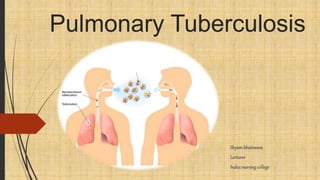

Pulmonary Tuberculosis
Shyambhatewara
Lecturer
Indexnursing college
Tuberculosis
Tuberculosis (TB) is an infectious disease that
primarily affects the lung parenchyma. It also may be
transmitted to other parts of the body, including the
meninges, kidneys , bones, and lymph nodes.
Etiological factors
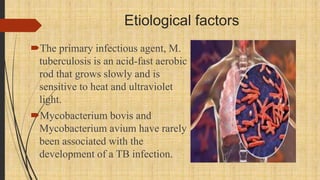
The primary infectious agent, M.
tuberculosis is an acid-fast aerobic
rod that grows slowly and is
sensitive to heat and ultraviolet
light.
Mycobacterium bovis and
Mycobacterium avium have rarely
been associated with the
development of a TB infection.
Associated risk fctors
Child younger than 5 years of age
Drinking unpasteurized milk if the cow is infected with
bovine tuberculosis
Homeless individuals or those from a lower socioeco-
nomic group, minority group, or refugee group
Individuals in constant, frequent contactwithanuntreated or
undiagnosed individual
Individuals living in crowded areas, such as long-term
care facilities, prisons, and mental health facilities
Associated risk factors
Older client
Individuals with malnutrition, infection, immune
dysfunction, or human immunodeficiency virus infection;
or immunosuppressed as a result of medication therapy
Individuals who abuse alcohol or are intravenous drug
users
Transmission
Via the airborne route by droplet infection.
When an infected individual coughs, laughs, sneezes, or
sings, droplet nuclei containing tuberculosis bacteria enter
the air and may be inhaled by others.
Pathophysiology
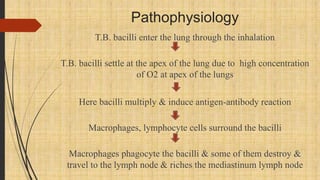
T.B. bacilli enter the lung through the inhalation
T.B. bacilli settle at the apex of the lung due to high concentration
of O2 at apex of the lungs
Here bacilli multiply & induce antigen-antibody reaction
Macrophages, lymphocyte cells surround the bacilli
Macrophages phagocyte the bacilli & some of them destroy &
travel to the lymph node & riches the mediastinum lymph node
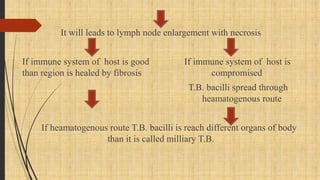
It will leads to lymph node enlargement with necrosis
If immune system of host is good If immune system of host is
than region is healed by fibrosis compromised
T.B. bacilli spread through
heamatogenous route
If heamatogenous route T.B. bacilli is reach different organs of body
than it is called milliary T.B.
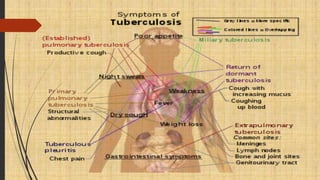
Clinical manifestations
May be asymptomatic in
primary infection
Fatigue
Lethargy
Anorexia
Weight loss
Low-grade fever
Chills
Night sweats
Persistent cough and the
production of mucoid and
mucopurulent sputum,
which is occasion- ally
streaked with blood
Chest tightness and a dull,
aching chest pain may
accompany the cough.
Diagnostic evaluation
Detailed history collection
Physical examination
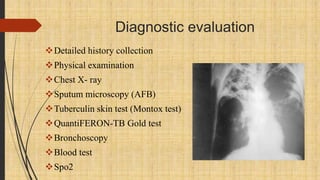
Chest X- ray
Sputum microscopy (AFB)
Tuberculin skin test (Montox test)
QuantiFERON-TB Gold test
Bronchoscopy
Blood test
Spo2
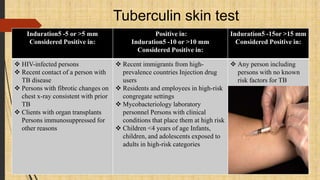
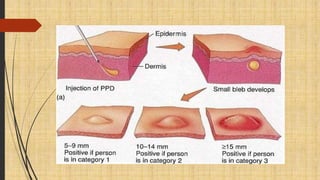
Induration5 -5 or >5 mm
Considered Positive in:
Positive in:
Induration5 -10 or >10 mm
Considered Positive in:
Induration5 -15or >15 mm
Considered Positive in:
 HIV-infected persons
 Recent contact of a person with
TB disease
 Persons with fibrotic changes on
chest x-ray consistent with prior
TB
 Clients with organ transplants
Persons immunosuppressed for
other reasons
 Recent immigrants from high-
prevalence countries Injection drug
users
 Residents and employees in high-risk
congregate settings
 Mycobacteriology laboratory
personnel Persons with clinical
conditions that place them at high risk
 Children <4 years of age Infants,
children, and adolescents exposed to
adults in high-risk categories
 Any person including
persons with no known
risk factors for TB
Tuberculin skin test
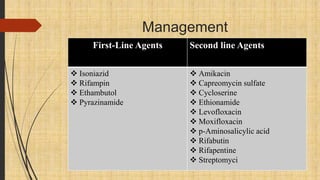
Management
First-Line Agents Second line Agents
 Isoniazid
 Rifampin
 Ethambutol
 Pyrazinamide
 Amikacin
 Capreomycin sulfate
 Cycloserine
 Ethionamide
 Levofloxacin
 Moxifloxacin
 p-Aminosalicylic acid
 Rifabutin
 Rifapentine
 Streptomyci
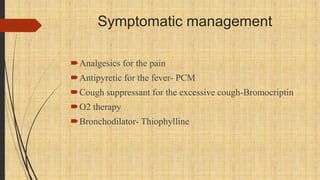
Symptomatic management
Analgesics for the pain
Antipyretic for the fever- PCM
Cough suppressant for the excessive cough-Bromocriptin
O2 therapy
Bronchodilator- Thiophylline
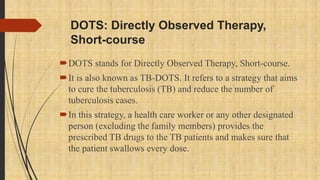
DOTS: Directly Observed Therapy,
Short-course
DOTS stands for Directly Observed Therapy, Short-course.
It is also known as TB-DOTS. It refers to a strategy that aims
to cure the tuberculosis (TB) and reduce the number of
tuberculosis cases.
In this strategy, a health care worker or any other designated
person (excluding the family members) provides the
prescribed TB drugs to the TB patients and makes sure that
the patient swallows every dose.
Importance of DOTS
 It prevents TB from spreading to others.
 It decreases the chances of treatment failure.
 It helps patents finish their TB treatment as quickly as possible and without any
gap.
 It decreases the risk of drug-resistance TB which results from the incomplete
treatment.
 We cannot be sure that the patient will take medication as directed; people may
forget or have problems taking medication correctly. This problem can be solved
with DOTS.
Client Education
Provide the client and family with information about
tuberculosis and alway concerns about the contagious
aspect of the infection. Instruct the client to follow the
medication regimen exactly as prescribed and always to
have a supply of the medication on hand.
Advise the client that the medication regimen is continued
up to 12 months depending on the situation.
Advise the client of the side and adverse effects of the
medication and ways of minimizing them to ensure
compliance.
Client Education
Reassure the client that after 2 to 3 weeks of medication
therapy, it is unlikely that the client will infect anyone.
Advise the client to resume activities gradually.
Instruct the client about the well-balanced diet (foods rich
in iron, protein, and vitamin C) to promote healing and to
prevent recurrence of the infection.
Inform the client and family that respiratory isolation is
not necessary because family members already have been
exposed.
Client Education
Instruct the client to cover the mouth and nose when
coughing or sneezing and to put used tissues into plastic
bags.
Instruct the client and family about thorough hand
washing. Inform the client that a sputum culture is needed
every 2 to 4 weeks once medication therapy is initiated.
Inform the client that when the results of 3 sputum
cultures are negative, the client is no longer considered
infectious and usually can return to former employment.
Client Education
Advise the client to avoid excessive exposure to silicone
or dust because these substances can cause further lung
damage.
Instruct the client regarding the importance of compliance
with treatment, follow-up care, and sputum cultures, as
prescribed
Pulmonary tuberculosis

Pulmonary tuberculosis

  • 1.
  • 2.
    Tuberculosis Tuberculosis (TB) isan infectious disease that primarily affects the lung parenchyma. It also may be transmitted to other parts of the body, including the meninges, kidneys , bones, and lymph nodes.
  • 3.
    Etiological factors The primaryinfectious agent, M. tuberculosis is an acid-fast aerobic rod that grows slowly and is sensitive to heat and ultraviolet light. Mycobacterium bovis and Mycobacterium avium have rarely been associated with the development of a TB infection.
  • 4.
    Associated risk fctors Childyounger than 5 years of age Drinking unpasteurized milk if the cow is infected with bovine tuberculosis Homeless individuals or those from a lower socioeco- nomic group, minority group, or refugee group Individuals in constant, frequent contactwithanuntreated or undiagnosed individual Individuals living in crowded areas, such as long-term care facilities, prisons, and mental health facilities
  • 5.
    Associated risk factors Olderclient Individuals with malnutrition, infection, immune dysfunction, or human immunodeficiency virus infection; or immunosuppressed as a result of medication therapy Individuals who abuse alcohol or are intravenous drug users
  • 6.
    Transmission Via the airborneroute by droplet infection. When an infected individual coughs, laughs, sneezes, or sings, droplet nuclei containing tuberculosis bacteria enter the air and may be inhaled by others.
  • 7.
    Pathophysiology T.B. bacilli enterthe lung through the inhalation T.B. bacilli settle at the apex of the lung due to high concentration of O2 at apex of the lungs Here bacilli multiply & induce antigen-antibody reaction Macrophages, lymphocyte cells surround the bacilli Macrophages phagocyte the bacilli & some of them destroy & travel to the lymph node & riches the mediastinum lymph node
  • 8.
    It will leadsto lymph node enlargement with necrosis If immune system of host is good If immune system of host is than region is healed by fibrosis compromised T.B. bacilli spread through heamatogenous route If heamatogenous route T.B. bacilli is reach different organs of body than it is called milliary T.B.
  • 9.
    Clinical manifestations May beasymptomatic in primary infection Fatigue Lethargy Anorexia Weight loss Low-grade fever Chills Night sweats Persistent cough and the production of mucoid and mucopurulent sputum, which is occasion- ally streaked with blood Chest tightness and a dull, aching chest pain may accompany the cough.
  • 11.
    Diagnostic evaluation Detailed historycollection Physical examination Chest X- ray Sputum microscopy (AFB) Tuberculin skin test (Montox test) QuantiFERON-TB Gold test Bronchoscopy Blood test Spo2
  • 12.
    Induration5 -5 or>5 mm Considered Positive in: Positive in: Induration5 -10 or >10 mm Considered Positive in: Induration5 -15or >15 mm Considered Positive in:  HIV-infected persons  Recent contact of a person with TB disease  Persons with fibrotic changes on chest x-ray consistent with prior TB  Clients with organ transplants Persons immunosuppressed for other reasons  Recent immigrants from high- prevalence countries Injection drug users  Residents and employees in high-risk congregate settings  Mycobacteriology laboratory personnel Persons with clinical conditions that place them at high risk  Children <4 years of age Infants, children, and adolescents exposed to adults in high-risk categories  Any person including persons with no known risk factors for TB Tuberculin skin test
  • 14.
    Management First-Line Agents Secondline Agents  Isoniazid  Rifampin  Ethambutol  Pyrazinamide  Amikacin  Capreomycin sulfate  Cycloserine  Ethionamide  Levofloxacin  Moxifloxacin  p-Aminosalicylic acid  Rifabutin  Rifapentine  Streptomyci
  • 15.
    Symptomatic management Analgesics forthe pain Antipyretic for the fever- PCM Cough suppressant for the excessive cough-Bromocriptin O2 therapy Bronchodilator- Thiophylline
  • 16.
    DOTS: Directly ObservedTherapy, Short-course DOTS stands for Directly Observed Therapy, Short-course. It is also known as TB-DOTS. It refers to a strategy that aims to cure the tuberculosis (TB) and reduce the number of tuberculosis cases. In this strategy, a health care worker or any other designated person (excluding the family members) provides the prescribed TB drugs to the TB patients and makes sure that the patient swallows every dose.
  • 17.
    Importance of DOTS It prevents TB from spreading to others.  It decreases the chances of treatment failure.  It helps patents finish their TB treatment as quickly as possible and without any gap.  It decreases the risk of drug-resistance TB which results from the incomplete treatment.  We cannot be sure that the patient will take medication as directed; people may forget or have problems taking medication correctly. This problem can be solved with DOTS.
  • 18.
    Client Education Provide theclient and family with information about tuberculosis and alway concerns about the contagious aspect of the infection. Instruct the client to follow the medication regimen exactly as prescribed and always to have a supply of the medication on hand. Advise the client that the medication regimen is continued up to 12 months depending on the situation. Advise the client of the side and adverse effects of the medication and ways of minimizing them to ensure compliance.
  • 19.
    Client Education Reassure theclient that after 2 to 3 weeks of medication therapy, it is unlikely that the client will infect anyone. Advise the client to resume activities gradually. Instruct the client about the well-balanced diet (foods rich in iron, protein, and vitamin C) to promote healing and to prevent recurrence of the infection. Inform the client and family that respiratory isolation is not necessary because family members already have been exposed.
  • 20.
    Client Education Instruct theclient to cover the mouth and nose when coughing or sneezing and to put used tissues into plastic bags. Instruct the client and family about thorough hand washing. Inform the client that a sputum culture is needed every 2 to 4 weeks once medication therapy is initiated. Inform the client that when the results of 3 sputum cultures are negative, the client is no longer considered infectious and usually can return to former employment.
  • 21.
    Client Education Advise theclient to avoid excessive exposure to silicone or dust because these substances can cause further lung damage. Instruct the client regarding the importance of compliance with treatment, follow-up care, and sputum cultures, as prescribed

Editor's Notes

  • #2 hsjcsahcsacbjkasbckjasbcjsac