Presented by:
Whelhelmina I. Montefrio, BSN – RN
Head Nurse – Fever Ward
Chickenpox
 a very contagious disease caused by the
varicella-zoster virus ( a member of the
herpes family of viruses )
 People who get the virus can develop into a
serious illness in some babies or children,
pregnant women, smokers & to a person w/
poor immune system, ex. person w/
leukemia, w/ HIV/AIDS, on high dose steroids
medication, or are taking chemotherapy.
Signs and Symptoms
Initial symptoms of chicken pox includes:
Fatigue
Mild fever
Lack of appetite
& a feeling of being generally unwell
This is quickly followed ( usually within 24hrs ) the development of red rash appears in the trunks,
chest & then spread to other parts of the body including the mouth & throat, eyelids & genital area.
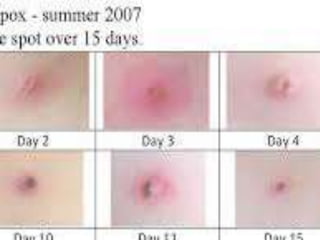
Once the chicken pox rash appears, it goes through 3 phases :
Raised pink or red bumps (papules) w/c break out over several days
Fluid-filled blisters (vesicles), forming from the raised bumps over about 1day before breaking &
leaking
Crusts & scabs , w/c cover the broken blisters & take several more days to heal
The spots cause itching – one of the most annoying manifestations of CP & a pt. who scratches the
lesions may excoriate the skin or cause an infection from bacteria that get into open lesions.
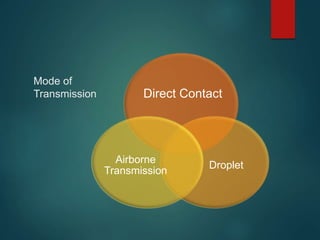
Mode of
Transmission Direct Contact
Droplet
Airborne
Transmission
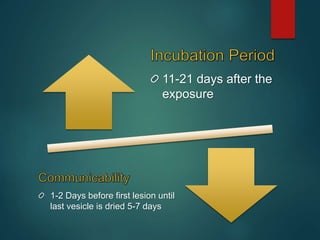
11-21 days after the
exposure
1-2 Days before first lesion until
last vesicle is dried 5-7 days
Prevention
Hygiene Measures
Vaccination
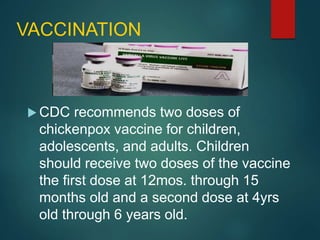
VACCINATION
 CDC recommends two doses of
chickenpox vaccine for children,
adolescents, and adults. Children
should receive two doses of the vaccine
the first dose at 12mos. through 15
months old and a second dose at 4yrs
old through 6 years old.
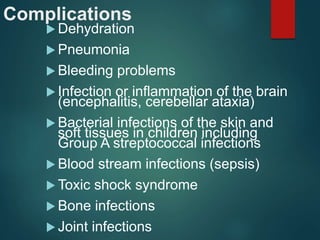
Complications
 Dehydration
 Pneumonia
 Bleeding problems
 Infection or inflammation of the brain
(encephalitis, cerebellar ataxia)
 Bacterial infections of the skin and
soft tissues in children including
Group A streptococcal infections
 Blood stream infections (sepsis)
 Toxic shock syndrome
 Bone infections
 Joint infections
Varicella Pneumonia
 Lung infection ( pneumonia)
caused by the chickenpox virus is
uncommon complication of
chickenpox. It develops when the
chickenpox virus travels to the
lungs.
Cont.
Varicella pneumonia can occur 2 to
10 days after the chickenpox rash.
Fever and cough are usually the
first signs. Most people recover
from varicella pneumonia. But the
symptoms may last for weeks or
months.
Signs and Symptoms
Chest Pain
Dyspnea
Fever
Cough
 Pleuritic friction rub
Treatment & Nsg. Mngt.
Like other pneumonia-causing
organisms, the Varicella virus can cause
mild to severe symptoms in patients. It
is commonly treated with an anti-viral
and anti-inflammatory medications.
Cont.
 Treatment mainly consists of easing and
relieving the symptoms while the immune
system suppresses the virus in the body.
cont.
 Daily aseptic baths
 Oral Antihistamines to decrease
pruritus.
 Acyclovir
 Avoid salicylates
 Isolation until all lesion have crusted
Thank You .

Chicken pox

  • 1.
    Presented by: Whelhelmina I.Montefrio, BSN – RN Head Nurse – Fever Ward
  • 2.
    Chickenpox  a verycontagious disease caused by the varicella-zoster virus ( a member of the herpes family of viruses )  People who get the virus can develop into a serious illness in some babies or children, pregnant women, smokers & to a person w/ poor immune system, ex. person w/ leukemia, w/ HIV/AIDS, on high dose steroids medication, or are taking chemotherapy.
  • 3.
    Signs and Symptoms Initialsymptoms of chicken pox includes: Fatigue Mild fever Lack of appetite & a feeling of being generally unwell This is quickly followed ( usually within 24hrs ) the development of red rash appears in the trunks, chest & then spread to other parts of the body including the mouth & throat, eyelids & genital area. Once the chicken pox rash appears, it goes through 3 phases : Raised pink or red bumps (papules) w/c break out over several days Fluid-filled blisters (vesicles), forming from the raised bumps over about 1day before breaking & leaking Crusts & scabs , w/c cover the broken blisters & take several more days to heal The spots cause itching – one of the most annoying manifestations of CP & a pt. who scratches the lesions may excoriate the skin or cause an infection from bacteria that get into open lesions.
  • 5.
    Mode of Transmission DirectContact Droplet Airborne Transmission
  • 6.
    11-21 days afterthe exposure 1-2 Days before first lesion until last vesicle is dried 5-7 days
  • 7.
  • 8.
    VACCINATION  CDC recommendstwo doses of chickenpox vaccine for children, adolescents, and adults. Children should receive two doses of the vaccine the first dose at 12mos. through 15 months old and a second dose at 4yrs old through 6 years old.
  • 9.
    Complications  Dehydration  Pneumonia Bleeding problems  Infection or inflammation of the brain (encephalitis, cerebellar ataxia)  Bacterial infections of the skin and soft tissues in children including Group A streptococcal infections  Blood stream infections (sepsis)  Toxic shock syndrome  Bone infections  Joint infections
  • 10.
    Varicella Pneumonia  Lunginfection ( pneumonia) caused by the chickenpox virus is uncommon complication of chickenpox. It develops when the chickenpox virus travels to the lungs.
  • 11.
    Cont. Varicella pneumonia canoccur 2 to 10 days after the chickenpox rash. Fever and cough are usually the first signs. Most people recover from varicella pneumonia. But the symptoms may last for weeks or months.
  • 12.
    Signs and Symptoms ChestPain Dyspnea Fever Cough  Pleuritic friction rub
  • 13.
    Treatment & Nsg.Mngt. Like other pneumonia-causing organisms, the Varicella virus can cause mild to severe symptoms in patients. It is commonly treated with an anti-viral and anti-inflammatory medications.
  • 14.
    Cont.  Treatment mainlyconsists of easing and relieving the symptoms while the immune system suppresses the virus in the body.
  • 15.
    cont.  Daily asepticbaths  Oral Antihistamines to decrease pruritus.  Acyclovir  Avoid salicylates  Isolation until all lesion have crusted
  • 16.

Editor's Notes

  • #2 Good morning everybody..my lecture for today is all about Chicken Pox.. I choose this topic bcoz this are the mostly cases we had in our ward, in Fever Ward.. Usually, chicken pox is a mild, self limiting disease in a healthy person but in some cases it can be serious & can lead to complications especially in high risk people. So, its very important for us Nurses to understand & know how to avoid getting Chicken Pox & how to prevent the spread of the disease while helping & taking care our patient.
  • #3 8 Herpes Viruses : 1.) HSV I -labialis; 2.) HSV II -genital; 3.) Varicella Zoster- primary (chicken pox); reactivation (herpes zoster); 4.) EBV- infectious monoclucleosis; 5.) CMV; 6.) Herpes Virus VI; 7.) Herpes Virus VII ( ROSEOLA ) 8.) Associated w/ Leukemia ( blood cancer ) One bout of chicken pox gives lifelong immunity from contracting the disease again. However the virus remains dormant in the body, in the dorsal root of ganglia that is why if your immune system will decrease or you get any disease that will suppress your immune system the virus become reactivated as Shingles ( Herpes Zoster ).
  • #4 New spots continue to appear for several days, as a result you may have all three stages of the rash – bumps, blisters, & scab lesions & remain contagious until all spots crust over.
  • #5 Hallmark of Varicella is lesions in all stages of development in one region of the body.
  • #6 Coughing & sneezing are the most common modes of transmission. Chicken Pox mainly Airborne transmission, the virus can transmitted through the air via a cough or sneeze by respiratory tract secretions, a very small droplet particles <5 microns suspended in the air & transmitted by air current to a long distance, at times Droplet when the droplet particles more than 5-10 microns maybe generated & transmitted in 1- 1.5 meters, & in Contact transmission if you touch the lesions direct with pt who sheds the virus from vesicles or indirect through contaminating objects like handling things or beddings used by the infected person without using PPE and you touch your eyes/ nose/ mouth/ without washing your hands then you may get the infection.
  • #7  Period of Communicability : The pt is contagious a day before the eruption of rashes & continuous to be so up to the 5th or 7th day after the last scab formation or until all vesicles have become encrusted.
  • #8 The first strategy in dealing with chicken pox is to prevent the spread of the disease.
  • #9 For most people, chicken pox is a mild disease, but still, it’s better to get vaccinated. The chicken pox vaccine is a safe, effective way to prevent chickenpox & its possible complications.