Curviform bacteria The spirochetes Campylobacter  Helicobacter
Curviform bacteria that are pathogenic for human Vibrio Campylobacter  Helicobacter  Spirillum Spirochetae
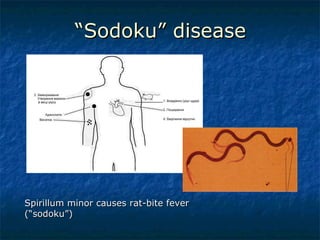
“ Sodoku” disease Spirillum minor causes rat-bite fever (“sodoku”)
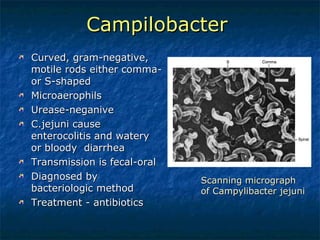
Campilobacter   Curved, gram-negative, motile rods either comma- or S-shaped Microaerophils Urease-neganive  C.jejuni cause enterocolitis and watery or bloody  diarrhea Transmission is fecal-oral Diagnosed by bacteriologic method Treatment - antibiotics Scanning micrograph of Campylibacter jejuni
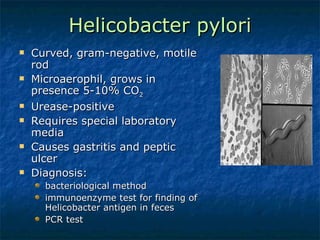
Helicobacter pylori Curved, gram-negative, motile rod  Microaerophil, grows in presence 5-10% CO 2 Urease-positive Requires special laboratory media Causes gastritis and peptic ulcer Diagnosis:  bacteriological method immunoenzyme test for finding of Helicobacter antigen in feces PCR test
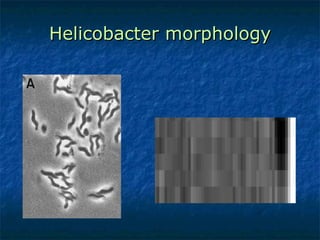
Helicobacter morphology
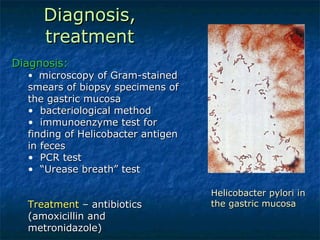
Diagnosis, treatment Helicobacter pylori in the gastric mucosa Diagnosis:  microscopy of Gram-stained smears of biopsy specimens of the gastric mucosa bacteriological method immunoenzyme test for finding of Helicobacter antigen in feces PCR test “ Urease breath” test Treatment  – antibiotics (amoxicillin and metronidazole)
Classification of spirochetes Order – Spirochaetales Family – Spirochaetaceae Genus:  Leptonema Cristispira Brachispira Treponema Borrelia Family – Leptospiraceae Genus -  Leptospira Free-living saprobes Human pathogens
Properties of spirochetes   Prokaryotes  Helically-coiled rod-shaped bacteria Have Gram-negative cell wall Motile Have endoflagella (or periplasmic flagella) located within well-developed periplasmic space Thin cells with diameter 0,06 to 0,8   m and length 6-30   m Does not stain with the usual bacteriological methods (eg, Gram staining) Dark-field and phase-contrast microscopy are used for spirochetes investigation  Useful staining methods are Romanowsky-Giemsa, Morozov’s  ( silver impregnation)
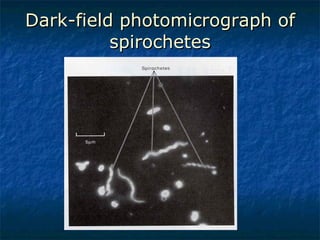
Dark-field photomicrograph of spirochetes
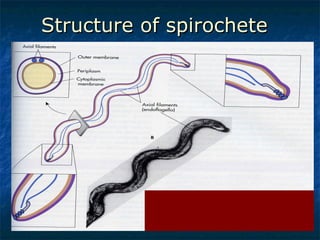
Structure of spirochete
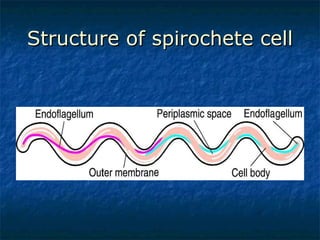
Structure of spirochete cell
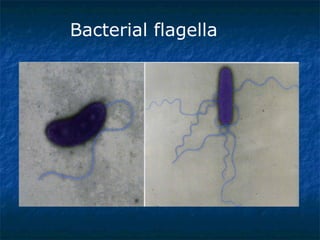
Bacterial flagella
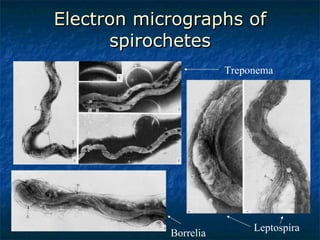
Electron micrographs of spirochetes Treponema  Borrelia  Leptospira
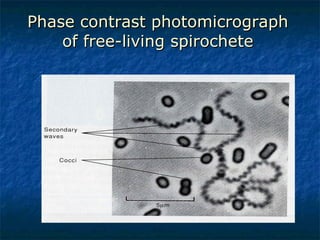
Phase contrast photomicrograph of free-living spirochete
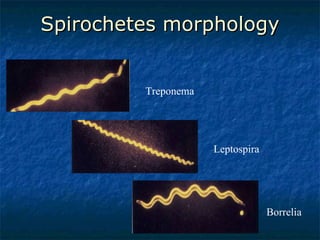
Spirochetes morphology Treponema  Leptospira  Borrelia
Members of genus Treponema Tr. pallidum pallidum causes syphilis Tr. pallidum endemicus causes bejel Tr. pallidum pentenue causes yaws Tr. carateum causes pinta
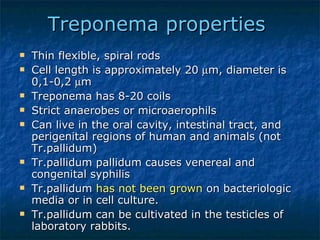
Treponema properties   Thin flexible, spiral rods Cell length is approximately 20   m, diameter is 0,1-0,2   m Treponema has 8-20 coils Strict anaerobes or microaerophils Can live in the oral cavity, intestinal tract, and perigenital regions of human and animals (not Tr.pallidum) Tr.pallidum pallidum causes venereal and congenital syphilis Tr.pallidum  has not been grown  on bacteriologic media or in cell culture.  Tr.pallidum can be cultivated in the testicles of laboratory rabbits.
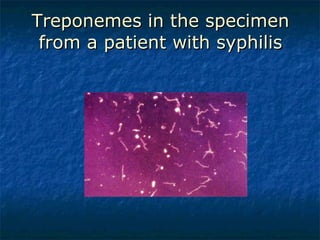
Treponemes in the specimen from a patient with syphilis
Pathogenesis and forms of syphilis The human is the sole  host and source  of Tr.pallidum Transmission : by intimate (sexual or oral) contact From pregnant woman to the fetus Through blood transfusion (rare) Forms  of syphilis: venereal syphilis vongenital syphilis Stages  of syphilis: Primary  Secondary  Tertiary
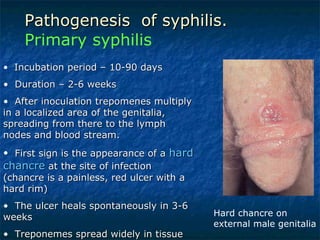
Pathogenesis  of syphilis. Primary syphilis Hard chancre on external male genitalia  Incubation period – 10-90 days Duration – 2-6 weeks After inoculation trepomenes multiply in a localized area of the genitalia, spreading from there to the lymph nodes and blood stream.  First sign is the appearance of a  hard chancre  at the site of infection (chancre is a painless, red ulcer with a hard rim) The ulcer heals spontaneously in 3-6 weeks Treponemes spread widely in tissue
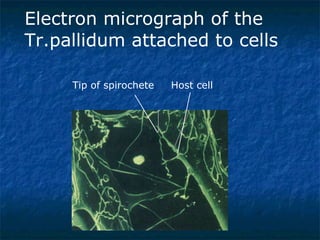
Electron micrograph of the Tr.pallidum attached to cells . Tip of spirochete  Host cell
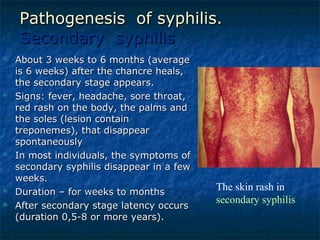
Pathogenesis  of syphilis. Secondary  syphilis About 3 weeks to 6 months (average is 6 weeks) after the chancre heals, the secondary stage appears.  Signs: fever, headache, sore throat, red rash on the body, the palms and the soles (lesion contain treponemes), that disappear spontaneously  In most individuals, the symptoms of secondary syphilis disappear in a few weeks.  Duration – for weeks to months After secondary stage latency occurs (duration 0,5-8 or more years). The skin rash in  secondary syphilis
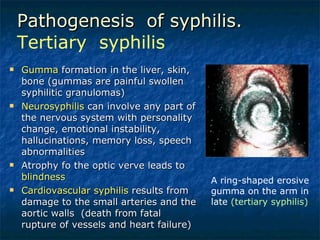
Pathogenesis  of syphilis. Tertiary  syphilis Gumma  formation in the liver, skin, bone (gummas are painful swollen syphilitic granulomas) Neurosyphilis  can involve any part of the nervous system with personality change, emotional instability, hallucinations, memory loss, speech abnormalities Atrophy fo the optic verve leads to  blindness Cardiovascular syphilis  results from damage to the small arteries and the aortic walls  (death from fatal rupture of vessels and heart failure) A ring-shaped erosive gumma on the arm in late  (tertiary syphilis)
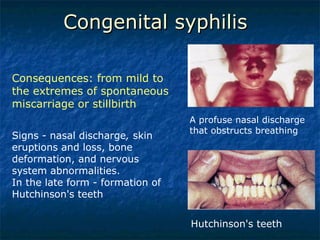
Congenital syphilis A profuse nasal discharge that obstructs breathing Hutchinson's teeth Consequences: from mild to the extremes of spontaneous miscarriage or stillbirth Signs - nasal discharge ,  skin eruptions and loss, bone deformation, and nervous system abnormalities.  In the late form - formation of Hutchinson's teeth
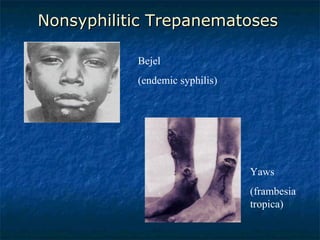
Nonsyphilitic Trepanematoses Yaws  (frambesia tropica) Bejel  (endemic syphilis)
Diagnosis  Depends on stage and form of disease Primary syphilis.  Investigation of native material from the chancre  Dare-field and phase-contrast microscopy Immunofluorescence microscopy (express diagnosis) PCR Secondary syphilis.  Dare-field and phase-contrast microscopy material from lesions and lymph nodes  Immunofluorescence microscopy (express diagnosis) PCR (lesions and blood) Serological method: nonspecific and specific serologic test for antitreponemal antibody revealing  Tertiary, neurosyphilis, congenital syphilis. Serological method.
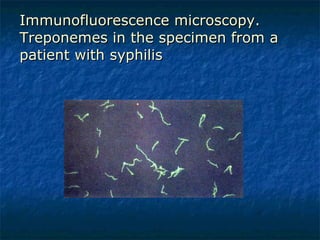
Immunofluorescence microscopy. Treponemes in the specimen from a patient with syphilis
Diagnosis  The laboratory  diagnosis of  congenital syphilis  is based in the finding that the infant has a higher titer of antibody than has the mother.  Nonspecific serologic test.   These tests involve the use of nontreponemal antigens. Cardiolipin extracts from beef heart react with antibodies in serum samples from patients with syphilis (Wasserman test).  False-positive reactions occurs in infections such as leprosy, hepatitis, and infectious mononucleosis and in autoimmune disease.  Specific serologic test.  These tests involve the use of treponemal antigens and therefore are more specific (indirect hemagglutination assay, immunoenzyme test, immobilization test) Bacteriological method can not be used.
Treatment and prevention Treatment. Antibiotic – penicillin is effective in all stages of syphilis. There is no vaccine against syphilis
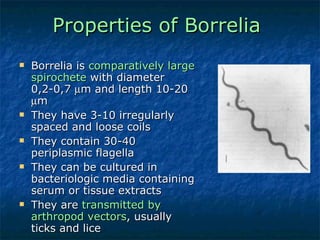
Properties of Borrelia   Borrelia is  comparatively large spirochete  with diameter 0,2-0,7   m and length 10-20   m They have 3-10 irregularly spaced and loose coils They contain 30-40 periplasmic flagella They can be cultured in bacteriologic media containing serum or tissue extracts They are  transmitted by arthropod vectors , usually ticks and lice
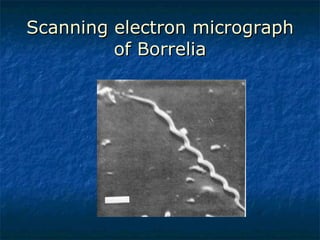
Scanning electron micrograph of Borrelia
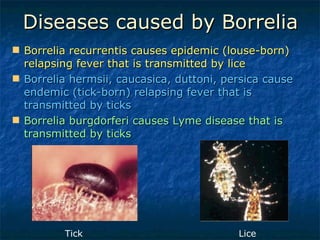
Diseases caused by Borrelia Borrelia recurrentis causes epidemic (louse-born) relapsing fever that is transmitted by lice Borrelia hermsii, caucasica, duttoni, persica cause endemic (tick-born) relapsing fever that is transmitted by ticks Borrelia burgdorferi causes Lyme disease that is transmitted by ticks Tick  Lice
Pathogenesis of relapsing fever The reservoir : for agents of tick-born relapsing fever are wild rodents, and the human is an accidental host for agent of louse-born relapsing fever is human Vectors : for agents of tick-born relapsing fever are ticks for agent of louse-born relapsing fever are lice The spirochetes mature and persist in the salivary gland and intestines of the arthropods and are transmitted to human by its byte The species of Borrelia are passed  transovarially  in the ticks The pathologic manifestation are similar in tick-born and louse-born relapsing fever
Pathogenesis of relapsing fever The incubation period  – 2 to 15 days Early sings : high fever, headache, shaking chills, and fatigue Later features : nausea, vomiting, muscle aches, and abdominal pain. Extensive damage to the liver, spleen, heart, kidneys, and cranial nerves occurs in many cases.  Untreated cases are often lengthy and debilitating and are attended by  5% to 40% mortality .
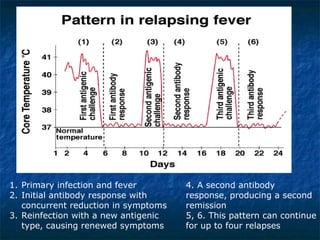
Primary infection and fever Initial antibody response with concurrent reduction in symptoms Reinfection with a new antigenic type, causing renewed symptoms 4. A second antibody response, producing a second remission 5, 6. This pattern can continue for up to four relapses
Diagnosis of relapsing fever Microscopy  of stained by Romanowsky-Giemsa smears of peripheral blood (the most useful method and very definitive evidence of relapsing fever) Bacteriological method  (rarely) Serologic method  (rarely)
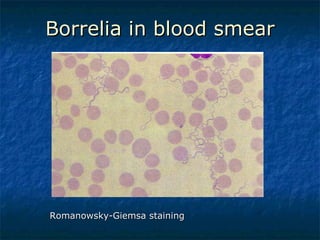
Borrelia in blood smear Romanowsky-Giemsa staining
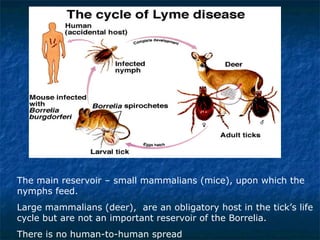
The main reservoir – small mammalians (mice), upon which the nymphs feed. Large mammalians (deer),  are an obligatory host in the tick’s life cycle but are not an important reservoir of the Borrelia. There is no human-to-human spread
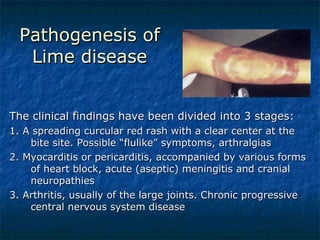
Pathogenesis of Lime disease The clinical findings have been divided into 3 stages: 1. A spreading curcular red rash with a clear center at the bite site. Possible “flulike” symptoms, arthralgias 2. Myocarditis or pericarditis, accompanied by various forms of heart block, acute (aseptic) meningitis and cranial neuropathies  3. Arthritis, usually of the large joints. Chronic progressive central nervous system disease
Diagnosis, treatment, prevention Diagnosis :  Serological method  – detection either IgM antibody or a rising titer of IgG antibody with ELISA (immunoenzyme test) or an indirect immunofluorescence test PCR test Bacteriological method  (rarely) Treatment   – antibiotics  Prevention  – vaccine is  absent
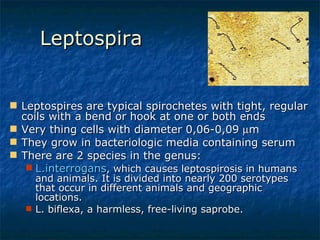
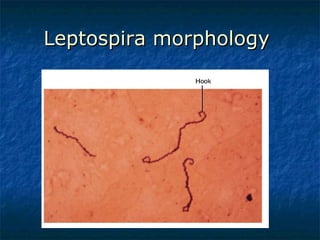
Leptospira  Leptospires are typical spirochetes with tight, regular coils with a bend or hook at one or both ends Very thing cells with diameter 0,06-0,09   m They grow in bacteriologic media containing serum There are 2 species in the genus: L.interrogans , which causes leptospirosis in humans and animals. It is divided into nearly 200 serotypes that occur in different animals and geographic locations. L. biflexa, a harmless, free-living saprobe.
Leptospira morphology
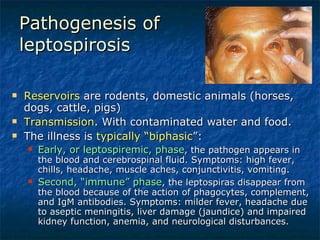
Pathogenesis of leptospirosis Reservoirs  are rodents, domestic animals (horses, dogs, cattle, pigs) Transmission . With contaminated water and food. The illness is  typically “biphasic ”: Early, or leptospiremic, phase , the pathogen appears in the blood and cerebrospinal fluid. Symptoms: high fever, chills, headache, muscle aches, conjunctivitis, vomiting. Second, “immune” phase , the leptospiras disappear from the blood because of the action of phagocytes, complement, and IgM antibodies. Symptoms: milder fever, headache due to aseptic meningitis, liver damage (jaundice) and impaired kidney function, anemia, and neurological disturbances.
Diagnosis, treatment, prevention Diagnosis:   Serological method  – detection antibody titer with macroscopic slide agglutination test Bacteriological method  (rarely). Isolation of leptospiras from blood and urine by inoculating a specimen into special media or laboratory animals. Dard-field microscopy  of specimens Treatment  – antibiotics  Prevention  – strain-specific inactivated vaccines are available for humans, dogs, and cattle.

Bohomolets Microbiology Lecture #22

  • 1.
    Curviform bacteria Thespirochetes Campylobacter Helicobacter
  • 2.
    Curviform bacteria thatare pathogenic for human Vibrio Campylobacter Helicobacter Spirillum Spirochetae
  • 3.
    “ Sodoku” diseaseSpirillum minor causes rat-bite fever (“sodoku”)
  • 4.
    Campilobacter Curved, gram-negative, motile rods either comma- or S-shaped Microaerophils Urease-neganive C.jejuni cause enterocolitis and watery or bloody diarrhea Transmission is fecal-oral Diagnosed by bacteriologic method Treatment - antibiotics Scanning micrograph of Campylibacter jejuni
  • 5.
    Helicobacter pylori Curved,gram-negative, motile rod Microaerophil, grows in presence 5-10% CO 2 Urease-positive Requires special laboratory media Causes gastritis and peptic ulcer Diagnosis: bacteriological method immunoenzyme test for finding of Helicobacter antigen in feces PCR test
  • 6.
  • 7.
    Diagnosis, treatment Helicobacterpylori in the gastric mucosa Diagnosis: microscopy of Gram-stained smears of biopsy specimens of the gastric mucosa bacteriological method immunoenzyme test for finding of Helicobacter antigen in feces PCR test “ Urease breath” test Treatment – antibiotics (amoxicillin and metronidazole)
  • 8.
    Classification of spirochetesOrder – Spirochaetales Family – Spirochaetaceae Genus: Leptonema Cristispira Brachispira Treponema Borrelia Family – Leptospiraceae Genus - Leptospira Free-living saprobes Human pathogens
  • 9.
    Properties of spirochetes Prokaryotes Helically-coiled rod-shaped bacteria Have Gram-negative cell wall Motile Have endoflagella (or periplasmic flagella) located within well-developed periplasmic space Thin cells with diameter 0,06 to 0,8  m and length 6-30  m Does not stain with the usual bacteriological methods (eg, Gram staining) Dark-field and phase-contrast microscopy are used for spirochetes investigation Useful staining methods are Romanowsky-Giemsa, Morozov’s ( silver impregnation)
  • 10.
  • 11.
  • 12.
  • 13.
  • 14.
    Electron micrographs ofspirochetes Treponema Borrelia Leptospira
  • 15.
    Phase contrast photomicrographof free-living spirochete
  • 16.
  • 17.
    Members of genusTreponema Tr. pallidum pallidum causes syphilis Tr. pallidum endemicus causes bejel Tr. pallidum pentenue causes yaws Tr. carateum causes pinta
  • 18.
    Treponema properties Thin flexible, spiral rods Cell length is approximately 20  m, diameter is 0,1-0,2  m Treponema has 8-20 coils Strict anaerobes or microaerophils Can live in the oral cavity, intestinal tract, and perigenital regions of human and animals (not Tr.pallidum) Tr.pallidum pallidum causes venereal and congenital syphilis Tr.pallidum has not been grown on bacteriologic media or in cell culture. Tr.pallidum can be cultivated in the testicles of laboratory rabbits.
  • 19.
    Treponemes in thespecimen from a patient with syphilis
  • 20.
    Pathogenesis and formsof syphilis The human is the sole host and source of Tr.pallidum Transmission : by intimate (sexual or oral) contact From pregnant woman to the fetus Through blood transfusion (rare) Forms of syphilis: venereal syphilis vongenital syphilis Stages of syphilis: Primary Secondary Tertiary
  • 21.
    Pathogenesis ofsyphilis. Primary syphilis Hard chancre on external male genitalia Incubation period – 10-90 days Duration – 2-6 weeks After inoculation trepomenes multiply in a localized area of the genitalia, spreading from there to the lymph nodes and blood stream. First sign is the appearance of a hard chancre at the site of infection (chancre is a painless, red ulcer with a hard rim) The ulcer heals spontaneously in 3-6 weeks Treponemes spread widely in tissue
  • 22.
    Electron micrograph ofthe Tr.pallidum attached to cells . Tip of spirochete Host cell
  • 23.
    Pathogenesis ofsyphilis. Secondary syphilis About 3 weeks to 6 months (average is 6 weeks) after the chancre heals, the secondary stage appears. Signs: fever, headache, sore throat, red rash on the body, the palms and the soles (lesion contain treponemes), that disappear spontaneously In most individuals, the symptoms of secondary syphilis disappear in a few weeks. Duration – for weeks to months After secondary stage latency occurs (duration 0,5-8 or more years). The skin rash in secondary syphilis
  • 24.
    Pathogenesis ofsyphilis. Tertiary syphilis Gumma formation in the liver, skin, bone (gummas are painful swollen syphilitic granulomas) Neurosyphilis can involve any part of the nervous system with personality change, emotional instability, hallucinations, memory loss, speech abnormalities Atrophy fo the optic verve leads to blindness Cardiovascular syphilis results from damage to the small arteries and the aortic walls (death from fatal rupture of vessels and heart failure) A ring-shaped erosive gumma on the arm in late (tertiary syphilis)
  • 25.
    Congenital syphilis Aprofuse nasal discharge that obstructs breathing Hutchinson's teeth Consequences: from mild to the extremes of spontaneous miscarriage or stillbirth Signs - nasal discharge , skin eruptions and loss, bone deformation, and nervous system abnormalities. In the late form - formation of Hutchinson's teeth
  • 26.
    Nonsyphilitic Trepanematoses Yaws (frambesia tropica) Bejel (endemic syphilis)
  • 27.
    Diagnosis Dependson stage and form of disease Primary syphilis. Investigation of native material from the chancre Dare-field and phase-contrast microscopy Immunofluorescence microscopy (express diagnosis) PCR Secondary syphilis. Dare-field and phase-contrast microscopy material from lesions and lymph nodes Immunofluorescence microscopy (express diagnosis) PCR (lesions and blood) Serological method: nonspecific and specific serologic test for antitreponemal antibody revealing Tertiary, neurosyphilis, congenital syphilis. Serological method.
  • 28.
    Immunofluorescence microscopy. Treponemesin the specimen from a patient with syphilis
  • 29.
    Diagnosis Thelaboratory diagnosis of congenital syphilis is based in the finding that the infant has a higher titer of antibody than has the mother. Nonspecific serologic test. These tests involve the use of nontreponemal antigens. Cardiolipin extracts from beef heart react with antibodies in serum samples from patients with syphilis (Wasserman test). False-positive reactions occurs in infections such as leprosy, hepatitis, and infectious mononucleosis and in autoimmune disease. Specific serologic test. These tests involve the use of treponemal antigens and therefore are more specific (indirect hemagglutination assay, immunoenzyme test, immobilization test) Bacteriological method can not be used.
  • 30.
    Treatment and preventionTreatment. Antibiotic – penicillin is effective in all stages of syphilis. There is no vaccine against syphilis
  • 31.
    Properties of Borrelia Borrelia is comparatively large spirochete with diameter 0,2-0,7  m and length 10-20  m They have 3-10 irregularly spaced and loose coils They contain 30-40 periplasmic flagella They can be cultured in bacteriologic media containing serum or tissue extracts They are transmitted by arthropod vectors , usually ticks and lice
  • 32.
  • 33.
    Diseases caused byBorrelia Borrelia recurrentis causes epidemic (louse-born) relapsing fever that is transmitted by lice Borrelia hermsii, caucasica, duttoni, persica cause endemic (tick-born) relapsing fever that is transmitted by ticks Borrelia burgdorferi causes Lyme disease that is transmitted by ticks Tick Lice
  • 34.
    Pathogenesis of relapsingfever The reservoir : for agents of tick-born relapsing fever are wild rodents, and the human is an accidental host for agent of louse-born relapsing fever is human Vectors : for agents of tick-born relapsing fever are ticks for agent of louse-born relapsing fever are lice The spirochetes mature and persist in the salivary gland and intestines of the arthropods and are transmitted to human by its byte The species of Borrelia are passed transovarially in the ticks The pathologic manifestation are similar in tick-born and louse-born relapsing fever
  • 35.
    Pathogenesis of relapsingfever The incubation period – 2 to 15 days Early sings : high fever, headache, shaking chills, and fatigue Later features : nausea, vomiting, muscle aches, and abdominal pain. Extensive damage to the liver, spleen, heart, kidneys, and cranial nerves occurs in many cases. Untreated cases are often lengthy and debilitating and are attended by 5% to 40% mortality .
  • 36.
    Primary infection andfever Initial antibody response with concurrent reduction in symptoms Reinfection with a new antigenic type, causing renewed symptoms 4. A second antibody response, producing a second remission 5, 6. This pattern can continue for up to four relapses
  • 37.
    Diagnosis of relapsingfever Microscopy of stained by Romanowsky-Giemsa smears of peripheral blood (the most useful method and very definitive evidence of relapsing fever) Bacteriological method (rarely) Serologic method (rarely)
  • 38.
    Borrelia in bloodsmear Romanowsky-Giemsa staining
  • 39.
    The main reservoir– small mammalians (mice), upon which the nymphs feed. Large mammalians (deer), are an obligatory host in the tick’s life cycle but are not an important reservoir of the Borrelia. There is no human-to-human spread
  • 40.
    Pathogenesis of Limedisease The clinical findings have been divided into 3 stages: 1. A spreading curcular red rash with a clear center at the bite site. Possible “flulike” symptoms, arthralgias 2. Myocarditis or pericarditis, accompanied by various forms of heart block, acute (aseptic) meningitis and cranial neuropathies 3. Arthritis, usually of the large joints. Chronic progressive central nervous system disease
  • 41.
    Diagnosis, treatment, preventionDiagnosis : Serological method – detection either IgM antibody or a rising titer of IgG antibody with ELISA (immunoenzyme test) or an indirect immunofluorescence test PCR test Bacteriological method (rarely) Treatment – antibiotics Prevention – vaccine is absent
  • 42.
    Leptospira Leptospiresare typical spirochetes with tight, regular coils with a bend or hook at one or both ends Very thing cells with diameter 0,06-0,09  m They grow in bacteriologic media containing serum There are 2 species in the genus: L.interrogans , which causes leptospirosis in humans and animals. It is divided into nearly 200 serotypes that occur in different animals and geographic locations. L. biflexa, a harmless, free-living saprobe.
  • 43.
  • 44.
    Pathogenesis of leptospirosisReservoirs are rodents, domestic animals (horses, dogs, cattle, pigs) Transmission . With contaminated water and food. The illness is typically “biphasic ”: Early, or leptospiremic, phase , the pathogen appears in the blood and cerebrospinal fluid. Symptoms: high fever, chills, headache, muscle aches, conjunctivitis, vomiting. Second, “immune” phase , the leptospiras disappear from the blood because of the action of phagocytes, complement, and IgM antibodies. Symptoms: milder fever, headache due to aseptic meningitis, liver damage (jaundice) and impaired kidney function, anemia, and neurological disturbances.
  • 45.
    Diagnosis, treatment, preventionDiagnosis: Serological method – detection antibody titer with macroscopic slide agglutination test Bacteriological method (rarely). Isolation of leptospiras from blood and urine by inoculating a specimen into special media or laboratory animals. Dard-field microscopy of specimens Treatment – antibiotics Prevention – strain-specific inactivated vaccines are available for humans, dogs, and cattle.