Trends in  Online Journalism
Online Journalism One of the biggest growth opportunities is online journalism Web Editors   often make more money than their print editor counterparts Expectations include writing AND technical skills
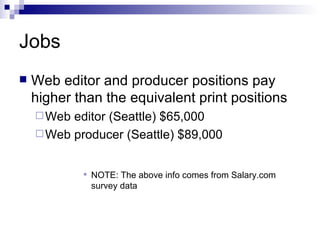
Jobs Web editor and producer positions pay higher than the equivalent print positions Web editor (Seattle) $65,000 Web producer (Seattle) $89,000 NOTE: The above info comes from Salary.com survey data
Online Journalism Jobs Job titles may vary, but there are typically these positions: Web Editor Senior Web Editor/Managing Web Editor Web Producer Senior Web Producer/Managing Web Producer Other titles: Multimedia Assignment Editor Multimedia Assignment Producer Presentation Editor Internet Content Editor
Recent Survey Results Highest valued “Editing and Copyediting Skills” among New Media Content Producers: News judgment Grammar and style Headline writing for the Web Story combining/shortening
Recent Survey Results Highest valued “Content Editing Skills” among New Media Content Producers: Photo editing Reporting and writing original stories Alternative story forms (polls, quizzes, etc.) Audio production Video production
Recent Survey Results Highest valued “attitude and intangible” skills in New Media Content Producers: Multitasking ability Attention to detail Communication skills Ability to work under time pressure
Reading Habits Reading online is typically 25% slower than print Some “tricks” to keep a reader interested: Layout with bullet points and bold subheads Break longer stories into “chunks” Include multimedia elements  Polls Slideshows Audio/Video
Web Journalism What works online? Breaking news Links to credible sources Instant archives Interactivity Multimedia
Storytelling or Presentation Convergence New ways of “telling the story” are emerging Use more than just audio, video or text Readers/Viewers can participate Unlimited “space” to tell the story Non-linear structure
Example “Being A Black Man”  in  The Washington Post
Backpack Journalism Online journalists need to know how to write, shoot and record They also have technology skills for posting/uploading stories online “Backpack Journalism” = All the tools for reporting fit in your backpack Self-contained reporter from story creation to distribution
“Backpack Journalist” Employers want to hire someone that can do it all Write an accurate story fast Use new media tools to tell the story
Examples KRON-TV San Francisco Current TV
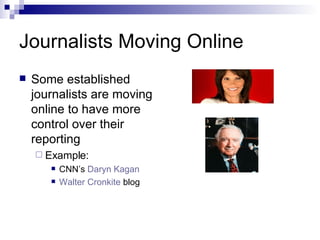
Journalists Moving Online Some established journalists are moving online to have more control over their reporting Example: CNN’s  Daryn   Kagan Walter Cronkite  blog
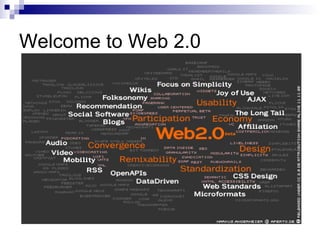
Welcome to Web 2.0
Web 2.0 The term is subject to “hype” and remains in debate and in flux
Web 2.0 Content power shift to the masses rather than the “mass media” Mass media is “de-massed” It’s all about YOU
 
Web 2.0 & Journalism Architecture of participation User-generated content Blogs Wikis “ Crowdsourcing” Social networking sites
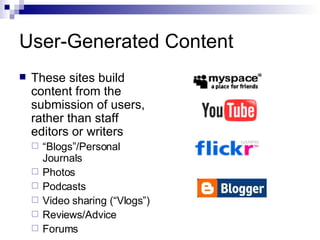
User-Generated Content These sites build content from the submission of users, rather than staff editors or writers “ Blogs”/Personal Journals Photos  Podcasts Video sharing (“Vlogs”)  Reviews/Advice Forums
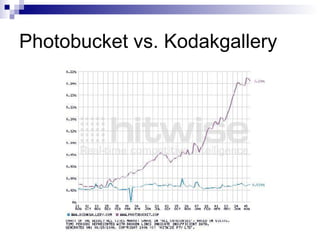
Photobucket vs. Kodakgallery
Beyond the Computer Web serves as a platform for other technologies to interoperate with Mobile devices Home entertainment devices Appliances
Online Publishing Tools Publishing information online has become easier due to several self-publishing tools and content management systems
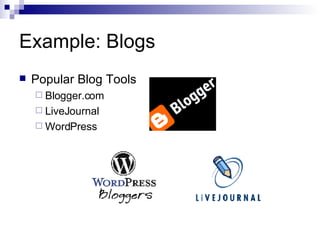
Example: Blogs Popular Blog Tools Blogger.com LiveJournal WordPress
Blog Popularity A new blog is started every second Many remain unread and semi-anonymous A few end up with a strong following Most are not created by journalists!
Who is Blogging? Bloggers are young More than half (54%) of bloggers are under the age of 30.  55% of bloggers blog under a pseudonym, and 46% blog under their own name.  SOURCE: PEW INSTITUTE 2006 SURVEY
Is it Journalism? Most bloggers do not think of what they do as journalism. 34% of bloggers consider their blog a form of journalism, and 65% of bloggers do not. SOURCE: PEW INSTITUTE 2006 SURVEY
Is It Journalism? Most have not “trained” to be journalists 57% of bloggers include links to original sources either “sometimes” or “often.”  56% of bloggers spend extra time trying to verify facts they want to include in a post either “sometimes” or “often.”  SOURCE: PEW INSTITUTE 2006 SURVEY
Beyond Text Bloggers are using more than simple words to tell their stories 72% Photos 30% Audio 15% Video SOURCE: PEW INSTITUTE 2006 SURVEY
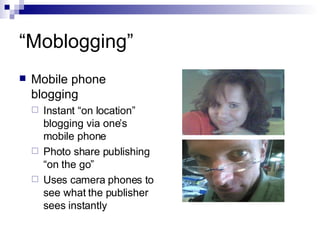
“ Moblogging” Mobile phone blogging Instant “on location” blogging via one’s mobile phone Photo share publishing “on the go” Uses camera phones to see what the publisher sees instantly
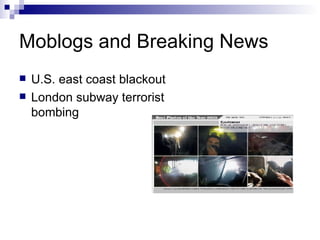
Moblogs and Breaking News U.S. east coast blackout London subway terrorist bombing
User-controlled News Internet users like to have some control over the media they consume Personalized news Peer-recommended news “Open-source” news
Personalized News Google News No editors are employed Uses traffic analysis and readership patterns to determine what is most newsworthy
Peer-recommended News Digg.com Readers “vote” on what they like Highest votes = highest news placement on site
“Open-Source” News OhMyNews Huge in South Korea Expanded to international audience 41,000 “citizen reporters” 20% of content created in-house by only 55 staff reporters
“Open-Source” News WikiNews User-created news reports Collaborative editing by peers A Russian-language version is now available
Mainstream News Dominates Independent news is thriving, but mainstream news still dominates online Top U.S. news sites: 1. Yahoo! News 2. MSNBC 3. AOL News 4. CNN 5.  The New York Times SOURCE: 9/7/2006 COMSCORE REPORT
Mainstream News Blogs Mainstream news outlets are adapting their own blogs The New York Times The Washington Post CBS News MSNBC
The Aggregators News site aggregators have proven to be very popular…and influential They do not write news, but they do create headlines and selectively choose which stories get coverage
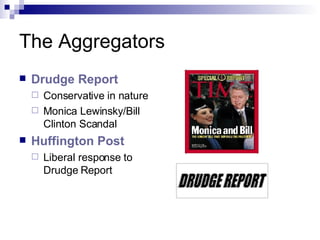
The Aggregators Drudge Report Conservative in nature Monica Lewinsky/Bill Clinton Scandal Huffington  Post Liberal response to Drudge Report
The Aggregators Beyond news, there are several popular aggregate blog sites for specific areas of interest Examples: Technorati.com BoingBoing.net
“ Crowdsourcing” “ Crowdsourcing” is a new trend in online journalism that has many supporters and skeptics
What is “Crowdsourcing?” A collaborative form of reporting Each contributor researches and contributes a component to the overall piece The actual story may or may not be written by a collaborator Content is usually overseen by a centralized editor
“Pro-Am” Journalism Crowdsourcing is often referred to as “pro-am journalism” A combination of both professional and amateur contributions
Examples of “Crowdsourcing” In Journalism: Wired.com and NYU: AssignmentZero.com Minnesota Public Radio: Public Insight Journalism
Gannett Restructuring Major media company Gannett restructured most of its print and Web operations to include “crowdsourcing” in Nov. 2006 “ Information Centers” Gannett is the largest newspaper publisher in the U.S. (by circulation)
Pros Community involvement Transparency of reporting process Micro-reporting of events and developments normally missed by mainstream media “ Hyper-local” reporting Builds valuable “database” of content Tomorrow’s “reporters” may also be “database managers”
Cons “Amateur” reporting has its risks Majority rules Stories only developed because users ask for it (or participate in it) Subject to manipulation Political or personal agendas might inspire disproportionate coverage of particular issues Staff reporters might lose some value
“Assignment Zero” Launched March 2007 Users “log in” to find potential news story assignments that they can contribute to Suggest questions for the reporter to ask Conduct research/interviews for the story In some cases, you can actually write the full story

Trends in Online Journalism

  • 1.
    Trends in Online Journalism
  • 2.
    Online Journalism Oneof the biggest growth opportunities is online journalism Web Editors often make more money than their print editor counterparts Expectations include writing AND technical skills
  • 3.
    Jobs Web editorand producer positions pay higher than the equivalent print positions Web editor (Seattle) $65,000 Web producer (Seattle) $89,000 NOTE: The above info comes from Salary.com survey data
  • 4.
    Online Journalism JobsJob titles may vary, but there are typically these positions: Web Editor Senior Web Editor/Managing Web Editor Web Producer Senior Web Producer/Managing Web Producer Other titles: Multimedia Assignment Editor Multimedia Assignment Producer Presentation Editor Internet Content Editor
  • 5.
    Recent Survey ResultsHighest valued “Editing and Copyediting Skills” among New Media Content Producers: News judgment Grammar and style Headline writing for the Web Story combining/shortening
  • 6.
    Recent Survey ResultsHighest valued “Content Editing Skills” among New Media Content Producers: Photo editing Reporting and writing original stories Alternative story forms (polls, quizzes, etc.) Audio production Video production
  • 7.
    Recent Survey ResultsHighest valued “attitude and intangible” skills in New Media Content Producers: Multitasking ability Attention to detail Communication skills Ability to work under time pressure
  • 8.
    Reading Habits Readingonline is typically 25% slower than print Some “tricks” to keep a reader interested: Layout with bullet points and bold subheads Break longer stories into “chunks” Include multimedia elements Polls Slideshows Audio/Video
  • 9.
    Web Journalism Whatworks online? Breaking news Links to credible sources Instant archives Interactivity Multimedia
  • 10.
    Storytelling or PresentationConvergence New ways of “telling the story” are emerging Use more than just audio, video or text Readers/Viewers can participate Unlimited “space” to tell the story Non-linear structure
  • 11.
    Example “Being ABlack Man” in The Washington Post
  • 12.
    Backpack Journalism Onlinejournalists need to know how to write, shoot and record They also have technology skills for posting/uploading stories online “Backpack Journalism” = All the tools for reporting fit in your backpack Self-contained reporter from story creation to distribution
  • 13.
    “Backpack Journalist” Employerswant to hire someone that can do it all Write an accurate story fast Use new media tools to tell the story
  • 14.
    Examples KRON-TV SanFrancisco Current TV
  • 15.
    Journalists Moving OnlineSome established journalists are moving online to have more control over their reporting Example: CNN’s Daryn Kagan Walter Cronkite blog
  • 16.
  • 17.
    Web 2.0 Theterm is subject to “hype” and remains in debate and in flux
  • 18.
    Web 2.0 Contentpower shift to the masses rather than the “mass media” Mass media is “de-massed” It’s all about YOU
  • 19.
  • 20.
    Web 2.0 &Journalism Architecture of participation User-generated content Blogs Wikis “ Crowdsourcing” Social networking sites
  • 21.
    User-Generated Content Thesesites build content from the submission of users, rather than staff editors or writers “ Blogs”/Personal Journals Photos Podcasts Video sharing (“Vlogs”) Reviews/Advice Forums
  • 22.
  • 23.
    Beyond the ComputerWeb serves as a platform for other technologies to interoperate with Mobile devices Home entertainment devices Appliances
  • 24.
    Online Publishing ToolsPublishing information online has become easier due to several self-publishing tools and content management systems
  • 25.
    Example: Blogs PopularBlog Tools Blogger.com LiveJournal WordPress
  • 26.
    Blog Popularity Anew blog is started every second Many remain unread and semi-anonymous A few end up with a strong following Most are not created by journalists!
  • 27.
    Who is Blogging?Bloggers are young More than half (54%) of bloggers are under the age of 30. 55% of bloggers blog under a pseudonym, and 46% blog under their own name. SOURCE: PEW INSTITUTE 2006 SURVEY
  • 28.
    Is it Journalism?Most bloggers do not think of what they do as journalism. 34% of bloggers consider their blog a form of journalism, and 65% of bloggers do not. SOURCE: PEW INSTITUTE 2006 SURVEY
  • 29.
    Is It Journalism?Most have not “trained” to be journalists 57% of bloggers include links to original sources either “sometimes” or “often.” 56% of bloggers spend extra time trying to verify facts they want to include in a post either “sometimes” or “often.” SOURCE: PEW INSTITUTE 2006 SURVEY
  • 30.
    Beyond Text Bloggersare using more than simple words to tell their stories 72% Photos 30% Audio 15% Video SOURCE: PEW INSTITUTE 2006 SURVEY
  • 31.
    “ Moblogging” Mobilephone blogging Instant “on location” blogging via one’s mobile phone Photo share publishing “on the go” Uses camera phones to see what the publisher sees instantly
  • 32.
    “ Moblogging” Mobilephone blogging Instant “on location” blogging via one’s mobile phone Photo share publishing “on the go” Uses camera phones to see what the publisher sees instantly
  • 33.
    Moblogs and BreakingNews U.S. east coast blackout London subway terrorist bombing
  • 34.
    User-controlled News Internetusers like to have some control over the media they consume Personalized news Peer-recommended news “Open-source” news
  • 35.
    Personalized News GoogleNews No editors are employed Uses traffic analysis and readership patterns to determine what is most newsworthy
  • 36.
    Peer-recommended News Digg.comReaders “vote” on what they like Highest votes = highest news placement on site
  • 37.
    “Open-Source” News OhMyNewsHuge in South Korea Expanded to international audience 41,000 “citizen reporters” 20% of content created in-house by only 55 staff reporters
  • 38.
    “Open-Source” News WikiNewsUser-created news reports Collaborative editing by peers A Russian-language version is now available
  • 39.
    Mainstream News DominatesIndependent news is thriving, but mainstream news still dominates online Top U.S. news sites: 1. Yahoo! News 2. MSNBC 3. AOL News 4. CNN 5. The New York Times SOURCE: 9/7/2006 COMSCORE REPORT
  • 40.
    Mainstream News BlogsMainstream news outlets are adapting their own blogs The New York Times The Washington Post CBS News MSNBC
  • 41.
    The Aggregators Newssite aggregators have proven to be very popular…and influential They do not write news, but they do create headlines and selectively choose which stories get coverage
  • 42.
    The Aggregators DrudgeReport Conservative in nature Monica Lewinsky/Bill Clinton Scandal Huffington Post Liberal response to Drudge Report
  • 43.
    The Aggregators Beyondnews, there are several popular aggregate blog sites for specific areas of interest Examples: Technorati.com BoingBoing.net
  • 44.
    “ Crowdsourcing” “Crowdsourcing” is a new trend in online journalism that has many supporters and skeptics
  • 45.
    What is “Crowdsourcing?”A collaborative form of reporting Each contributor researches and contributes a component to the overall piece The actual story may or may not be written by a collaborator Content is usually overseen by a centralized editor
  • 46.
    “Pro-Am” Journalism Crowdsourcingis often referred to as “pro-am journalism” A combination of both professional and amateur contributions
  • 47.
    Examples of “Crowdsourcing”In Journalism: Wired.com and NYU: AssignmentZero.com Minnesota Public Radio: Public Insight Journalism
  • 48.
    Gannett Restructuring Majormedia company Gannett restructured most of its print and Web operations to include “crowdsourcing” in Nov. 2006 “ Information Centers” Gannett is the largest newspaper publisher in the U.S. (by circulation)
  • 49.
    Pros Community involvementTransparency of reporting process Micro-reporting of events and developments normally missed by mainstream media “ Hyper-local” reporting Builds valuable “database” of content Tomorrow’s “reporters” may also be “database managers”
  • 50.
    Cons “Amateur” reportinghas its risks Majority rules Stories only developed because users ask for it (or participate in it) Subject to manipulation Political or personal agendas might inspire disproportionate coverage of particular issues Staff reporters might lose some value
  • 51.
    “Assignment Zero” LaunchedMarch 2007 Users “log in” to find potential news story assignments that they can contribute to Suggest questions for the reporter to ask Conduct research/interviews for the story In some cases, you can actually write the full story