
Best Practices in Blogging
Presentation courtesy of
Are Bloggers Journalists?
• 52% of bloggers consider themselves to be
journalists
• 20% of bloggers derive the majority of their
income from their blog work
• But are bloggers the same as journalists?
Source: 2010 PRWeek/PR Newswire Media Survey
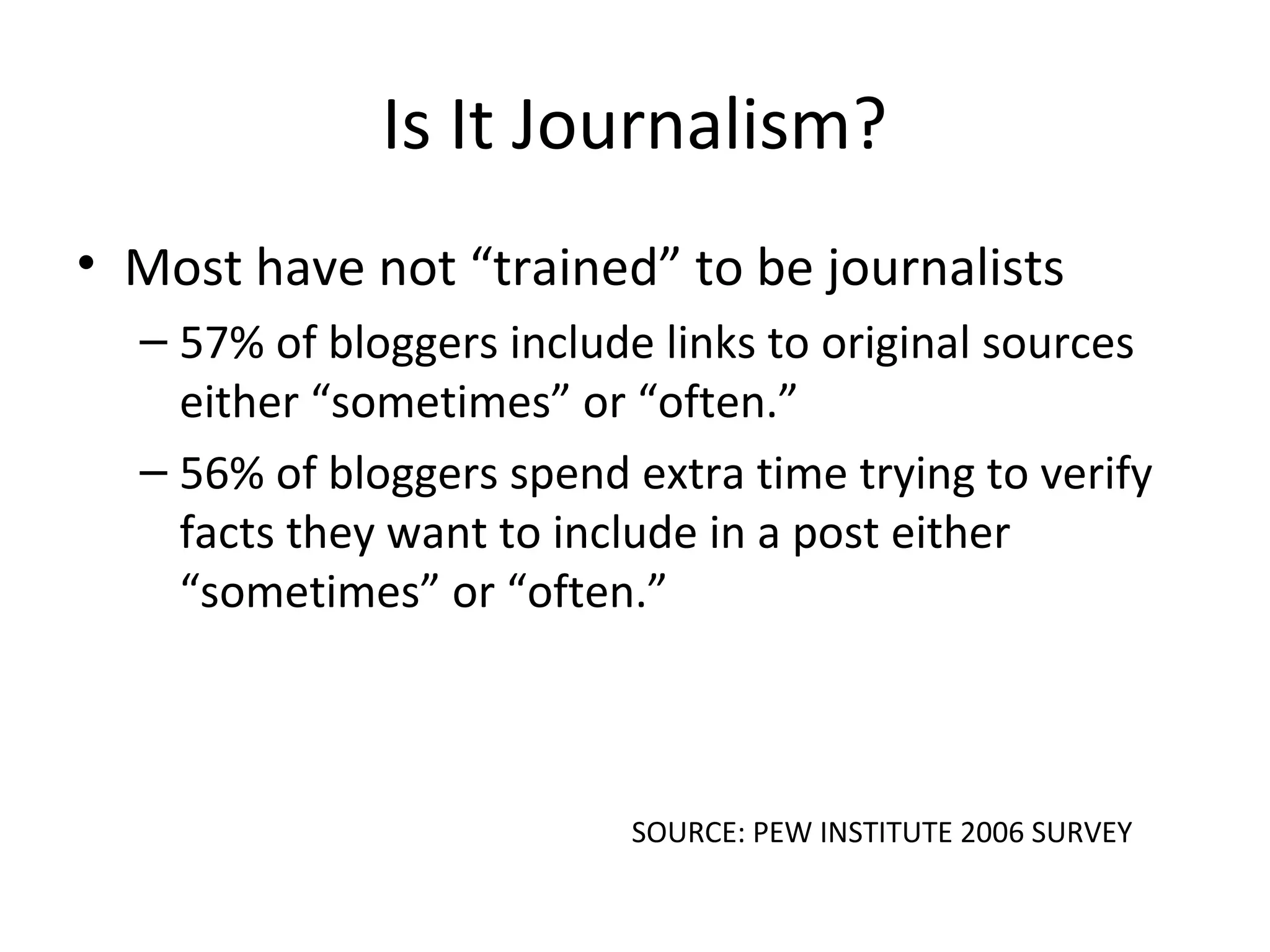
Is It Journalism?
• Most have not “trained” to be journalists
– 57% of bloggers include links to original sources
either “sometimes” or “often.”
– 56% of bloggers spend extra time trying to verify
facts they want to include in a post either
“sometimes” or “often.”
SOURCE: PEW INSTITUTE 2006 SURVEY
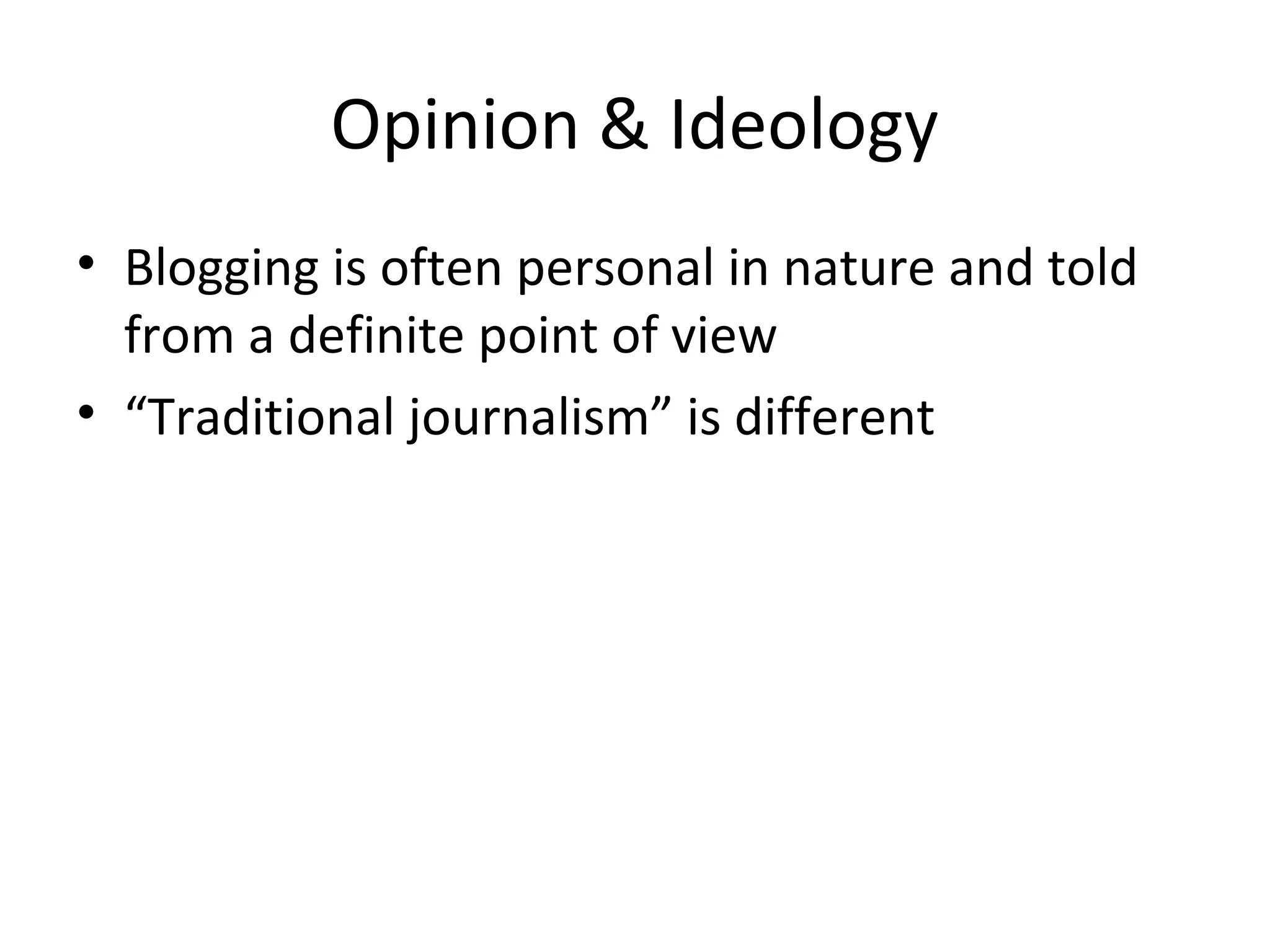
Opinion & Ideology
• Blogging is often personal in nature and told
from a definite point of view
• “Traditional journalism” is different
Traditional Journalism
• “Fair and balanced” reporting is the goal
• Despite limitations of time and resources, we
strive to gather and present facts in an
unbiased way
It’s not about “You”
• Challenge your own assumptions and those of
your readers
• Logic, intellect and research should prevail
over emotion, gut instinct and personal belief
systems
Bias
• Bias in the news and blogging can take many
forms
– Word choices
– Image choices
– Omission of information
– Selection of sources
– Story framing & context
Word Choices
• Whether intentional or not, the words you
choose may reveal your personal views
• Stay neutral and stick to the facts
• Interactive Exercise:
– Word Choices
– Headline Choices
Image Choices
• What graphic or image should accompany
your story?
• Can you think of examples where the image
captures something different than the
physical reality of the event?
• Interactive Exercise: Image Choices
Omission of Information
• Who sets the mainstream media news
agenda?
• What gets covered or ignored?
• Interactive Exercise: Omissions
Selection of Sources
• Should you exclude a viewpoint to reinforce
your own agenda or belief?
• Interactive Exercise: Sources
Story Framing & Context
• On the Web, the earliest reports are often
amplified by others
• Stories are “framed” and contextualized by
the journalist (but also by others)
• Interactive Exercise: Story Framing
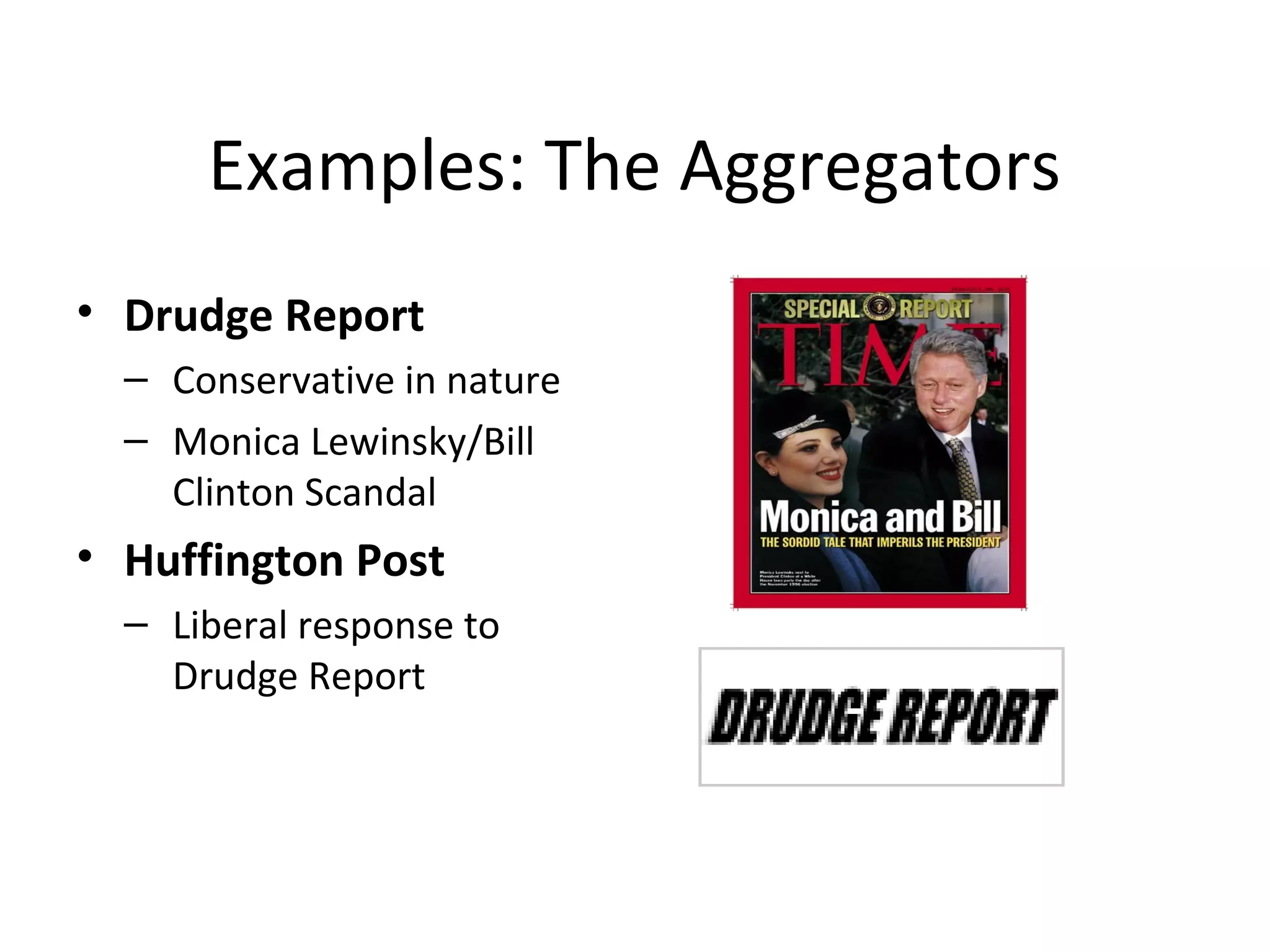
Examples: The Aggregators
• Drudge Report
– Conservative in nature
– Monica Lewinsky/Bill
Clinton Scandal
• Huffington Post
– Liberal response to
Drudge Report
The Aggregators
• Beyond news, there are
several popular
aggregate blog sites for
specific areas of interest
• Examples:
– Technorati.com
– BoingBoing.net
“Crowdsourcing”
• “Crowdsourcing” is a new trend in online
journalism that has many supporters and
skeptics
What is “Crowdsourcing?”
• A collaborative form of reporting
• Each contributor researches and contributes a
component to the overall piece
• The actual story may or may not be written by a
collaborator
• Content is usually overseen by a centralized editor
“Pro-Am” Journalism
• Crowdsourcing is often referred to as “pro-am
journalism”
– A combination of both professional and amateur
contributions
More Resources
• University of Michigan’s News Bias Explored
• Pew Research’s State of the News Media
Report
• PRWeek/PR Newswire Media Survey

Best Practices in Blogging

  • 1.
    Best Practices inBlogging Presentation courtesy of
  • 2.
    Are Bloggers Journalists? •52% of bloggers consider themselves to be journalists • 20% of bloggers derive the majority of their income from their blog work • But are bloggers the same as journalists? Source: 2010 PRWeek/PR Newswire Media Survey
  • 3.
    Is It Journalism? •Most have not “trained” to be journalists – 57% of bloggers include links to original sources either “sometimes” or “often.” – 56% of bloggers spend extra time trying to verify facts they want to include in a post either “sometimes” or “often.” SOURCE: PEW INSTITUTE 2006 SURVEY
  • 4.
    Opinion & Ideology •Blogging is often personal in nature and told from a definite point of view • “Traditional journalism” is different
  • 5.
    Traditional Journalism • “Fairand balanced” reporting is the goal • Despite limitations of time and resources, we strive to gather and present facts in an unbiased way
  • 6.
    It’s not about“You” • Challenge your own assumptions and those of your readers • Logic, intellect and research should prevail over emotion, gut instinct and personal belief systems
  • 7.
    Bias • Bias inthe news and blogging can take many forms – Word choices – Image choices – Omission of information – Selection of sources – Story framing & context
  • 8.
    Word Choices • Whetherintentional or not, the words you choose may reveal your personal views • Stay neutral and stick to the facts • Interactive Exercise: – Word Choices – Headline Choices
  • 9.
    Image Choices • Whatgraphic or image should accompany your story? • Can you think of examples where the image captures something different than the physical reality of the event? • Interactive Exercise: Image Choices
  • 10.
    Omission of Information •Who sets the mainstream media news agenda? • What gets covered or ignored? • Interactive Exercise: Omissions
  • 11.
    Selection of Sources •Should you exclude a viewpoint to reinforce your own agenda or belief? • Interactive Exercise: Sources
  • 12.
    Story Framing &Context • On the Web, the earliest reports are often amplified by others • Stories are “framed” and contextualized by the journalist (but also by others) • Interactive Exercise: Story Framing
  • 13.
    Examples: The Aggregators •Drudge Report – Conservative in nature – Monica Lewinsky/Bill Clinton Scandal • Huffington Post – Liberal response to Drudge Report
  • 14.
    The Aggregators • Beyondnews, there are several popular aggregate blog sites for specific areas of interest • Examples: – Technorati.com – BoingBoing.net
  • 15.
    “Crowdsourcing” • “Crowdsourcing” isa new trend in online journalism that has many supporters and skeptics
  • 16.
    What is “Crowdsourcing?” •A collaborative form of reporting • Each contributor researches and contributes a component to the overall piece • The actual story may or may not be written by a collaborator • Content is usually overseen by a centralized editor
  • 17.
    “Pro-Am” Journalism • Crowdsourcingis often referred to as “pro-am journalism” – A combination of both professional and amateur contributions
  • 18.
    More Resources • Universityof Michigan’s News Bias Explored • Pew Research’s State of the News Media Report • PRWeek/PR Newswire Media Survey