Blogging & the Law
Presentation courtesy of
Defamation
• A defamatory statement injures the good
name of an individual/company and lowers
their standing in the community
• Two kinds of defamation
– Libel
– Slander
Slander
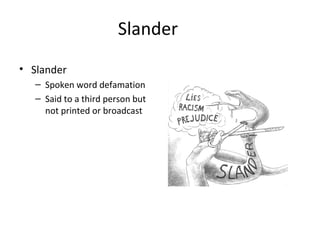
• Slander
– Spoken word defamation
– Said to a third person but
not printed or broadcast
Libel
• Libel
– Defamation in a tangible medium (print, Internet
or broadcast)
– To prove libel, you must show that:
• Harm was caused
• The story was published or broadcast
• The person/company was identified by name
• The media was at fault or error
• The broadcast/published facts must be false
Fair Comment
• Truth is the best defense against libel
• Opinions also have some protection
– Include facts to back up your opinion
– Label your statement as “opinion”
– Make sure the context is clear
• Times Co. vs. Sullivan (1964): Court decision
that actual malice must be proved
Privacy
• People have the right to be left alone
• To avoid invading someone’s privacy:
– Obtain consent from the individual if taping
• Do not record phone calls or tape someone without
their knowledge
– Do not release private information on an
employee
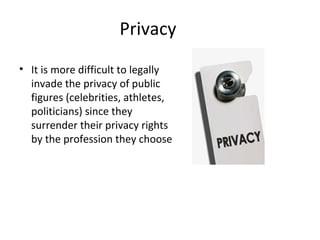
Privacy
• It is more difficult to legally
invade the privacy of public
figures (celebrities, athletes,
politicians) since they
surrender their privacy rights
by the profession they choose
Litigation Risks
• Copyright Infringement
• Invasion of Privacy
• Defamation
• Sexual Harassment
• Hostile Work Environment Claims
• Other Legal Risks
Copyright Infringement
• Copyrighted content on your blog can result in
legal action
– Example:
• ABC vs. “Spocko’s Brain”
“Deep Linking”
• The legality is in debate
– Most courts have found that you can “deep link” into another
person’s content
• Shetland Times vs. Shetland News
• Ticketmaster vs. Microsoft
• Ticketmaster vs. Tickets.com
– Exceptions:
• In Dec. 2006, a new court ruling in Texas found the opposite
– SFX Motorsports vs. SuperCrossLive.com
Invasion of Privacy
• Disclosure of personal facts that were not
previously known to public
– A public figure has less recourse than a private
citizen
• Can I be sued?
– Perhaps. If it is not deemed “newsworthy” and it
causes harm to the individual’s reputation and
well-being
Invasion of Privacy
• Example:
– Washingtonienne.com
• A woman in Washington D.C. posts details of her
“affairs” with prominent political figures
• One politician sued for $20 million claiming “invasion of
privacy”
Defamation Online
• The US Supreme Court has said that blogs
have the same protections as traditional
media:
– "in the context of defamation law, the rights of
the institutional media are no greater and no less
than those enjoyed by other individuals and
organizations engaged in the same activities."
Opinion
• The labeling of a blog published statement as
“opinion” does not guarantee that it won’t be
found to be libelous
– Courts ask: “Would a ‘reasonable’ person confuse
your statement for fact?”
– The context of the statement is also examined
• Chat rooms and blog “comments” are usually seen as
“opinion” by design and are more likely to be exempt
from “libel”
Examples of Actual Cases
• Considered Libelous (when false):
– Calling an attorney a "crook"
– Describing a woman as a call girl
– Accusing a minister of unethical conduct
– Accusing a father of violating the confidence of
son
Examples of Actual Cases
• NOT Libelous:
– Calling a TV show participant a "local loser,"
"chicken butt" and "big skank"
– Calling someone a "bitch" or a "son of a bitch"
– Changing product code name from "Carl Sagan" to
"Butt Head Astronomer"
Trade Libel
• Trade libel is defamation against the goods or
services of a company or business.
– For example, saying that you found a severed
finger in you're a particular company's chili (if it
isn't true).
Defamation in Blogs
• If you repeat someone else's defamatory
statement in your blog, can you be found to
be held at the same standard as the original
speaker?
– This would have great implications for
“guestbooks” and “comments” that are left online
and/or unmoderated
Defamation Online
• Recognizing the difficulty this would pose in
the online world, Congress enacted Section
230 of the Communications Decency Act
– Provides a strong protection against liability for
Internet "intermediaries" who provide or
republish speech by others.
Section 230 of the CDA
• Protects bloggers in most circumstances
– Bloggers are not liable for defamatory content
written by “third parties”
• Comments
• RSS Feeds
• Chat rooms
– This protection does not necessarily apply to you
if you hand select and publish the above content
Defamation
• $11.1 million awarded in Oct. 2006 in a widely
observed suit
– Largest fine of its kind
– A woman posted negative comments about a
business owner after their transaction went bad
• Used terms “crook,” “con artist” and “fraud”
Sexual Harassment
• 27 workers fired for sexually-charged blogs
and postings on MySpace
– The Auto Club of Southern California employees
made comments about weight and sexual
orientation of other workers through their
postings and “Friends” comments
Security Breaches
• Loss of Trade Secrets
• Confidential Information
• Intellectual Property
Apple vs. Does
• Apple Computer sued various blog and indie
news sites to reveal the source of leaked
“trade secrets” relating to a music project
– The “Does” are “John Does”
• They are the unknown parties that leaked the
documents
Apple vs. Does
• Apple attempted to subpoena the ISP to give
up the e-mail records of those involved
• A court ruled that the bloggers/sites were
allowed to the same constitutional
protections as traditional journalists
• Apple was further ordered to pay $700,000 in
legal fees
Resources
• Electronic Frontier Foundation’s Legal Guide for Bl
• Citizen Media Law Project
• Media Bloggers Association

Blogging Law

  • 1.
    Blogging & theLaw Presentation courtesy of
  • 2.
    Defamation • A defamatorystatement injures the good name of an individual/company and lowers their standing in the community • Two kinds of defamation – Libel – Slander
  • 3.
    Slander • Slander – Spokenword defamation – Said to a third person but not printed or broadcast
  • 4.
    Libel • Libel – Defamationin a tangible medium (print, Internet or broadcast) – To prove libel, you must show that: • Harm was caused • The story was published or broadcast • The person/company was identified by name • The media was at fault or error • The broadcast/published facts must be false
  • 5.
    Fair Comment • Truthis the best defense against libel • Opinions also have some protection – Include facts to back up your opinion – Label your statement as “opinion” – Make sure the context is clear • Times Co. vs. Sullivan (1964): Court decision that actual malice must be proved
  • 6.
    Privacy • People havethe right to be left alone • To avoid invading someone’s privacy: – Obtain consent from the individual if taping • Do not record phone calls or tape someone without their knowledge – Do not release private information on an employee
  • 7.
    Privacy • It ismore difficult to legally invade the privacy of public figures (celebrities, athletes, politicians) since they surrender their privacy rights by the profession they choose
  • 8.
    Litigation Risks • CopyrightInfringement • Invasion of Privacy • Defamation • Sexual Harassment • Hostile Work Environment Claims • Other Legal Risks
  • 9.
    Copyright Infringement • Copyrightedcontent on your blog can result in legal action – Example: • ABC vs. “Spocko’s Brain”
  • 10.
    “Deep Linking” • Thelegality is in debate – Most courts have found that you can “deep link” into another person’s content • Shetland Times vs. Shetland News • Ticketmaster vs. Microsoft • Ticketmaster vs. Tickets.com – Exceptions: • In Dec. 2006, a new court ruling in Texas found the opposite – SFX Motorsports vs. SuperCrossLive.com
  • 11.
    Invasion of Privacy •Disclosure of personal facts that were not previously known to public – A public figure has less recourse than a private citizen • Can I be sued? – Perhaps. If it is not deemed “newsworthy” and it causes harm to the individual’s reputation and well-being
  • 12.
    Invasion of Privacy •Example: – Washingtonienne.com • A woman in Washington D.C. posts details of her “affairs” with prominent political figures • One politician sued for $20 million claiming “invasion of privacy”
  • 13.
    Defamation Online • TheUS Supreme Court has said that blogs have the same protections as traditional media: – "in the context of defamation law, the rights of the institutional media are no greater and no less than those enjoyed by other individuals and organizations engaged in the same activities."
  • 14.
    Opinion • The labelingof a blog published statement as “opinion” does not guarantee that it won’t be found to be libelous – Courts ask: “Would a ‘reasonable’ person confuse your statement for fact?” – The context of the statement is also examined • Chat rooms and blog “comments” are usually seen as “opinion” by design and are more likely to be exempt from “libel”
  • 15.
    Examples of ActualCases • Considered Libelous (when false): – Calling an attorney a "crook" – Describing a woman as a call girl – Accusing a minister of unethical conduct – Accusing a father of violating the confidence of son
  • 16.
    Examples of ActualCases • NOT Libelous: – Calling a TV show participant a "local loser," "chicken butt" and "big skank" – Calling someone a "bitch" or a "son of a bitch" – Changing product code name from "Carl Sagan" to "Butt Head Astronomer"
  • 17.
    Trade Libel • Tradelibel is defamation against the goods or services of a company or business. – For example, saying that you found a severed finger in you're a particular company's chili (if it isn't true).
  • 18.
    Defamation in Blogs •If you repeat someone else's defamatory statement in your blog, can you be found to be held at the same standard as the original speaker? – This would have great implications for “guestbooks” and “comments” that are left online and/or unmoderated
  • 19.
    Defamation Online • Recognizingthe difficulty this would pose in the online world, Congress enacted Section 230 of the Communications Decency Act – Provides a strong protection against liability for Internet "intermediaries" who provide or republish speech by others.
  • 20.
    Section 230 ofthe CDA • Protects bloggers in most circumstances – Bloggers are not liable for defamatory content written by “third parties” • Comments • RSS Feeds • Chat rooms – This protection does not necessarily apply to you if you hand select and publish the above content
  • 21.
    Defamation • $11.1 millionawarded in Oct. 2006 in a widely observed suit – Largest fine of its kind – A woman posted negative comments about a business owner after their transaction went bad • Used terms “crook,” “con artist” and “fraud”
  • 22.
    Sexual Harassment • 27workers fired for sexually-charged blogs and postings on MySpace – The Auto Club of Southern California employees made comments about weight and sexual orientation of other workers through their postings and “Friends” comments
  • 23.
    Security Breaches • Lossof Trade Secrets • Confidential Information • Intellectual Property
  • 24.
    Apple vs. Does •Apple Computer sued various blog and indie news sites to reveal the source of leaked “trade secrets” relating to a music project – The “Does” are “John Does” • They are the unknown parties that leaked the documents
  • 25.
    Apple vs. Does •Apple attempted to subpoena the ISP to give up the e-mail records of those involved • A court ruled that the bloggers/sites were allowed to the same constitutional protections as traditional journalists • Apple was further ordered to pay $700,000 in legal fees
  • 26.
    Resources • Electronic FrontierFoundation’s Legal Guide for Bl • Citizen Media Law Project • Media Bloggers Association