INTRODUCATION TO ONLINE JOURNALISM
 History of Internet
 Give a convincing definition of online journalism
 Explain the forms of online journalism
 Explain why traditional media outlets are moving online
 Exploring new media outlets e.g citizen journalism, backpack journalism
WHAT IS INTERNET??
INTERNET
 The history of the Internet starts in the 1950s and 1960s with the development of
computers.
 The conceptual foundation for creation of the Internet was largely created by three
individuals, Vannevar Bush, Norbert Wiener and Marshall McLuhan.
 In 1957, the Soviet Union launched the first satellite, Sputnik.
SHORT HISTORY OF INTERNET
 DARPA NET 1958
 ARPA NET 1967
 NSFNET 1985
 CSNET 1981
 EU-Net,
What is Online Journalism
 Online journalism refers to news content produced and/or distributed via
the Internet, particularly material created by journalists who work for
mainstream market driven news organizations.
What is Online Journalism
 Online journalism is defined the reporting of
facts when produced and distributed via the
Internet.
What is Online Journalism
 Digital journalism also known as online journalism is a contemporary form
of journalism where editorial content is distributed via the Internet as opposed to
publishing via print or broadcast
What is online journalism?
 The simple answer is, of course, journalism as it is practiced online.
 Journalism is any non-fiction or documentary narrative that reports or analyzes facts
and events firmly rooted in time (either topical or historical) which are selected and
arranged by reporters, writers, and editors to tell a story from a particular point of
view.
Whatarethedistinguishingcharacteristicsofonlinejournalismascomparedto
traditionaljournalism?
Real time

Online journalism can be published in real time, updating breaking news and
events as they happen. Nothing new here -- we've had this ability with
telegraph, teletype, radio, and TV. Just as we gather around the TV or radio, so
we can gather and attend real-time events online in chat rooms and auditorium
facilities.
What is online journalism?
Interactivity
 Traditional journalism guides the reader through a linear narrative. The online journalist lets
readers become participants, as they click their way through a hyperlinked set of pages.
Narrative momentum and a strong editorial voice pull a reader through a linear narrative.
What is online journalism?
 With interactivity, the online journalist can pre-determine, to a certain extent, the
reader/participant's progress through the material, but manifold navigation pathways,
branching options, and hyperlinks encourage the reader/participant to continue to explore
various narrative threads assembled by the reporter/writer/editor.
What is online journalism?
Quick feedback
 Readers/participants can respond instantly to material presented by the
online journalist; this response can take several forms. Email to the
reporter or editor resembles the traditional letter to editor of print
publications, but email letters can be published much sooner online than
in print.
What is online journalism?
 Online journalists can also take advantage of threaded discussions that let
readers respond immediately to an article, and to the comments of other readers,
in a bulletin board-style discussion that can be accessed at any time. Readers can
become participants in the ongoing co-creation of an editorial environment that
evolves from the online journalist's original reporting and the initial article. Blogs
(short for "Web log", a Web-based journal) make this easy.
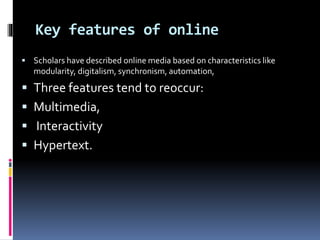
Key features of online
 Scholars have described online media based on characteristics like
modularity, digitalism, synchronism, automation,
 Three features tend to reoccur:
 Multimedia,
 Interactivity
 Hypertext.
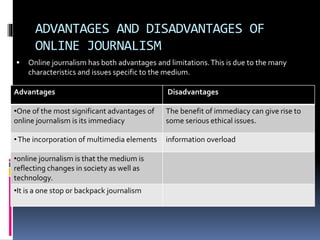
ADVANTAGES AND DISADVANTAGES OF
ONLINE JOURNALISM
 Online journalism has both advantages and limitations.This is due to the many
characteristics and issues specific to the medium.
Advantages Disadvantages
•One of the most significant advantages of
online journalism is its immediacy
The benefit of immediacy can give rise to
some serious ethical issues.
•The incorporation of multimedia elements information overload
•online journalism is that the medium is
reflecting changes in society as well as
technology.
•It is a one stop or backpack journalism
Advantages Disadvantages
-There is littleGovernment check on
entry requirements and monitoring
capacity.
Anybody with very little resources for
the basic needs could start Online
Journalism
why Newspapers and broadcast
outlets on web?
 In this digital age the newspaper industry is going through a tough
time all around the glob. More and more people are now using
Internet to get news and information.
How has the Internet affected
print journalism?
 The Internet is a time-saving research resource for journalists and editors, especially for
reporters looking for background, if they care to dig and look.You also see a lot of articles,
columns, syndicated features now about the Internet in print and broadcast publications.
 FCC in America published a report titled, “THE INFORMATION NEEDS OF
COMMUNITIESThe changing media landscape in a broadband age.” The
report said that as more and more people were using Internet to access news, readers
of newspaper declined resulting in job losses in the newspaper industry.The report
says:
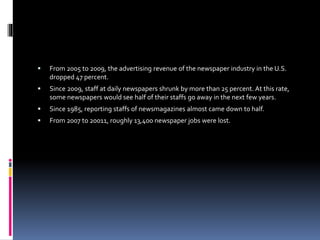
 From 2005 to 2009, the advertising revenue of the newspaper industry in the U.S.
dropped 47 percent.
 Since 2009, staff at daily newspapers shrunk by more than 25 percent. At this rate,
some newspapers would see half of their staffs go away in the next few years.
 Since 1985, reporting staffs of newsmagazines almost came down to half.
 From 2007 to 20011, roughly 13,400 newspaper jobs were lost.
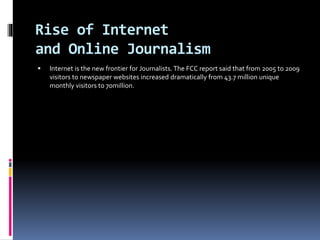
Rise of Internet
and Online Journalism
 Internet is the new frontier for Journalists.The FCC report said that from 2005 to 2009
visitors to newspaper websites increased dramatically from 43.7 million unique
monthly visitors to 70million.
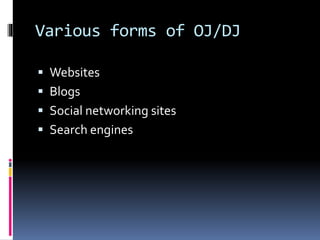
Various forms of OJ/DJ
 Websites
 Blogs
 Social networking sites
 Search engines

what is online journalism?

  • 1.
    INTRODUCATION TO ONLINEJOURNALISM  History of Internet  Give a convincing definition of online journalism  Explain the forms of online journalism  Explain why traditional media outlets are moving online  Exploring new media outlets e.g citizen journalism, backpack journalism
  • 2.
  • 3.
    INTERNET  The historyof the Internet starts in the 1950s and 1960s with the development of computers.  The conceptual foundation for creation of the Internet was largely created by three individuals, Vannevar Bush, Norbert Wiener and Marshall McLuhan.  In 1957, the Soviet Union launched the first satellite, Sputnik.
  • 4.
    SHORT HISTORY OFINTERNET  DARPA NET 1958  ARPA NET 1967  NSFNET 1985  CSNET 1981  EU-Net,
  • 5.
    What is OnlineJournalism  Online journalism refers to news content produced and/or distributed via the Internet, particularly material created by journalists who work for mainstream market driven news organizations.
  • 6.
    What is OnlineJournalism  Online journalism is defined the reporting of facts when produced and distributed via the Internet.
  • 7.
    What is OnlineJournalism  Digital journalism also known as online journalism is a contemporary form of journalism where editorial content is distributed via the Internet as opposed to publishing via print or broadcast
  • 8.
    What is onlinejournalism?  The simple answer is, of course, journalism as it is practiced online.  Journalism is any non-fiction or documentary narrative that reports or analyzes facts and events firmly rooted in time (either topical or historical) which are selected and arranged by reporters, writers, and editors to tell a story from a particular point of view.
  • 9.
    Whatarethedistinguishingcharacteristicsofonlinejournalismascomparedto traditionaljournalism? Real time  Online journalismcan be published in real time, updating breaking news and events as they happen. Nothing new here -- we've had this ability with telegraph, teletype, radio, and TV. Just as we gather around the TV or radio, so we can gather and attend real-time events online in chat rooms and auditorium facilities.
  • 10.
    What is onlinejournalism? Interactivity  Traditional journalism guides the reader through a linear narrative. The online journalist lets readers become participants, as they click their way through a hyperlinked set of pages. Narrative momentum and a strong editorial voice pull a reader through a linear narrative.
  • 11.
    What is onlinejournalism?  With interactivity, the online journalist can pre-determine, to a certain extent, the reader/participant's progress through the material, but manifold navigation pathways, branching options, and hyperlinks encourage the reader/participant to continue to explore various narrative threads assembled by the reporter/writer/editor.
  • 12.
    What is onlinejournalism? Quick feedback  Readers/participants can respond instantly to material presented by the online journalist; this response can take several forms. Email to the reporter or editor resembles the traditional letter to editor of print publications, but email letters can be published much sooner online than in print.
  • 13.
    What is onlinejournalism?  Online journalists can also take advantage of threaded discussions that let readers respond immediately to an article, and to the comments of other readers, in a bulletin board-style discussion that can be accessed at any time. Readers can become participants in the ongoing co-creation of an editorial environment that evolves from the online journalist's original reporting and the initial article. Blogs (short for "Web log", a Web-based journal) make this easy.
  • 14.
    Key features ofonline  Scholars have described online media based on characteristics like modularity, digitalism, synchronism, automation,  Three features tend to reoccur:  Multimedia,  Interactivity  Hypertext.
  • 15.
    ADVANTAGES AND DISADVANTAGESOF ONLINE JOURNALISM  Online journalism has both advantages and limitations.This is due to the many characteristics and issues specific to the medium. Advantages Disadvantages •One of the most significant advantages of online journalism is its immediacy The benefit of immediacy can give rise to some serious ethical issues. •The incorporation of multimedia elements information overload •online journalism is that the medium is reflecting changes in society as well as technology. •It is a one stop or backpack journalism
  • 16.
    Advantages Disadvantages -There islittleGovernment check on entry requirements and monitoring capacity. Anybody with very little resources for the basic needs could start Online Journalism
  • 17.
    why Newspapers andbroadcast outlets on web?  In this digital age the newspaper industry is going through a tough time all around the glob. More and more people are now using Internet to get news and information.
  • 18.
    How has theInternet affected print journalism?  The Internet is a time-saving research resource for journalists and editors, especially for reporters looking for background, if they care to dig and look.You also see a lot of articles, columns, syndicated features now about the Internet in print and broadcast publications.
  • 19.
     FCC inAmerica published a report titled, “THE INFORMATION NEEDS OF COMMUNITIESThe changing media landscape in a broadband age.” The report said that as more and more people were using Internet to access news, readers of newspaper declined resulting in job losses in the newspaper industry.The report says:
  • 20.
     From 2005to 2009, the advertising revenue of the newspaper industry in the U.S. dropped 47 percent.  Since 2009, staff at daily newspapers shrunk by more than 25 percent. At this rate, some newspapers would see half of their staffs go away in the next few years.  Since 1985, reporting staffs of newsmagazines almost came down to half.  From 2007 to 20011, roughly 13,400 newspaper jobs were lost.
  • 21.
    Rise of Internet andOnline Journalism  Internet is the new frontier for Journalists.The FCC report said that from 2005 to 2009 visitors to newspaper websites increased dramatically from 43.7 million unique monthly visitors to 70million.
  • 22.
    Various forms ofOJ/DJ  Websites  Blogs  Social networking sites  Search engines