By: Dean Elliott
   “A wide range of activities in which everyday
    people contribute information or
    commentary about news events.” (Educause
    Learning Initiative (2007))
   “The collection, dissemination, and analysis
    of news by the public, by means of cell
    phones, digital cameras, blogs, etc.” (Google
    Dictionary)
   The rise in citizen journalism corresponds
    with the growth in new communication and
    information technologies.
   These new technologies that serve as media
    for internet based social interaction are
    known as “social media”.
   Through social media websites, such as
    Facebook, Twitter, LinkedIn, and blogs,
    citizens can report their own experiences and
    eye witness accounts.
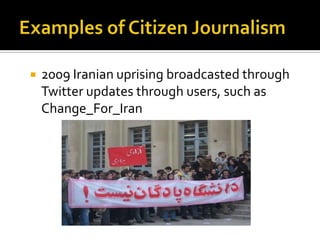
   2009 Iranian uprising broadcasted through
    Twitter updates through users, such as
    Change_For_Iran
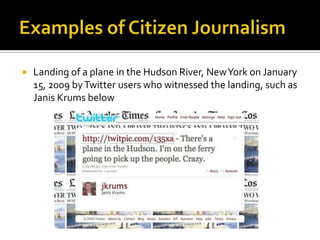
   Landing of a plane in the Hudson River, New York on January
    15, 2009 by Twitter users who witnessed the landing, such as
    Janis Krums below
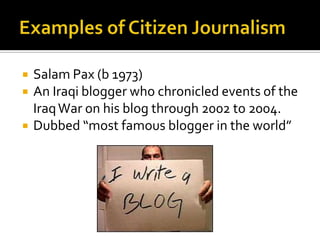
   Salam Pax (b 1973)
   An Iraqi blogger who chronicled events of the
    Iraq War on his blog through 2002 to 2004.
   Dubbed “most famous blogger in the world”
   Originally Citizen Journalism was confined to
    a few non professional reporting sites, such
    as NowPublic and CyberJournalist.
   However, now use of blogs, wikis, digital
    storytelling applications, photo- and video-
    sharing sites, and other online social media
    serve as vehicles for citizen journalism
    efforts.
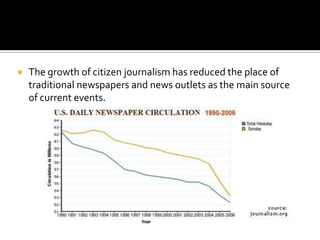
   The growth of citizen journalism has reduced the place of
    traditional newspapers and news outlets as the main source
    of current events.
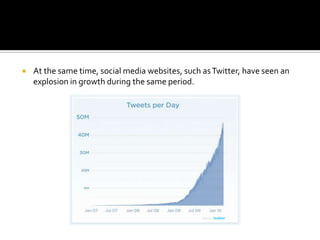
   At the same time, social media websites, such as Twitter, have seen an
    explosion in growth during the same period.
   Citizen Journalism has transformed the
    power relationship between the media and
    the public.
   As a result, traditional media outlets have
    attempted to harness the power of citizen
    journalism through collaboration with user
    generated content and social media.
   Examples of cooperation between media
    outlets and citizen journalism include:
     BBC’s User Generated Content Hub
     Rueter’s partnership with blogging network
      Global Voices
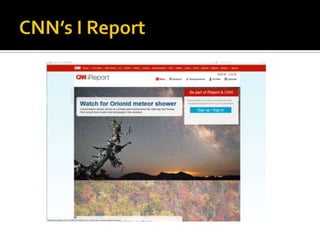
     CNN’s I Report
   Users can submit videos, audio, and photos from their
    cell phone or computer to have their stories shared on
    CNN’s network television channel and website.
   Through I Report, CNN harnesses the power of citizen
    journalism to convey breaking news and unique
    perspectives in a way traditional media does not
    allow.
   However, as will be seen, this collaboration between
    the media and citizen journalism holds significant
    benefits and drawbacks that must be accounted when
    providing quick and reliable information.
   Increased speed and access to information
     Traditional media is limited by access to resources
      and time to communicate events to the public.
     Citizen Journalism greatly increases the range of
      sources for events and the speed with which they
      can be communicated.
     For instance, coverage of 2009 Iranian protesters
      by participants and observers where traditional
      media was prohibited in Iran.
   Personal feedback
     It extends the belief that the experiences of
      people personally involved with an issue present a
      different—and often more complete—picture of
      events than can be derived from the perspective
      of an outsider. (Educause Learning Initiative
      (2007))
     For example, Salam Pax’s chronicles of the Iraq
      War
   Improved trust and interaction with local
    media
     Research has shown that traditional news outlets
      believe that participation by readers improves the
      quality of the news, and such participation tends
      to increase the trust that the community has in
      the news and media.
     For example, CNN’s I Report
   Reduced Quality of Content
     Amidst the diverse array of information and
     sources, discerning between important and trivial
     content becomes costly and time consuming.
   Reduced Reliability
     Much of the information gathered from citizen
      journalists may be false or partially inaccurate.
     While conscientious professional journalists are
      careful to separate supportable evidence from opinion
      or speculation, many citizen journalists have a weaker
      sense of what constitutes a reliable story.
     If the media relies too heavily upon citizen journalists
      for information, consumers may begin to distrust the
      media.
   Citizen journalism has become a powerful
    tool to unite the media and the public to
    produce quick, reliable, and detailed stories,
    which neither group could accomplish alone.
   This collaboration has begun to revolutionize
    the way in which we obtain information
    about current events.
   Nevertheless, the rise of citizen journalism
    poses significant risks that could reduce the
    quality and reliability of information
    distributed to the public.
   As a result, citizen journalism will likely
    continue to influence and play a role in
    traditional media yet never fully replace it.