 public opinion: what the public thinks about a
  particular issue or set of issues at any point in time.
 public opinion polls: interviews or surveys with
  samples of citizens that are used to estimate the
  feelings and beliefs of the entire population.
The History of Public Opinion Research
   Literary Digest began polling in 1916
        straw polls: unscientific surveys used to gauge public
         opinion on a variety of issues and policies
        sample: a subset of the whole population selected to be
         questioned for the purposes of prediction or gauging
         opinion
   George Gallup got it right when Literary Digest got
    it wrong (1936)
Traditional Public Opinion Polls
   Determining the content and phrasing the
    questions
        The wording of the questions can affect the answers
Traditional Public Opinion Polls
   Selecting the sample
        random sampling: a method of poll selection that gives
         each person in a group the same chance of being selected.
        stratified sampling: a variation of random sampling;
         census data are used to divide the country into four
         sampling regions. Sets of counties and standard
         metropolitan statistical areas are then randomly selected
         in proportion to the total national population.
        Volunteers have different opinions from those who do not
         volunteer to answer survey.
Traditional Public Opinion Polls
   Contacting respondents
        Telephone most common (random digit dialing)
        Some in-person surveys done, but can affect responses
Political Polls
       push polls: polls taken for the purpose of
        providing information on an opponent that
        would lead respondents to vote against that
        candidate.
       tracking polls: continuous surveys that enable
        a campaign to chart its daily rise or fall in
        support.
       exit polls: polls conducted at selected polling
        places on Election Day
         1980 Carter conceded before the polls closed
Shortcomings of Polling
       Margin of error: a measure of the accuracy of a
        public opinion poll.
         all polls contain errors
         makes prediction of close elections difficult
       Sampling error
         accuracy depends on the quality of the sample (equal
          opportunity to be sampled)
Shortcomings of Polling
       Limited respondent options
         limited responses lead to inaccuracy
       Lack of information
         polls more inaccurate if they ask people about issues
          that people don’t know or care about
       Difficulty measuring intensity
Why We Form and Express Political
Opinions
 Personal Benefits
    Will a policy affect us personally? We choose self-
     interest.
    Is a policy related to moral issue? We choose personal
     beliefs.
    Policy not personal, not moral? No opinion, swayed
     easily.
Why We Form and Express Political
Opinions
       Political Knowledge
         Knowledge of history and politics is historically low
         More knowledge of the system increases participation
         We DO know general direction we want country to
          take
Why We Form and Express Political
Opinions
       Cues from Leaders or Opinion Makers
         Low levels of knowledge lead to rapid opinion shifts
         Political leaders can use mass media to influence
          public opinion
Why We Form and Express Political
Opinions
       Political Ideology
         political ideology: the coherent set of values and
          beliefs about the purpose and scope of government
          held by groups and individuals
         conservatives, liberals and moderates
The Evolution of News Media in the United
States
 mass media – the entire array of organizations
  through which information is collected and
  disseminated to the general public
 news media – media providing the public with new
  information about subjects of public interest
Print Media
   partisan press, newspapers took positions
    (Federalists/Anti-Federalists)
   penny press, politically independent
   yellow journalism – a form of newspaper
    publishing in vogue in the late nineteenth
    century that featured
    pictures, comics, color, and
    sensationalized, oversimplified news coverage
   muckraking – a form of journalism, in vogue in
    the early twentieth century, concerned with
    reforming government and business conduct
Radio News
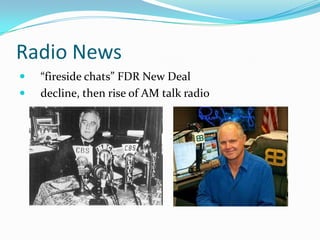
   “fireside chats” FDR New Deal
   decline, then rise of AM talk radio
Television News
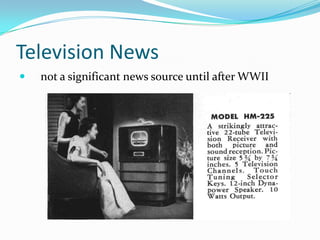
   not a significant news source until after WWII
 decline of network news, rise of cable news
 (CNN, Fox, others)
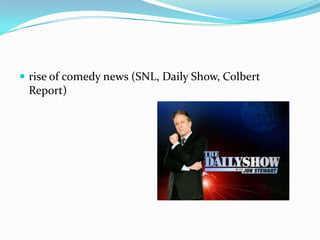
 rise of comedy news (SNL, Daily Show, Colbert
 Report)
The New Media
   Internet
Current Media Trends
       The Influence of Media Giants
         National newspapers, networks, cable networks, wire
          services
       Media Consolidation
         some fear limited flow of information
Current Media Trends
 Increasing Use of Experts
    consultants—who picked them, why should they shape
     our views?
 Narrowcasting
    targeting a specific group
 Technological Innovation
    Blogs
    Social networks
Rules Governing the Media
 Journalistic Standards
    Code of Ethics, personal integrity
Rules Governing the Media
       Government Regulation of the Electronic Media
         airwaves are public property
             broadcasters lease airwaves from government
         airwaves are in limited supply
         FCC regulation of total national audience of
          corporations
Rules Governing the Media
       Content Regulation
         content regulation – government attempts to
          regulate the substance of the mass media
         equal time rule – the rule that requires broadcast
          stations to sell air time equally to all candidates in a
          political campaign if they choose to sell it to any
Rules Governing the Media
       Efforts to Control the News Media
         “Only a free and unrestrained press can effectively
          expose deception in the government.” New York
          Times Co. v. U.S. (1971)
How the Media Cover Politics
 How the Press and Public Figures Interact
   press release – a document offering an official
    comment or position
   press briefing – a relatively restricted session between
    a press secretary or aide and the press
   press conference – an unrestricted session between an
    elected official and the press
   New York Times Co. v. Sullivan (1964) – the Supreme
    Court concluded that “actual malice” must be proved to
    support a finding of libel against a public figure
How the Media Cover Politics
       Covering the Presidency
         President can easily address the nation almost at will
         Negative coverage of administration common
       Covering Congress
         Also disproportionately negative
         C-SPAN
       Covering the Supreme Court
         severely limited coverage
         want to protect perception as nonpolitical and
          autonomous
Media Influence, Media Bias, and Public
Confidence
 Media Influence
   media effects – the influence of news sources on public opinion
   agenda setting – the constant process of forming the list of issues
    to be addressed by government
   framing – the process by which a news organization defines a
    political issue and consequently affects opinion about the issue
 Media Bias
   Media is traditionally liberal and identifies with Democratic party
 The Public’s Perception of the Media
   public assessment of media is generally unfavorable
   ideological fragmentation of the media

Public opinion

  • 2.
     public opinion:what the public thinks about a particular issue or set of issues at any point in time.  public opinion polls: interviews or surveys with samples of citizens that are used to estimate the feelings and beliefs of the entire population.
  • 3.
    The History ofPublic Opinion Research  Literary Digest began polling in 1916  straw polls: unscientific surveys used to gauge public opinion on a variety of issues and policies  sample: a subset of the whole population selected to be questioned for the purposes of prediction or gauging opinion  George Gallup got it right when Literary Digest got it wrong (1936)
  • 4.
    Traditional Public OpinionPolls  Determining the content and phrasing the questions  The wording of the questions can affect the answers
  • 5.
    Traditional Public OpinionPolls  Selecting the sample  random sampling: a method of poll selection that gives each person in a group the same chance of being selected.  stratified sampling: a variation of random sampling; census data are used to divide the country into four sampling regions. Sets of counties and standard metropolitan statistical areas are then randomly selected in proportion to the total national population.  Volunteers have different opinions from those who do not volunteer to answer survey.
  • 6.
    Traditional Public OpinionPolls  Contacting respondents  Telephone most common (random digit dialing)  Some in-person surveys done, but can affect responses
  • 7.
    Political Polls  push polls: polls taken for the purpose of providing information on an opponent that would lead respondents to vote against that candidate.  tracking polls: continuous surveys that enable a campaign to chart its daily rise or fall in support.  exit polls: polls conducted at selected polling places on Election Day  1980 Carter conceded before the polls closed
  • 8.
    Shortcomings of Polling  Margin of error: a measure of the accuracy of a public opinion poll.  all polls contain errors  makes prediction of close elections difficult  Sampling error  accuracy depends on the quality of the sample (equal opportunity to be sampled)
  • 9.
    Shortcomings of Polling  Limited respondent options  limited responses lead to inaccuracy  Lack of information  polls more inaccurate if they ask people about issues that people don’t know or care about  Difficulty measuring intensity
  • 10.
    Why We Formand Express Political Opinions  Personal Benefits  Will a policy affect us personally? We choose self- interest.  Is a policy related to moral issue? We choose personal beliefs.  Policy not personal, not moral? No opinion, swayed easily.
  • 11.
    Why We Formand Express Political Opinions  Political Knowledge  Knowledge of history and politics is historically low  More knowledge of the system increases participation  We DO know general direction we want country to take
  • 12.
    Why We Formand Express Political Opinions  Cues from Leaders or Opinion Makers  Low levels of knowledge lead to rapid opinion shifts  Political leaders can use mass media to influence public opinion
  • 13.
    Why We Formand Express Political Opinions  Political Ideology  political ideology: the coherent set of values and beliefs about the purpose and scope of government held by groups and individuals  conservatives, liberals and moderates
  • 14.
    The Evolution ofNews Media in the United States  mass media – the entire array of organizations through which information is collected and disseminated to the general public  news media – media providing the public with new information about subjects of public interest
  • 15.
    Print Media  partisan press, newspapers took positions (Federalists/Anti-Federalists)  penny press, politically independent  yellow journalism – a form of newspaper publishing in vogue in the late nineteenth century that featured pictures, comics, color, and sensationalized, oversimplified news coverage  muckraking – a form of journalism, in vogue in the early twentieth century, concerned with reforming government and business conduct
  • 16.
    Radio News  “fireside chats” FDR New Deal  decline, then rise of AM talk radio
  • 17.
    Television News  not a significant news source until after WWII
  • 18.
     decline ofnetwork news, rise of cable news (CNN, Fox, others)
  • 19.
     rise ofcomedy news (SNL, Daily Show, Colbert Report)
  • 20.
  • 21.
    Current Media Trends  The Influence of Media Giants  National newspapers, networks, cable networks, wire services  Media Consolidation  some fear limited flow of information
  • 22.
    Current Media Trends Increasing Use of Experts  consultants—who picked them, why should they shape our views?  Narrowcasting  targeting a specific group  Technological Innovation  Blogs  Social networks
  • 23.
    Rules Governing theMedia  Journalistic Standards  Code of Ethics, personal integrity
  • 24.
    Rules Governing theMedia  Government Regulation of the Electronic Media  airwaves are public property  broadcasters lease airwaves from government  airwaves are in limited supply  FCC regulation of total national audience of corporations
  • 25.
    Rules Governing theMedia  Content Regulation  content regulation – government attempts to regulate the substance of the mass media  equal time rule – the rule that requires broadcast stations to sell air time equally to all candidates in a political campaign if they choose to sell it to any
  • 26.
    Rules Governing theMedia  Efforts to Control the News Media  “Only a free and unrestrained press can effectively expose deception in the government.” New York Times Co. v. U.S. (1971)
  • 27.
    How the MediaCover Politics  How the Press and Public Figures Interact  press release – a document offering an official comment or position  press briefing – a relatively restricted session between a press secretary or aide and the press  press conference – an unrestricted session between an elected official and the press  New York Times Co. v. Sullivan (1964) – the Supreme Court concluded that “actual malice” must be proved to support a finding of libel against a public figure
  • 28.
    How the MediaCover Politics  Covering the Presidency  President can easily address the nation almost at will  Negative coverage of administration common  Covering Congress  Also disproportionately negative  C-SPAN  Covering the Supreme Court  severely limited coverage  want to protect perception as nonpolitical and autonomous
  • 29.
    Media Influence, MediaBias, and Public Confidence  Media Influence  media effects – the influence of news sources on public opinion  agenda setting – the constant process of forming the list of issues to be addressed by government  framing – the process by which a news organization defines a political issue and consequently affects opinion about the issue  Media Bias  Media is traditionally liberal and identifies with Democratic party  The Public’s Perception of the Media  public assessment of media is generally unfavorable  ideological fragmentation of the media