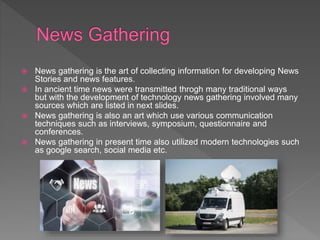
 News gathering is the art of collecting information for developing News
Stories and news features.
 In ancient time news were transmitted throgh many traditional ways
but with the development of technology news gathering involved many
sources which are listed in next slides.
 News gathering is also an art which use various communication
techniques such as interviews, symposium, questionnaire and
conferences.
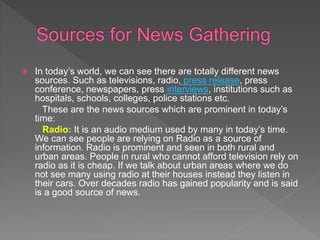
 News gathering in present time also utilized modern technologies such
as google search, social media etc.
 In today’s world, we can see there are totally different news
sources. Such as televisions, radio, press release, press
conference, newspapers, press interviews, institutions such as
hospitals, schools, colleges, police stations etc.
These are the news sources which are prominent in today’s
time:
Radio: It is an audio medium used by many in today’s time.
We can see people are relying on Radio as a source of
information. Radio is prominent and seen in both rural and
urban areas. People in rural who cannot afford television rely on
radio as it is cheap. If we talk about urban areas where we do
not see many using radio at their houses instead they listen in
their cars. Over decades radio has gained popularity and is said
is a good source of news.
Television: television telecasts their news on television
through which other newspaper takes there sources. It is said to
be the most authentic source of news as it has visuals to
establish the authenticity. Television helps and provides
newspapers to give detailed information to the audience but
television news just doesn’t act as the source to the newspaper
but also the audience itself.
Newspapers and magazines: these two also act as a good
source of news. Newspaper on both the levels national and
international provides the best information in details. The
newspaper has 5W’s and 1H which gives all the significant
information at the starting of the news and further deals with the
minor details and same is done in the magazines.
Press release: Press Releases are generally used for the release
of a particular news. The Press Release should contain worthwhile
material which has some news value. A Press Release should be
written in a journalistic style and provide facts and information of
interest to readers and should cover all aspects of a specific subject.
The release should be on current subject and a piece of clear writing
without any ambiguity, color or ornamentation but it should at the same
time not be generally lengthy.
Press notes: The press notes are less formal in character. These
are also issued on important official matters e.g. raising or lowering of
tariff rates, price fixation of food grains, subsidy announcement of
seeds, fertilizer etc. Apart from the name of department, place and
date, a press note mentions headings. Unlike the press communiqué,
the newspaper can edit or condense the press notes.
Handouts: The handouts are issued on a variety of subjects like
the day-to-day activities of the ministry or departments, VIP
speeches, question and answers in Parliament or legislature and
the developmental programmes of government departments. It
covers the name of the PIB or information department. No official
handout is issued, if the minister or a government official has
spoken in his personal capacity.
Press statement: the statements are usually given by known
people, then he shares his statement with media and later this
becomes press statement.
Police station: every event which is of big concern to the police
station would be firstly found in the police station. If the reporter
wants to know about a crime scene he would get first-hand
information from there.
The four most commonly used methods in news gathering
used by journalists are observation, telephone conversations,
research and interviews.
Observation consists of your actually seeing an event take place
and then reporting what you have seen in the form of a news story.
The difference between a good story and a poor one is often in the
skill of the observer. Skilled observers use their eyes, ears, mind,
notebooks and tape recorders. They make sure they get the
concrete facts, specific figures and accurate information. They look
for the colorful, the dramatic or the unusual in any situation.
Skilled observers always try to get more information than they
actually need. They know it is easier to discard excess material
than to retrace their steps after the story is cold. Developing your
powers of observation can come only through experience. You
cannot become a skilled observer by simply reading a book. The
key to becoming a good observer is to look for more than you see
on the surface.
TELEPHONE CONVERSATIONS
The telephone plays an important role in your daily work as a
journalist. It saves you time, legwork and it often enables you to
reach people who are ordinarily too busy to see you in person.
Telephone conversations may range from full-scale interviews to
brief queries to verify or amplify information.
RESEARCH
Research is nothing more than digging out information from files
and reference works. Research is used to verify or amplify facts in
news stories and to give depth to feature stories and magazine
articles.
INTERVIEWS
About 90 percent of everything in a news story is based on some
form of interviewing - either in person, by telephone, or
occasionally, by correspondence.
As a News journalist in search of information, you must learn who
to get information from and how to record facts. You must learn
techniques for handling different kinds of people - how to draw
some out, how to keep others on the topic and how to evaluate the
motives or honesty of others. In short, you must learn how to get
along with people and how to treat them with tact and
understanding while still accomplishing your purpose.
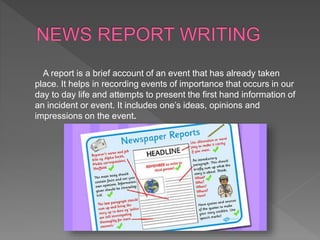
A report is a brief account of an event that has already taken
place. It helps in recording events of importance that occurs in our
day to day life and attempts to present the first hand information of
an incident or event. It includes one’s ideas, opinions and
impressions on the event.
 Key Elements in News Paper Report Writing
 Headline: It should catch the attention of the reader and it may
even sum up the story.
 Byline: It should include the name and the specialty of the writer.
For example: Food, sports, current events, crime, politics, science
etc;
 Place Line: It is the name of the place where the story begins.
 Lead Sentence: It is the opening section of the paragraph which
gives important information and it should answer most of the 5W's.
 Body: Include the most important details first followed by an
explanation.
 Facts and quotations can also be used
 POINTS TO REMEMBER
 Mention the place, date, time and other relevant facts about the event.
 Include information collected from people around or affected by the
event.
 Write the name of the reporter.
 Provide a suitable title/heading.
 Write in past tense.
 Write in reported speech and use passive form of expression.
 Develop ideas (causes, reasons, consequences, opinions) logically.
 Write in a less formal and more descriptive manner while writing a
report for a school magazine.
 Present your ideas and impressions to make the report interesting.
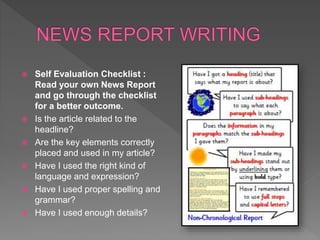
 Self Evaluation Checklist :
Read your own News Report
and go through the checklist
for a better outcome.
 Is the article related to the
headline?
 Are the key elements correctly
placed and used in my article?
 Have I used the right kind of
language and expression?
 Have I used proper spelling and
grammar?
 Have I used enough details?

News gathering show

  • 2.
     News gatheringis the art of collecting information for developing News Stories and news features.  In ancient time news were transmitted throgh many traditional ways but with the development of technology news gathering involved many sources which are listed in next slides.  News gathering is also an art which use various communication techniques such as interviews, symposium, questionnaire and conferences.  News gathering in present time also utilized modern technologies such as google search, social media etc.
  • 3.
     In today’sworld, we can see there are totally different news sources. Such as televisions, radio, press release, press conference, newspapers, press interviews, institutions such as hospitals, schools, colleges, police stations etc. These are the news sources which are prominent in today’s time: Radio: It is an audio medium used by many in today’s time. We can see people are relying on Radio as a source of information. Radio is prominent and seen in both rural and urban areas. People in rural who cannot afford television rely on radio as it is cheap. If we talk about urban areas where we do not see many using radio at their houses instead they listen in their cars. Over decades radio has gained popularity and is said is a good source of news.
  • 4.
    Television: television telecaststheir news on television through which other newspaper takes there sources. It is said to be the most authentic source of news as it has visuals to establish the authenticity. Television helps and provides newspapers to give detailed information to the audience but television news just doesn’t act as the source to the newspaper but also the audience itself. Newspapers and magazines: these two also act as a good source of news. Newspaper on both the levels national and international provides the best information in details. The newspaper has 5W’s and 1H which gives all the significant information at the starting of the news and further deals with the minor details and same is done in the magazines.
  • 5.
    Press release: PressReleases are generally used for the release of a particular news. The Press Release should contain worthwhile material which has some news value. A Press Release should be written in a journalistic style and provide facts and information of interest to readers and should cover all aspects of a specific subject. The release should be on current subject and a piece of clear writing without any ambiguity, color or ornamentation but it should at the same time not be generally lengthy. Press notes: The press notes are less formal in character. These are also issued on important official matters e.g. raising or lowering of tariff rates, price fixation of food grains, subsidy announcement of seeds, fertilizer etc. Apart from the name of department, place and date, a press note mentions headings. Unlike the press communiqué, the newspaper can edit or condense the press notes.
  • 6.
    Handouts: The handoutsare issued on a variety of subjects like the day-to-day activities of the ministry or departments, VIP speeches, question and answers in Parliament or legislature and the developmental programmes of government departments. It covers the name of the PIB or information department. No official handout is issued, if the minister or a government official has spoken in his personal capacity. Press statement: the statements are usually given by known people, then he shares his statement with media and later this becomes press statement. Police station: every event which is of big concern to the police station would be firstly found in the police station. If the reporter wants to know about a crime scene he would get first-hand information from there.
  • 7.
    The four mostcommonly used methods in news gathering used by journalists are observation, telephone conversations, research and interviews. Observation consists of your actually seeing an event take place and then reporting what you have seen in the form of a news story. The difference between a good story and a poor one is often in the skill of the observer. Skilled observers use their eyes, ears, mind, notebooks and tape recorders. They make sure they get the concrete facts, specific figures and accurate information. They look for the colorful, the dramatic or the unusual in any situation. Skilled observers always try to get more information than they actually need. They know it is easier to discard excess material than to retrace their steps after the story is cold. Developing your powers of observation can come only through experience. You cannot become a skilled observer by simply reading a book. The key to becoming a good observer is to look for more than you see on the surface.
  • 8.
    TELEPHONE CONVERSATIONS The telephoneplays an important role in your daily work as a journalist. It saves you time, legwork and it often enables you to reach people who are ordinarily too busy to see you in person. Telephone conversations may range from full-scale interviews to brief queries to verify or amplify information. RESEARCH Research is nothing more than digging out information from files and reference works. Research is used to verify or amplify facts in news stories and to give depth to feature stories and magazine articles.
  • 9.
    INTERVIEWS About 90 percentof everything in a news story is based on some form of interviewing - either in person, by telephone, or occasionally, by correspondence. As a News journalist in search of information, you must learn who to get information from and how to record facts. You must learn techniques for handling different kinds of people - how to draw some out, how to keep others on the topic and how to evaluate the motives or honesty of others. In short, you must learn how to get along with people and how to treat them with tact and understanding while still accomplishing your purpose.
  • 10.
    A report isa brief account of an event that has already taken place. It helps in recording events of importance that occurs in our day to day life and attempts to present the first hand information of an incident or event. It includes one’s ideas, opinions and impressions on the event.
  • 11.
     Key Elementsin News Paper Report Writing  Headline: It should catch the attention of the reader and it may even sum up the story.  Byline: It should include the name and the specialty of the writer. For example: Food, sports, current events, crime, politics, science etc;  Place Line: It is the name of the place where the story begins.  Lead Sentence: It is the opening section of the paragraph which gives important information and it should answer most of the 5W's.  Body: Include the most important details first followed by an explanation.  Facts and quotations can also be used
  • 12.
     POINTS TOREMEMBER  Mention the place, date, time and other relevant facts about the event.  Include information collected from people around or affected by the event.  Write the name of the reporter.  Provide a suitable title/heading.  Write in past tense.  Write in reported speech and use passive form of expression.  Develop ideas (causes, reasons, consequences, opinions) logically.  Write in a less formal and more descriptive manner while writing a report for a school magazine.  Present your ideas and impressions to make the report interesting.
  • 13.
     Self EvaluationChecklist : Read your own News Report and go through the checklist for a better outcome.  Is the article related to the headline?  Are the key elements correctly placed and used in my article?  Have I used the right kind of language and expression?  Have I used proper spelling and grammar?  Have I used enough details?