News Story Structures 
By Hoem Seiha 
H/p: 012‐699‐553 
Email: entrepconsulting@gmail.com 
A structure of a news story is based on the style a writer 
applies. Styles are divided into two common ways: 
1. Inverted Pyramid Style (most common) 
2. Hourglass Style 
3. Chronological Style 
Basic News Story Structures 
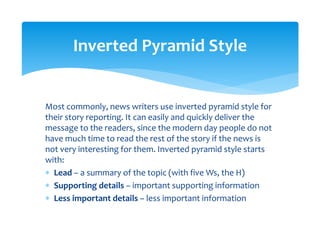
Most commonly, news writers use inverted pyramid style for 
their story reporting. It can easily and quickly deliver the 
message to the readers, since the modern day people do not 
have much time to read the rest of the story if the news is 
not very interesting for them. Inverted pyramid style starts 
with: 
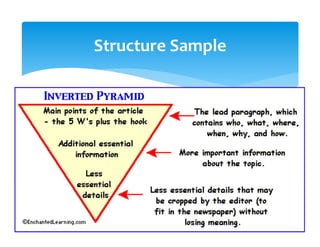
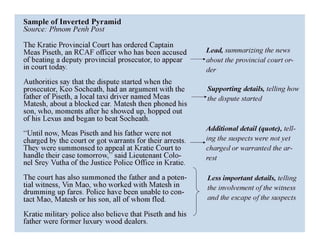
∗ Lead – a summary of the topic (with five Ws, the H) 
∗ Supporting details – important supporting information 
∗ Less important details – less important information 
Inverted Pyramid Style 
Structure Sample 
The hourglass form summarizes the news, then shifts to a 
narrative. The top delivers the news, the turn acts as a 
transition, the narrative tells the story. 
∗ THE TOP. Here you deliver the news in a summary lead, 
followed by three or four paragraphs that answer the 
reader’s most pressing questions. In the top you give the 
basic news, enough to satisfy a time‐pressed reader. You 
report the story in its most concise form. If all that is read 
is the top, the reader is still informed. Because it’s limited 
to four to six paragraphs, the top of the story should 
contain only the most significant information. 
Hourglass Style 
∗ THE TURN. Here you signal the reader that a narrative, 
usually chronological, is beginning. Usually, the turn is a 
transitional phrase that contains attribution for the 
narrative that follows: according to police, eyewitnesses 
described the event this way, the shooting unfolded this 
way, law enforcement sources and neighbors agree. 
∗ THE NARRATIVE. The story has three elements: a 
beginning, middle and end. The bottom allows the writer 
to tell a chronological narrative complete with detail, 
dialogue, and background information. 
 
Hourglass Style (Cont.) 
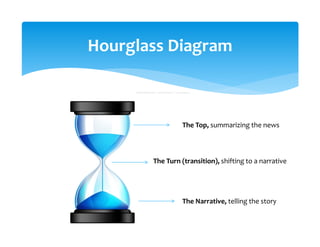
Hourglass Diagram 
The Top, summarizing the news 
The Turn (transition), shifting to a narrative 
The Narrative, telling the story 
Identify the top, the turn, 
and the narrative. 
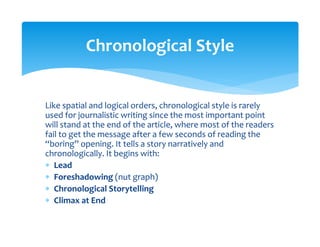
Like spatial and logical orders, chronological style is rarely 
used for journalistic writing since the most important point 
will stand at the end of the article, where most of the readers 
fail to get the message after a few seconds of reading the 
“boring” opening. It tells a story narratively and 
chronologically. It begins with: 
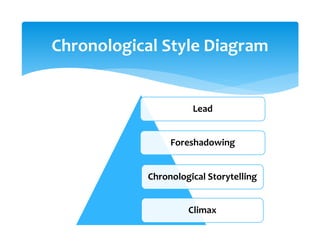
∗ Lead 
∗ Foreshadowing (nut graph) 
∗ Chronological Storytelling 
∗ Climax at End 
Chronological Style 
Lead 
Foreshadowing 
Chronological Storytelling 
Climax 
Chronological Style Diagram 

News story structures