PR in Marketing How the Lines Are Blurring as Technology Grows as a Driver
PR has always been a key component of any quality marketing program It has some inherent advantages that gain it recognition as an authoritative independent source Third-party veterans of user, analysts It used to be one, separate element in the mix Now it is everywhere because technology has made a new breed of journalist The content may be used in any marketing technique The lines between advertising PR and other techniques have blurred But a company’s reputation depends on trust.  Truthful PR stories can build that credibility. PR in the Marketing Mix
 
1. Where do you get the bulk of your news and information today? Internet (Ask, Yahoo, Google, (other search engine) Newspapers Magazines Radio TV Social networks Social interaction with others/word of mouth Where did you get the same information 2-3 years ago? Internet Newspapers Magazines Radio TV Social networks Social interaction with others/word of mouth
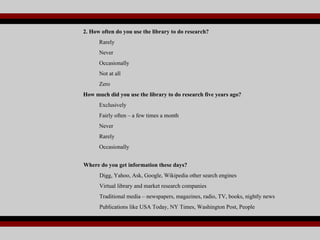
2. How often do you use the library to do research? Rarely Never  Occasionally Not at all Zero How much did you use the library to do research five years ago? Exclusively Fairly often – a few times a month Never Rarely Occasionally Where do you get information these days? Digg, Yahoo, Ask, Google, Wikipedia other search engines Virtual library and market research companies Traditional media – newspapers, magazines, radio, TV, books, nightly news Publications like USA Today, NY Times, Washington Post, People
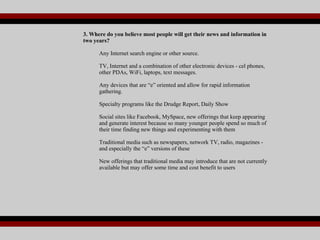
3. Where do you believe most people will get their news and information in two years? Any Internet search engine or other source. TV, Internet and a combination of other electronic devices - cel phones, other PDAs, WiFi, laptops, text messages. Any devices that are “e” oriented and allow for rapid information gathering. Specialty programs like the Drudge Report, Daily Show Social sites like Facebook, MySpace, new offerings that keep appearing and generate interest because so many younger people spend so much of their time finding new things and experimenting with them Traditional media such as newspapers, network TV, radio, magazines - and especially the “e” versions of these New offerings that traditional media may introduce that are not currently available but may offer some time and cost benefit to users
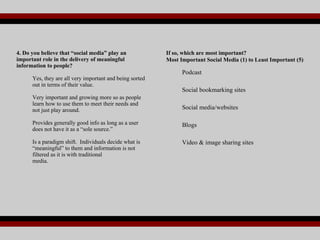
4. Do you believe that “social media” play an important role in the delivery of meaningful information to people? Yes, they are all very important and being sorted out in terms of their value. Very important and growing more so as people learn how to use them to meet their needs and not just play around. Provides generally good info as long as a user does not have it as a “sole source.” Is a paradigm shift.  Individuals decide what is “meaningful” to them and information is not filtered as it is with traditional  media. If so, which are most important? Most Important Social Media (1) to Least Important (5)   Podcast Social bookmarking sites Social media/websites Blogs  Video & image sharing sites
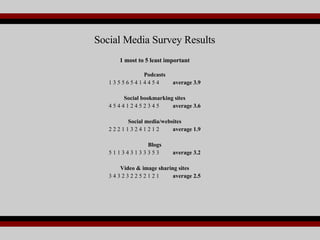
Social Media Survey Results 1 most to 5 least important Podcasts 1 3 5 5 6 5 4 1 4 4 5 4  average 3.9 Social bookmarking sites 4 5 4 4 1 2 4 5 2 3 4 5  average 3.6 Social media/websites 2 2 2 1 1 3 2 4 1 2 1 2  average 1.9 Blogs 5 1 1 3 4 3 1 3 3 3 5 3  average 3.2 Video & image sharing sites 3 4 3 2 3 2 2 5 2 1 2 1  average 2.5
Print Media Will not merely disappear.  Will morph into something else to deliver information.  Many of these media already have web sites and “e” versions. Will adjust to what the market is becoming. Printouts for all media will lessen because of cost, the green movement and news technologies that favor rapid response.  Printing costs are a big driver for change. Radio Radio will remain solid because devices like IPods make it easy to access. Things will go digital.  PDFs will increase.  Online information will be accessible for cell phones. Technology and traditional media There will not be any single “next big thing.”  Technology moves in incremental steps and will evolve and be revolutionary over time. Traditional media will adjust to and loose ground to new media because there are so many forms of new media.  The key element is for people to learn them and be able to use them effectively to get what they need. Historical examples show us new technologies move into play.  Example:  Mainframe computers to timesharing to client/server to personal computers to the Internet. 5. What the future may hold for traditional media and sources of information
6. Advantages of online research Can be used anywhere, anytime. Rapid research meets people’s demand for instant gratification of information.  They can go online and get it without going to libraries and poring through the stacks of materials to find what they need. Speed of research is super fast and quantity of available information is high, but must be sorted. Advantages to using the library and its resources for information and research Qualified, expert staff available to guide and direct you. Credible information that has been vetted. There is social interaction. Information can be trusted and is not a mere mass of data.
PR in Integrated Marketing Communications Third party credibility from PR outweighs ads People tend to believe what news they read, not paid ads PR has high ROI One client in 2006 had $8.4 million in media coverage, which gave an ROI of 18 times Another paid $1,400 in PR fees for a product introduction that garnered $17,950 worth of media coverage
Consistent Uploading Weekly; bi-weekly Same message throughout Links to Other Blogs Blogs linking to you and you linking to other blogs Company and Media Recognition Blogger’s Choice Awards Reference in the Times, Wall Street Journal, etc. Executive Posts GM FastLane Blog Credibility
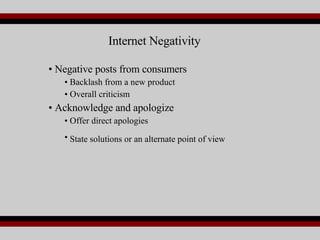
Negative posts from consumers Backlash from a new product Overall criticism Acknowledge and apologize Offer direct apologies State solutions or an alternate point of view   Internet Negativity
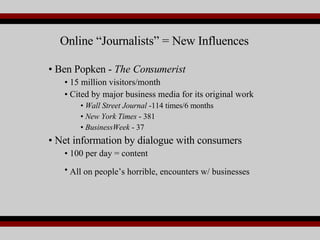
Ben Popken -  The Consumerist 15 million visitors/month Cited by major business media for its original work Wall Street Journal  -114 times/6 months New York Times  - 381 BusinessWeek  - 37 Net information by dialogue with consumers 100 per day = content All on people’s horrible, encounters w/ businesses   Online “Journalists” = New Influences
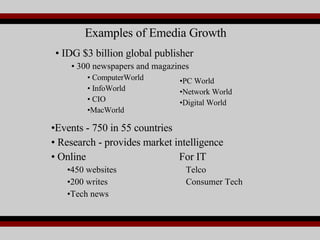
Events - 750 in 55 countries Research - provides market intelligence  Online For IT 450 websites   Telco 200 writes   Consumer Tech Tech news Examples of Emedia Growth IDG $3 billion global publisher 300 newspapers and magazines ComputerWorld InfoWorld CIO MacWorld PC World Network World Digital World
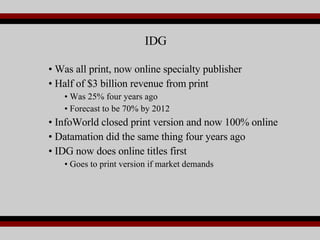
Was all print, now online specialty publisher Half of $3 billion revenue from print Was 25% four years ago Forecast to be 70% by 2012 InfoWorld closed print version and now 100% online Datamation did the same thing four years ago IDG now does online titles first Goes to print version if market demands IDG
It is an open conversation Readers will comment on your activities and expect you to respond Democratizing Companies of any size can compete equally Why is Social media different from traditional PR/Marketing Tactics?
66% of Americans trust blogs for their product recommendations (Nielsen Global Survey) 1 of 4 Americans has a page on MySpace The average Facebook user logs in six times/day 20,000 new members each day  Statistics on Social Media
Confidence that info is correct  Usability that info to help in business decisions “ Gee Whiz factor removed so they understand info and are not “wowed” or “cowed” by the techniques What do business people need from new/social media
Shift from print to online changes assumptions about marketing and publishing  Publishing is a starting point, not the ending point Publishers carefully get research and verify information It is edited, then published Publishing A Beginning Not an End
A story may expand and enlarge a reader (participants)  Add their comments and theories with a blog post, podcast, or other online contribution Messages are no longer one-way.  Your audience contributes to expanding your content It is like a dialogue, a conversation Online Media is the Opposite
77% of IT professionals in 430 Fortune 1000 companies use social networking  42% Three times/week 35% One time/week 22% not active Demonstrating rapidly increasing numbers of IT professionals using social sites to get and share information, network and communicate fast IT Professionals and Social Networking *Trend Scan Survey by Syntel
Evolutionary change is a fact If you want to be part of getting information efficiently, these new ways to do it are imperative.  Conversation has become a norm for journalism People are trying to reach specific groups and targets - not masses. Everyone wants “instant gratification of information” New techniques and devices: Kindle - from Amazon No carrying books, magazines or newspapers Can be delivered to you in one minute when you buy for $10 Holds hundreds of books, newspapers, blogs So where is all this going?
All ways to access information is changing No longer news organizations with large staffs, reporters and editors who cover beats and generate news based on their areas  Rather we have a sea change in the ways info is generated and disseminated  In many ways new outline media have already supplemented traditional news media e.g. blogs, podcasts, video social media Like the Industrial Revolution, but this is the Information Revolution People are more interested to reach audiences directly and have discussions, conversations, than get info from mass media So where is all this going?
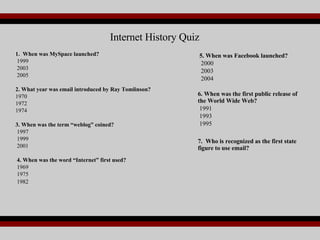
1.  When was MySpace launched? 1999 2003 2005 2. What year was email introduced by Ray Tomlinson? 1970 1972 1974 3.  When was the term “weblog” coined? 1997 1999 2001 4.  When was the word “Internet” first used? 1969 1975 1982   5.  When was Facebook launched? 2000 2003 2004 6. When was the first public release of the World Wide Web? 1991 1993 1995 7.  Who is recognized as the first state figure to use email? Internet History Quiz
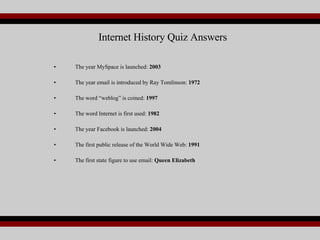
Internet History Quiz Answers The year MySpace is launched:  2003 The year email is introduced by Ray Tomlinson:  1972 The word “weblog” is coined:  1997 The word Internet is first used:  1982 The year Facebook is launched:  2004 The first public release of the World Wide Web:  1991 The first state figure to use email:  Queen Elizabeth

Larrys Presentation5.17. 1

  • 1.
    PR in MarketingHow the Lines Are Blurring as Technology Grows as a Driver
  • 2.
    PR has alwaysbeen a key component of any quality marketing program It has some inherent advantages that gain it recognition as an authoritative independent source Third-party veterans of user, analysts It used to be one, separate element in the mix Now it is everywhere because technology has made a new breed of journalist The content may be used in any marketing technique The lines between advertising PR and other techniques have blurred But a company’s reputation depends on trust. Truthful PR stories can build that credibility. PR in the Marketing Mix
  • 3.
  • 4.
    1. Where doyou get the bulk of your news and information today? Internet (Ask, Yahoo, Google, (other search engine) Newspapers Magazines Radio TV Social networks Social interaction with others/word of mouth Where did you get the same information 2-3 years ago? Internet Newspapers Magazines Radio TV Social networks Social interaction with others/word of mouth
  • 5.
    2. How oftendo you use the library to do research? Rarely Never Occasionally Not at all Zero How much did you use the library to do research five years ago? Exclusively Fairly often – a few times a month Never Rarely Occasionally Where do you get information these days? Digg, Yahoo, Ask, Google, Wikipedia other search engines Virtual library and market research companies Traditional media – newspapers, magazines, radio, TV, books, nightly news Publications like USA Today, NY Times, Washington Post, People
  • 6.
    3. Where doyou believe most people will get their news and information in two years? Any Internet search engine or other source. TV, Internet and a combination of other electronic devices - cel phones, other PDAs, WiFi, laptops, text messages. Any devices that are “e” oriented and allow for rapid information gathering. Specialty programs like the Drudge Report, Daily Show Social sites like Facebook, MySpace, new offerings that keep appearing and generate interest because so many younger people spend so much of their time finding new things and experimenting with them Traditional media such as newspapers, network TV, radio, magazines - and especially the “e” versions of these New offerings that traditional media may introduce that are not currently available but may offer some time and cost benefit to users
  • 7.
    4. Do youbelieve that “social media” play an important role in the delivery of meaningful information to people? Yes, they are all very important and being sorted out in terms of their value. Very important and growing more so as people learn how to use them to meet their needs and not just play around. Provides generally good info as long as a user does not have it as a “sole source.” Is a paradigm shift. Individuals decide what is “meaningful” to them and information is not filtered as it is with traditional media. If so, which are most important? Most Important Social Media (1) to Least Important (5) Podcast Social bookmarking sites Social media/websites Blogs Video & image sharing sites
  • 8.
    Social Media SurveyResults 1 most to 5 least important Podcasts 1 3 5 5 6 5 4 1 4 4 5 4 average 3.9 Social bookmarking sites 4 5 4 4 1 2 4 5 2 3 4 5 average 3.6 Social media/websites 2 2 2 1 1 3 2 4 1 2 1 2 average 1.9 Blogs 5 1 1 3 4 3 1 3 3 3 5 3 average 3.2 Video & image sharing sites 3 4 3 2 3 2 2 5 2 1 2 1 average 2.5
  • 9.
    Print Media Willnot merely disappear. Will morph into something else to deliver information. Many of these media already have web sites and “e” versions. Will adjust to what the market is becoming. Printouts for all media will lessen because of cost, the green movement and news technologies that favor rapid response. Printing costs are a big driver for change. Radio Radio will remain solid because devices like IPods make it easy to access. Things will go digital. PDFs will increase. Online information will be accessible for cell phones. Technology and traditional media There will not be any single “next big thing.” Technology moves in incremental steps and will evolve and be revolutionary over time. Traditional media will adjust to and loose ground to new media because there are so many forms of new media. The key element is for people to learn them and be able to use them effectively to get what they need. Historical examples show us new technologies move into play. Example: Mainframe computers to timesharing to client/server to personal computers to the Internet. 5. What the future may hold for traditional media and sources of information
  • 10.
    6. Advantages ofonline research Can be used anywhere, anytime. Rapid research meets people’s demand for instant gratification of information. They can go online and get it without going to libraries and poring through the stacks of materials to find what they need. Speed of research is super fast and quantity of available information is high, but must be sorted. Advantages to using the library and its resources for information and research Qualified, expert staff available to guide and direct you. Credible information that has been vetted. There is social interaction. Information can be trusted and is not a mere mass of data.
  • 11.
    PR in IntegratedMarketing Communications Third party credibility from PR outweighs ads People tend to believe what news they read, not paid ads PR has high ROI One client in 2006 had $8.4 million in media coverage, which gave an ROI of 18 times Another paid $1,400 in PR fees for a product introduction that garnered $17,950 worth of media coverage
  • 12.
    Consistent Uploading Weekly;bi-weekly Same message throughout Links to Other Blogs Blogs linking to you and you linking to other blogs Company and Media Recognition Blogger’s Choice Awards Reference in the Times, Wall Street Journal, etc. Executive Posts GM FastLane Blog Credibility
  • 13.
    Negative posts fromconsumers Backlash from a new product Overall criticism Acknowledge and apologize Offer direct apologies State solutions or an alternate point of view Internet Negativity
  • 14.
    Ben Popken - The Consumerist 15 million visitors/month Cited by major business media for its original work Wall Street Journal -114 times/6 months New York Times - 381 BusinessWeek - 37 Net information by dialogue with consumers 100 per day = content All on people’s horrible, encounters w/ businesses Online “Journalists” = New Influences
  • 15.
    Events - 750in 55 countries Research - provides market intelligence Online For IT 450 websites Telco 200 writes Consumer Tech Tech news Examples of Emedia Growth IDG $3 billion global publisher 300 newspapers and magazines ComputerWorld InfoWorld CIO MacWorld PC World Network World Digital World
  • 16.
    Was all print,now online specialty publisher Half of $3 billion revenue from print Was 25% four years ago Forecast to be 70% by 2012 InfoWorld closed print version and now 100% online Datamation did the same thing four years ago IDG now does online titles first Goes to print version if market demands IDG
  • 17.
    It is anopen conversation Readers will comment on your activities and expect you to respond Democratizing Companies of any size can compete equally Why is Social media different from traditional PR/Marketing Tactics?
  • 18.
    66% of Americanstrust blogs for their product recommendations (Nielsen Global Survey) 1 of 4 Americans has a page on MySpace The average Facebook user logs in six times/day 20,000 new members each day Statistics on Social Media
  • 19.
    Confidence that infois correct Usability that info to help in business decisions “ Gee Whiz factor removed so they understand info and are not “wowed” or “cowed” by the techniques What do business people need from new/social media
  • 20.
    Shift from printto online changes assumptions about marketing and publishing Publishing is a starting point, not the ending point Publishers carefully get research and verify information It is edited, then published Publishing A Beginning Not an End
  • 21.
    A story mayexpand and enlarge a reader (participants) Add their comments and theories with a blog post, podcast, or other online contribution Messages are no longer one-way. Your audience contributes to expanding your content It is like a dialogue, a conversation Online Media is the Opposite
  • 22.
    77% of ITprofessionals in 430 Fortune 1000 companies use social networking 42% Three times/week 35% One time/week 22% not active Demonstrating rapidly increasing numbers of IT professionals using social sites to get and share information, network and communicate fast IT Professionals and Social Networking *Trend Scan Survey by Syntel
  • 23.
    Evolutionary change isa fact If you want to be part of getting information efficiently, these new ways to do it are imperative. Conversation has become a norm for journalism People are trying to reach specific groups and targets - not masses. Everyone wants “instant gratification of information” New techniques and devices: Kindle - from Amazon No carrying books, magazines or newspapers Can be delivered to you in one minute when you buy for $10 Holds hundreds of books, newspapers, blogs So where is all this going?
  • 24.
    All ways toaccess information is changing No longer news organizations with large staffs, reporters and editors who cover beats and generate news based on their areas Rather we have a sea change in the ways info is generated and disseminated In many ways new outline media have already supplemented traditional news media e.g. blogs, podcasts, video social media Like the Industrial Revolution, but this is the Information Revolution People are more interested to reach audiences directly and have discussions, conversations, than get info from mass media So where is all this going?
  • 25.
    1. Whenwas MySpace launched? 1999 2003 2005 2. What year was email introduced by Ray Tomlinson? 1970 1972 1974 3. When was the term “weblog” coined? 1997 1999 2001 4. When was the word “Internet” first used? 1969 1975 1982 5. When was Facebook launched? 2000 2003 2004 6. When was the first public release of the World Wide Web? 1991 1993 1995 7. Who is recognized as the first state figure to use email? Internet History Quiz
  • 26.
    Internet History QuizAnswers The year MySpace is launched: 2003 The year email is introduced by Ray Tomlinson: 1972 The word “weblog” is coined: 1997 The word Internet is first used: 1982 The year Facebook is launched: 2004 The first public release of the World Wide Web: 1991 The first state figure to use email: Queen Elizabeth