Jan. 28, 2015 NIT-Patna: Foundation Day 2015 1
CMOS Digital Circuit Design
How to Make Both Ends Meet?
Susanta Sen
Institute of Radio Physics and Electronics
University of Calcutta
Jan. 28, 2015 NIT-Patna: Foundation Day 2015 2
Review of
MOS Transistor
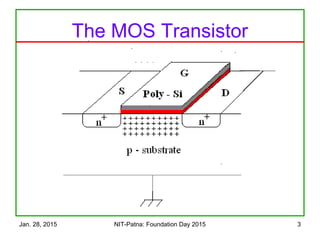
Jan. 28, 2015 NIT-Patna: Foundation Day 2015 3
The MOS Transistor
Jan. 28, 2015 NIT-Patna: Foundation Day 2015 4
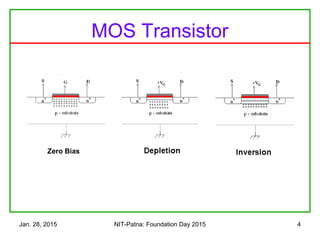
MOS Transistor
Zero Bias
Jan. 28, 2015 NIT-Patna: Foundation Day 2015 5
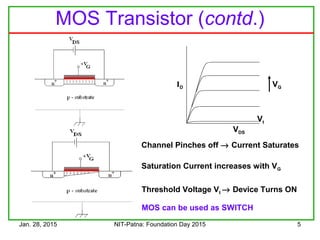
MOS Transistor (contd.)
VDS
ID
Channel Pinches off → Current Saturates
VG
Saturation Current increases with VG
Vt
Threshold Voltage Vt → Device Turns ON
MOS can be used as SWITCH
Jan. 28, 2015 NIT-Patna: Foundation Day 2015 6
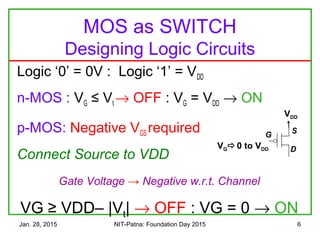
MOS as SWITCH
Designing Logic Circuits
Logic ‘0’ = 0V : Logic ‘1’ = VDD
n-MOS : VG ≤ Vt → OFF : VG = VDD → ON
p-MOS: Negative VGS required
Connect Source to VDD
Gate Voltage → Negative w.r.t. Channel
VG ≥ VDD– |Vt| → OFF : VG = 0 → ON
S
VDD
VG0 to VDD D
G
Jan. 28, 2015 NIT-Patna: Foundation Day 2015 7
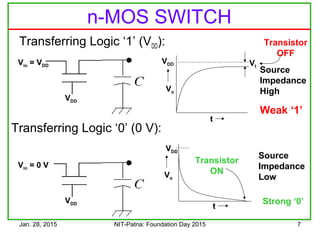
n-MOS SWITCH
Transferring Logic ‘1’ (VDD):
VDD
Vin = VDD Vt
VDD
Vo
t
Transistor
OFF
Source
Impedance
High
Weak ‘1’
Transistor
ON
Source
Impedance
Low
Strong ‘0’VDD
Vin = 0 V
Vo
t
VDD
Transferring Logic ‘0’ (0 V):
Jan. 28, 2015 NIT-Patna: Foundation Day 2015 8
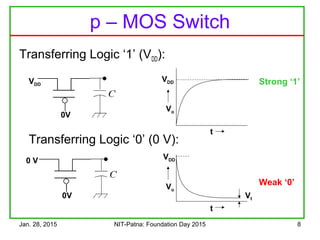
p – MOS Switch
Transferring Logic ‘1’ (VDD):
VDD
Vo
t
0V
VDD Strong ‘1’
Transferring Logic ‘0’ (0 V):
0V
0 V
t
Vo
VDD
Vt
Weak ‘0’
Jan. 28, 2015 NIT-Patna: Foundation Day 2015 9
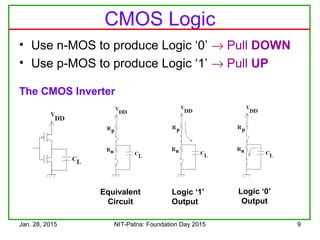
CMOS Logic
• Use n-MOS to produce Logic ‘0’ → Pull DOWN
• Use p-MOS to produce Logic ‘1’ → Pull UP
The CMOS Inverter
Equivalent
Circuit
Logic ‘1’
Output
Logic ‘0’
Output
Jan. 28, 2015 NIT-Patna: Foundation Day 2015 10
Switching Theory
Revisited
MOS Circuit Design
Digital Logic
Jan. 28, 2015 NIT-Patna: Foundation Day 2015 11
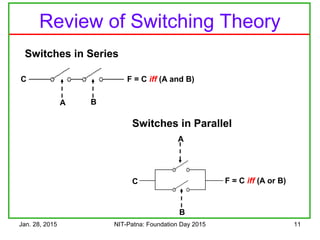
Review of Switching Theory
C
A B
F = C iff (A and B)
Switches in Series
A
B
C F = C iff (A or B)
Switches in Parallel
Jan. 28, 2015 NIT-Patna: Foundation Day 2015 12
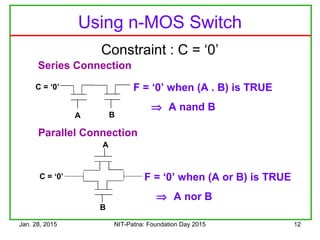
Using n-MOS Switch
Constraint : C = ‘0’
A B
Series Connection
C = ‘0’ F = ‘0’ when (A . B) is TRUE
⇒ A nand B
A
B
C = ‘0’ F = ‘0’ when (A or B) is TRUE
⇒ A nor B
Parallel Connection
Jan. 28, 2015 NIT-Patna: Foundation Day 2015 13
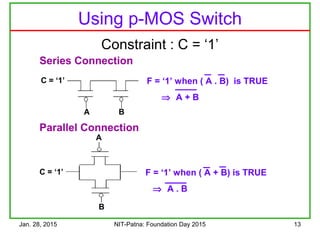
Using p-MOS Switch
Constraint : C = ‘1’
A B
C = ‘1’ F = ‘1’ when ( A . B) is TRUE
⇒ A + B
Series Connection
C = ‘1’
A
B
F = ‘1’ when ( A + B) is TRUE
⇒ A . B
Parallel Connection
Jan. 28, 2015 NIT-Patna: Foundation Day 2015 14
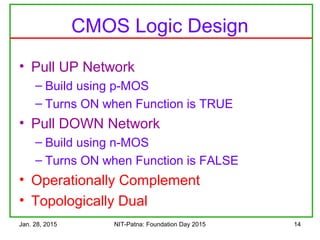
CMOS Logic Design
• Pull UP Network
– Build using p-MOS
– Turns ON when Function is TRUE
• Pull DOWN Network
– Build using n-MOS
– Turns ON when Function is FALSE
• Operationally Complement
• Topologically Dual
Jan. 28, 2015 NIT-Patna: Foundation Day 2015 15
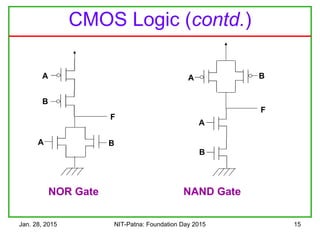
CMOS Logic (contd.)
A
A
B
BA
A
B
B
F
F
NAND GateNOR Gate
Jan. 28, 2015 NIT-Patna: Foundation Day 2015 16
CMOS Design Example
Consider the Function
f = A . (B + C)
Design the
Pull Down
Network first
A
B C
PullUp
F
B
A
C
f = [A . (B + C)] is true
The Pull Down Network connects
‘f ’ to ground when
Connect Ground
Jan. 28, 2015 NIT-Patna: Foundation Day 2015 17
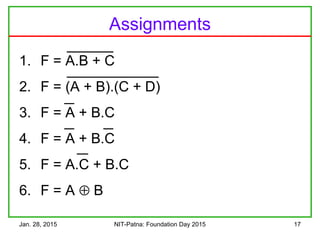
Assignments
1. F = A.B + C
2. F = (A + B).(C + D)
3. F = A + B.C
4. F = A + B.C
5. F = A.C + B.C
6. F = A ⊕ B
Steady State
Input-Output Characteristics
Jan. 28, 2015 NIT-Patna: Foundation Day 2015 19
V
DD
VO
Vi
(=VG)
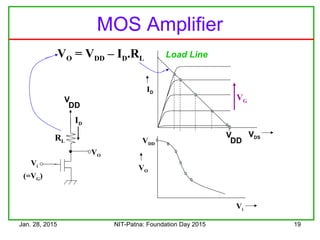
MOS Amplifier
VDS
ID
V
DD
VG
Vi
VO
Load Line
RL
ID
VO = VDD – ID.RL
VDD
Jan. 28, 2015 NIT-Patna: Foundation Day 2015 20
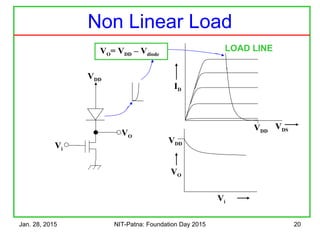
Non Linear Load
VDSVDD
ID
VDD
VO
Vi
LOAD LINEVO= VDD – Vdiode
VO
Vi
VDD
Jan. 28, 2015 NIT-Patna: Foundation Day 2015 21
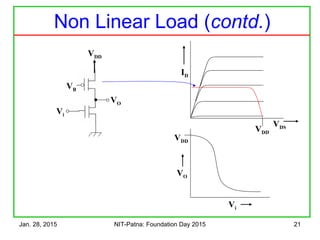
Non Linear Load (contd.)
Vi
VO
VB
VDD
VDD
VDS
ID
VDD
VO
Vi
Jan. 28, 2015 NIT-Patna: Foundation Day 2015 22
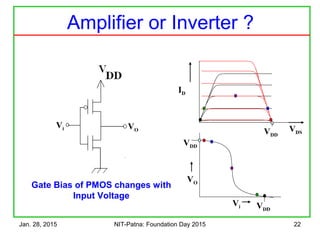
The CMOS InverterAmplifier or Inverter ?
Vi VO
VO
Vi
Gate Bias of PMOS changes with
Input Voltage
VDD
VDD
VDS
ID
VDD
Jan. 28, 2015 NIT-Patna: Foundation Day 2015 24
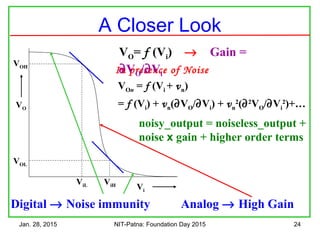
A Closer Look
In presence of Noise
VOn = f (Vi + vn)
= f (Vi) + vn(∂VO/∂Vi) + vn
2
(∂2
VO/∂Vi
2
)+…VO
Vi
noisy_output = noiseless_output +
noise x gain + higher order terms
VO= f (Vi) → Gain =
∂VO/∂Vi
ViHViL
VOL
VOH
Digital → Noise immunity Analog → High Gain
Jan. 28, 2015 NIT-Patna: Foundation Day 2015 25
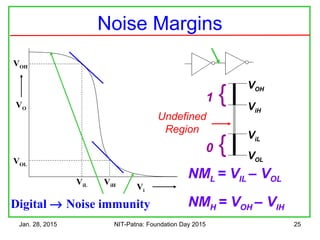
Noise Margins
VO
Vi
ViHViL
VOL
VOH
Digital → Noise immunity
NML = VIL – VOL
NMH = VOH – VIH
VOH
ViH
1 {
VOL
ViL
0 {
Undefined
Region
Jan. 28, 2015 NIT-Patna: Foundation Day 2015 26
Vi VO
VO
Vi
VDD
VDD
VDS
ID
VDD
Tuning the Characteristics
• Make the n-MOS wider
• It conducts more current
ID = ½ µCox[VGS – Vt]2
(W/L)
•Best Noise Margin
•When Vi = Voat VDD/2
•Wp = 3.Wn
Jan. 28, 2015 NIT-Patna: Foundation Day 2015 27
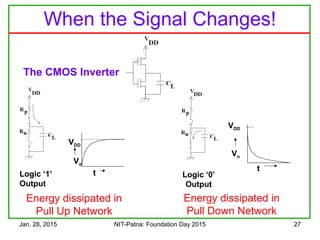
When the Signal Changes!
The CMOS Inverter
Logic ‘1’
Output
VDD
Vo
t Logic ‘0’
Output
Vo
t
VDD
Energy dissipated in
Pull Up Network
Energy dissipated in
Pull Down Network
Jan. 28, 2015 NIT-Patna: Foundation Day 2015 30
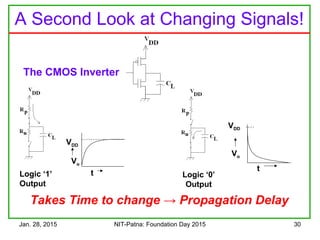
A Second Look at Changing Signals!
The CMOS Inverter
Logic ‘1’
Output
VDD
Vo
t Logic ‘0’
Output
Vo
t
VDD
Takes Time to change → Propagation Delay
Jan. 28, 2015 NIT-Patna: Foundation Day 2015 31
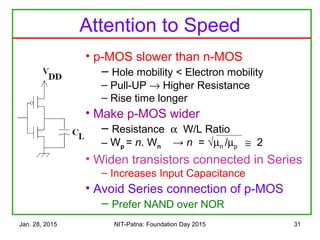
Attention to Speed
• p-MOS slower than n-MOS
– Hole mobility < Electron mobility
– Pull-UP → Higher Resistance
– Rise time longer
• Make p-MOS wider
– Resistance α W/L Ratio
– Wp = n. Wn → n = √µn /µp ≅ 2
• Widen transistors connected in Series
– Increases Input Capacitance
• Avoid Series connection of p-MOS
– Prefer NAND over NOR
Jan. 28, 2015 NIT-Patna: Foundation Day 2015 32
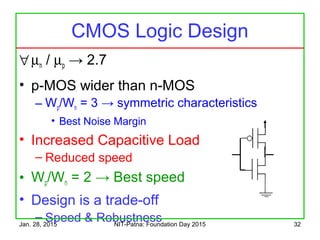
∀µn / µp → 2.7
• p-MOS wider than n-MOS
– Wp/Wn = 3 → symmetric characteristics
• Best Noise Margin
• Increased Capacitive Load
– Reduced speed
• Wp/Wn = 2 → Best speed
• Design is a trade-off
– Speed & Robustness
CMOS Logic Design
Jan. 28, 2015 NIT-Patna: Foundation Day 2015 33
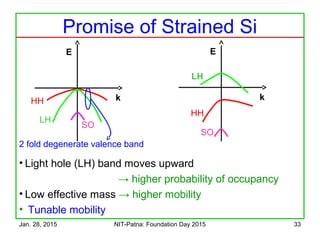
LH
SO
E
k
HH
LH
SO
2 fold degenerate valence band
E
kHH
• Light hole (LH) band moves upward
→ higher probability of occupancy
• Low effective mass → higher mobility
• Tunable mobility
Promise of Strained Si
Jan. 28, 2015 NIT-Patna: Foundation Day 2015 34
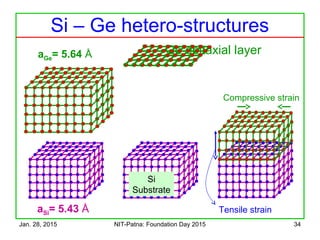
aSi=5.43A
aGe= 5.64 Å
Si
Substrate
Ge epitaxial layer
Tensile strain
%2.4
0
0
=
−
=
a
aa
ε
Si – Ge hetero-structures
aSi= 5.43 Å
Compressive strain
Jan. 28, 2015 NIT-Patna: Foundation Day 2015 35
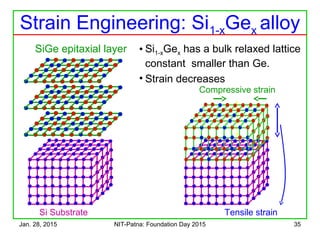
• Si1-xGex has a bulk relaxed lattice
constant smaller than Ge.
• Strain decreases
Strain Engineering: Si1-xGex alloy
SiGe epitaxial layer
Si Substrate Tensile strain
Compressive strain
Jan. 28, 2015 NIT-Patna: Foundation Day 2015 36
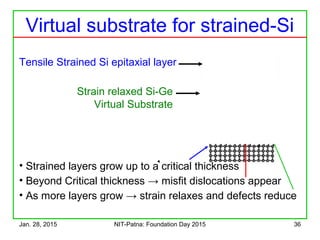
Virtual substrate for strained-Si
• Strained layers grow up to a critical thickness
• Beyond Critical thickness → misfit dislocations appear
• As more layers grow → strain relaxes and defects reduce
Strain relaxed Si-Ge
Virtual Substrate
Tensile Strained Si epitaxial layer
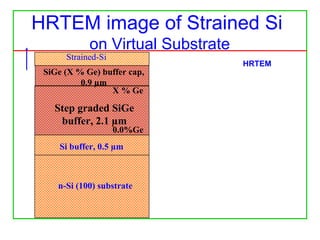
HRTEM image of Strained Si
on Virtual Substrate
Strained-Si
SiGe (X % Ge) buffer cap,
0.9 µm
X % Ge
0.0%Ge
Step graded SiGe
buffer, 2.1 µm
Si buffer, 0.5 µm
n-Si (100) substrate
HRTEM
Jan. 28, 2015 NIT-Patna: Foundation Day 2015 38
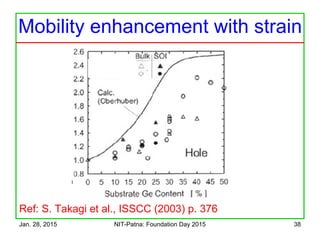
Ref: S. Takagi et al., ISSCC (2003) p. 376
Mobility enhancement with strain
Jan. 28, 2015 NIT-Patna: Foundation Day 2015 39
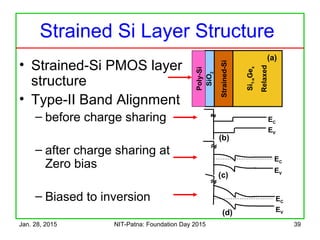
Strained Si Layer Structure
• Strained-Si PMOS layer
structure
• Type-II Band Alignment
– before charge sharing
– after charge sharing at
Zero bias
– Biased to inversion
Si1-xGex
Relaxed
Strained-Si
SiO2
(a)
EC
EV
(b)
EC
EV(d)
EC
EV
(c)
Poly-Si
Jan. 28, 2015 NIT-Patna: Foundation Day 2015 40
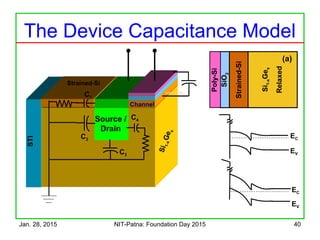
The Device Capacitance Model
EC
EV
EC
EV
Si1-xGex
Relaxed
SiO2
(a)
Poly-Si
Strained-Si
C1
C2
C3
STI
Channel
Strained-Si
Si1-xGex
C4Source /
Drain
Jan. 28, 2015 NIT-Patna: Foundation Day 2015 41
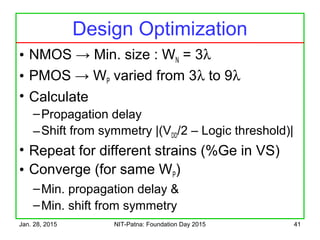
Design Optimization
• NMOS → Min. size : WN = 3λ
• PMOS → WP varied from 3λ to 9λ
• Calculate
–Propagation delay
–Shift from symmetry |(VDD/2 – Logic threshold)|
• Repeat for different strains (%Ge in VS)
• Converge (for same WP)
–Min. propagation delay &
–Min. shift from symmetry
Jan. 28, 2015 NIT-Patna: Foundation Day 2015 42
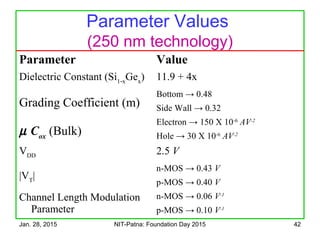
Parameter Values
(250 nm technology)
Parameter Value
Dielectric Constant (Si1 x‑
Gex
) 11.9 + 4x
Grading Coefficient (m)
Bottom → 0.48
Side Wall → 0.32
µ Cox
(Bulk)
Electron → 150 X 10-6
AV-2
Hole → 30 X 10-6
AV-2
VDD
2.5 V
|VT
|
n-MOS → 0.43 V
p-MOS → 0.40 V
Channel Length Modulation
Parameter
n-MOS → 0.06 V-1
p-MOS → 0.10 V-1
Jan. 28, 2015 NIT-Patna: Foundation Day 2015 44
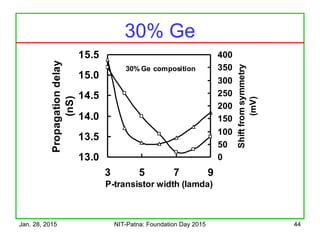
30% Ge
13.0
13.5
14.0
14.5
15.0
15.5
3 5 7 9
P-transistor width (lamda)
Propagationdelay
(nS)
0
50
100
150
200
250
300
350
400
Shiftfromsymmetry
(mV)
30% Ge composition
Jan. 28, 2015 NIT-Patna: Foundation Day 2015 45
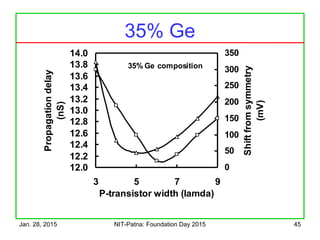
35% Ge
12.0
12.2
12.4
12.6
12.8
13.0
13.2
13.4
13.6
13.8
14.0
3 5 7 9
P-transistor width (lamda)
Propagationdelay
(nS)
0
50
100
150
200
250
300
350
Shiftfromsymmetry
(mV)
35% Ge composition
Jan. 28, 2015 NIT-Patna: Foundation Day 2015 46
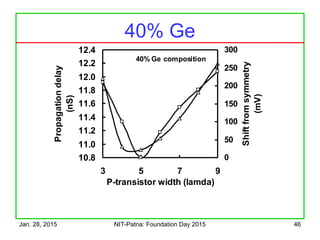
40% Ge
10.8
11.0
11.2
11.4
11.6
11.8
12.0
12.2
12.4
3 5 7 9
P-transistor width (lamda)
Propagationdelay
(nS)
0
50
100
150
200
250
300
Shiftfromsymmetry
(mV)
40% Ge composition
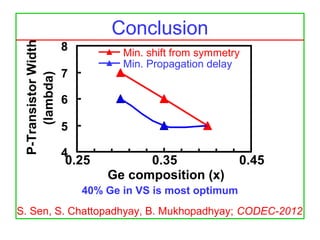
Min. shift from symmetry
Min. Propagation delay
Summary
40% Ge in VS is most optimum
Conclusion
4
5
6
7
8
0.25 0.35 0.45
Ge composition (x)
P-TransistorWidth
(lambda)
S. Sen, S. Chattopadhyay, B. Mukhopadhyay; CODEC-2012
Jan. 28, 2015 NIT-Patna: Foundation Day 2015 48

Trends in cmos digital design

  • 1.
    Jan. 28, 2015NIT-Patna: Foundation Day 2015 1 CMOS Digital Circuit Design How to Make Both Ends Meet? Susanta Sen Institute of Radio Physics and Electronics University of Calcutta
  • 2.
    Jan. 28, 2015NIT-Patna: Foundation Day 2015 2 Review of MOS Transistor
  • 3.
    Jan. 28, 2015NIT-Patna: Foundation Day 2015 3 The MOS Transistor
  • 4.
    Jan. 28, 2015NIT-Patna: Foundation Day 2015 4 MOS Transistor Zero Bias
  • 5.
    Jan. 28, 2015NIT-Patna: Foundation Day 2015 5 MOS Transistor (contd.) VDS ID Channel Pinches off → Current Saturates VG Saturation Current increases with VG Vt Threshold Voltage Vt → Device Turns ON MOS can be used as SWITCH
  • 6.
    Jan. 28, 2015NIT-Patna: Foundation Day 2015 6 MOS as SWITCH Designing Logic Circuits Logic ‘0’ = 0V : Logic ‘1’ = VDD n-MOS : VG ≤ Vt → OFF : VG = VDD → ON p-MOS: Negative VGS required Connect Source to VDD Gate Voltage → Negative w.r.t. Channel VG ≥ VDD– |Vt| → OFF : VG = 0 → ON S VDD VG0 to VDD D G
  • 7.
    Jan. 28, 2015NIT-Patna: Foundation Day 2015 7 n-MOS SWITCH Transferring Logic ‘1’ (VDD): VDD Vin = VDD Vt VDD Vo t Transistor OFF Source Impedance High Weak ‘1’ Transistor ON Source Impedance Low Strong ‘0’VDD Vin = 0 V Vo t VDD Transferring Logic ‘0’ (0 V):
  • 8.
    Jan. 28, 2015NIT-Patna: Foundation Day 2015 8 p – MOS Switch Transferring Logic ‘1’ (VDD): VDD Vo t 0V VDD Strong ‘1’ Transferring Logic ‘0’ (0 V): 0V 0 V t Vo VDD Vt Weak ‘0’
  • 9.
    Jan. 28, 2015NIT-Patna: Foundation Day 2015 9 CMOS Logic • Use n-MOS to produce Logic ‘0’ → Pull DOWN • Use p-MOS to produce Logic ‘1’ → Pull UP The CMOS Inverter Equivalent Circuit Logic ‘1’ Output Logic ‘0’ Output
  • 10.
    Jan. 28, 2015NIT-Patna: Foundation Day 2015 10 Switching Theory Revisited MOS Circuit Design Digital Logic
  • 11.
    Jan. 28, 2015NIT-Patna: Foundation Day 2015 11 Review of Switching Theory C A B F = C iff (A and B) Switches in Series A B C F = C iff (A or B) Switches in Parallel
  • 12.
    Jan. 28, 2015NIT-Patna: Foundation Day 2015 12 Using n-MOS Switch Constraint : C = ‘0’ A B Series Connection C = ‘0’ F = ‘0’ when (A . B) is TRUE ⇒ A nand B A B C = ‘0’ F = ‘0’ when (A or B) is TRUE ⇒ A nor B Parallel Connection
  • 13.
    Jan. 28, 2015NIT-Patna: Foundation Day 2015 13 Using p-MOS Switch Constraint : C = ‘1’ A B C = ‘1’ F = ‘1’ when ( A . B) is TRUE ⇒ A + B Series Connection C = ‘1’ A B F = ‘1’ when ( A + B) is TRUE ⇒ A . B Parallel Connection
  • 14.
    Jan. 28, 2015NIT-Patna: Foundation Day 2015 14 CMOS Logic Design • Pull UP Network – Build using p-MOS – Turns ON when Function is TRUE • Pull DOWN Network – Build using n-MOS – Turns ON when Function is FALSE • Operationally Complement • Topologically Dual
  • 15.
    Jan. 28, 2015NIT-Patna: Foundation Day 2015 15 CMOS Logic (contd.) A A B BA A B B F F NAND GateNOR Gate
  • 16.
    Jan. 28, 2015NIT-Patna: Foundation Day 2015 16 CMOS Design Example Consider the Function f = A . (B + C) Design the Pull Down Network first A B C PullUp F B A C f = [A . (B + C)] is true The Pull Down Network connects ‘f ’ to ground when Connect Ground
  • 17.
    Jan. 28, 2015NIT-Patna: Foundation Day 2015 17 Assignments 1. F = A.B + C 2. F = (A + B).(C + D) 3. F = A + B.C 4. F = A + B.C 5. F = A.C + B.C 6. F = A ⊕ B
  • 18.
  • 19.
    Jan. 28, 2015NIT-Patna: Foundation Day 2015 19 V DD VO Vi (=VG) MOS Amplifier VDS ID V DD VG Vi VO Load Line RL ID VO = VDD – ID.RL VDD
  • 20.
    Jan. 28, 2015NIT-Patna: Foundation Day 2015 20 Non Linear Load VDSVDD ID VDD VO Vi LOAD LINEVO= VDD – Vdiode VO Vi VDD
  • 21.
    Jan. 28, 2015NIT-Patna: Foundation Day 2015 21 Non Linear Load (contd.) Vi VO VB VDD VDD VDS ID VDD VO Vi
  • 22.
    Jan. 28, 2015NIT-Patna: Foundation Day 2015 22 The CMOS InverterAmplifier or Inverter ? Vi VO VO Vi Gate Bias of PMOS changes with Input Voltage VDD VDD VDS ID VDD
  • 23.
    Jan. 28, 2015NIT-Patna: Foundation Day 2015 24 A Closer Look In presence of Noise VOn = f (Vi + vn) = f (Vi) + vn(∂VO/∂Vi) + vn 2 (∂2 VO/∂Vi 2 )+…VO Vi noisy_output = noiseless_output + noise x gain + higher order terms VO= f (Vi) → Gain = ∂VO/∂Vi ViHViL VOL VOH Digital → Noise immunity Analog → High Gain
  • 24.
    Jan. 28, 2015NIT-Patna: Foundation Day 2015 25 Noise Margins VO Vi ViHViL VOL VOH Digital → Noise immunity NML = VIL – VOL NMH = VOH – VIH VOH ViH 1 { VOL ViL 0 { Undefined Region
  • 25.
    Jan. 28, 2015NIT-Patna: Foundation Day 2015 26 Vi VO VO Vi VDD VDD VDS ID VDD Tuning the Characteristics • Make the n-MOS wider • It conducts more current ID = ½ µCox[VGS – Vt]2 (W/L) •Best Noise Margin •When Vi = Voat VDD/2 •Wp = 3.Wn
  • 26.
    Jan. 28, 2015NIT-Patna: Foundation Day 2015 27 When the Signal Changes! The CMOS Inverter Logic ‘1’ Output VDD Vo t Logic ‘0’ Output Vo t VDD Energy dissipated in Pull Up Network Energy dissipated in Pull Down Network
  • 27.
    Jan. 28, 2015NIT-Patna: Foundation Day 2015 30 A Second Look at Changing Signals! The CMOS Inverter Logic ‘1’ Output VDD Vo t Logic ‘0’ Output Vo t VDD Takes Time to change → Propagation Delay
  • 28.
    Jan. 28, 2015NIT-Patna: Foundation Day 2015 31 Attention to Speed • p-MOS slower than n-MOS – Hole mobility < Electron mobility – Pull-UP → Higher Resistance – Rise time longer • Make p-MOS wider – Resistance α W/L Ratio – Wp = n. Wn → n = √µn /µp ≅ 2 • Widen transistors connected in Series – Increases Input Capacitance • Avoid Series connection of p-MOS – Prefer NAND over NOR
  • 29.
    Jan. 28, 2015NIT-Patna: Foundation Day 2015 32 ∀µn / µp → 2.7 • p-MOS wider than n-MOS – Wp/Wn = 3 → symmetric characteristics • Best Noise Margin • Increased Capacitive Load – Reduced speed • Wp/Wn = 2 → Best speed • Design is a trade-off – Speed & Robustness CMOS Logic Design
  • 30.
    Jan. 28, 2015NIT-Patna: Foundation Day 2015 33 LH SO E k HH LH SO 2 fold degenerate valence band E kHH • Light hole (LH) band moves upward → higher probability of occupancy • Low effective mass → higher mobility • Tunable mobility Promise of Strained Si
  • 31.
    Jan. 28, 2015NIT-Patna: Foundation Day 2015 34 aSi=5.43A aGe= 5.64 Å Si Substrate Ge epitaxial layer Tensile strain %2.4 0 0 = − = a aa ε Si – Ge hetero-structures aSi= 5.43 Å Compressive strain
  • 32.
    Jan. 28, 2015NIT-Patna: Foundation Day 2015 35 • Si1-xGex has a bulk relaxed lattice constant smaller than Ge. • Strain decreases Strain Engineering: Si1-xGex alloy SiGe epitaxial layer Si Substrate Tensile strain Compressive strain
  • 33.
    Jan. 28, 2015NIT-Patna: Foundation Day 2015 36 Virtual substrate for strained-Si • Strained layers grow up to a critical thickness • Beyond Critical thickness → misfit dislocations appear • As more layers grow → strain relaxes and defects reduce Strain relaxed Si-Ge Virtual Substrate Tensile Strained Si epitaxial layer
  • 34.
    HRTEM image ofStrained Si on Virtual Substrate Strained-Si SiGe (X % Ge) buffer cap, 0.9 µm X % Ge 0.0%Ge Step graded SiGe buffer, 2.1 µm Si buffer, 0.5 µm n-Si (100) substrate HRTEM
  • 35.
    Jan. 28, 2015NIT-Patna: Foundation Day 2015 38 Ref: S. Takagi et al., ISSCC (2003) p. 376 Mobility enhancement with strain
  • 36.
    Jan. 28, 2015NIT-Patna: Foundation Day 2015 39 Strained Si Layer Structure • Strained-Si PMOS layer structure • Type-II Band Alignment – before charge sharing – after charge sharing at Zero bias – Biased to inversion Si1-xGex Relaxed Strained-Si SiO2 (a) EC EV (b) EC EV(d) EC EV (c) Poly-Si
  • 37.
    Jan. 28, 2015NIT-Patna: Foundation Day 2015 40 The Device Capacitance Model EC EV EC EV Si1-xGex Relaxed SiO2 (a) Poly-Si Strained-Si C1 C2 C3 STI Channel Strained-Si Si1-xGex C4Source / Drain
  • 38.
    Jan. 28, 2015NIT-Patna: Foundation Day 2015 41 Design Optimization • NMOS → Min. size : WN = 3λ • PMOS → WP varied from 3λ to 9λ • Calculate –Propagation delay –Shift from symmetry |(VDD/2 – Logic threshold)| • Repeat for different strains (%Ge in VS) • Converge (for same WP) –Min. propagation delay & –Min. shift from symmetry
  • 39.
    Jan. 28, 2015NIT-Patna: Foundation Day 2015 42 Parameter Values (250 nm technology) Parameter Value Dielectric Constant (Si1 x‑ Gex ) 11.9 + 4x Grading Coefficient (m) Bottom → 0.48 Side Wall → 0.32 µ Cox (Bulk) Electron → 150 X 10-6 AV-2 Hole → 30 X 10-6 AV-2 VDD 2.5 V |VT | n-MOS → 0.43 V p-MOS → 0.40 V Channel Length Modulation Parameter n-MOS → 0.06 V-1 p-MOS → 0.10 V-1
  • 40.
    Jan. 28, 2015NIT-Patna: Foundation Day 2015 44 30% Ge 13.0 13.5 14.0 14.5 15.0 15.5 3 5 7 9 P-transistor width (lamda) Propagationdelay (nS) 0 50 100 150 200 250 300 350 400 Shiftfromsymmetry (mV) 30% Ge composition
  • 41.
    Jan. 28, 2015NIT-Patna: Foundation Day 2015 45 35% Ge 12.0 12.2 12.4 12.6 12.8 13.0 13.2 13.4 13.6 13.8 14.0 3 5 7 9 P-transistor width (lamda) Propagationdelay (nS) 0 50 100 150 200 250 300 350 Shiftfromsymmetry (mV) 35% Ge composition
  • 42.
    Jan. 28, 2015NIT-Patna: Foundation Day 2015 46 40% Ge 10.8 11.0 11.2 11.4 11.6 11.8 12.0 12.2 12.4 3 5 7 9 P-transistor width (lamda) Propagationdelay (nS) 0 50 100 150 200 250 300 Shiftfromsymmetry (mV) 40% Ge composition
  • 43.
    Min. shift fromsymmetry Min. Propagation delay Summary 40% Ge in VS is most optimum Conclusion 4 5 6 7 8 0.25 0.35 0.45 Ge composition (x) P-TransistorWidth (lambda) S. Sen, S. Chattopadhyay, B. Mukhopadhyay; CODEC-2012
  • 44.
    Jan. 28, 2015NIT-Patna: Foundation Day 2015 48