6/3/2015 274
UNIT-III
GA
TELEVELDESIGN
Topics
• Logic gates and other complexgates
• Switch logic
• Alternate gatecircuits
• Time delays
• Driving large capacitive loads
• Wiring capacitances
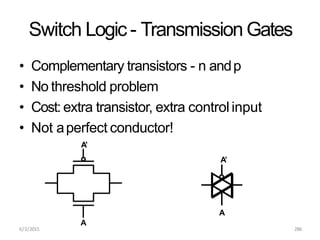
• Fan-in and fan-out, Choiceof layers
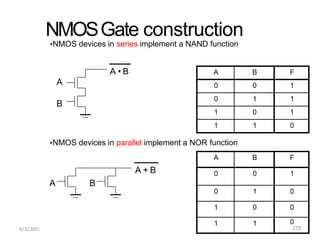
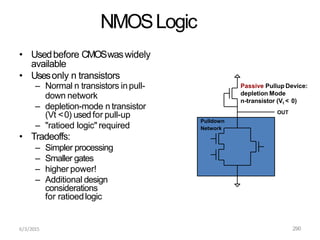
NMOSGate construction
A B
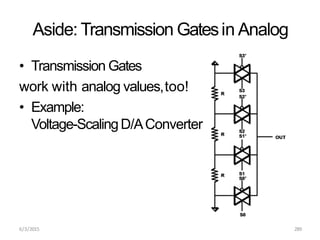
•NMOS devices in series implement a NAND function
A • B
A
B
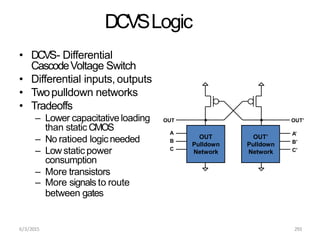
6/3/2015
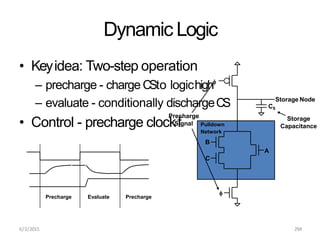
•NMOS devices in parallel implement a NOR function
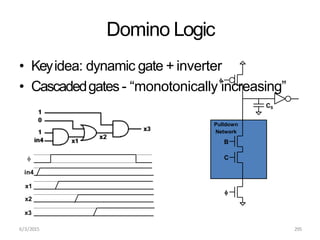
A + B
A B F
0 0 1
0 1 1
1 0 1
1 1 0
A B F
0 0 1
0 1 0
1 0 0
1 1 0
275
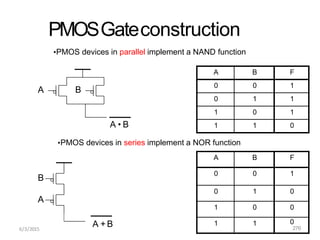
PMOSGateconstruction
A B
•PMOS devices in parallel implement a NAND function
B
A
A + B
A • B
•PMOS devices in series implement a NOR function
A B F
0 0 1
0 1 1
1 0 1
1 1 0
6/3/2015
A B F
0 0 1
0 1 0
1 0 0
1 1 0
276
Parasitics and Performance
• Consider the
following layout:
• What is the impact
on performanceof
parasitics
– At point a(VDDrail)?
– At point b(input)?
– At Point c(output)?
b
a
c
6/3/2015 277
Parasitics and Performance
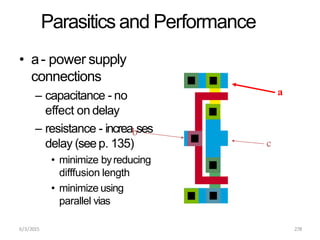
• a- power supply
connections
– capacitance - no
effect on delay
– resistance - increabses
delay (seep. 135)
• minimize byreducing
difffusion length
• minimize using
parallel vias
a
c
6/3/2015 278
Driving LargeLoads
• Off-chip loads, long wires, etc. have highcapacitance
• Increasing transistor sizeincreases driving ability
(and speed), but in turn increases gatecapacitance
• Solution: stagesof progressively largertransistors
– Usenopt =ln(Cbig/Cg).
– Scaleby afactor of a=e
6/3/2015 281
6/3/2015 282
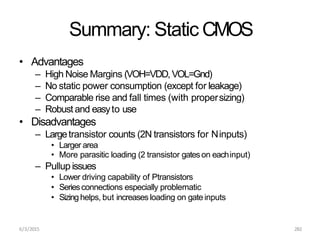
Summary: Static CMOS
• Advantages
– High Noise Margins (VOH=VDD,VOL=Gnd)
– No static power consumption (except for leakage)
– Comparable rise and fall times (with propersizing)
– Robust and easyto use
• Disadvantages
– Largetransistor counts (2N transistors for Ninputs)
• Larger area
• More parasitic loading (2 transistor gateson eachinput)
– Pullup issues
• Lower driving capability of Ptransistors
• Seriesconnections especially problematic
• Sizing helps, but increases loading on gate inputs
6/3/2015 283
Alternatives to StaticCMOS
• Switch Logic
• nmos
• Pseudo-nmos
• Dynamic Logic
• Low-PowerGates
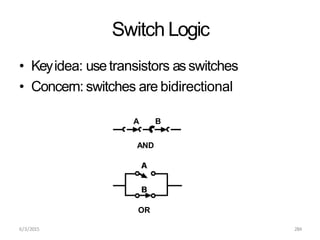
Switch Logic
• Keyidea: usetransistors asswitches
• Concern: switches are bidirectional
AND
A B
OR
6/3/2015 284
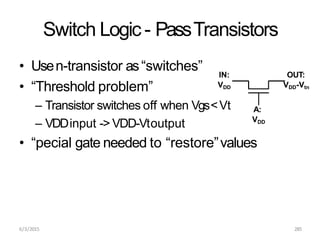
Switch Logic - PassTransistors
• Usen-transistor as“switches”
• “Threshold problem”
– Transistor switches off when Vgs<Vt
– VDDinput -> VDD-Vtoutput
• “pecial gate needed to “restore”values
IN:
VDD
6/3/2015 285
A:
VDD
OUT:
VDD-Vtn
Switch Logic - Transmission Gates
A
A
6/3/2015 286
• Complementary transistors - n andp
• No threshold problem
• Cost: extra transistor, extra control input
• Not aperfect conductor!
A’
A’
Switch Logic Example- 2-1 MUX
IN
6/3/2015 287
ChargeSharing
• Consider transmission gates in series
– Eachnode hasparasitic capacitances
– Problems occur when inputs change to
redistribute charge
– Solution: design network sothere is always apath
from VDDor Gndto output
6/3/2015 288
Aside: Transmission Gatesin Analog
• Transmission Gates
work with analog values,too!
• Example:
Voltage-ScalingD/AConverter
6/3/2015 289
NMOSLogic
• Usedbefore CMOSwaswidely
available
• Usesonly n transistors
– Normal n transistors inpull-
down network
– depletion-mode n transistor
(Vt <0) usedfor pull-up
– "ratioed logic" required
• Tradeoffs:
– Simpler processing
– Smaller gates
– higher power!
– Additional design
considerations
for ratioedlogic
Passive Pullup Device:
depletion Mode
n-transistor (Vt < 0)
OUT
6/3/2015 290
Pulldown
Network
Pseudo-nmosLogic
• Sameidea, asnmos, but usep-
transistor for pullup
• "ratioed logic" required for
proper design (more about
this next)
• Tradeoffs:
– Fewer transistors -> smaller
gates, esp. for large number
of inputs
– lesscapacitative load on gates
that drive inputs
– larger powerconsumption
– lessnoise margin (VOL> 0)
– additional design
considerations due to ratioed
logic
Passive Pullup Device:
P-Transistor
OUT
Pulldown
Network
6/3/2015 291
Rationed Logicfor Pseudo-nmos
• Approach:
– AssumeVOUT=VOL=0.25*VDD
– Assume1 pulldown transistor ison
– Equate currents in p, ntransistors
– Solvefor ratio between sizesof p, n
transistors to get theseconditions
necessary for
– Further calculations
series connections
Idn  I pn
1
k'
Wn
n L n
gs,n tn
 2
V  V 2

1
k'
Wp
p Lp
gs,p tp ds,p ds,p
2V  V V  V2
  (EQ 3  21)
2
Wp
Wn
Ln
L p
 3.9 (EQ 3  22)  Assu ming V DD  3.3V
Idp
OUT
Pulldown
Network
Idn
6/3/2015 292
DCVSLogic
• DCVS- Differential
CascodeVoltage Switch
• Differential inputs, outputs
• Twopulldown networks
• Tradeoffs
– Lower capacitative loading
than static CMOS
– No ratioed logicneeded
– Low static power
consumption
– More transistors
– More signals to route
between gates
OUT
Pulldown
Network
OUT’
OUT’
Pulldown
Network
OUT
A
B
C
6/3/2015 293
A’
B’
C’
Pulldown
Network
CS

A
B
C
Dynamic Logic
• Keyidea: Two-step operation
– precharge - charge C
Sto logichigh
– evaluate - conditionally dischargeC
S
• Control - precharge clockf
Storage Node
Storage
Capacitance
Precharge
Signal
Precharge
6/3/2015 294
Evaluate Precharge
Domino Logic
• Keyidea: dynamic gate + inverter
• Cascadedgates - “monotonically increasing”


CS
Pulldown
Network
B
C

in4
x1
x2
x3
6/3/2015 295
6/3/2015 296
Domino LogicTradeoffs
• Fewer transistors -> smaller gates
• Lower power consumption thanpseudo-nmos
• Clocking required
• Logicnot complete (AND,OR,but no NOT)

Gate level design, switch logic, pass transistors

  • 1.
    6/3/2015 274 UNIT-III GA TELEVELDESIGN Topics • Logicgates and other complexgates • Switch logic • Alternate gatecircuits • Time delays • Driving large capacitive loads • Wiring capacitances • Fan-in and fan-out, Choiceof layers
  • 2.
    NMOSGate construction A B •NMOSdevices in series implement a NAND function A • B A B 6/3/2015 •NMOS devices in parallel implement a NOR function A + B A B F 0 0 1 0 1 1 1 0 1 1 1 0 A B F 0 0 1 0 1 0 1 0 0 1 1 0 275
  • 3.
    PMOSGateconstruction A B •PMOS devicesin parallel implement a NAND function B A A + B A • B •PMOS devices in series implement a NOR function A B F 0 0 1 0 1 1 1 0 1 1 1 0 6/3/2015 A B F 0 0 1 0 1 0 1 0 0 1 1 0 276
  • 4.
    Parasitics and Performance •Consider the following layout: • What is the impact on performanceof parasitics – At point a(VDDrail)? – At point b(input)? – At Point c(output)? b a c 6/3/2015 277
  • 5.
    Parasitics and Performance •a- power supply connections – capacitance - no effect on delay – resistance - increabses delay (seep. 135) • minimize byreducing difffusion length • minimize using parallel vias a c 6/3/2015 278
  • 6.
    Driving LargeLoads • Off-chiploads, long wires, etc. have highcapacitance • Increasing transistor sizeincreases driving ability (and speed), but in turn increases gatecapacitance • Solution: stagesof progressively largertransistors – Usenopt =ln(Cbig/Cg). – Scaleby afactor of a=e 6/3/2015 281
  • 7.
    6/3/2015 282 Summary: StaticCMOS • Advantages – High Noise Margins (VOH=VDD,VOL=Gnd) – No static power consumption (except for leakage) – Comparable rise and fall times (with propersizing) – Robust and easyto use • Disadvantages – Largetransistor counts (2N transistors for Ninputs) • Larger area • More parasitic loading (2 transistor gateson eachinput) – Pullup issues • Lower driving capability of Ptransistors • Seriesconnections especially problematic • Sizing helps, but increases loading on gate inputs
  • 8.
    6/3/2015 283 Alternatives toStaticCMOS • Switch Logic • nmos • Pseudo-nmos • Dynamic Logic • Low-PowerGates
  • 9.
    Switch Logic • Keyidea:usetransistors asswitches • Concern: switches are bidirectional AND A B OR 6/3/2015 284
  • 10.
    Switch Logic -PassTransistors • Usen-transistor as“switches” • “Threshold problem” – Transistor switches off when Vgs<Vt – VDDinput -> VDD-Vtoutput • “pecial gate needed to “restore”values IN: VDD 6/3/2015 285 A: VDD OUT: VDD-Vtn
  • 11.
    Switch Logic -Transmission Gates A A 6/3/2015 286 • Complementary transistors - n andp • No threshold problem • Cost: extra transistor, extra control input • Not aperfect conductor! A’ A’
  • 12.
    Switch Logic Example-2-1 MUX IN 6/3/2015 287
  • 13.
    ChargeSharing • Consider transmissiongates in series – Eachnode hasparasitic capacitances – Problems occur when inputs change to redistribute charge – Solution: design network sothere is always apath from VDDor Gndto output 6/3/2015 288
  • 14.
    Aside: Transmission GatesinAnalog • Transmission Gates work with analog values,too! • Example: Voltage-ScalingD/AConverter 6/3/2015 289
  • 15.
    NMOSLogic • Usedbefore CMOSwaswidely available •Usesonly n transistors – Normal n transistors inpull- down network – depletion-mode n transistor (Vt <0) usedfor pull-up – "ratioed logic" required • Tradeoffs: – Simpler processing – Smaller gates – higher power! – Additional design considerations for ratioedlogic Passive Pullup Device: depletion Mode n-transistor (Vt < 0) OUT 6/3/2015 290 Pulldown Network
  • 16.
    Pseudo-nmosLogic • Sameidea, asnmos,but usep- transistor for pullup • "ratioed logic" required for proper design (more about this next) • Tradeoffs: – Fewer transistors -> smaller gates, esp. for large number of inputs – lesscapacitative load on gates that drive inputs – larger powerconsumption – lessnoise margin (VOL> 0) – additional design considerations due to ratioed logic Passive Pullup Device: P-Transistor OUT Pulldown Network 6/3/2015 291
  • 17.
    Rationed Logicfor Pseudo-nmos •Approach: – AssumeVOUT=VOL=0.25*VDD – Assume1 pulldown transistor ison – Equate currents in p, ntransistors – Solvefor ratio between sizesof p, n transistors to get theseconditions necessary for – Further calculations series connections Idn  I pn 1 k' Wn n L n gs,n tn  2 V  V 2  1 k' Wp p Lp gs,p tp ds,p ds,p 2V  V V  V2   (EQ 3  21) 2 Wp Wn Ln L p  3.9 (EQ 3  22)  Assu ming V DD  3.3V Idp OUT Pulldown Network Idn 6/3/2015 292
  • 18.
    DCVSLogic • DCVS- Differential CascodeVoltageSwitch • Differential inputs, outputs • Twopulldown networks • Tradeoffs – Lower capacitative loading than static CMOS – No ratioed logicneeded – Low static power consumption – More transistors – More signals to route between gates OUT Pulldown Network OUT’ OUT’ Pulldown Network OUT A B C 6/3/2015 293 A’ B’ C’
  • 19.
    Pulldown Network CS  A B C Dynamic Logic • Keyidea:Two-step operation – precharge - charge C Sto logichigh – evaluate - conditionally dischargeC S • Control - precharge clockf Storage Node Storage Capacitance Precharge Signal Precharge 6/3/2015 294 Evaluate Precharge
  • 20.
    Domino Logic • Keyidea:dynamic gate + inverter • Cascadedgates - “monotonically increasing”   CS Pulldown Network B C  in4 x1 x2 x3 6/3/2015 295
  • 21.
    6/3/2015 296 Domino LogicTradeoffs •Fewer transistors -> smaller gates • Lower power consumption thanpseudo-nmos • Clocking required • Logicnot complete (AND,OR,but no NOT)