MOBILE GENETIC ELEMENTS
• Transposons or Transposable elements (TEs)
• move around the genome
2
THREE DIFFERENT MECHANISMS FOR
TRANSPOSITION
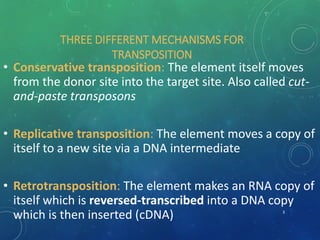
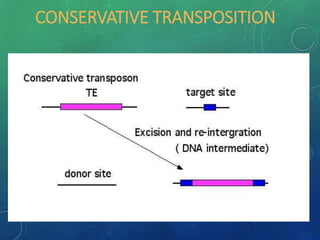
• Conservative transposition: The element itself moves
from the donor site into the target site. Also called cut-
and-paste transposons
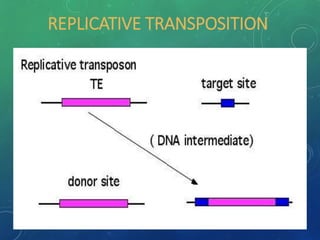
• Replicative transposition: The element moves a copy of
itself to a new site via a DNA intermediate
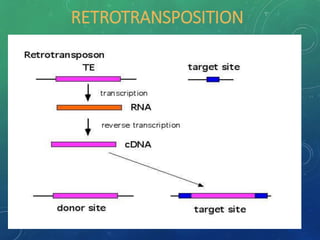
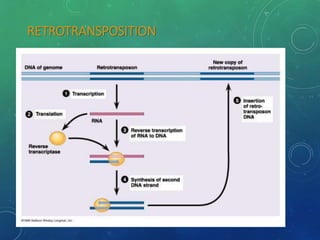
• Retrotransposition: The element makes an RNA copy of
itself which is reversed-transcribed into a DNA copy
which is then inserted (cDNA) 3
CONSERVATIVE TRANSPOSITION
4
REPLICATIVE TRANSPOSITION
5
RETROTRANSPOSITION
6
TRANSPOSABLE ELEMENTS IN
PROKARYOTES
• Insertion sequence (IS) elements
• Tn Transposons
• Composite (e.g. Tn9)
• Non-composite (e.g. Tn3)
7
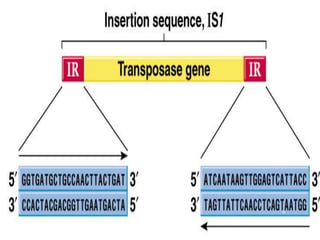
INSERTION SEQUENCE (IS) ELEMENTS
• Simplest type of transposable element found in bacterial
chromosomes and plasmids
• Encode only genes for mobilization and insertion
• Range in size from 768 bp to 5 kb
• IS1 first identified in E. coli’s glactose operon is 768 bp long
and is present with 4-19 copies in the E. coli chromosome
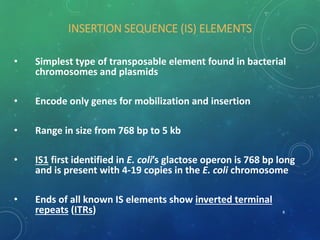
• Ends of all known IS elements show inverted terminal
repeats (ITRs) 8
9
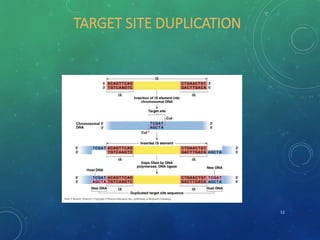
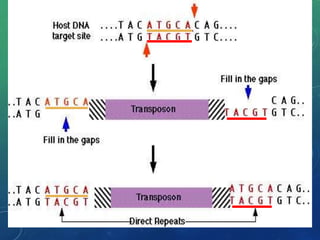
• Generation of short direct repeats flanking the newly inserted element
• This results from a staggered cut being made in the DNA strands at the site of insertion
10
common feature of mobile elements
TARGET SITE DUPLICATION
11
12
TN TRANSPOSONS
• Similar to IS elements but are more complex
structurally and carry additional genes
• 2 types of transposons:
• Composite transposons
• Noncomposite transposons
13
COMPOSITE TRANSPOSONS
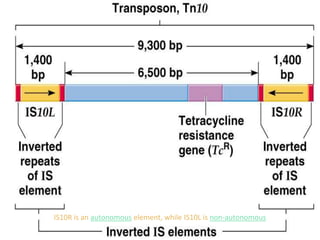
• The transposon is a composite transposon, composed of IS-
elements flanking an included sequence, in this case
containing an antibiotic resistance gene
• Composite transposons probably evolved from IS elements
by the chance location of a pair in close proximity to one
another.
14
15
IS10R is an autonomous element, while IS10L is non-autonomous
NONCOMPOSITE TRANSPOSONS
• Carry genes (e.g., a gene for antibiotic resistance)
• Ends are non-IS element repeated sequences
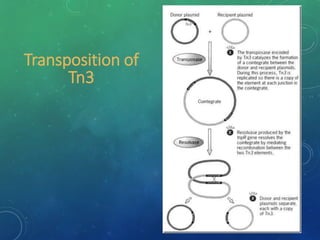
• Tn3 is 5 kb with 38-bp ITRs and includes 3 genes; bla (-
lactamase), tnpA (transposase), and tnpB (resolvase,
which functions in recombination)
16
Transposition of
Tn3
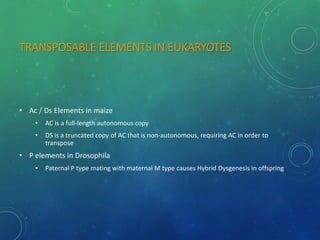
TRANSPOSABLE ELEMENTS IN EUKARYOTES
• Ac / Ds Elements in maize
• AC is a full-length autonomous copy
• DS is a truncated copy of AC that is non-autonomous, requiring AC in order to
transpose
• P elements in Drosophila
• Paternal P type mating with maternal M type causes Hybrid Dysgenesis in offspring
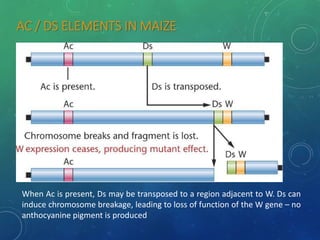
AC / DS ELEMENTS IN MAIZE
When Ac is present, Ds may be transposed to a region adjacent to W. Ds can
induce chromosome breakage, leading to loss of function of the W gene – no
anthocyanine pigment is produced
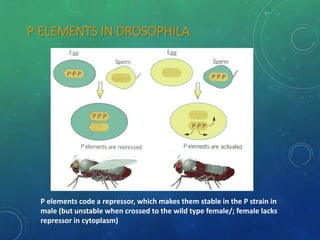
P ELEMENTS IN DROSOPHILA
P elements code a repressor, which makes them stable in the P strain in
male (but unstable when crossed to the wild type female/; female lacks
repressor in cytoplasm)
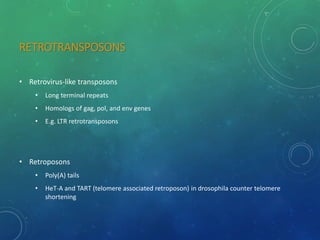
RETROTRANSPOSONS
• Retrovirus-like transposons
• Long terminal repeats
• Homologs of gag, pol, and env genes
• E.g. LTR retrotransposons
• Retroposons
• Poly(A) tails
• HeT-A and TART (telomere associated retroposon) in drosophila counter telomere
shortening
RETROTRANSPOSITION
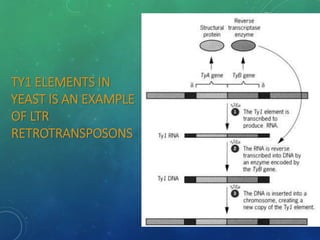
TY1 ELEMENTS IN
YEAST IS AN EXAMPLE
OF LTR
RETROTRANSPOSONS
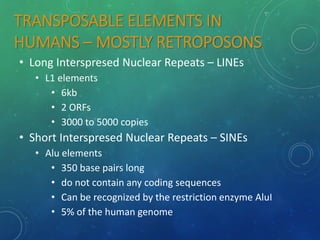
TRANSPOSABLE ELEMENTS IN
HUMANS – MOSTLY RETROPOSONS
• Long Interspresed Nuclear Repeats – LINEs
• L1 elements
• 6kb
• 2 ORFs
• 3000 to 5000 copies
• Short Interspresed Nuclear Repeats – SINEs
• Alu elements
• 350 base pairs long
• do not contain any coding sequences
• Can be recognized by the restriction enzyme AluI
• 5% of the human genome
TRANSPOSON MEDIATED CHROMOSOMAL
REARRANGEMENTS
• Deletions – intrachromosomal recombination
between two transposons in the same orientation
• Inversions - intrachromosomal recombination
between two transposons in the opposite
orientation
• Duplications – unequal crossing over

TRANSPOSONS ;THE JUMPING GENES

  • 2.
    MOBILE GENETIC ELEMENTS •Transposons or Transposable elements (TEs) • move around the genome 2
  • 3.
    THREE DIFFERENT MECHANISMSFOR TRANSPOSITION • Conservative transposition: The element itself moves from the donor site into the target site. Also called cut- and-paste transposons • Replicative transposition: The element moves a copy of itself to a new site via a DNA intermediate • Retrotransposition: The element makes an RNA copy of itself which is reversed-transcribed into a DNA copy which is then inserted (cDNA) 3
  • 4.
  • 5.
  • 6.
  • 7.
    TRANSPOSABLE ELEMENTS IN PROKARYOTES •Insertion sequence (IS) elements • Tn Transposons • Composite (e.g. Tn9) • Non-composite (e.g. Tn3) 7
  • 8.
    INSERTION SEQUENCE (IS)ELEMENTS • Simplest type of transposable element found in bacterial chromosomes and plasmids • Encode only genes for mobilization and insertion • Range in size from 768 bp to 5 kb • IS1 first identified in E. coli’s glactose operon is 768 bp long and is present with 4-19 copies in the E. coli chromosome • Ends of all known IS elements show inverted terminal repeats (ITRs) 8
  • 9.
  • 10.
    • Generation ofshort direct repeats flanking the newly inserted element • This results from a staggered cut being made in the DNA strands at the site of insertion 10 common feature of mobile elements
  • 11.
  • 12.
  • 13.
    TN TRANSPOSONS • Similarto IS elements but are more complex structurally and carry additional genes • 2 types of transposons: • Composite transposons • Noncomposite transposons 13
  • 14.
    COMPOSITE TRANSPOSONS • Thetransposon is a composite transposon, composed of IS- elements flanking an included sequence, in this case containing an antibiotic resistance gene • Composite transposons probably evolved from IS elements by the chance location of a pair in close proximity to one another. 14
  • 15.
    15 IS10R is anautonomous element, while IS10L is non-autonomous
  • 16.
    NONCOMPOSITE TRANSPOSONS • Carrygenes (e.g., a gene for antibiotic resistance) • Ends are non-IS element repeated sequences • Tn3 is 5 kb with 38-bp ITRs and includes 3 genes; bla (- lactamase), tnpA (transposase), and tnpB (resolvase, which functions in recombination) 16
  • 17.
  • 18.
    TRANSPOSABLE ELEMENTS INEUKARYOTES • Ac / Ds Elements in maize • AC is a full-length autonomous copy • DS is a truncated copy of AC that is non-autonomous, requiring AC in order to transpose • P elements in Drosophila • Paternal P type mating with maternal M type causes Hybrid Dysgenesis in offspring
  • 19.
    AC / DSELEMENTS IN MAIZE When Ac is present, Ds may be transposed to a region adjacent to W. Ds can induce chromosome breakage, leading to loss of function of the W gene – no anthocyanine pigment is produced
  • 20.
    P ELEMENTS INDROSOPHILA P elements code a repressor, which makes them stable in the P strain in male (but unstable when crossed to the wild type female/; female lacks repressor in cytoplasm)
  • 21.
    RETROTRANSPOSONS • Retrovirus-like transposons •Long terminal repeats • Homologs of gag, pol, and env genes • E.g. LTR retrotransposons • Retroposons • Poly(A) tails • HeT-A and TART (telomere associated retroposon) in drosophila counter telomere shortening
  • 22.
  • 23.
    TY1 ELEMENTS IN YEASTIS AN EXAMPLE OF LTR RETROTRANSPOSONS
  • 24.
    TRANSPOSABLE ELEMENTS IN HUMANS– MOSTLY RETROPOSONS • Long Interspresed Nuclear Repeats – LINEs • L1 elements • 6kb • 2 ORFs • 3000 to 5000 copies • Short Interspresed Nuclear Repeats – SINEs • Alu elements • 350 base pairs long • do not contain any coding sequences • Can be recognized by the restriction enzyme AluI • 5% of the human genome
  • 25.
    TRANSPOSON MEDIATED CHROMOSOMAL REARRANGEMENTS •Deletions – intrachromosomal recombination between two transposons in the same orientation • Inversions - intrachromosomal recombination between two transposons in the opposite orientation • Duplications – unequal crossing over