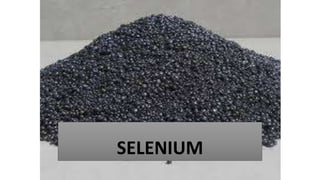
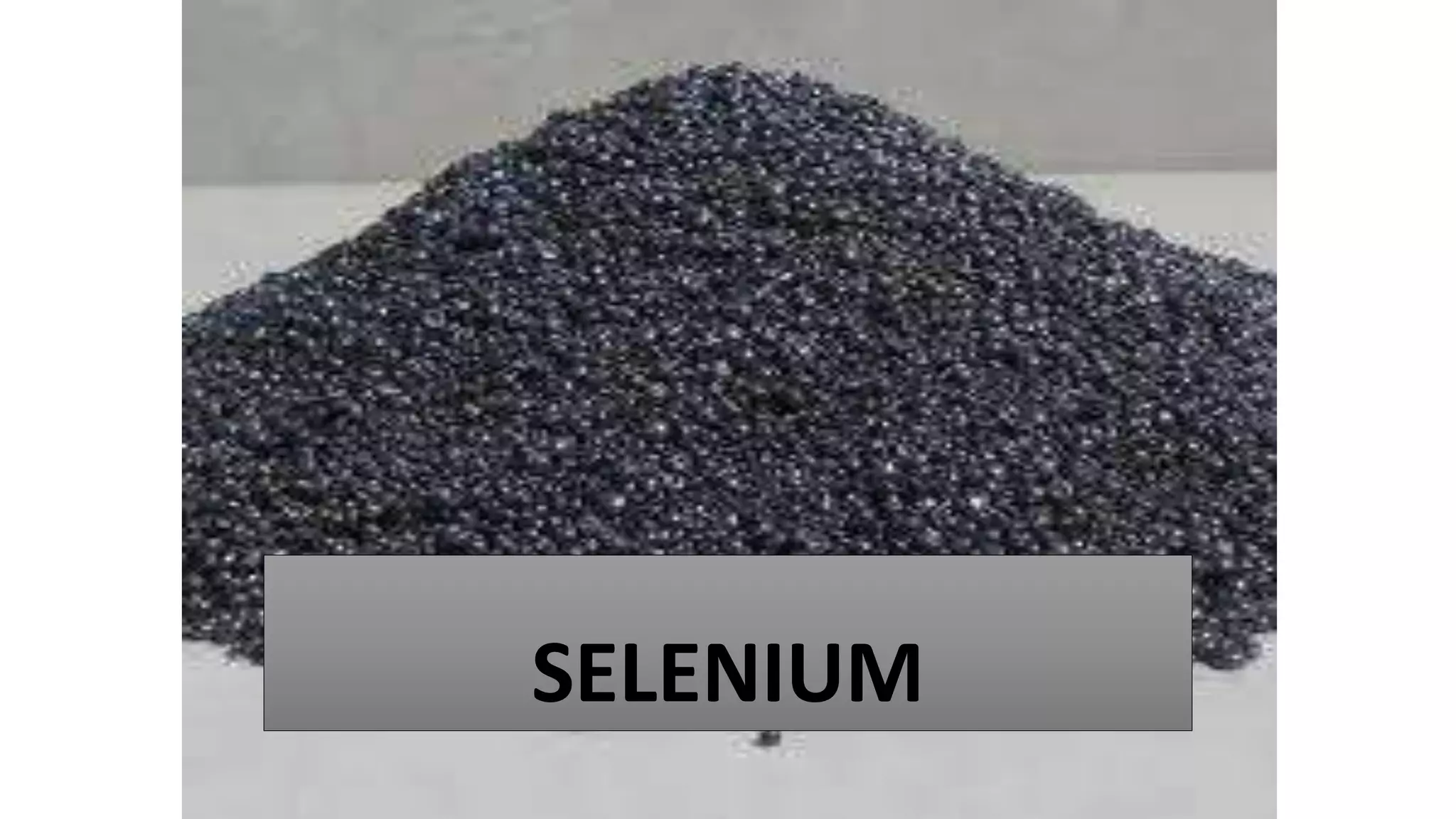
SELENIUM
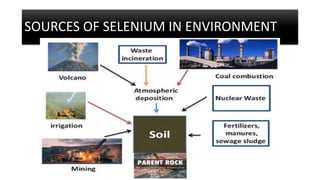
SOURCES OF SELENIUM IN ENVIRONMENT
Biological Role
• Our bodies contain about 14 milligrams, and every cell in a human
body contains more than a million selenium atoms.
• Too little selenium can cause health problems, but too much is also
dangerous. In excess it is carcinogenic and teratogenic (disturbs the
development of an embryo or foetus).
• Low levels of selenium can end up in soils or water
through weathering of rocks.
• It will than be taken up by plants or end up in air when
it is adsorbed on fine dust particles.
• Selenium is most likely to enter the air through coal and
oil combustion, as selenium dioxide.
EFFECTS OF SELENIUM ON THE ENVIRONMENT
• There is evidence selenium can accumulate in the body tissues of
organisms and can than be passed up through the food chain.
• Usually this bio magnification of selenium starts when animals eat a
lot of plants that have been absorbing large amounts of selenium,
prior to digestion.
HEALTH EFFECTS OF SELENIUM
• Exposure to selenium through air only comes about in the
workplace usually.
• It can cause dizziness, fatigue and irritations of the mucous
membranes.
• When the exposure is extremely high, collection of fluid in the lungs
and bronchitis may occur.
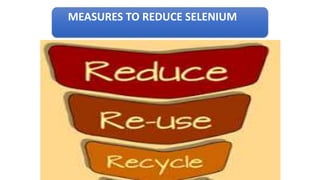
MEASURES TO REDUCE SELENIUM
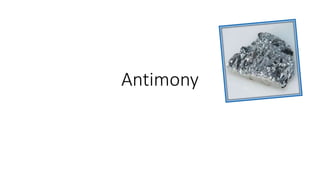
Antimony
Introduction, Sources, HEALTH EFFECTS, DISASTERS
Sources
• Man-made: waste incinerators, metal processing works, mines and
industrial facilities burning coal.
• In urban areas, the main sources are fumes from the burning of oil
fuels and dusts from industry.
• Naturally from the earth's crust and so is found in soils, natural water
bodies and sediments.
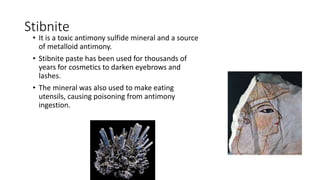
Stibnite
• It is a toxic antimony sulfide mineral and a source
of metalloid antimony.
• Stibnite paste has been used for thousands of
years for cosmetics to darken eyebrows and
lashes.
• The mineral was also used to make eating
utensils, causing poisoning from antimony
ingestion.
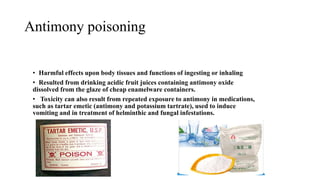
Antimony poisoning
• Harmful effects upon body tissues and functions of ingesting or inhaling
• Resulted from drinking acidic fruit juices containing antimony oxide
dissolved from the glaze of cheap enamelware containers.
• Toxicity can also result from repeated exposure to antimony in medications,
such as tartar emetic (antimony and potassium tartrate), used to induce
vomiting and in treatment of helminthic and fungal infestations.
Health effects of antimony
• Especially people that work with antimony can suffer the effects of
exposure by breathing in antimony dusts.
• Breathing in antimony that is bound to hydrogen in the gaseous phase, is
what mainly causes the health effects.
• Exposure to relatively high concentrations of antimony (9 mg/m3 of air) for
a longer period of time can cause irritation of the eyes, skin and lungs.
As the exposure continues more serious health effects may occur, such as
lung diseases, heart problems, diarrhea, severe vomiting and stomach
ulcers.
ARSENIC
Heavy Metal
 Highly toxic to the humans
 Arsenic can exist in four valence states: –3, 0, +3 and +5
 Permissible exposure limit (PEL) for arsenic is set at 10 micrograms
of inorganic arsenic per cubic meter of air (10 µg/m3), averaged over
any 8-hour period
 Release of arsenic in the environment is a result of both manmade
and natural activity.
 Arsenic enters the environment naturally through
1. Ground water (arsenic contaminated ground water pollutes
the water reservoirs i.e rivers or seas and marine
organisms…..affecting the food chain)
2. Mineral ores (through weathering of arsenic-containing
minerals and ores…… mostly of sulphide bearing
mineral deposits e.g gold and copper)
3. Geothermal processes (Arsenic is released into the air by
volcanoes)
The effect of Arsenic poisoning on human are as follow
 Carcinogenic Effects: It causes cancers of the lung, liver, bladder,
kidney by chromosomal damage
 Gastrointestinal, Hepatic, and Renal Effects
 Neurologic Effects: Peripheral neuropathy(destruction of axonal
cylinders) is a common complication of arsenic poisoning
 Dermal Effects: It causes hyper-pigmentation, hyperkeratosis, and
skin cancer
 Respiratory Effects
 Hematopoietic Effects: Anemia (decrease of red blood cell),
Leucopenia (decrease in white blood cells) and Thrombocytopenia
(decrease in platelets) are common in chronic arsenic toxicity
 Reproductive Effects: Increased frequency of spontaneous
abortions and congenital malformations has been linked to arsenic
exposure
 It cant be destroyed once enter the environment
 Arsenic-contaminated environments are characterized
by limited species abundance and diversity.
 Plants absorbs As fairly easily
 Inorganic As in water enhances the chances of genetic
alteration in plant eating fresh water organisms i.e.
fish
 When birds eat these organism they suffer from As
toxicity
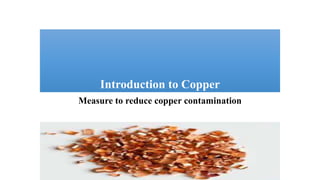
Introduction to Copper
Measure to reduce copper contamination
Introduction of Copper
• Copper is distributed in nature in ores containing sulfides, arsenides,
chlorides, and carbonates
• A reddish brown ductile metal, copper is valued for its high electrical
conductivity and resistance to corrosion
• Copper exists in the +2 oxidation state
• Compounds containing Copper are Copper(II) oxide(CuO) is black,
and Copper(I) oxide (is red)
Sources of Copper
• Natural sources
Wind-blown dust, decaying vegetation, forest fires Also released into
waterways by natural weathering of soil and rocks
• Human activities
Mining, metal production, phosphate fertilizer production, Industrial
settings, waste disposals and effluent from sewage treatment plants.
Routes Of Exposures
Oral exposure
From food
Inhalation
From copper smelters and refineries and industries
Dermal contact
From air, water, and soil that contains copper
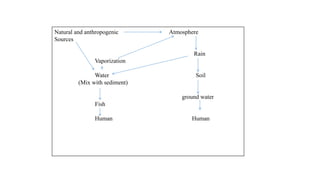
Natural and anthropogenic Atmosphere
Sources
Rain
Vaporization
Water Soil
(Mix with sediment)
ground water
Fish
Human Human
Copper toxicity
• A condition in which copper is retained and begins to build up
in the body tissues
• It Interferes with proper conversion of thyroid hormone
• It also disturbs zinc balance
• It inhibits cortisol production, and increases aldosterone
production
• As excess copper and calcium increase in the cells and tissues,
a calcium "shell" will build up
http://www.holistic-back-relief.com/copper-toxicity.html
Symptoms(Human Beings)
Symptoms of High (Excess) Copper
• Cold hands, and/or feet
• Depression
• Dry skin
• Feeling of loss of control
• Paranoia
• Despair, suicidal feelings,
hopelessness
• Arthritis, calcium spurs
• Constipation
• Panic attacks, high anxiety
Symptoms of Copper Deficiency
• Anemia
• Fatigue
• Decrease in number of white blood cells
• Osteoporosis
• Nerve damage can cause tingling and loss of
sensation in the feet and hands
• Confusion
• Impaired Coordination
• Vitamin B12 deficiency
• Iron deficiency
• White, gray and silver hair
Copper and Environment
• Copper does not break because of that it can accumulate in plants and
animals
• When copper ends up in soil it strongly attaches to organic matter and
minerals
• On copper-rich soils only a limited number of plants has a chance of survival
• Copper is a serious threat to the productions of farmlands
• Copper can interrupt the activity in soils, as it negatively influences the
activity of microorganisms and earthworms
• When the soils of farmland are polluted with copper, animals will absorb
concentrations that are damaging to their health

HEAVY METALS AND THEIR EFFECTS

  • 1.
  • 2.
    SOURCES OF SELENIUMIN ENVIRONMENT
  • 3.
    Biological Role • Ourbodies contain about 14 milligrams, and every cell in a human body contains more than a million selenium atoms. • Too little selenium can cause health problems, but too much is also dangerous. In excess it is carcinogenic and teratogenic (disturbs the development of an embryo or foetus).
  • 4.
    • Low levelsof selenium can end up in soils or water through weathering of rocks. • It will than be taken up by plants or end up in air when it is adsorbed on fine dust particles. • Selenium is most likely to enter the air through coal and oil combustion, as selenium dioxide. EFFECTS OF SELENIUM ON THE ENVIRONMENT
  • 5.
    EFFECTS OF SELENIUMON THE ENVIRONMENT • There is evidence selenium can accumulate in the body tissues of organisms and can than be passed up through the food chain. • Usually this bio magnification of selenium starts when animals eat a lot of plants that have been absorbing large amounts of selenium, prior to digestion.
  • 6.
    HEALTH EFFECTS OFSELENIUM • Exposure to selenium through air only comes about in the workplace usually. • It can cause dizziness, fatigue and irritations of the mucous membranes. • When the exposure is extremely high, collection of fluid in the lungs and bronchitis may occur.
  • 7.
  • 8.
  • 9.
    Sources • Man-made: wasteincinerators, metal processing works, mines and industrial facilities burning coal. • In urban areas, the main sources are fumes from the burning of oil fuels and dusts from industry. • Naturally from the earth's crust and so is found in soils, natural water bodies and sediments.
  • 10.
    Stibnite • It isa toxic antimony sulfide mineral and a source of metalloid antimony. • Stibnite paste has been used for thousands of years for cosmetics to darken eyebrows and lashes. • The mineral was also used to make eating utensils, causing poisoning from antimony ingestion.
  • 11.
    Antimony poisoning • Harmfuleffects upon body tissues and functions of ingesting or inhaling • Resulted from drinking acidic fruit juices containing antimony oxide dissolved from the glaze of cheap enamelware containers. • Toxicity can also result from repeated exposure to antimony in medications, such as tartar emetic (antimony and potassium tartrate), used to induce vomiting and in treatment of helminthic and fungal infestations.
  • 12.
    Health effects ofantimony • Especially people that work with antimony can suffer the effects of exposure by breathing in antimony dusts. • Breathing in antimony that is bound to hydrogen in the gaseous phase, is what mainly causes the health effects. • Exposure to relatively high concentrations of antimony (9 mg/m3 of air) for a longer period of time can cause irritation of the eyes, skin and lungs. As the exposure continues more serious health effects may occur, such as lung diseases, heart problems, diarrhea, severe vomiting and stomach ulcers.
  • 13.
  • 14.
     Highly toxicto the humans  Arsenic can exist in four valence states: –3, 0, +3 and +5  Permissible exposure limit (PEL) for arsenic is set at 10 micrograms of inorganic arsenic per cubic meter of air (10 µg/m3), averaged over any 8-hour period
  • 15.
     Release ofarsenic in the environment is a result of both manmade and natural activity.  Arsenic enters the environment naturally through 1. Ground water (arsenic contaminated ground water pollutes the water reservoirs i.e rivers or seas and marine organisms…..affecting the food chain) 2. Mineral ores (through weathering of arsenic-containing minerals and ores…… mostly of sulphide bearing mineral deposits e.g gold and copper) 3. Geothermal processes (Arsenic is released into the air by volcanoes)
  • 16.
    The effect ofArsenic poisoning on human are as follow  Carcinogenic Effects: It causes cancers of the lung, liver, bladder, kidney by chromosomal damage  Gastrointestinal, Hepatic, and Renal Effects  Neurologic Effects: Peripheral neuropathy(destruction of axonal cylinders) is a common complication of arsenic poisoning  Dermal Effects: It causes hyper-pigmentation, hyperkeratosis, and skin cancer  Respiratory Effects  Hematopoietic Effects: Anemia (decrease of red blood cell), Leucopenia (decrease in white blood cells) and Thrombocytopenia (decrease in platelets) are common in chronic arsenic toxicity  Reproductive Effects: Increased frequency of spontaneous abortions and congenital malformations has been linked to arsenic exposure
  • 17.
     It cantbe destroyed once enter the environment  Arsenic-contaminated environments are characterized by limited species abundance and diversity.  Plants absorbs As fairly easily  Inorganic As in water enhances the chances of genetic alteration in plant eating fresh water organisms i.e. fish  When birds eat these organism they suffer from As toxicity
  • 18.
    Introduction to Copper Measureto reduce copper contamination
  • 19.
    Introduction of Copper •Copper is distributed in nature in ores containing sulfides, arsenides, chlorides, and carbonates • A reddish brown ductile metal, copper is valued for its high electrical conductivity and resistance to corrosion • Copper exists in the +2 oxidation state • Compounds containing Copper are Copper(II) oxide(CuO) is black, and Copper(I) oxide (is red)
  • 20.
    Sources of Copper •Natural sources Wind-blown dust, decaying vegetation, forest fires Also released into waterways by natural weathering of soil and rocks • Human activities Mining, metal production, phosphate fertilizer production, Industrial settings, waste disposals and effluent from sewage treatment plants.
  • 21.
    Routes Of Exposures Oralexposure From food Inhalation From copper smelters and refineries and industries Dermal contact From air, water, and soil that contains copper
  • 22.
    Natural and anthropogenicAtmosphere Sources Rain Vaporization Water Soil (Mix with sediment) ground water Fish Human Human
  • 23.
    Copper toxicity • Acondition in which copper is retained and begins to build up in the body tissues • It Interferes with proper conversion of thyroid hormone • It also disturbs zinc balance • It inhibits cortisol production, and increases aldosterone production • As excess copper and calcium increase in the cells and tissues, a calcium "shell" will build up http://www.holistic-back-relief.com/copper-toxicity.html
  • 24.
    Symptoms(Human Beings) Symptoms ofHigh (Excess) Copper • Cold hands, and/or feet • Depression • Dry skin • Feeling of loss of control • Paranoia • Despair, suicidal feelings, hopelessness • Arthritis, calcium spurs • Constipation • Panic attacks, high anxiety Symptoms of Copper Deficiency • Anemia • Fatigue • Decrease in number of white blood cells • Osteoporosis • Nerve damage can cause tingling and loss of sensation in the feet and hands • Confusion • Impaired Coordination • Vitamin B12 deficiency • Iron deficiency • White, gray and silver hair
  • 25.
    Copper and Environment •Copper does not break because of that it can accumulate in plants and animals • When copper ends up in soil it strongly attaches to organic matter and minerals • On copper-rich soils only a limited number of plants has a chance of survival • Copper is a serious threat to the productions of farmlands • Copper can interrupt the activity in soils, as it negatively influences the activity of microorganisms and earthworms • When the soils of farmland are polluted with copper, animals will absorb concentrations that are damaging to their health